
【EA Real Operation】HISUI【Same-value Withdrawal Pattern】
1. Introduction
Thank you very much for visiting.
I am the developer of the Expert Advisor “HISUI” called “Imagawa Mochi-yo”.
Here, from the developer’s perspective, I will explain how HISUI operates in real trading on my own live account, including accessible internal logic.
I will describe it in a way that can be helpful to people like the following, so if you are interested, I would appreciate your reading.
- I am considering purchasing HISUI, but I want to see in a live account what kind of automated trading it actually performs for material for consideration.
- I am not considering purchasing HISUI, but I am interested in EAs, and would like to study and reference real operation through explanations and introductions.
- I have already purchased HISUI and am using it in practice, but I am worried whether it is functioning normally (for example: automated trading is running, but I am unsure whether the entry and exit positions match the specifications).
The real-time operation of HISUI will be divided into several patterns such as winning (profitable) patterns, losing (loss) patterns, and breakeven near zero patterns, and will be serialized in multiple articles (all articles will be freely published).
This time, we will introduce the breakeven pattern.
2. HISUI Breakeven Pattern (A)
The figure below is one of the real trading results on January 23, 2025. The chart is a 5-minute chart (M5); red arrows indicate long entries, and pink arrows indicate exits.
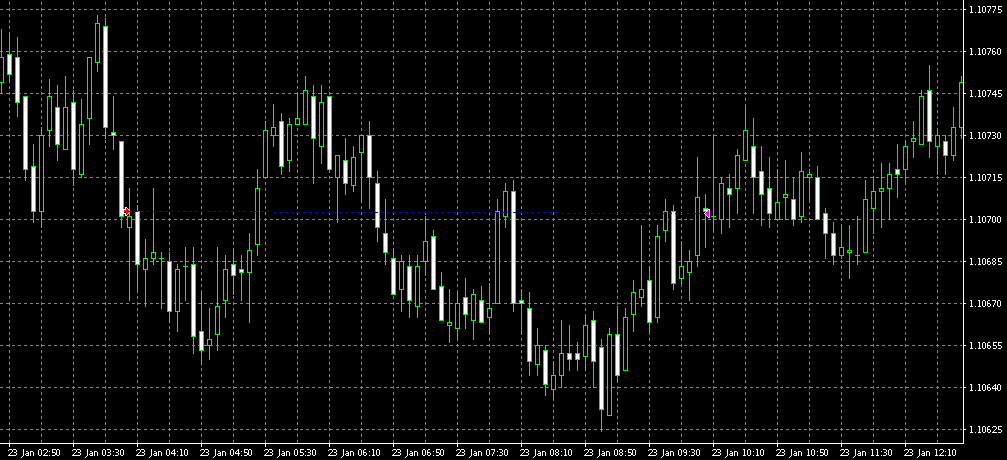
With HISUI, under the default parameter settings, when six hours have passed since the last entry and the entry price is near breakeven, it will close the position (note that it is near breakeven, so it may close slightly positive or slightly negative, not necessarily exactly zero).
The trade in the above figure closed because it was near breakeven six hours after entry.
3. HISUI Breakeven Pattern (B)
Next, another breakeven pattern will be introduced. The figure below is one of the real trading results on January 14, 2025. The chart is a 5-minute chart (M5); blue arrows indicate short entries, red arrows indicate long entries, and pink arrows indicate exits.
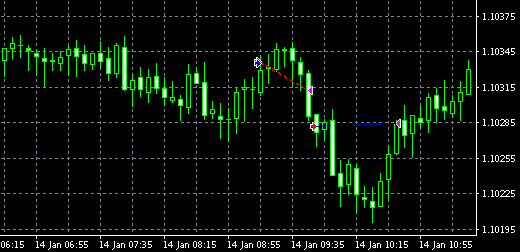
The trade on the left with a blue entry ended in profit-taking, but the trade that follows with a red entry nearly breakevens.
This is not six hours elapsed, but based on the movement of the market after entry, HISUI’s logic (calculation) determined that it would be better to breakeven, so this is the resulting exit.
Thus, even before the breakeven start time defined by the parameters, the logic may breakeven.
Note that for this trade, since the price moved higher after settlement, there was a possibility of taking profit, but as a long-term trend, it is judged better to breakeven in such price movements.
4. Conclusion
This time, we introduced and explained two breakeven patterns in HISUI’s real operation.
HISUI is designed primarily for short-term trading, aiming to keep the position holding time as brief as possible while ensuring overall profitability over the long term. As a result, breakeven breakeven patterns are incorporated into the logic as shown in this article.
In previous serialized articles, we have introduced HISUI’s winning patterns, losing patterns, and breakeven patterns—the behavior when HISUI trades. Depending on market movements, there are times when it will not trade.
Therefore, in the next installment, we plan to introduce and explain patterns where HISUI does not trade (no-trade pattern) →written)
The product page for HISUI described and explained in this article ishere.
× ![]()