
【EA Real Operations】HISUI【How to think when losing repeatedly】
1. Introduction
Thank you very much for visiting.
I am the developer of “HISUI,” an EA (Expert Advisor).
Here, from the developer's perspective, I will explain what kind of automatic trading “HISUI” running on my real account actually performs, including internal logic within the publicly shareable scope.
I will write this so that it can be a reference for people like the following, so if you’re interested, I would be happy if you read it.
- I am considering purchasing “HISUI” and want to see what kind of automated trading it actually performs on a real account for reference materials, etc.
- I am not considering purchasing “HISUI,” but I’m interested in EAs and would like to study and reference real operation by viewing explanations and demonstrations to deepen my understanding of EAs.
- I have already purchased “HISUI,” and am actively using it, but I’m worried whether it is operating normally (e.g., auto-trading is active, but I’m unsure whether the entry and exit positions are as specified).
The real-time operation of “HISUI” will be divided into several patterns such as winning (profitable), losing (loss), and break-even (near zero profits/losses), and serialized across multiple articles (all articles will be published for free).
Previous articleintroduced two losing patterns of “HISUI.”
As announced, this time I will describe, a little differently, how to think and maintain your mental state when losses continue in real operation of “HISUI.”
However, what works for one person’s mindset or mental state will differ from person to person.
Also, this is only my own approach to operating “HISUI,” so it does not mean that every EA’s operation will suit everyone or that everyone should adopt this mindset.
Therefore, in this article, those who feel it fits can adopt it, while those who don’t can simply skim and forget it.
Note that “HISUI” is a high-win-rate, low-risk-reward EA, so there may be many aspects that do not align with the mindset for low-win-rate, high-risk-reward EAs or EAs that go all-in on averaging up to the limit (which could lead to exit in certain conditions).
2. Principles for Maintaining Mental State During HISUI Operation
For EAs that are fully automatic like HISUI, it is better not to watch each trade closely or continuously monitor market movements while a position is held.
If you monitor trades constantly, fret over drawdowns, celebrate after one win, and slump after one loss, it will be hard to maintain your mental state.
The more frequently an EA trades, like HISUI which trades many times a day, the stronger this tendency is likely to be.
On the other hand, if you check the trading status only about once a week, the impact on your mental state will be comparatively smaller (not zero, but it can be reduced).
Of course, this assumes you can confirm the operation’s stability and that the EA is trustworthy; it’s unlikely you’d run an unreliable EA on a real account.
Therefore, it is important first to perform backtests and demo account operations to gain a certain level of trust in the EA, which helps maintain your mental state.
3. Periods with Frequent Losses in Backtests and Long-Term Results
As noted above, “HISUI” is a high-win-rate, low-risk-reward EA.
In 15 years of backtesting, the win rate is about 83%, and the risk-reward ratio is about 0.3.
Therefore, the trend tends to have many consecutive wins and few consecutive losses, but it can still result in a “slow-and-steady” climb being wiped out by one or two losses.
There are periods when the market is unfavorable and the number of winning trades between losses is small, causing capital to shrink.
For example, below is a backtest graph for the month of March 2024 (March 1–31).
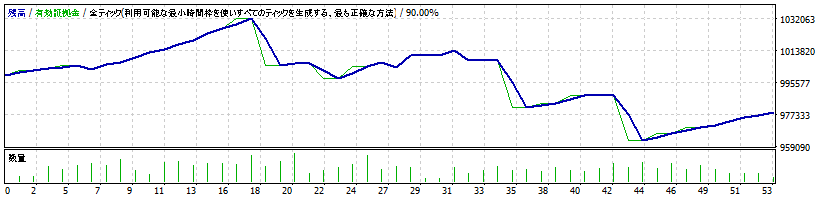
When HISUI’s logic encounters a continued unfavorable market, this kind of result can happen.
However, it is not advisable to stop using the EA or change parameters based on just one month of results.
Because expanding the backtest period from March 1, 2024, to June 30, the results are as follows.
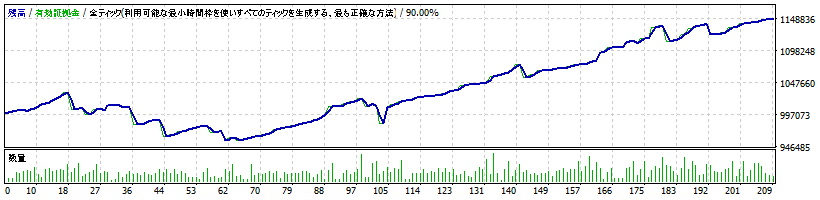
If you stop the EA based on March’s results alone, you won’t gain profits later, and changing parameters may not lead to the same (profitable) outcomes (note: changing parameters can potentially increase profits, so it isn’t universally bad to change them).
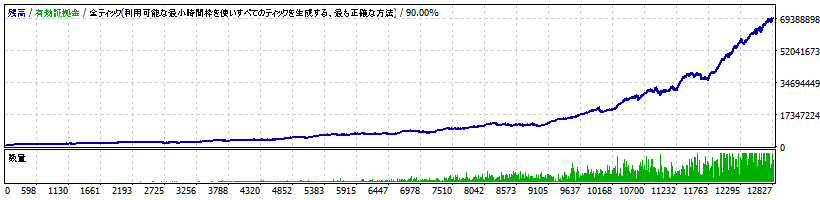
Also, the 15-year backtest results listed on “HISUI”’s product page show periods of slow profit growth or drawdowns, but overall it remains significantly profitable.
Here, only graphs are shown, but those who want detailed numbers such as win rate please check the product page.
4. Understanding the Probability of Losing Streaks and Realistic Expectations
As noted, the win rate in HISUI’s 15-year backtest is about 83%.
Assuming the win rate is slightly lower at 80% in backtesting, the probabilities of consecutive losses are as follows.
Probability of 2 consecutive losses: 4%
Probability of 3 consecutive losses: 0.8%
Probability of 4 consecutive losses: 0.16%
Of course, this is a long-term theoretical perspective; in the short term, market sentiment can reduce win rate or increase it in favorable markets.
In reality, HISUI, across more than 10,000 trades in the 15-year backtest, recorded a maximum losing streak of 7 consecutive losses.
Also, due to the entry method’s characteristics, HISUI often holds two positions in close proximity in the same direction, so the two positions can lose simultaneously (i.e., a double loss) more often than the above probabilities suggest.
Thus, understanding both theoretical losing-streak probabilities and real trading characteristics helps reduce anxiety about automated trading after a losing streak compared to not knowing these factors at all.
5. Long-Term Operation
I believe it is beneficial to approach long-term operation while considering the contents above.
In short-term operation, there is a risk of only trading during periods when the market happens to be unfriendly, as described in section 3.
If you are unlucky, you may encounter such a market right after starting real-account operation.
However, I would be grateful if you operate with the belief that you can earn profits in the long run.
※Since future market movements are unknown, there is no guarantee that long-term operation will necessarily yield profits, so please understand this.
6. Conclusion
This time, I introduced and explained how to think and maintain your mental state when losses continue in HISUI’s real operation.
If there is at least one useful idea, I would be happy if you find it helpful.
The content for the next article is undecided, but the series will continue, so if you found this article orthe previous articlesinteresting, I’d appreciate your looking forward to the next one. (→I wrote)
The HISUI product page introduced and discussed in this article ishere.
× ![]()