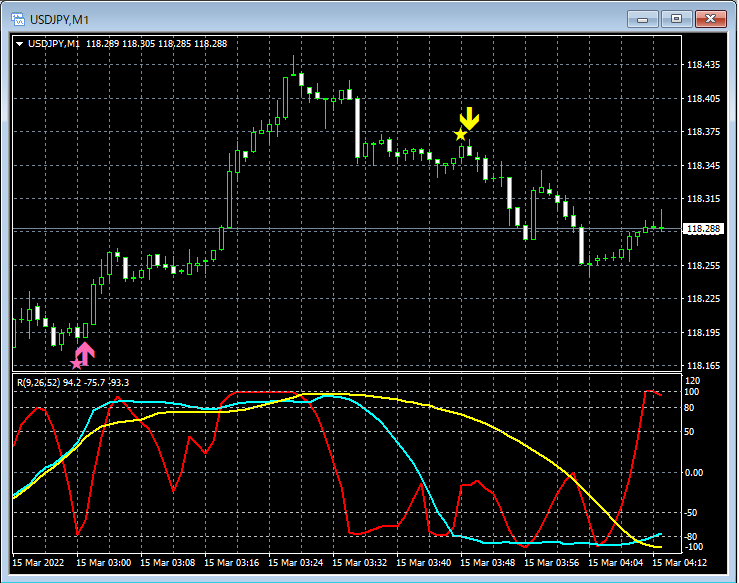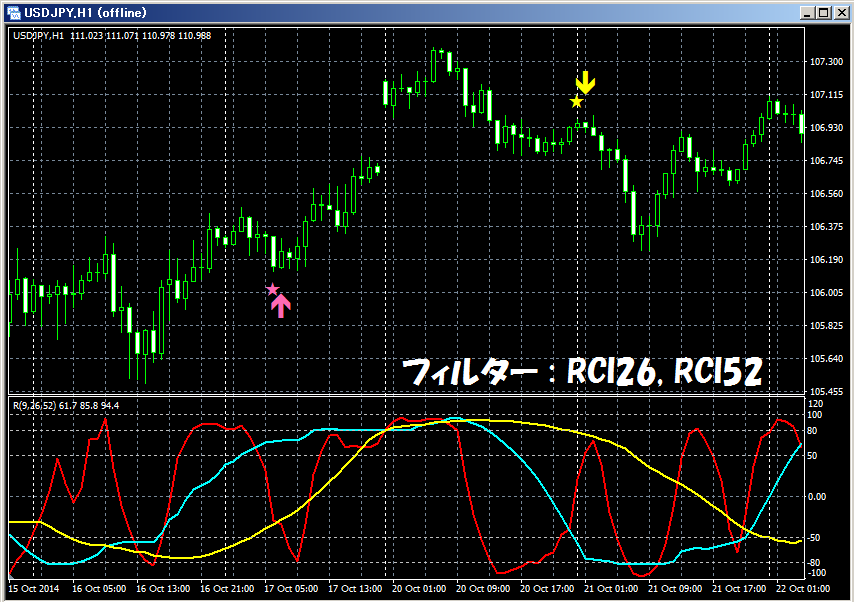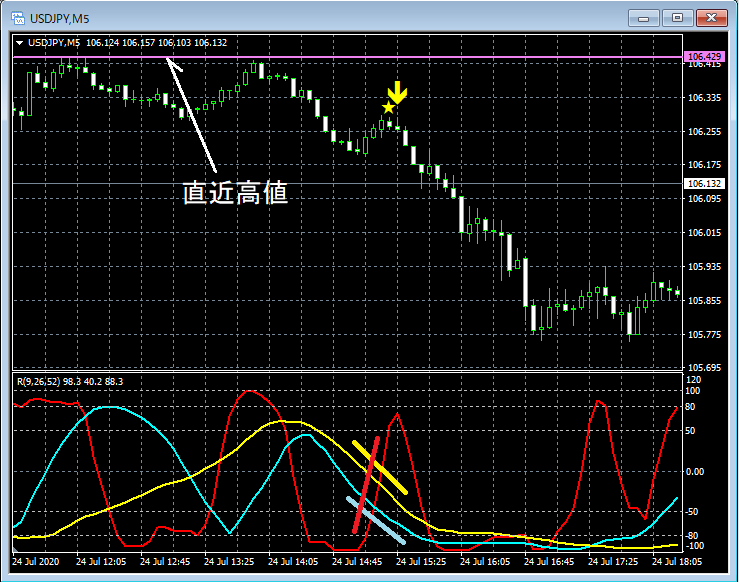

Recent high, double top, and mBDSR (RCI two-filter) selling signal
0
An indicator that shines when combined with RCI 【BODSOR・mBDSR】
Methods and Case Studies (PDF) ★GogoJungle AWARD 2020 winner★
https://www.gogojungle.co.jp/tools/indicators/11836
The PDF file is attached with 283 items.
Many of them are examples that have been distilled to the point of using three RCI lines to logically link higher and lower timeframes, sequentially considering the conditions of multiple lower-timeframe charts, and finally waiting for impulsive buy opportunities on pullbacks or sell opportunities on rallies in the lower timeframe (i.e., the mBDSR signal)..
Also,many of them focus on capturing points where multiple entry reasons overlap.
In the descriptions,more than 1,000 charts

In recent Investor Navi+ articles,examples that show the strong compatibility between various trading methods and the mBDSR signalsare highlighted.
NZD/CAD 4-hour chart

Looking at the area circled in white on the 4-hour chart above,the price has risen close to the recent high. It wouldn’t be surprising if it pauses and pulls back a bit.
NZD/CAD 15-minute chart

On the 15-minute chart above,the price has risen near the recent high, andmBDSR pullback/short signal (filters: RCI26 and RCI52)lights up, after which the price declines smoothly.
Additionally,the right-hand peak of a double toplights up for a pullback signal, which is also noteworthy.
From this example,a trading method focused on recent highs and double topsandthe signals of mBDSRshow a high degree of compatibility.
Moreover, in this example,placing a stop-loss just above the recent highis suggested,enabling high risk-reward trades.
An indicator that shines when combined with RCI【BODSOR・mBDSR】
Methods and Case Studies (PDF) ★GogoJungle AWARD 2020 winner★
https://www.gogojungle.co.jp/tools/indicators/11836
The PDF file is attached with 283 items.
Many of them are examples that have been distilled to the point of using three RCI lines to logically link higher and lower timeframes, sequentially considering the conditions of multiple lower-timeframe charts, and finally waiting for impulsive buy opportunities on pullbacks or sell opportunities on rallies in the lower timeframe (i.e., the mBDSR signal).Also,
many of them focus on capturing points where multiple entry reasons overlap.
In the descriptions,more than 1,000 charts are used.
× ![]()