

[October 19, 2026 Issue] Summary of This Week's Featured Articles
This Week’s Curated Articles

The calculations matched. But the one that didn’t match was actually correct.
When we recalculated and cross-checked, only the Nikkei 225 wouldn’t line up. Investigating further, it turned out the ATR calculation method had been changed without record—for the four symbols that had “matched.” This piece chronicles how we build a verification environment that creates reasons to trust results, such as preregistered parameters and one-off verification data.

How do you visualize Dow Theory? Decoding market structure with CHoCH, BOS, and Watching [DWM Practical Chart Analysis EP.02]
We place a candlestick-only chart alongside the DowWave Marker display, and explain how to distinguish CHoCH, BOS, and Watching on USDJPY H4 and GBPJPY M5. You’ll learn to separate “change, update, and monitor” in structure, instead of labeling a single tag as a definitive reversal.

[Scalping Course ③] Where to short the pullback in GOLD? Confirm the “end of the pullback” across three timeframes
To avoid the trap of “I sold the pullback but it kept pulling back,” we organize a step-by-step check of the “end of the pullback” in order: H1 → M5 → M1. We also compare three confusing scenarios—like a low broken only by a wick—in a table.

[Mechanics of BB ③] Where do you protect extended profits? Watch mid-timeframe contractions and the next resistance
The final part of the BB explanation series. We examine BTC/USD in August 2026 where the daily was expanding while the 4H was contracting, and show a flow for partial profit-taking and position holding, based on the low you want to protect and the next resistance candidates.

[Part 5] “Jump in when the RCI angle steepens” is just gambling
Part 5 points out that jumping in the instant the RCI angle turns steep is a “bet” that fails to distinguish between a move’s start and its late stage. It stresses the importance of using multiple RCIs—short-, mid-, and long-term—to assess overall market context and the long line’s shape.

How to boost your strategy’s accuracy by adding ○○○
For the pain of “It should’ve been spot on, but got faked out again,” we introduce ways to reduce fake-outs by adding a small tweak to your current strategy or indicators. A piece for those who want to lift accuracy without scrapping their method.

[FX Course] You don’t need to change your strategy just because you lost consecutively
Before switching strategies after a losing streak, this column urges checking three points: Did you follow your rules? Has the market environment changed? Did similar losing streaks occur in your past tests? It promotes the idea of “narrowing when to use a method,” not “ditching it.”

Averaged down and lost it all. Tried to make it back—and lost everything.
From a small adverse move to emotionally stacking average-down entries, ending in a forced liquidation—the common path to a blowup. We reframe the stop-loss as “a decision to join the next opportunity” and stress setting your exit line before entry.

[Focus has a shelf life] Why those who grind through GOLD M1 get sloppy with the later arrows
If your judgment gets sloppier later, the cause may be “how long you’ve kept going,” not the method. We list signs of fading focus and share ways to predefine the trading time window before opening your charts.

[Mastering GOLD] Why does your trading waver? Two answers to escape “overtrading” and “groundless exits” and build positive expectancy
Even a high win-rate method can lose money if both your entries and exits lack objective rationale. This article clarifies the nature of overtrading and chicken profit-taking, and presents three conditions: “waiting,” “proper RR,” and “environment-tuned brakes.”

Why a widening spread triggers stops sooner: Buy-side stops are judged on the sell price
We explain the real reason behind “my stop got hit earlier than expected.” Since buy-side stops are evaluated on the sell (Bid) price, they can be reached even if the market doesn’t move when the spread widens, and the closer your stop, the bigger the impact.

[Column] The “real talk” of scalping that delivers results
Scalping that delivers is “steady repetition of the same trade at the same high-expectancy points,” says this column. Using a sequence of trades on USDJPY M1 as an example, it emphasizes reproducibility over flashiness.
[Lab Logic Intro] GBPJPY Anomaly v04 — Indicator-less EA built on 110 cells of weekday × time, with design and live results
We explain an EA for GBPJPY that enters using only weekday and time, across 110 cells in 5-minute increments. Alongside 10 years of fee-inclusive live-measured results, we frankly disclose weaknesses like down years and profit concentration.

Risk management for EAs to think about before chasing profits
We organize capital management for running an EA long-term into five items: lot size, how to read backtests, account-wide risk, periodic inspections, and stop criteria. Each item includes concrete check steps, making this usable as a pre-operation checklist.
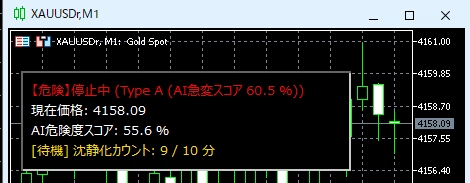
Put an end to martingale EA’s “small wins, big loss.” Thank you for your questions about the MT5-embedded AI defense system “Guardian Monitor AI”
We answer readers’ questions about an MT5-embedded AI monitoring tool developed to handle sudden markets for averaging-down EAs. From defining dangerous markets to why we combined AI with rule-based logic and how we counter overfitting—we detail the development background.

[¥500,000 → ¥5,000,000 Challenge] PF 1.91 recorded! +33.8% in 16 trading days!
Day 16 report of a real-account challenge aiming to grow ¥500,000 to ¥5,000,000 using the semi-discretionary EA “Capital Recapture Logic Ver. White Tiger.” It discloses cumulative P/L and PF trends, and also touches on risks inherent in martingale operation.

[2026-10-17] Voices from those who actually used “Heaven and Earth Day Swing”
A roundup of posts on social media from users of “Heaven and Earth Day Swing” and its dedicated EA “DSATEA.” Useful not only for those considering adoption, but also as hints for current users to learn how others are applying it.

Tesla’s new car is a stepping-stone toward a future where capitalism backfires
A Chicago-based column by Mr. Takizawa, CME (CBOT) floor member, discussing the fate of capitalism with Tesla’s new car as a clue. It also covers overseas market topics like the S&P 500, crude oil, and Asian bonds.
For those who want to go deeper — Featured paid series
 Paid Series
The Royal Road of Investing
A higher-timeframe series that practices a method of selecting optimal currency pairs using strength/weakness data by currency, trading mainly off the daily and 4-hour charts.
 Paid Series
FX Trade Logs and Rationale / Highly Reproducible Pullback Buys and Rally Sells [Yoshi - FX]
A practical series that discloses actual trade history and rationale to review from environment assessment through entry to exit. Learn reproducible pullback buys and rally sells, including stop-losses and small-profit exits.
 Paid Series
Stock Talk: Takatan’s Market Strategy / Single Stocks & Futures (All-Inclusive)
From daily market outlooks to weekend stocks to watch—comprehensive, professional guidance you can trust.
What is Investment Navi+?
Covers a wide range of investing themes
Market views on FX, stocks, and crypto assets; trading strategies; investing mindset; and money management. This is investment content you can read within GogoJungle.
Written by vendors and experts
GogoJungle vendors and investing professionals publish articles based on their own expertise. We deliver high-credibility content written by proven pros.
Use it as a gateway to learning
From free articles to paid series, choose according to your learning depth. Updated weekly as a weekly feature to bring you this week’s highlights.