
Basics of FX risk management — a single guide to stop-loss, lot size, risk-reward, and probability of ruin
Introduction
Risk management is often said to be important. However, with terms like stop-loss, lot size, risk-reward, and probability of ruin appearing, it’s easy to feel unsure where to start.
In this article, I’ll bundle these four into one piece andexplain in what order to decide and how they connectand organize them. Finally, I’ll also describe how to practice to know your own figures.
What you’ll learn from this article
- Four things to decide in risk management
- The order to decide the four and how they connect
- How to know your own numbers from practice records
What is risk management
Risk management is,a set of rules to prevent your funds from shrinking drastically after a single loss or consecutive losses.
No matter what method you use, there will be losing moments. What matters is deciding in advance how large the loss can be when you lose.
The four things to decide and their order
The four things to decide in risk management are as follows. If you decide them from the top down, their connections become clearer.
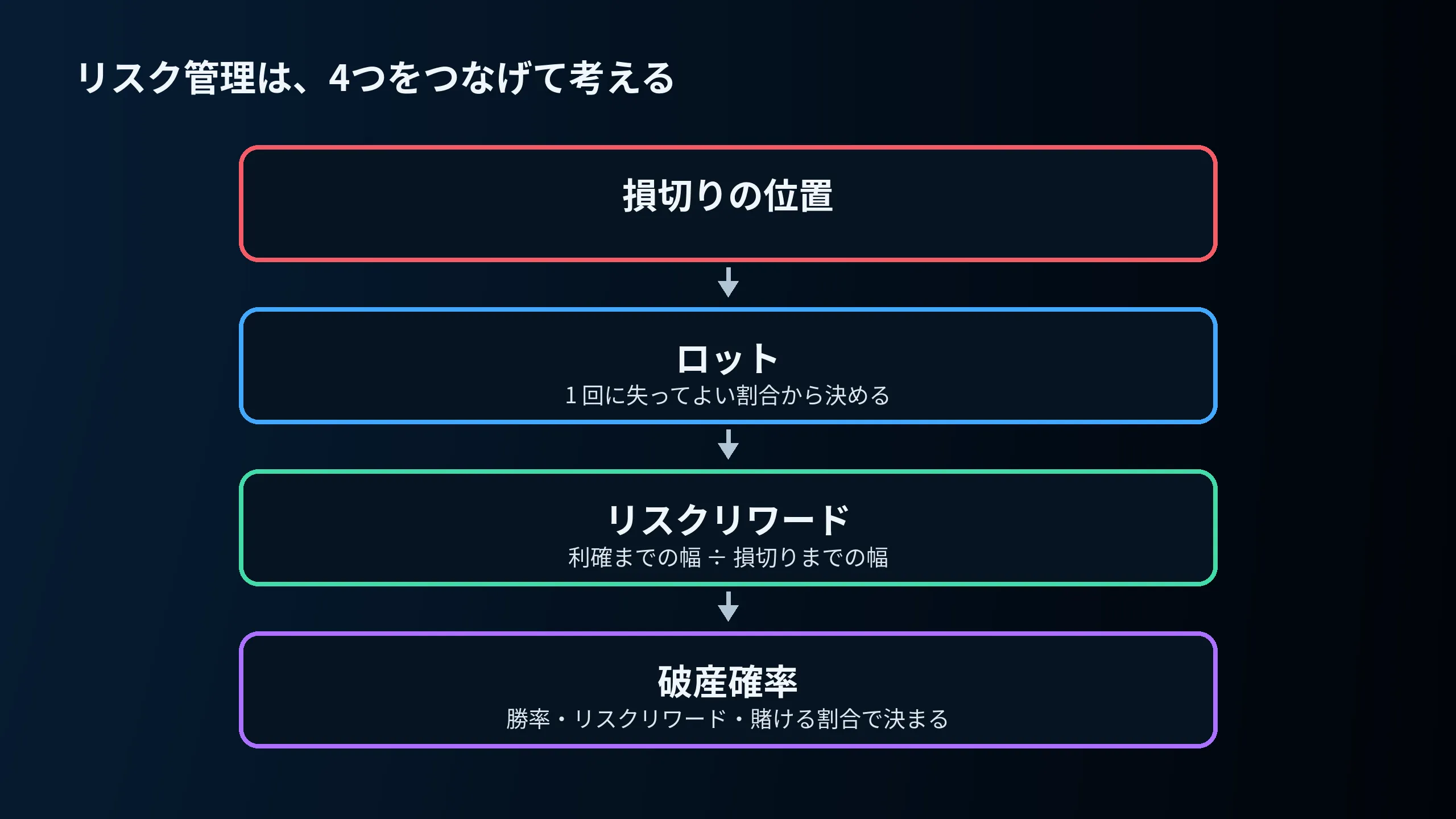
- Position of the stop-loss:Where the reason for entry would break down
- Lot size (trade volume):What percentage of capital you are willing to lose when a stop-loss hits
- Risk-reward (reward-to-risk ratio):Compared to the width to the stop-loss, how wide is the profit target
- Probability of ruin:If you continue with this method, what is the likelihood that your capital will substantially drop
1. Position of the stop-loss
A stop-loss is where you close the position at a predetermined price to limit the loss. The placement should be considered from thepoint where the reason for entering collapses. Do not place it too close by calculating from the amount involved.
The approach and practice method are described in detail in this article.
▶ How to decide the stop-loss position — Place it at a well-supported placehttps://www.gogojungle.co.jp/finance/navi/articles/127283
2. Lot size (percentage of capital you can lose in one trade)
Once the stop-loss position is decided, the width of the stop-loss is determined. Then,decide the percentage you can lose when a stop-loss hits (risk %) first, and then decide the lot size from that.
For example, if you have 1,000,000 yen and decide you can lose 1% in one trade, then the loss per trade is up to 10,000 yen. If the width to the stop-loss is wide, reduce the lot; if narrow, increase it, so that the loss remains the same 10,000 yen.
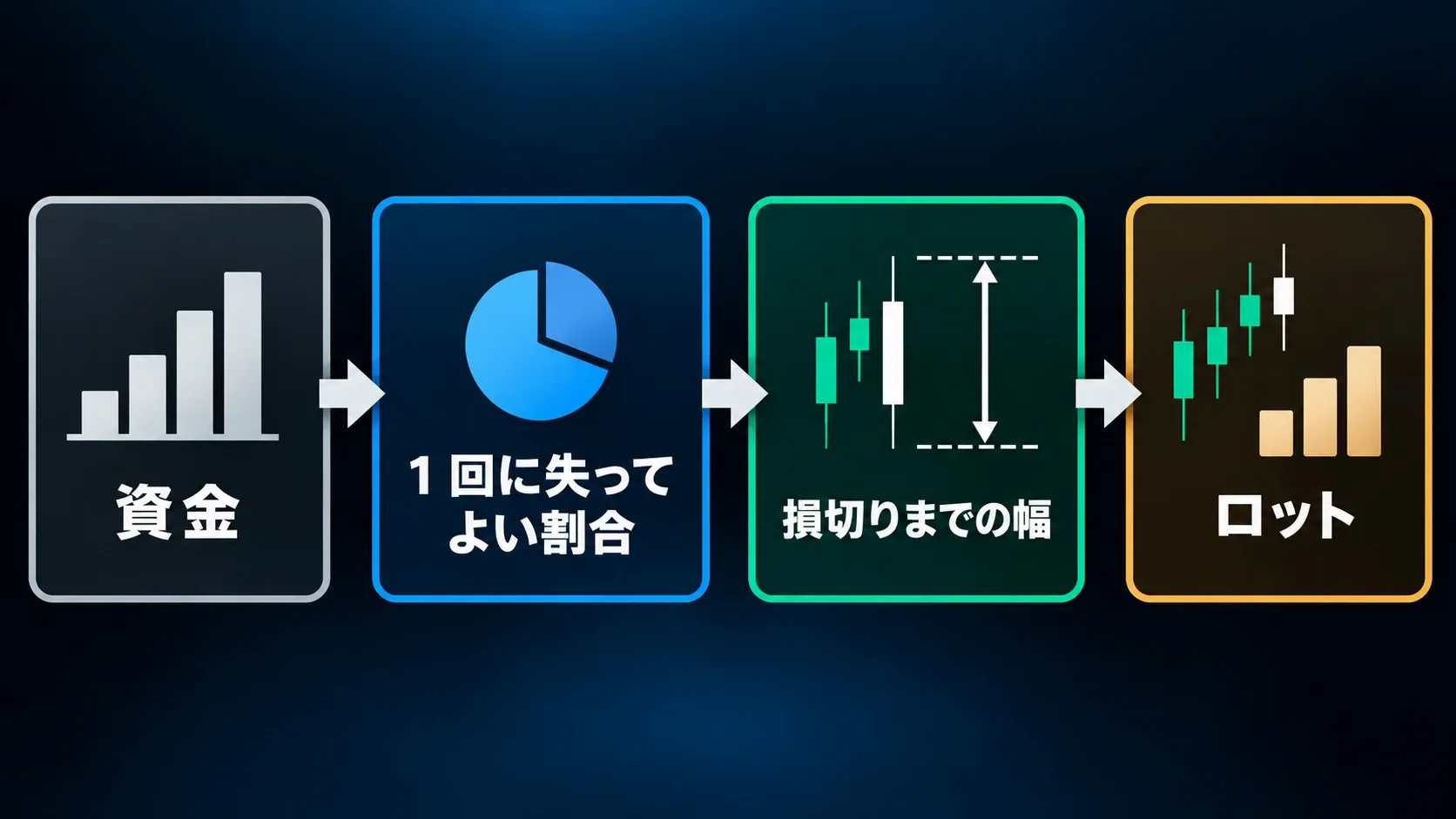
By doing this, even if the stop-loss width changes by situation, the loss per trade stays consistent.
3. Risk-reward (reward-to-risk ratio)
Risk-reward isthe amount of profit target width relative to the stop-loss width. If the stop-loss is 20 pips and the profit target is 40 pips, the reward-to-risk ratio is 1 to 2 (pips are the unit of width).
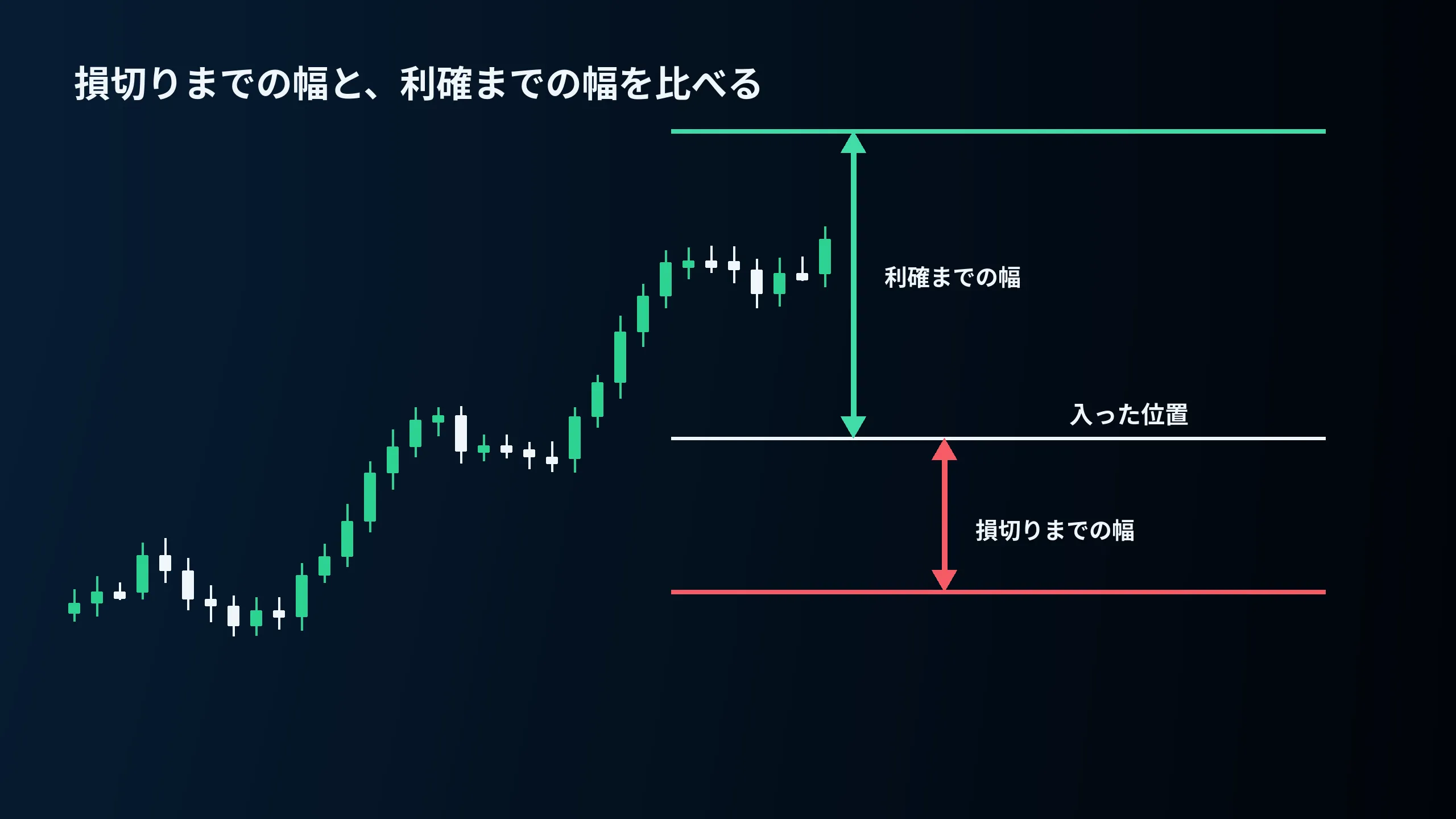
The reward-to-risk ratio is considered together with win rate.
- If the reward-to-risk ratio is 1 to 1, you won’t grow your total unless wins exceed half
- If the reward-to-risk ratio is 1 to 2, you’ll grow your total if wins occur in more than one out of three
Both calculations exclude fees and other costs. Placing profit targets farther away increases the reward-to-risk ratio, but also makes it harder to reach the target as often.Which one suits you depends on your records.
4. Probability of ruin
Probability of ruin is,the likelihood that your funds will fall to a predetermined level when you continue trading with the same approach. It is determined by the following three factors:
- Win rate
- Reward-to-risk ratio
- Percentage risk per trade (risk %)
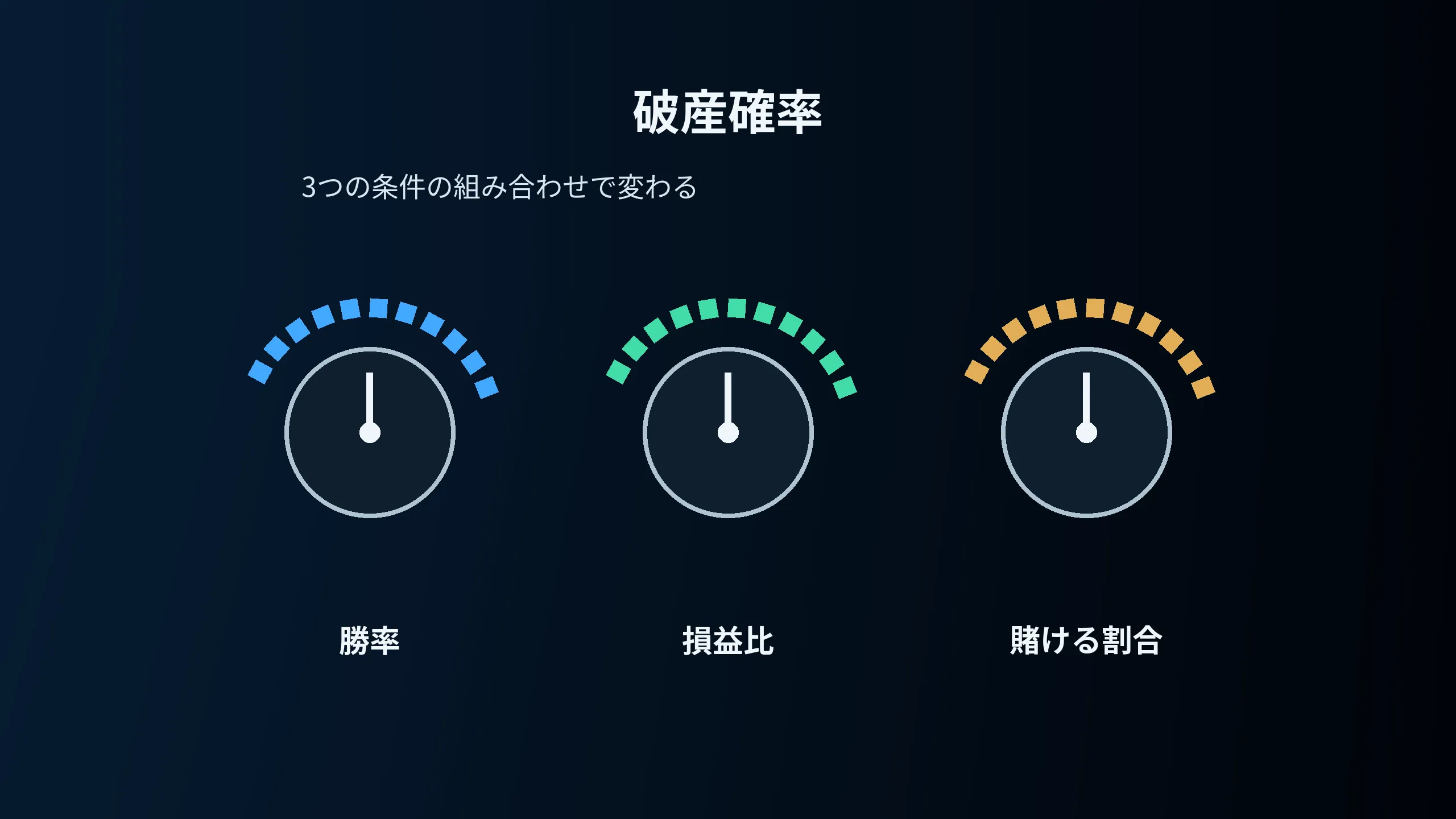
Of these, the part you can directly decide is the “percentage you risk.” The reward-to-risk ratio changes with where you place stop-loss and take-profit. The win rate is not something you decide; it is something you learn throughpractice and recording.
Your numbers come only from your records
Among the four discussed so far, win rate and reward-to-risk ratio vary by person and method. Numbers written in books or on the Internet are those of that person in their own situation. It does not necessarily match your own judgment.
To know your own numbers,repeat the same setup across many situations and keep a record. A method for counting scenarios on past charts is summarized in this article.
▶ What is FX backtesting (backtest)? How-to, steps, and ongoing practice guidehttps://www.gogojungle.co.jp/finance/navi/articles/126878
Practice steps
- Write down the stop-loss position and the reason for entry before entering
- Decide the risk % first, and then determine the lot size:Do not change it across situations
- Decide the take-profit position in advance, and note the reward-to-risk ratio
- Increase the number of scenarios to derive win rate and reward-to-risk:For dozens of repetitions with the same rules
- See what happens when you continue with those numbers:Length of losing streaks and how funds decrease
Practice with tools
The MT5 indicator “FX Backtesting Trainer” is a practice tool that plays back past charts one by one and allows trading orders and recording in a simulated account.
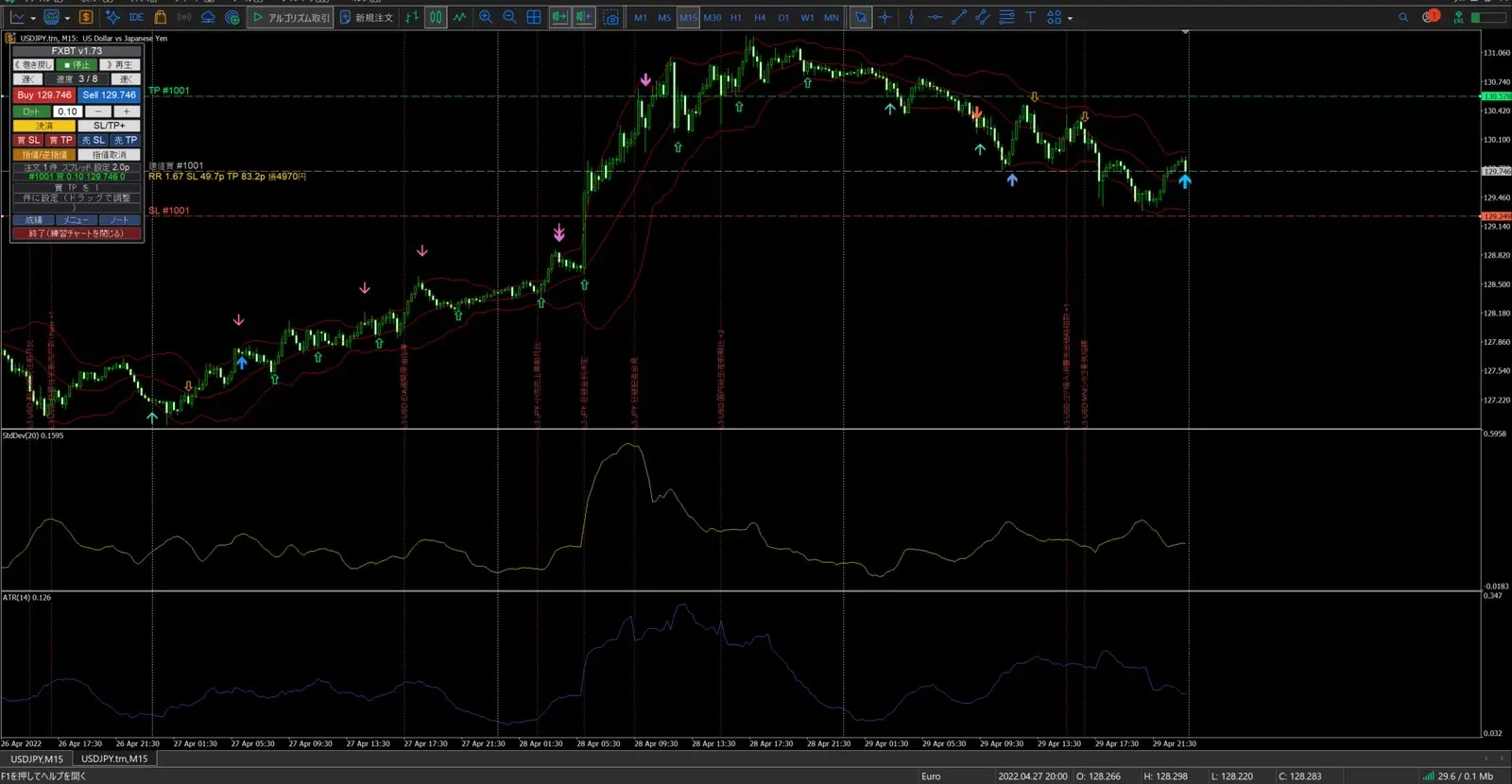
- Future candles do not exist in data, so you can set stop-loss and take-profit positions without knowing the results
- Stop-loss and take-profit are set by dragging chart lines. Next to the lines, you’ll see the reward-to-risk and the potential loss at stop-loss
- If you pre-set the risk %, the lot is calculated from the width to the stop-loss
- Win rate, reward-to-risk, maximum drawdown, consecutive wins/losses, and cumulative profit are calculated from records
- Probability of ruin counts unrealized losses as losses. Therefore, it tends to be higher than typical calculations.
- When the same bar contains both stop-loss and take-profit, priority is given to stop-loss to avoid overly optimistic results
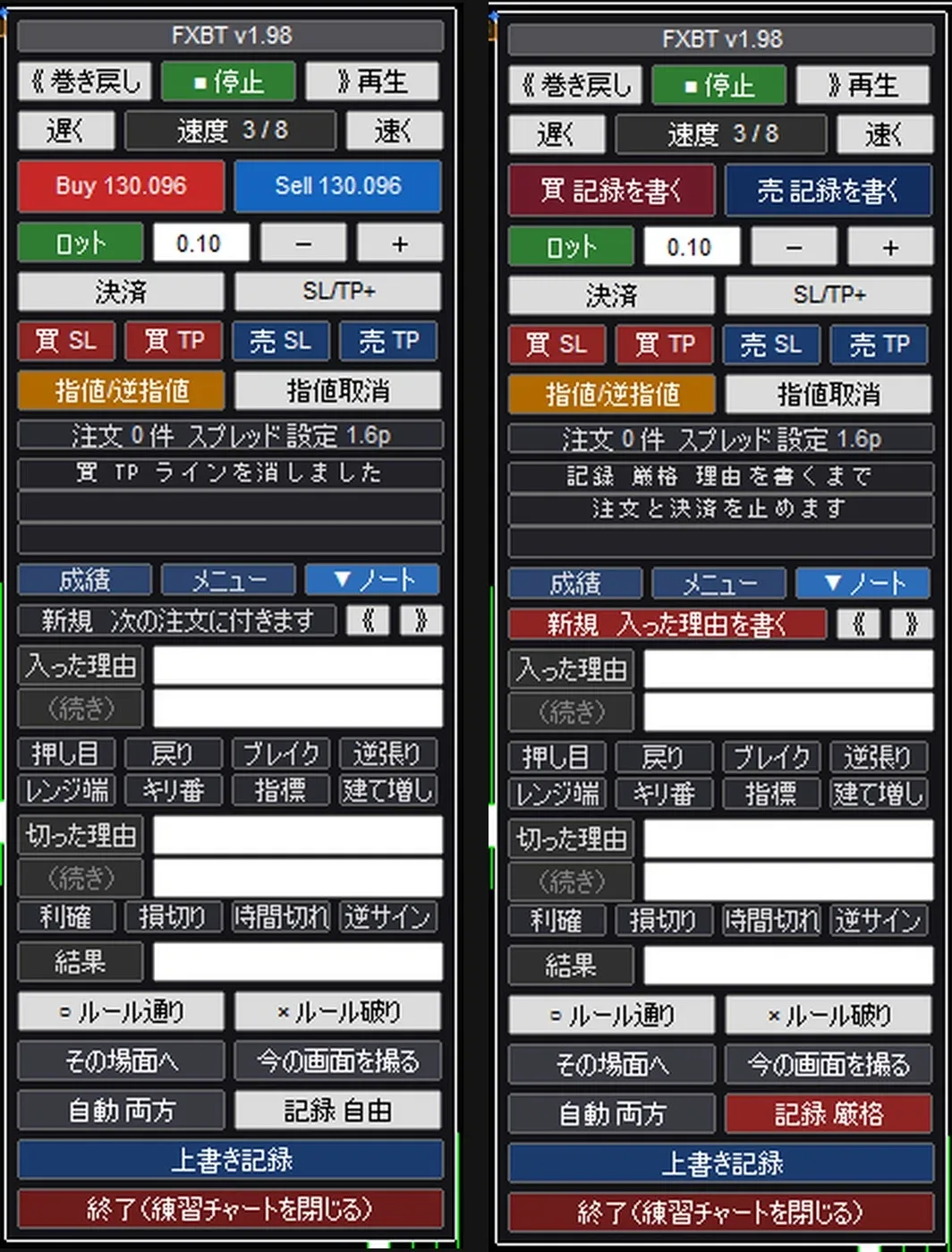
There are things you cannot do.
- Fees, swaps, and partial closes are not included in calculations. There is no margin call or forced liquidation
- Movements finer than the set minimum bar (default 1-minute bar) are not reproduced
- Account currency is only Japanese yen, and compatibility is MT5 (Windows) only
A summary of how to practice with this tool in MT5 is available in this article.
▶ How to practice past verification in MT5 — pitfalls of manually scrolling and practice playing one bar at a timehttps://www.gogojungle.co.jp/finance/navi/articles/126682
Conclusion
- In risk management, decide on four aspects: stop-loss position, lot size, risk-reward, and probability of ruin, in this order
- Lot size is determined from the percentage you can lose per trade. Reward-to-risk is considered with win rate
- Win rate and reward-to-risk come from your own records. Build up scenario counts using the same rules
Related articles
Seven commonly used approaches to discretionary trading and the difficult points and practice for each.
▶ Summary of representative discretionary trading methods — seven approaches and how to practice eachhttps://www.gogojungle.co.jp/finance/navi/articles/127390
Different practice methods in MT5 such as demo accounts, tester, and backtesting, and which are suitable for you.
▶ How to practice discretionary trading in MT5 — using demo accounts, testers, and backtesting appropriatelyhttps://www.gogojungle.co.jp/finance/navi/articles/127097
About the practice tools
The practice described in this article can be done with the MT5 indicator “FX Backtesting Trainer.” It allows replaying past charts one by one and practicing orders, recording, and review in a simulated account.
There is a free version.You can practice payments up to 30 times (cumulative) across all features, currency pairs, and timeframes. There is no expiration. You can first check whether it runs on your MT5 and whether your usual indicators work.
▶ Free version (Product ID 86772)https://www.gogojungle.co.jp/tools/indicators/87387
If you want to practice without worrying about the number of times, please view the product version. The trade notes and saved verifications written with the free version can be opened in the product version as well.
▶ Product version (Product ID 86765)https://www.gogojungle.co.jp/tools/indicators/86765
Notes
- This tool is for practice. It does not guarantee profits. Real orders are not placed.
- This article introduces practice methods and ideas. It does not recommend specific trading or capital allocations.