
Vol.2 Secret methods for members disclosed: "Manual trading techniques and correlations and anti-correlations"
From here on, this is a highly confidential article for paying subscribers or for “Ajinichi purchasers.”
Where articles are usually for the public, the discretionary judgment regarding signals was zero; for intermediate users, this article targets those somewhat familiar with MT4 operations and teaches discretionary judgment criteria.
Today, continuing from last week, this article is about trailing stops.
If you are currently using the “Ajinichi EA,” you are likely trading with a default trailing width of 10 pips in the EA parameters, or you have specified your own trailing width.
This is about removing the trailing and entering 0, which can offer a chance to extend profits while taking on some risk.
First, please watch the video content.
The above video is viewable only by subscribers and Ajinichi purchasers, so please do not spread it via external links.
Limited-public videos can be viewed only by those who know the link; however, if you post the link externally, anyone can view it, so please be careful.
Now to the main topic: as shown in the video, it is quite difficult to determine in advance that there is a strong trend, so you need to decide how to shape your trading style.
The first trading style is the hybrid trade style of Ajinichi that I recommend.
It is a trading style using signals + discretionary judgment + EA.
In this case, the concept is to keep the trailing width around 10 pips and maintain a long time without a position as much as possible.
Therefore, there will be more trades ending with small gains, and most often profits will be around up to 20 pips.
The daily trading results I actually do align with what I’ve discussed above.
Next, the second one is the Swing Trade method that we are introducing this time.
Who is suited for this swing trade? It is suitable for traders who can hold positions for a long period without mental distress.
In my case, I am experienced in swing trades, but it took several years to realize that I was the type who could not sleep well because of positions. (Back then I didn’t think it was a mental burden, but now I understand it was stress.)
People who wake up at night and look at charts may not be suitable.
If you can secure normal sleep without issues, you are suited; and for those who have never done it, trying with a small investment amount is also worthwhile.
Investment funds and institutions are said to be largely swing traders, so there are people for whom such a trading style suits well.
This style has been studied for a certain period, so if there is demand, I think I will continue writing articles as a series in the future.
Therefore, it is important to decide which of the two trading styles suits you.
Regarding the initial approach of the second swing trade, there are two methods: one is to take a position and endure drawdown while moving the SL, and the other is to move the SL early as in the video, potentially ending with small gains but reducing risk to some extent.
There are methods for enduring draws to a certain extent, and for those who want to endure as little drawdown as possible, adopting the early SL move method introduced here may be good.
Please also test manually moving trailing stops on other currency pairs as well.
In the future, I would like to write as many articles on correlation and anti-correlation as possible, so I’ll take a break from trailing stops for a while.
What I want you to learn first is the basis for making entry decisions.
Start by clearly defining discretionary judgment criteria to improve the accuracy of both entry and exit strategies.
The trigger for entry is the signal.
I also work part-time, so when I have another job, I forget about the charts.
That’s because there’s no position, but when I have a moment free, I check my smartphone emails.
Sometimes I receive emails listing nine currency pairs for selling or buying in a batch.
Then, for example, if as in the figure below USD/JPY is short, EUR/USD is long, EUR/JPY is long, when the dollar is weak EUR/USD should rise.
The red vertical line on the right in the figure compares the same time for USD/JPY.
Look closely at the price on the red vertical line. The USD/JPY signal is indeed showing the potential to break today's low, so entering is not bad.
Next is the second image, where EUR/USD should be rising, but look at EUR/USD's high for today.
There is quite a distance.
In other words, there is even the appearance of a rising tail.
First, see whether it presses up to the long-term baseline and becomes a pullback; given today’s high is far away, it seems better to skip the entry.
If you were watching the chart at the moment when the USD/JPY signal confirmed, you should enter on the run and keep the trailing to around 10 pips or so.
The third one, EUR/JPY, is also of interest.
After a significant decline, it may rebound.
EUR/JPY appeared to be rising above the long-term baseline, but it sharply dropped below the long-term baseline. In other words, the range is expanding and it is neither an uptrend nor a downtrend.
Pound/ Yen (GBP/JPY) similarly rose and then fell sharply, expanding the range, so it cannot be called a trend.
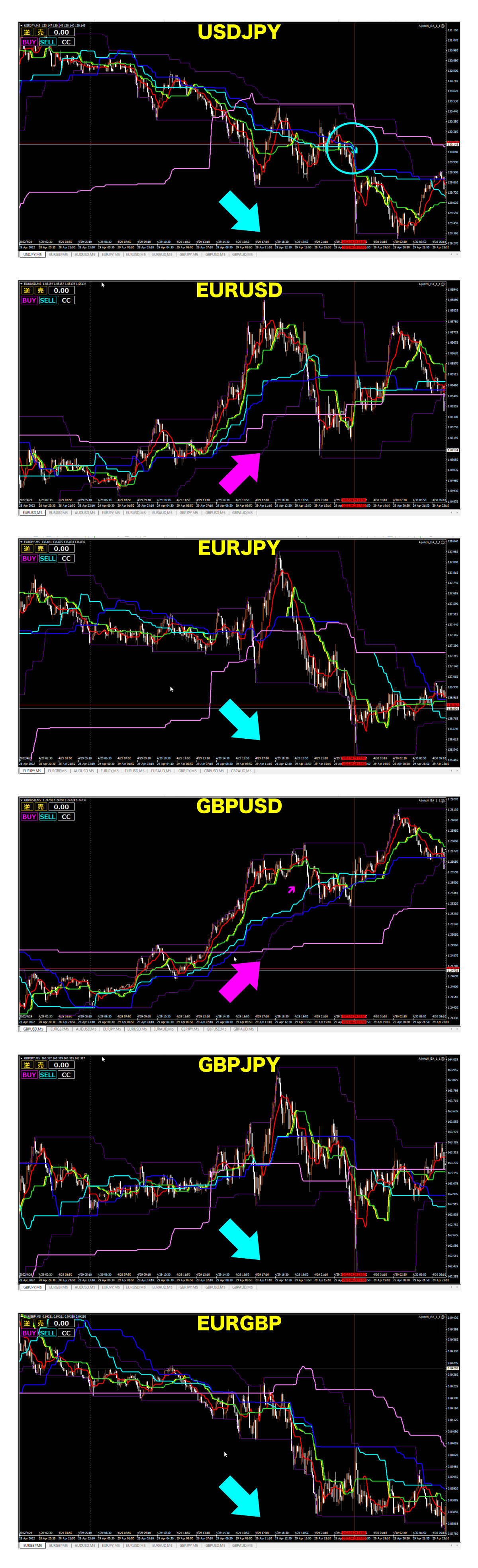
As shown above, when you look at the chart starting with the USD/JPY signal, you cannot judge a trend from the correlated EUR/JPY and GBP/JPY moves; the range is expanding, so for a while there may be no clear direction, with choppy fluctuations.
For anti-correlated EUR/USD and GBP/USD, at the red vertical line, EUR/USD does not necessarily rise.
GBP/USD is weak, so if GBP/USD is hitting new highs today while the dollar is weak, you could say the pound is strong but...
At this red vertical line, you cannot say GBP/USD is strong.
Because EUR/GBP is weak, the pound seems strong, and the dollar is not the weakest but weak, so if buying, GBP/USD long would be the choice.
However, at this point we will not buy yet; after a while, if the recent high is broken and today’s high is likely, consider a long entry or place a long stop-order at the recent high as a judgment.
By consistently determining the strongest and weakest currencies among the nine pairs, you can pass many entries by discretionary judgment.
The signal was USD/JPY, but the pair likely to trend turned out to be GBP/USD, which is a discretionary judgment.
And only enter when the correlation and anti-correlation relationships are clear, so you can win quickly with ease.
If you have any questions, I’d like to continue sharing information with all of you through articles like this. Also, regarding update frequency, I plan to publish at least once a month, so please understand.
In other words, in this article, for at least a month, please observe the nine currency pairs at the timing of signals and follow the trend with the combination of the strongest and weakest currencies.
When you have time, please perform your own backtesting or forward testing as well.
That’s all for today.