
Vol.1 Secret Method Release: A Private Blog for Purchasers of "Ajinitchi"
Today I will share intermediate-level trading logic secrets with you.
First, please study carefully the criteria for deciding whether to use a stop order at the time the signal is confirmed.
And as for the trailing action, I will talk under the assumption that you are using “Ajinitchi EA,” but even if you have not purchased the EA, you can achieve the same result by entering on a manual market entry in the same way, setting a trailing stop, and configuring your stop loss and take profit levels.
The basis for a market-entry trade is twofold: correlation and negative correlation.
The correlation and negative correlation judged after the signal confirmation by looking at the chart, I will now discuss with the three currency pairs I personally entered yesterday as an example.
A notification of the confirmed signal arrived on my smartphone.
When I looked at the smartphone, it displayed “AUDUSD Lowest Break” on the home screen.
This is interpreted as the AUD being weak.
To verify this, I checked the Mt4 chart screen via VPS from my smartphone.
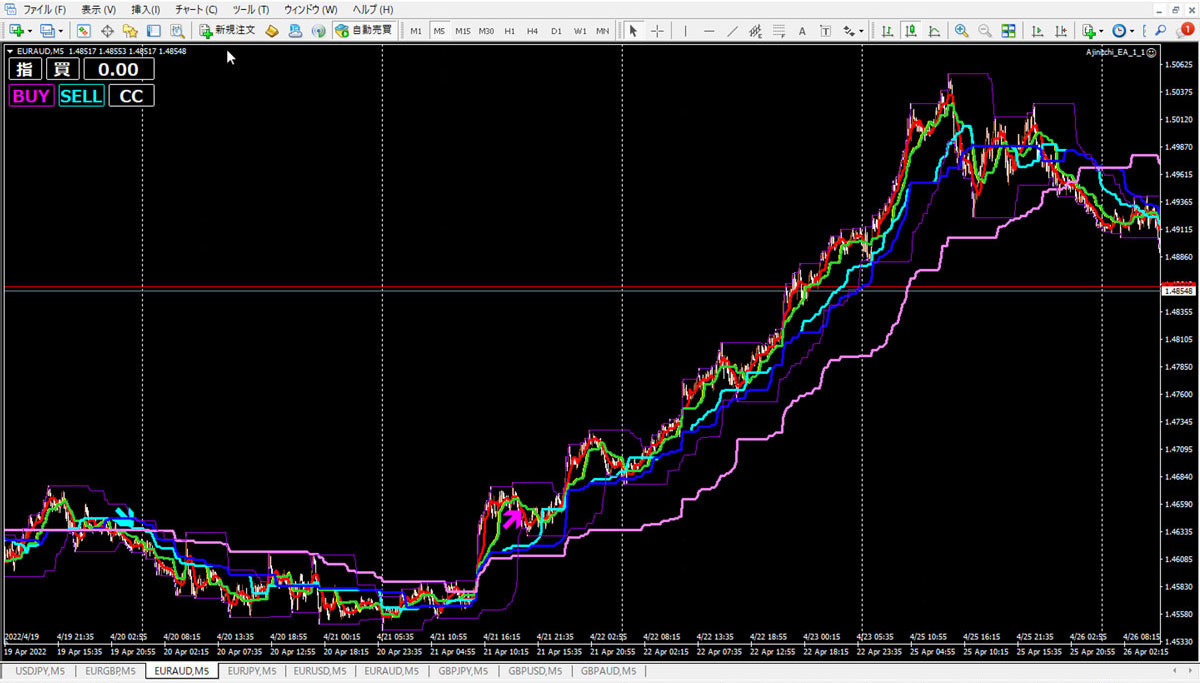
At the far right, the pink circle with an arrow is half visible.
If you move to the far right, all arrows become visible, but when using a 9-split screen, the chart display range becomes narrow, so I did not move to the far right.
The blue horizontal arrow indicating the entry remains visible, right?
This is proof that I actually entered on a market order.
At this timing, it is the signal of a rebound after a long downtrend, four days after the bottom.
However, looking at only this currency pair, there is not enough evidence.
Because a single currency pair alone is not sufficient to judge the trend, I would not long enter on market entry, but if AUD really rises, the two pairs inversely correlated, EURAUD and GBPAUD, should show a downward tendency, right?
These three correlations (correlation and two inversely correlated pairs) would triple the basis.
This means the win rate and the profitability should increase as well.
Let us look at the EURAUD and GBPAUD charts at the same time.
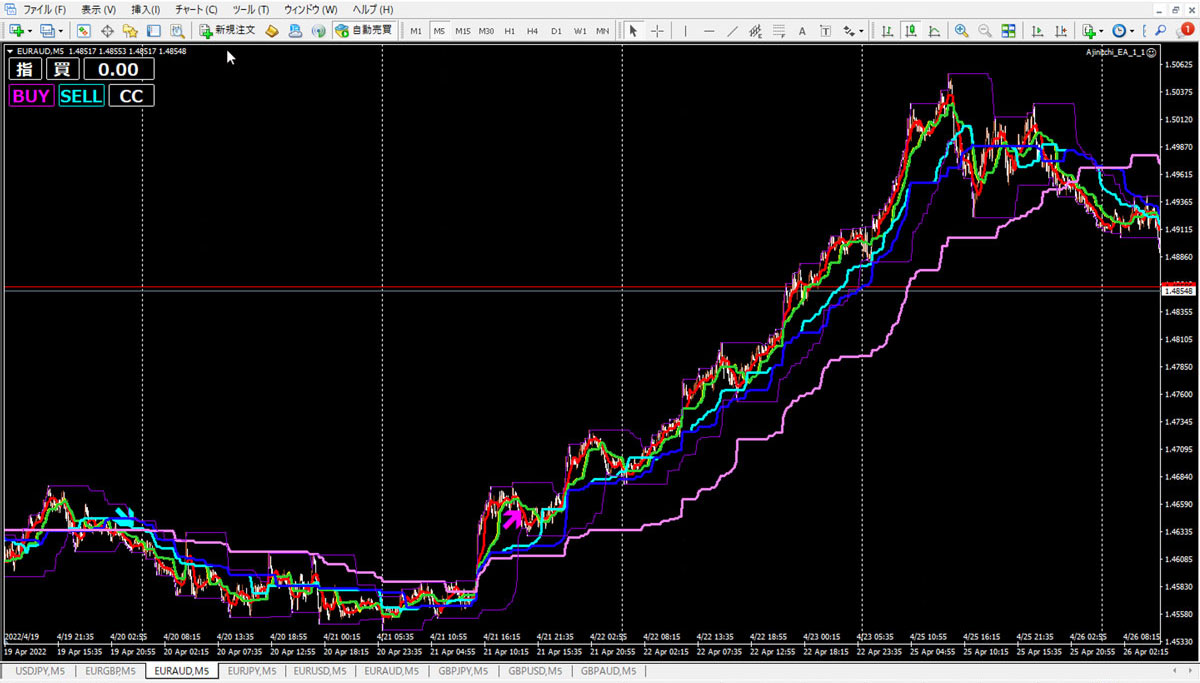
First is EURAUD.
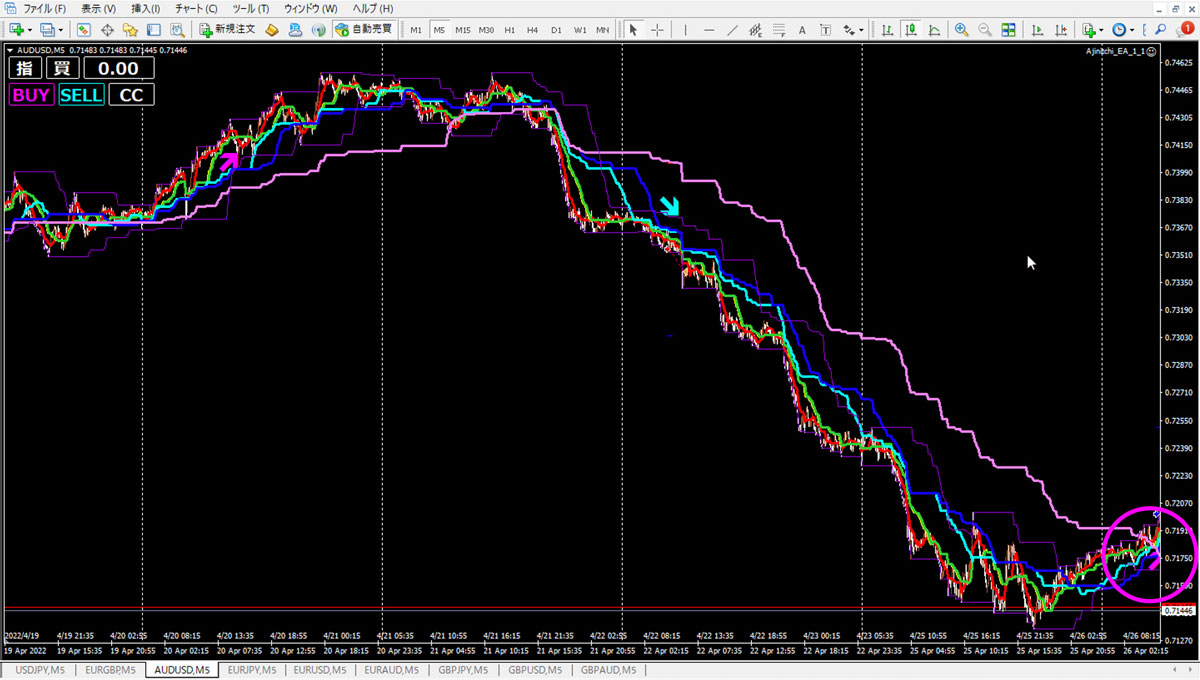
Ignore the red horizontal line and focus on the price at the far right.
Then there is the perfect order = PO.
The long-term moving average is beginning to form a downward staircase.
All five other lines have broken below the long-term moving average, completing the downward PO.
The dark purple high-low line has broken downward.
There is no signal, but it clearly shows a downward trend, so for now, it is OK.
With this, the rationale for a long AUDUSD and short EURAUD is in place.
Now let's look at GBPAUD.
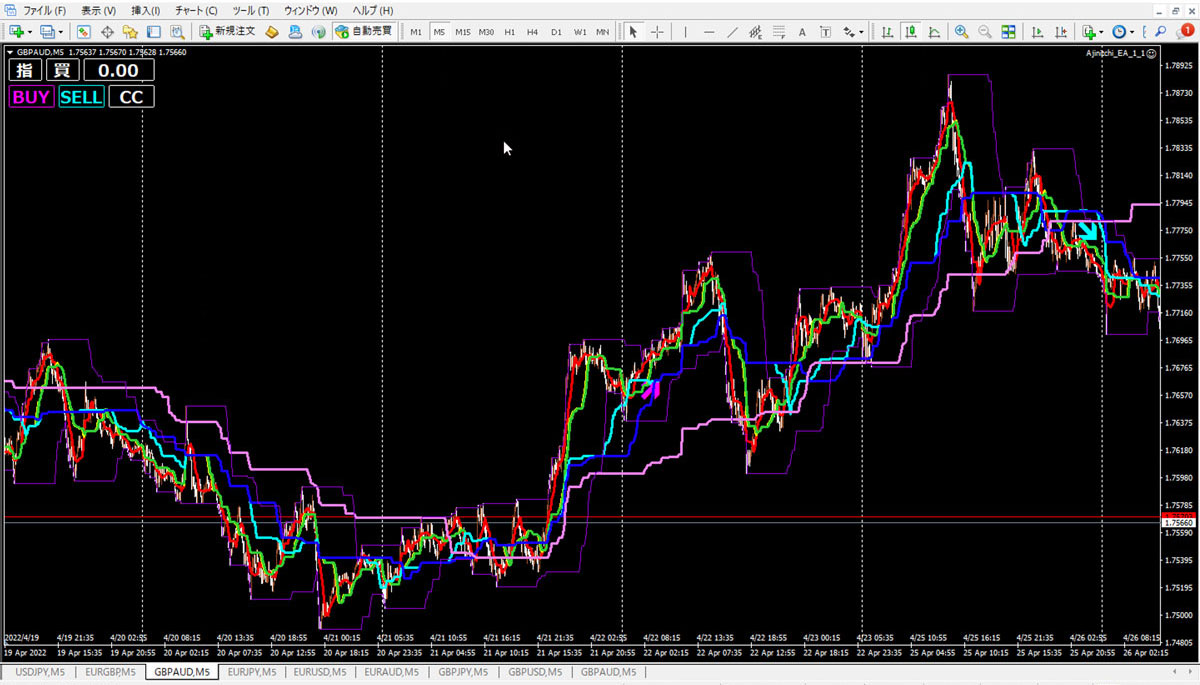
What do you think?
Up to this point, when you checked the AUDUSD signal confirmation on the chart, EURAUD and GBPAUD, which are inversely correlated, align, so you can buy AUDUSD.
And for the two pairs above which have not produced a signal, you verify which is more prone to drop with EURGBP.
Here is the EURGBP chart at the same moment.
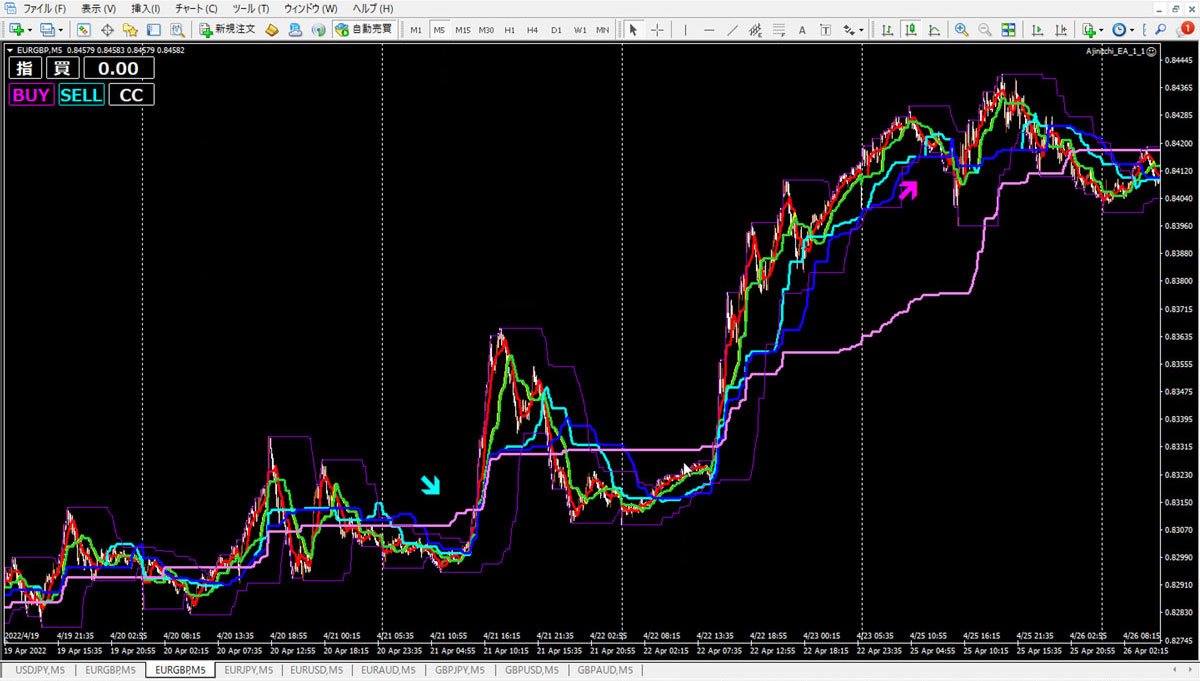
The last signal is a long signal from the previous day, but the long-term moving average was temporarily broken below, showing a rebound high tone.
The recent high is quite high.
The nearest low is closer, so if the low is breached, a downtrend will occur.
In this case, it is judged as a downward range, so I consider it a draw.
Since the euro and the pound are tied, if either can be judged as a downward trend, it is OK to recognize it.
The result of this trade is that GBPAUD hit the trailing stop and ended with a small profit.
The other two were closed together at 22 pips each with the CC button.
The pips shown at settlement were about the sum of the two positions, around 41 pips.
The holding time was about 10 minutes, and I achieved about 44 pips in profit.
In this way, even though opportunities are few, by observing the chart after the signal and using discretionary judgment to identify correlation and inverse correlation, you can trade efficiently in a short period of time.
Well, that will be all for today.
Thank you very much for watching until the end.
Kū (Ku), a part-time trader, here.