

[How to Cure Posi-Posi Disease] An 18-year Trader Discusses the Root Cause
“Even if you decide today to wait, you can’t wait because your willpower isn’t strong. Today I’ll talk about the root of that.”
Good evening!
I’m Masashi.
After 18 years, I’ve realized that the biggest difference between people who can win and those who can’t is the “quality of waiting.”
↓ A GOLD special feature has been released^^
Please join in while you can.
How to Cure the Position-Positioning Disease|Root Causes from an 18-Year Trader
When you open a chart, you somehow end up taking a position.
Even though you decided today to wait, you notice your fingers moving anyway.
These experiences aren’t just one or two times, right? (’;))
I used to be the same.
❌ Blaming yourself for not waiting, rushing in, and then losing again.
That loop was truly painful, even now I remember it.
Not being able to wait isn’t a matter of willpower. The problem is that you haven’t decided what to wait for.In this article, I’ll gently unravel the root structure that causes position-positioning disease.
By the end, you should see “what to change starting tomorrow.”
1. The Phenomenon of “I Kept Entering Again and Again” That Won’t Stop
New traders aren’t the only ones who develop position-positioning disease.
Even experienced people can reach a state where their hands won’t stop.
Around me too, there are quite a few people who have traded for years but never cured position-positioning disease.
Let me describe the symptoms a bit.
❌ As soon as you open the chart, you start vaguely looking for an entry
❌ When you think “this might be it,” you enter even if the justification is weak
❌ Right after you cut losses, you immediately search for the next position to “make up for it”
❌ The time you don’t hold a position somehow feels anxious and unsettled
If you relate to any of these, you are quite likely affected by position-positioning disease.
?It’s not that you can’t wait; it’s that the feeling of “being afraid when not in a position” comes first.
This isn’t something many people are conscious of, but it’s a big difference.
? Many who can’t wait feel that “the market is moving, so I must be in too.”
GOLD moves a lot in particular, so the fear of missing out is easy to trigger.
In my early days, when prices suddenly moved, I’d think “If I don’t ride now, I’ll lose,” and I’d jump in without any justification (’;)')
The results are usually the same.
You enter worried about missing out, but the price reverses the moment you enter.
? The problem is the pattern: “Whatever the situation, as long as it moves, you’re about to enter.”
The chart moves 24 hours a day.
Moving doesn’t equal a chance, but just watching the moves fools your brain into thinking “Now might be a chance.”
This is the entry point of position-positioning disease.
Some people may think, “I’m not that bad.”
But honestly, if you honestly reflect on the ratio of entries with basis versus entries without basis,the latter is often more numerous for many people.
First step“Recognize that you might be position-positioning”is to acknowledge it.
2. The Root Structural Problem Behind Position-Positioning Disease
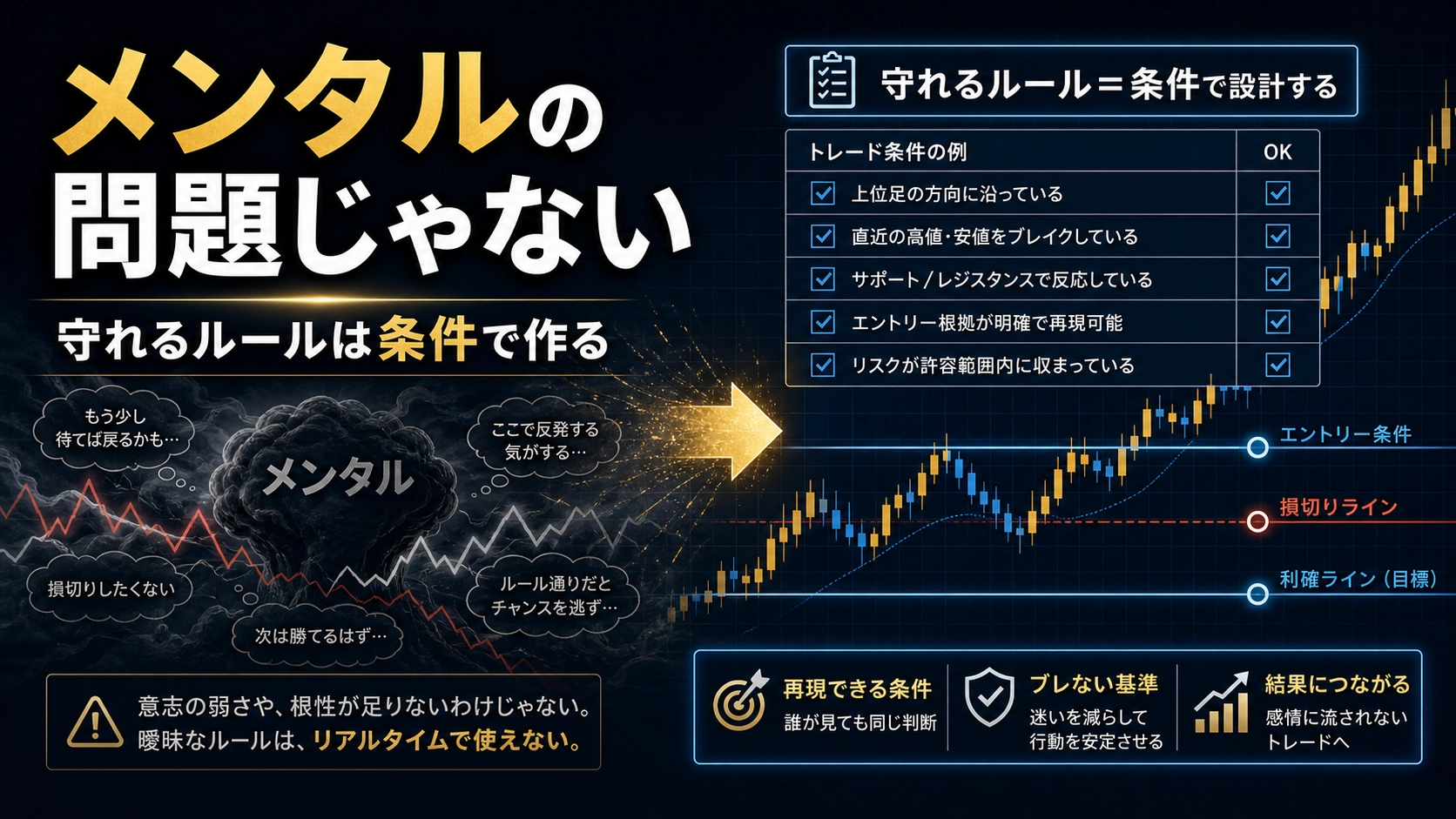
I honestly think it’s a waste to simply label the cause of position-positioning disease as “weak mental fortitude” or “lack of patience.”
? Because,Tackling it with mental-only approaches often doesn’t solve the root cause.
What I realized over 18 years is that the essence of position-positioning disease is“a lack of structure”.
When we say “structure,” it may sound complicated, so I’ll break it down a bit more.
In short,“the exact conditions for positions, given the exact situation and timing, aren’t clearly defined”and that’s the problem in trading.
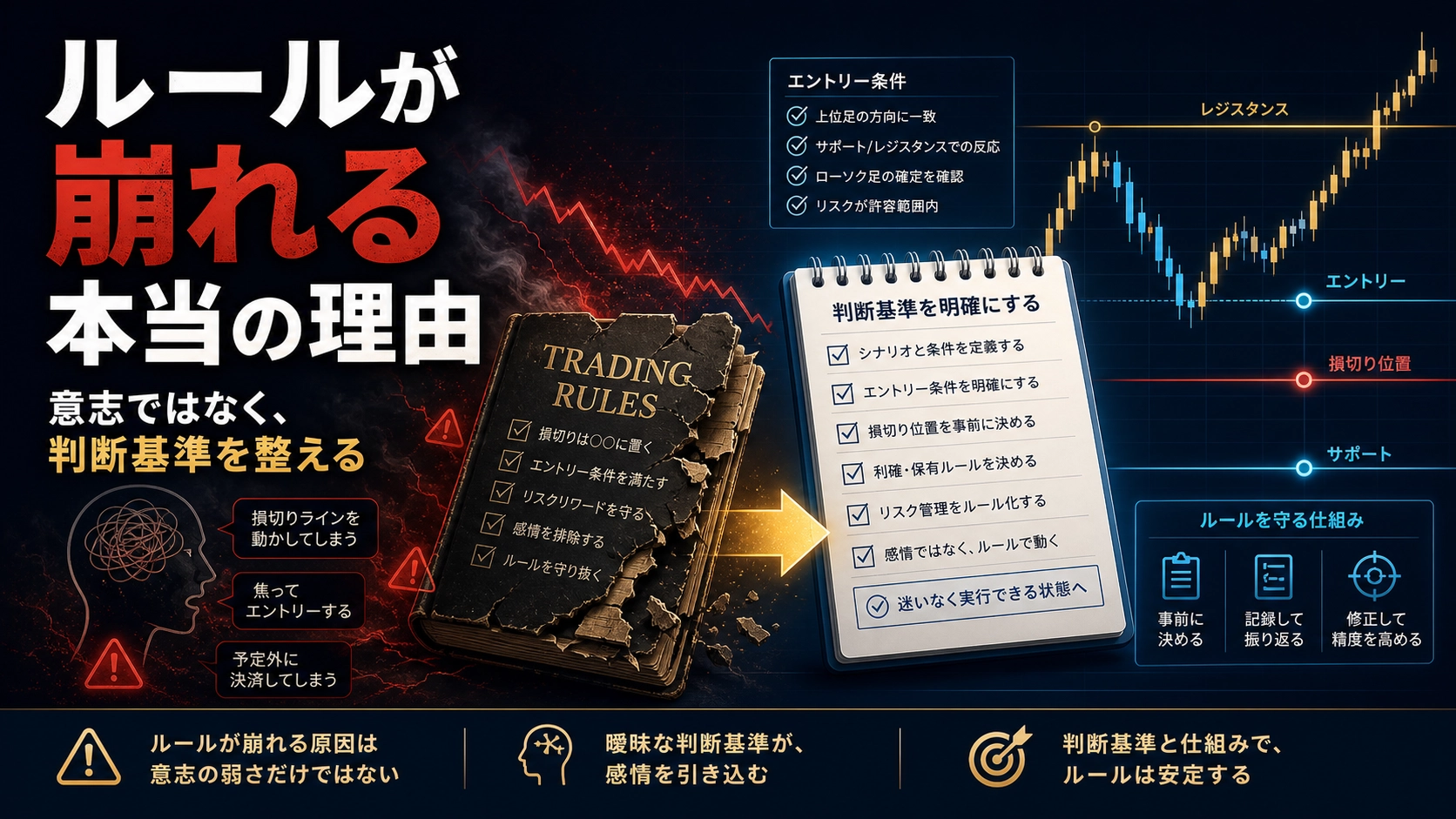
Some people may have rules, too.
But“having rules” and “seeing the structure” are different things.
For example, suppose there is a rule: “Buy when the moving average is rising.”
But even in rising conditions, there are positions where you should enter and ones where you should not.
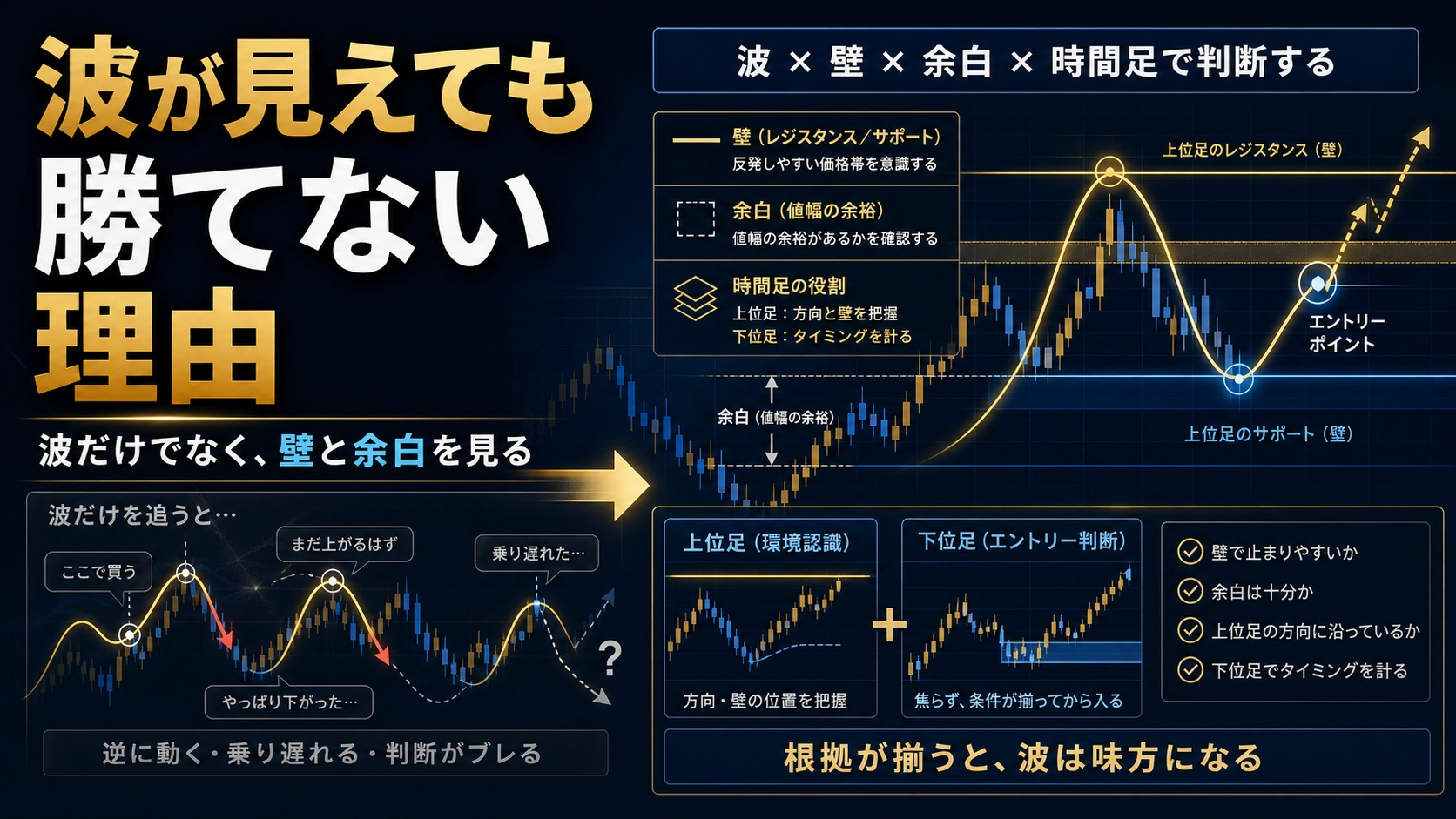
To judge the difference, you must understand the market’s“walls” and “waves”.
? Applying rules when you can’t see walls or waves makes the rules hollow
?Wallis a price range where the market has repeatedly reacted.
A price area where price has repeatedly stopped or bounced is likely to react again in the future.
?Waveis the rhythm of the price’s up and down movement.
markets don’t move in a straight line. It goes up, then down a bit, then up again.
If this rhythm is broken or direction is unclear, it looks like you could enter anywhere.
Position-positioning disease arises from this“not seeing walls and waves and simply reacting to the current movement”state.
There’s movement, so you enter.
Because it’s rising, you want to buy.
Because it’s falling, you want to sell.
This feeling is natural, but moving solely on it is an“emotional trade”that ignores market structure.
This isn’t about willpower.
Because you can’t see it, you end up entering
3. Winning Traders Fundamentally Differ in How They Wait
What’s the biggest difference between losing traders and winning traders?
? From years of watching, I can say clearly“the quality of waiting”.
❌Losing traders’ waiting styleis like this.
“Endure until a chance comes.”
?Winning traders’ waiting styleis like this.
“Do nothing until all conditions are met.”
The phrases are similar, but the meanings are completely different.
“Endure until a chance comes” means the definition of a “chance” is vague.
So it’s easy to enter with a feeling of “this might be a chance.”
In the end, you end up waiting but not really waiting.
“Do nothing until all conditions are met” meansthe conditions are clearly defined
Therefore, when conditions aren’t met, you can decisively say it isn’t a chance.
If they aren’t met, you don’t have to feel anything. You don’t have to move a finger.
? “Not being able to wait” isn’t a matter of willpower but a problem of not defining the waiting conditions
Another big difference is coming up.
? Losing tradersthink “the market will tell me something”
They try to interpret what movements mean.
? Winning traderscheck whether the market matches their own conditionswhen they look at charts.
If now it doesn’t match, they stop looking.
It’s simple.
I used to be in the former group.
I’d spend long hours staring at charts, endlessly thinking, “Is this it? Is it not?”
Honestly, I was seeking answers from the market because I lacked a personal axis and kept wavering (’;)'
❌【Losing group’s action pattern】
Open chart → observe movement → look for “could enter” → enter
?【Winning group’s action pattern】
Open chart → check conditions → if not good, close it
This difference may be small in a single trade.
But over a month or three months, the gap in results grows considerably.
✍️“A trader who feels things are somehow going well” is dangerous, and only those who understand why it is going well can achieve reproducibility.
Trading on a vague sense sometimes works for a day, but that is not reproducible.
When luck stops, it collapses all at once.
4. Decide What to Wait For, and Your View of the Market Changes
You’ve read up to here, and you may wonder, “So what exactly should I do?”
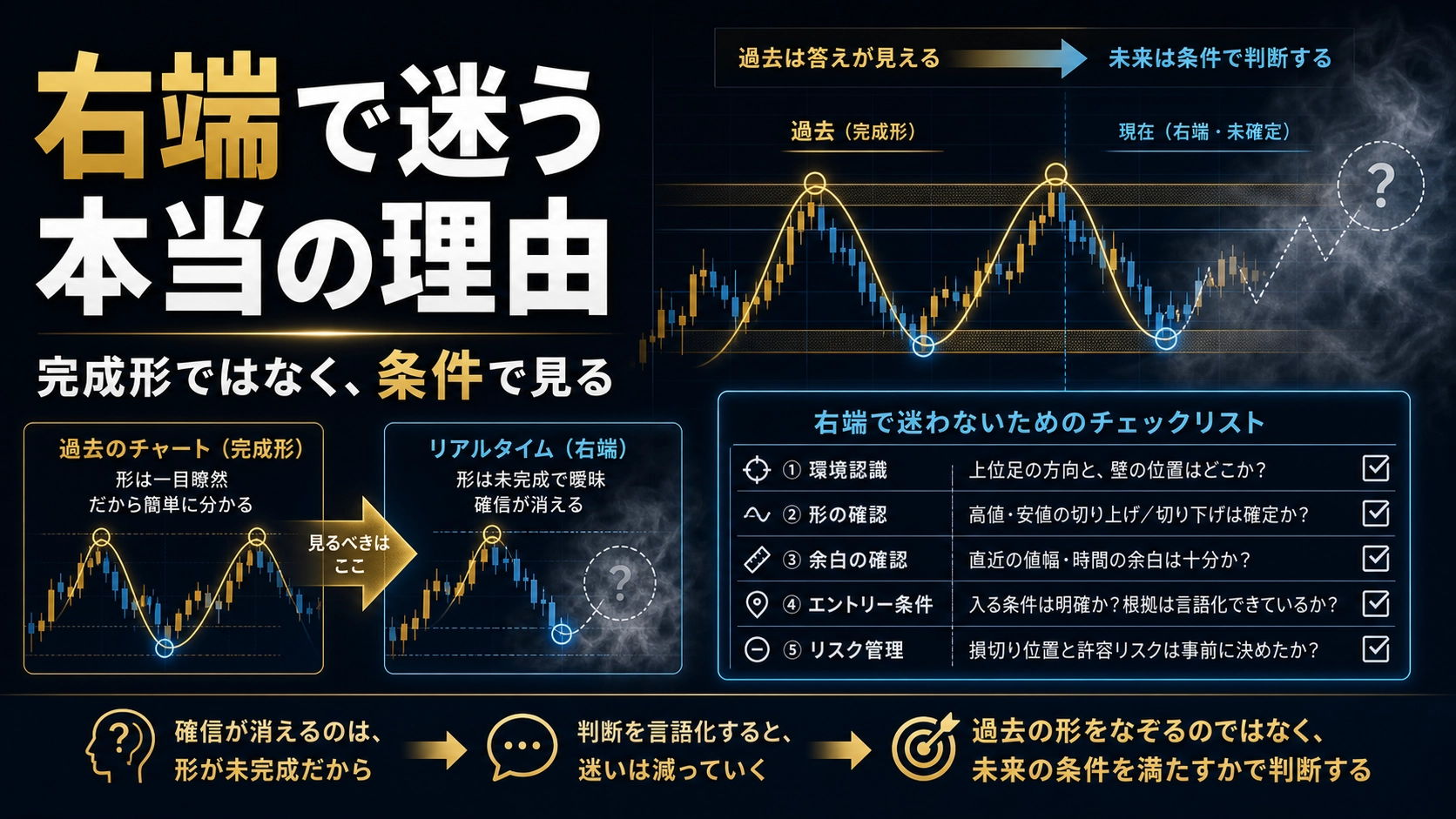
? The best answer is“Define your waiting conditions in your own words.”.
But this is not easy.
It’s easy to confuse this with “setting rules,” but it’s a bit different.
When you try to set rules, you start relying on numbers like “if MA crosses, or if it moved by X pips.”
Numbers are easy to understand.
But relying on numbers makes you move mechanically without assessing the market’s state.
What I do is,“assess walls and waves before deciding”as the guiding idea.
? You can spot walls just by looking at the chart.
Price ranges that have reacted many times in the past are often obvious at a glance.
You don’t need special tools or calculations.
? Spotting a wall and being able to use it are entirely different things
For example, when you approach a wall, if you don’t understand what the current wave is like, you can’t decide whether to enter before the wall or after it.
If you can’t decide, you’ll end up saying “I’ll enter for now.”
⚖️ The key isto alternate between lower and higher timeframesas a habit.
? First, check the lower timeframe for the current situation.
? Then check the higher timeframe for wall position and wave state.
? Finally return to the lower timeframe to decide on entry.
Just doing this back-and-forth carefully greatly reduces “entering on a whim.”
? The upper timeframe is used only to confirmthe wall position and what state the wave is in.
If you try to decide entry using the higher timeframe, the resolution becomes too coarse.
? The lower timeframe is used to read the minute-by-minute movements in this moment.
You make the final decision here on whether to enter.
If this division of roles collapses, you’ll keep wavering no matter which timeframe you watch.
The reason for back-and-forth is not to “see everything vaguely.”
Each timeframe has a clear role, so you rotate between them.
Just adopting this mindset can resolve a large portion of position-positioning disease.
When you view charts with the explicit aim of “confirming whether the condition is right to enter,” you’ll be able to close the chart honestly when you determine it’s not a good entry.
5. Five Habits You Can Start Tomorrow to Reduce Position-Positioning
Based on what we’ve covered, here are concrete actions you can actually start tomorrow.
?If your actions don’t change, insights will remain just insights.
✅Step 1: Before opening the chart, write your today’s purpose by hand
Aren’t you turning “looking at charts” into a routine?
First, before opening the chart, in your notebook write one line about what you will check today.
Examples: “check wall position on the higher timeframe,” or “only see whether the situation is enterable.” Keep it simple.
If you open the chart without a purpose, you’ll tend to think “I want to enter somehow.”
✅Step 2: Create a day each week where you just observe and don’t look
Consciously designate a day to not hold any positions.
That day, just observe the chart.
Doing this helps you separate “watching movement” from “entering,” and you’ll develop a sense that you don’t have to enter even if there’s movement.
At first it may feel odd, but with practice you’ll build a calm habit of watching charts.
✅Step 3: After entering, record in three lines why you entered
Trade journaling is often advised, but many don’t continue because entries are too lengthy.
Three lines are enough.
- What was the situation
- Why did you enter
- What was the result
Continuing this helps you see patterns of “had justification” vs “entered vaguely.”
✅Step 4: After a stop loss, close the chart for at least 30 minutes
Right after a stop loss, the urge to recover can be strong.
I’ve had many times where I quickly took another position after a stop loss, compounding losses (’ ;).
Decide “wait 30 minutes” and keep the chart closed during that time.
This alone will significantly reduce impulsive entries.
✅Step 5: Make the back-and-forth between lower and higher timeframes a “set routine”
Whenever you consider entering, always set a back-and-forth check: lower → higher → lower.
Make this a ritual.
After confirming the wall position and the current wave on the higher timeframe, only then decide to enter or not.
If you insert this check step before acting on impulse, impulsive entries will decline naturally.
✍️ Don’t do all five at once. Start with one tomorrow you feel ready to try
Small, cumulative actions will change results after a month^^
Summary
Position-positioning disease isn’t caused by weak willpower..
? Because the waiting “for what” isn’t decided, you keep reacting to movement.
And at its root, there is the habit of watching the chart without confirming the market’s walls and waves.
The difference between winning traders and others is often in the structure of how they view the market, more than their technique.
There are things you can change starting today.
First, just write three lines about why you entered.
That alone will begin to reveal your own patterns.
? Stop seeking answers from the market and align yourself with the market. That is the gateway to trading without hesitation
? The article described methods such as“how to view walls and waves”and“the back-and-forth between lower and higher timeframes”which are compiled in my two-year effort into the教材 titled.
If you feel you understand the concepts, as the next step I’d like you to learn“how to use them.”.
It’s not flashy, but it’s a content focused on creating your own axis to judge.
If you’re curious, take a look.
? Details here
https://www.gogojungle.co.jp/tools/ebooks/77829
? I also created a free AI tool for trade analysis. Please try it
https://trade-ai-free.streamlit.app/
【Traditional techniques for enormous profits】
▼ GOLD-specific Medication Manual
https://www.gogojungle.co.jp/tools/ebooks/50406
? Free gift|Partial manual released
https://www.gogojungle.co.jp/info/22533


Is it OK?