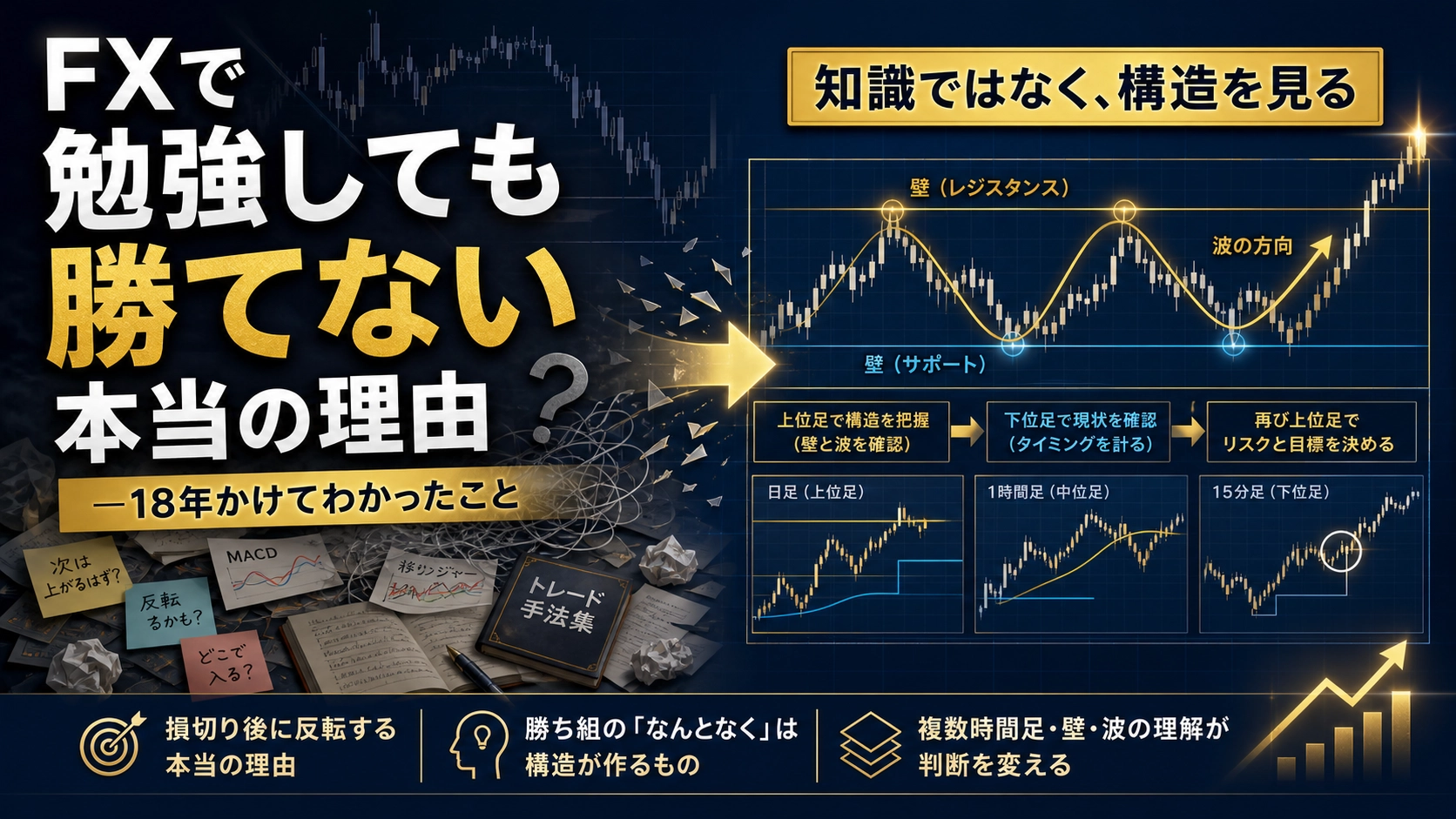

The Real Reason the Rules of Trading Collapse, Explained from 18 Years of Experience
The true reasons why trade rules break down|Explained from 18 years of experience
“Today I will do it exactly by the rules,” you resolve, and the moment you open the chart, it starts to break apart.
This isn’t a one-time thing, you know.
? You set a stop-loss line but moved it.
? You intended to wait, but you entered before any setup appeared. ? You stubbornly held out, thinking “it’ll bounce back soon” without a basis.
Not being able to follow the rules isn’t because your will is weak.
It’s because the rules themselves form a “fragile structure.”
In this article, I’ll explain the mechanism of rule collapsefrom the structure.
“Why does determination fade away?”
“What makes winning traders different?”
“What should I change from tomorrow?”
These three points are what this content will organize for you^^
? 1. The moment when rules suddenly fall apart with a bang
“Today I will absolutely follow the rules.”
With that determination, you sit in front of the screen.
But after 30 minutes you realize you’ve broken somewhere in the rules you set.
Do you think this is a matter of willpower?
To be honest,
the strength of will and whether you can keep the rules have little correlation.
I used to write in my planner every morning, “Today for sure.”
In my trading journal I would write “Strict rule adherence,” then open the screen after reading that.
But the result was always the same: one part of the rule would collapse.
After a while, I’d feel ashamed ('‵;)
“Why am I so weak?”
But this wasn’t a matter of personality or willpower.
? If you look closely at the phenomena when the rule breaks, there are several patterns.
- You feel impatient to wait even though you haven’t entered, so you end up entering
- You had a stop-loss line, but when price nears it, you move it away thinking “this isn’t it”
- Outside of the set time window, you think “this might work,” and you enter
- After losing, you want to “make back,” and your next decision criterion changes
All of these are common.
And what’s common to all of them, have you noticed?
It’s“the rule loses to the chart’s movement”—a state where the rule is losing to the chart.
? The moment the chart starts moving, you’re pulled toward what you can see now, more than what you previously decided“what I see now”.
This is the entry point of rule collapse.
“Just once.”, “This time is special.”, “This market is an exception.”
? The moment a rule collapses always occurs when emotions are pulled by chart movements
What matters is to notice this mechanism.
If you don’t notice, you’ll just say “another failure,” and repeat the same thing.
If you notice, you can stop yourself at the moment you’re about to be pulled.
? 2. The real structure of why rules collapse
If you dismiss the cause of rule collapse as “weak will” or “weak mentality,” you’ll keep stumbling in the same place for years.
The true cause lies much deeper.
? In short,“the rule and the market structure are misaligned, so it collapses”.
I’ll explain what that means in order.
Most traders decide their rules with“words”.
Rules decided with words can be overwritten with words too easily.
“This pattern is close enough, so this is fine.”
“It’s almost a wall, so I can wait a little longer.”
In this way, words replace words.
Why does this happen? Because traders aren’t“looking at the market’s structure”.
? For example,there is a concept of a “wall.”There are places on the chart where price bounces many times.
Those places are walls.
But many traders notice the existence of a wall, yet do not observe“what state the wall is in right now”.
You don’t enter because there is a wall; you enter after confirming how the wall is functioning now.
The order is reversed.
? The same applies to waves.
The market always has waves: up then down, down then up—the repeating movement.
If you don’t check where you are in the wave, you will enter just by looking at the shape.
Then, even though the shape appears, you lose because you’re opposing the wave’s flow.
And you think, “Why did the pattern appear, then?”, and trust in the rules collapses.
When trust in the rules collapses, there’s no reason to follow them next time.
? Rule collapse happens not due to will but due to “structural problems”
To add,without a habit of switching between lower and higher timeframes to confirm, this problem worsens.
Lower timeframes reflect “what is happening now.”
Higher timeframes reflect “the wall’s position and the overall wave.”
⚖️ You must alternate between these two pieces of information to avoid being pulled only by “what you see now.”
If you only look at the lower timeframe, the feeling of “this could work” strengthens.
That feeling moves your body before your rules do.
If the structure isn’t correct, no matter how strong your will, it will collapse.
Conversely, if the structure is correct, you can follow it even without strong will.
? 3. What winning traders do that they don’t do “just because”
When talking about the difference between winning and losing traders, people often mention “experience gap” or “sense.”
But honestly, that’s not the core.
? The biggest difference iswhether they judge things by “just because”.
“I feel like I can enter.”
“I feel like it will go down.”
“This might be the bottom.”
Have you ever wondered what the true source of this “feeling” is?
? The true source is“unfounded expectation”.
When you look at the chart, you can feel a “movement.”
It looks like there’s momentum. It looks like a pullback. It looks like a reversal.
This sensation carries your expectations with it.
And that expectation moves before the rule does.
Winning traders do not trust this “seeing” sensation.
To be precise, before the sensation there isan ENTERING CHECK.
Specifically, this is the flow of thinking.
?Losing trader’s thinking:
“It moved → looks good → enter → the rule collapsed but it’s okay.”
?Winning trader’s thinking:
“It moved → what is the current relationship with the upper timeframe’s wall? → where is the wave? → is there a formation on the lower timeframe to trade? → judgment.”
This difference isn’t about “sense,” but about“the order of confirmation”.
? The moment “just because” appears, it’s a sign you are skipping confirmation
In my 18 years of trading, I’ve seen many traders make this mistake.
Even if someone says “entry is too early” or “the rationale is weak,” they repeat the same thing without knowing what to confirm.
That’s why you end up in a situation where you “study but can’t win.”
? Most reasons you study yet cannot win come from“knowing the method” but not being able to build a confirmation structure.
It isn’t about increasing knowledge, but about building the confirmation structure..
I think this is the most essential difference between winners and losers.
? 4. How to build unbreakable rules|a conceptual answer
Putting the above together, it looks like this.
✅ Rule collapse isn’t about will but about structure
✅ The true form of “just because” is skipping the confirmation
✅ The market’s structure (walls and waves) and your rules are misaligned, so they collapse
Then, how can you create rules that don’t collapse?
? In short,stop deciding rules with only words
Rules decided with words can be broken with words.
But rules aligned with market structure are grounded in the market itself, making excuses harder.
Huh? You said we needed verbalization, didn’t you? you might wonder.
What’s accurate is that verbalization on the chart is essential.
In other words, it’s not only words butwords+structure
? First,check the current situation on the lower timeframe.
This is the process of checking “where price is now.”
? Next,switch to the higher timeframe to check the wall’s position and the state of the wave.
The higher timeframe is used to see the overall picture of walls and waves. That’s all.
“How is the current lower timeframe movement positioned relative to the higher timeframe wall?”
“Where is the wave now roughly?”
After confirming these two points, you return to the lower timeframe.
Instead of judging on the lower timeframe first and then seeking an answer on the higher timeframe,
understand the larger context on the higher timeframe first, then make precise judgments on the lower timeframe.
This back-and-forth is the structure that eliminates “just because.”
⚖️ As long as you keep judging only on the lower timeframe, “just because” will never disappear
It is“finding walls alone isn’t meaningful”.
? Being aware of walls and using them to make decisions are completely different things.
Most traders notice walls.
But they don’t take the step to judge whether now is a place to trade using the wall.
Enter when you approach the wall, ratherafter confirming how the wall is functioning now
That one hesitation is the key to preventing rule collapse.
? The same goes for waves.
In places where the wave flows against you, even if a pattern appears you can’t ride it.
Ride when the pattern appears in harmony with the wave flow.
Just this changes your trust in the rules.
It may sound simple, but it takes time to make this state real.
Knowing it as a word and having it ingrained in your body are completely different things.
✅ 5 habits you can start tomorrow
I’ve explained the mindset.
But now, “so what should I do from tomorrow?”
If you leave it abstract, you’ll end up with the same “I’ll be mindful,” so I’ll be as concrete as possible.
? The strongest weapon to follow the rules is“to engrain the habit of confirmation in your body”.
Try making the following five things your habits starting tomorrow.
✅【Habit 1】Say out loud, before entering, that you looked at the higher timeframe
Speaking it makes the confirmation process become action.
If you do it silently, you’re often satisfied with a “I feel like I saw it.”
Say aloud, “I checked the higher timeframe,” before judging.
It may sound silly, but this alone reduces slack.
✅【Habit 2】Before entering, write the entry justification in one line
When you feel “I feel like I can enter,” you can’t write even one line.
“I’m near the wall,” “I’m aligned with the wave,” “lower timeframe shows a setup.”
Check that you have at least one reason to write from these three before you enter.
If you can’t write it, don’t enter. Make this a rule.
✅【Habit 3】Write the stop-loss line before entering
Decide where to cut and write it on the chart before you enter.
Don’t enter before you write it.
Keeping this reduces the moving of stop-loss lines considerably.
✅【Habit 4】Review losing days the next morning
Reviewing immediately after a loss mixes a desire to recover with the analysis.
The answer you give in that state often leads to more confusion.
In the next morning, calmly write one line about why the rule collapsed.
As you accumulate this, you’ll see your own pattern of rule collapse.
✅【Habit 5】Also write down why you didn’t enter in your notes
Not only records of entries, but also why you stopped trying to enter.
There is always a reason you stopped. There lies the hint when your rule functioned.
Recording this reveals patterns of when you could follow the rules and repeat them.
If you record these, you’ll see patterns of when you were able to keep them and be able to reproduce them.
✍️ You don’t have to do all five at once. Pick one and try it for a week
“Don’t try to do everything perfectly” is also a tip to prevent collapse.
As the number of rules increases, the way you break them becomes more dramatic.
? Summary
Rule collapse isn’t caused by weak will.
It’s because the market structure and the rule are misaligned.
The true nature of “just because” is a sign you’re skipping confirmation.
? Be mindful of walls and waves.
⚖️ Alternate between lower and higher timeframes to confirm.
✍️ Before entering, write your one-line justification.
Even these alone will change your trades tomorrow.
? Truly unbreakable rules aren’t kept by will but by structure
You don’t have to change everything at once.
Gradually, one by one, build up^^
? For this time, some people might think, “I understand but don’t know exactly what to do.”
How to view walls, how to check wave status, how to use lower and higher timeframes in alternation.
All of this is systematized in my material“The Answer of the Market”.
Not about selling a method,but about building a framework you can judge for yourself
It isn’t flashy, but I think it will resonate with those who want a solid foundation^^
If you’re interested, please take a look.
? More details here
https://www.gogojungle.co.jp/tools/ebooks/77829
? I also created a free AI tool for trade analysis. Please feel free to try it out
https://trade-ai-free.streamlit.app/
【Methods for Maximum Profits: Traditional Techniques】
▼ GOLD Special Remedy Manual
https://www.gogojungle.co.jp/tools/ebooks/50406
? Free gift|Partial manual unveiled
https://www.gogojungle.co.jp/info/22533