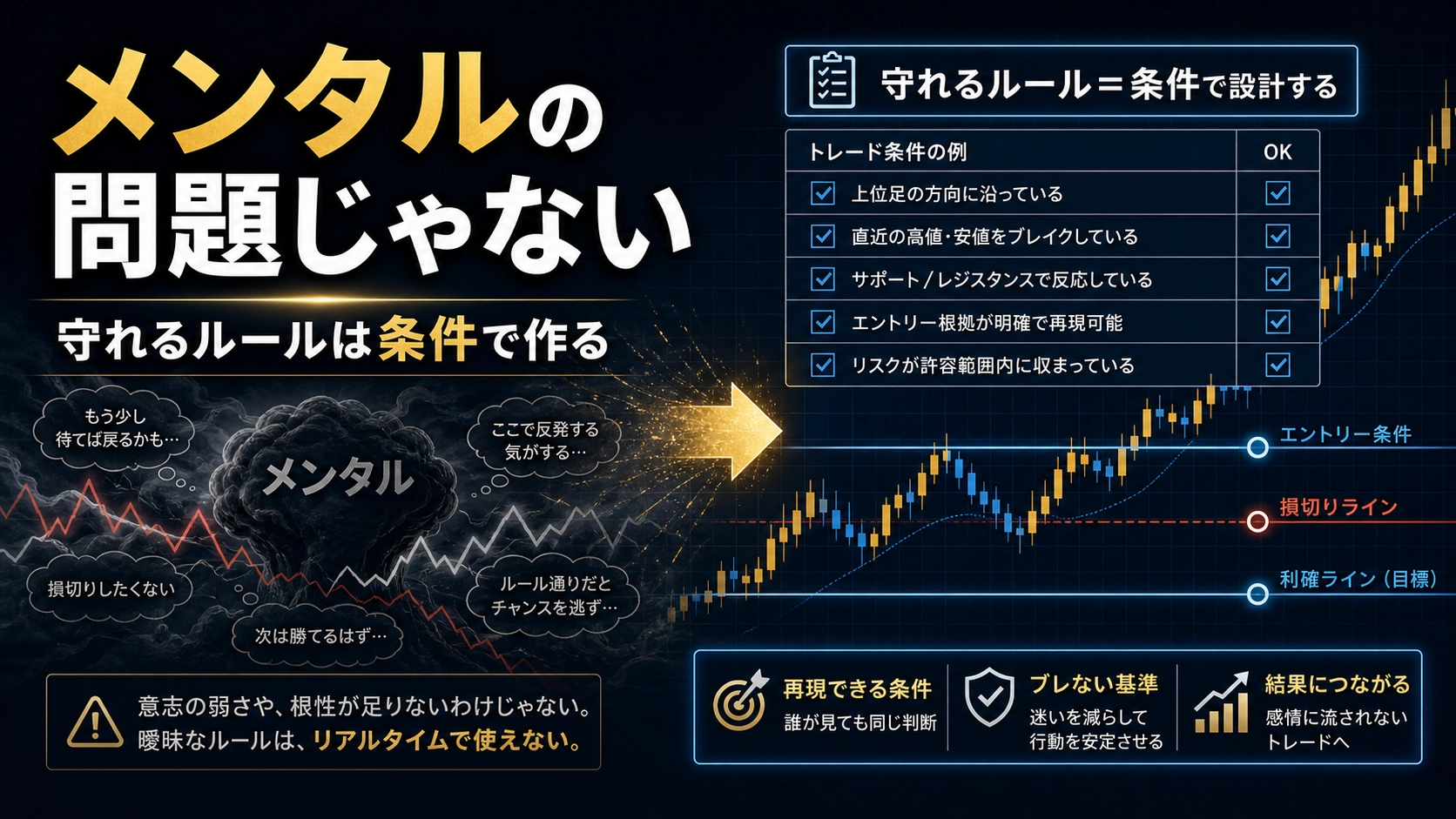

"It's not a mental issue that prevents you from following the rules" Explanation from an 18-year trader
? You’re not mentally weak for not following the rules|Explained by an 18-year Trader
“Today I will follow the rules for sure,” but before I know it I’ve postponed the stop loss.
Haven’t you had that kind of experience?
? “I’m weak-willed”
? “I need a tougher mindset”
—and blame yourself, repeating the same thing again.
But, honestly, I’ll say this.
The reason rules break down isn’t because of willpower or mental issues.
Rules don’t collapse because you’re a “person who can’t keep them,”but because you’re using rules that are designed to collapse.
In this article, I’ll explain why rule collapse happens, by examining the mechanism from thestructure.
After reading, you’ll clearly understand why you couldn’t keep them, and your actions from tomorrow should change^^
? 1. The Reality of Traders Who Repeat “It Collapsed Again”
You resolve to keep a strict rule before you open the chart in the morning.
“Today I will absolutely follow the rules. I will surely cut losses. I won’t be greedy.”
And then the market starts.
At first you can observe calmly for a while.
But the moment you enter and hold a position,your head starts to buzz.
? When you have a floating loss you think, “If I wait a little longer it’ll come back.”
? When you have floating gains you worry, “I want to extend this, but what if it disappears.”
And you can’t close the chart.
Before you know it you’ve stared at the screen for over an hour, the initial stop-loss line is far behind, and you drag it out with “just a little more.”
As a result,you finally close with three times the planned loss.
Self-loathing after, “Why couldn’t I keep it?”
The next day you resolve again, “Today I’ll do it.”
Doesn’t this sound familiar? (;'∀')
Eighteen years ago, I did exactly the same thing.
I wrote rules in a notebook every day, broke them every day, reflected every night, and wrote again the next morning.
From that repeating pattern I realized that“the problem isn’t in the moment you try to follow the rules”.
Most traders try to blame the moment of collapse rather than the underlying cause.
They reflect on, “Why couldn’t I cut there?” or “Why did I get greedy?” by isolating the moment, and reflect on those actions.
But even if you reflect on that, the same thing happens again.
? The reason is that the problem isn’t the moment.
The problem is from earlier stages,the stages of “making the rules” and “how to view the market”.
Because the rules are designed in a way that makes collapse easy, they’re hard to follow.
Because what you watch in the market is vague, there is space for emotions to creep in.
? If you’re still reflecting at the place where you think “it collapsed again,” and yet that reflection never points to the root cause, you’ll repeat the same thing
? 2. There is always a structural reason for rule collapse
When you feel you “can’t follow the rules,” many people search for the cause in“their own weakness”.
They think, “I must strengthen my will,” “I must control my emotions,” and try to change themselves.
But, please consider this a moment.
? When the traffic light turns red, you stop, right?
Why can you stop? because the standard is clear:“If it’s red, you stop”.
Red or green is something anyone can judge the same way. There is no room for interpretation.
? The reason trades may collapse is because this“room for interpretation”remains abundantly.
Suppose there is a rule like “Enter near a strong support.”
? What does “strong” mean?
? What range counts as “near”?
If you go into the market with this ambiguity, you can conveniently interpret it as, “This is a strong support” or “It’s near, so I’ll enter.”
In other words,the rule is designed with gaps that can be distorted by emotions.
Another structural problem is
? The question is“where in the market do you decide to trade?”.
There are places you should not trade and places you can trade.
Around a ‘wall’ (price levels where the market has repeatedly reacted), the market’s movement tends to change.
The state of the waves (up and down) changes when to enter or wait based on the current state.
Without understanding this “place and state,” you’ll be in a state of “you can enter anywhere.”If you can enter anywhere, it’s equivalent to saying
“you can justify entering at any point”.
People who have trouble with rules watch charts in this “anywhere” state.
? If you haven’t decided where in the market to trade, emotions start crafting reasons to trade after the fact.
The desire to enter somewhere already exists, and the head looks for reasons to enter elsewhere too.
? Rule collapse isn’t an issue of will. It’s an issue of design
? 3. Winning traders see something different
When you compare winning and losing traders, the tools and indicators used are often not that different.
The difference is“what they base their moves on”.
Let me contrast briefly.
?【How losing traders move】
・Look at the chart, feel like it will go up, and enter
・Set a stop-loss line around “this level”
・When there’s a floating gain, greed arises and they want it to grow
・When there’s a floating loss, they hope it will return to normal without basis
・The result changes with their emotions each time
?【How winning traders move】
・They have a standard: “Because this is a wall, I wait for the reaction at this wall before deciding.”
・The stop-loss line is determined by the relationship to the wall in advance
・Even if there’s a floating gain, there’s a predefined exit “to the next wall.”
・If there’s a floating loss, they can judge that if they break through the wall, it’s not as expected
・Results depend on the accuracy of the rules
? The biggest difference is“whether they’re predicting or not”.
Losing traders enter hoping the market will go up or down (predicting).
When their prediction is wrong, emotions shake, and when emotions shake, rules collapse.
Winning tradersconfirm what happened here before acting.
Not predicting, but confirming.
That is the fundamental difference.
? The reason “it seems like it’ll go up” is simply the habit of relying on a prediction..
Because there’s no basis, it becomes “just a feeling.”
Because there’s no basis, the stop-loss line is also “just a feeling.”
Because there’s no basis, when there’s a floating loss you think “it might come back.”
? “As long as there’s a feeling it might be so,” rules will always be overwritten by emotions
What I’ve spent 18 years organizing is to reduce this “feeling” as close to zero as possible.
It won’t be absolutely zero—not in markets where nothing is certain.
But by clarifying the criteria for “this is where I can trade” and “this is where I should wait,” you can minimize the space for emotions to intrude.
Winning traders have this“smaller gaps”.
? 4. How to fill the gaps where emotions intrude
So, specifically, how to change this?
I’ll start with conceptual levels.
? There are three core elements.
“Know the walls,” “see the state of the waves,” and “flip between timeframes”
? First“Walls”.
Walls are price ranges where the market has repeatedly reacted.
Where it paused when coming down from above, where it rebounded when coming up from below.
Anyone who looks at a chart can notice that “this area seems to stop things often.”
This is the key point:“finding the wall”and “being able to use it” are two different things.
If you realize the wall might react here, that alone isn’t enough as a reason to enter.
If you don’t know how price behaves at the wall, you’ll rush in thinking it reacted, only to break through the wall and incur a big loss repeatedly.
? Next“State of the waves”.
Markets always move up and down. These up-and-down movements are called waves.
If you don’t grasp the current state of the wave, you can’t judge whether now is the time to enter, even with a wall present.
Even when the wall comes into view, depending on the wave’s state,.
Ignoring that and entering can cause losses even when you had a reason.
⚖️ Then,“Timeframe flipping”.
Check the current situation on a lower timeframe, then verify the wall position and wave state on a higher timeframe.
Return to the lower timeframe and decide again if now is the right place to trade.
In this back-and-forth,the higher timeframe is used only to confirm the wall’s position and state.
Trying to decide on entries using the higher timeframe alone makes it hard to organize information.
⚖️ “Changing the order of viewing and the role of each timeframe” alone can drastically change how charts look
What you were looking at as a vague sense becomes a concrete confirmation task.
This change builds a structural shield against rule collapse^^
✅ 5. Four daily habits to start tomorrow to prevent rule collapse
Even with the concept understood, if you don’t see what to do, you won’t act.
Here are four concrete habits you can start tomorrow.
?Aim to design rules that you can follow, not just set a goal to follow rules.
This is the premise.
Now, in order.
✅【Habit 1】Always check the wall relative to your entry before entering
Make it a habit to verbalize, “Where is the nearest wall on this chart?”out loud to confirm.
The reason to verbalize is that thinking only in your head tends to mix in emotions.
Saying aloud, “The wall is here. The current price is this far away,” helps organize your judgment.
✅【Habit 2】Decide the stop-loss line before you enter
If you wait to consider the stop-loss after you’ve already taken a position, you’ll start thinking, “Let me wait a bit longer.”
Decide beforehand the point at which you will exit if price moves beyond this level.
Create a rule that you will not enter unless you’ve set this beforehand.
Don’t decide the stop-loss line on a whim.Set it based on the wall relationship.
That place where you’ll know your assumption is invalid becomes that level.
✅【Habit 3】Flip between lower and higher timeframes before deciding
Don’t enter the moment you feel like it.
First, check the current situation on the lower timeframe, then verify the wall and wave state on the higher timeframe.
Then return to the lower timeframe and reassess whether now is the place to trade.
Make this back-and-forth a routine..In the beginning it may feel tedious, but this extra step is the best barrier against rule collapse.
✅【Habit 4】Write down the reason for your entry
Not during the trade, but immediately before enteringnote it down.
When reviewing results later, this note helps verify whether the decision itself was correct.
Rather than celebrating or despairing over outcomes alone, reflecting on the decision process leads to long-term stability.
✍️ You don’t need to do all four at once. Start with Habits 1 and 2
? Summary
The cause of rule collapse isn’tweak will or mental issues.
? The decision of “where in the market to trade” hasn’t been determined.
? Your relationship to the wall hasn’t been clarified.
? The space for emotions to intrude has been designed into the system.
That’s the structural cause.
? Winning traders operate with“confirmation” rather than prediction.
Check the wall position, grasp the state of the waves, flip between timeframes, and trade only where there is a solid basis.
As these habits accumulate, rules becomesomething that is naturally followed, not something to be forced.
? Creating rules you can actually follow is the only path to continuing in trading
Please try at least one thing you can start today^^
? The details of the methods described in this article, namely“how to use the wall,” “how to judge the wave,” “timeframe flipping”, are explained in detail in my two-year compiled course“The Answer to Markets”.
Not only the concepts but also practical decision-making guidance are included, so if you feel you understand but can’t apply, this will be especially helpful.
? More details here
https://www.gogojungle.co.jp/tools/ebooks/77829
? I also created a free AI tool for trade analysis. If you’d like to try it
https://trade-ai-free.streamlit.app/
【A classic technique for massive profits】
▼ GOLD-specific Prescription Manual
https://www.gogojungle.co.jp/tools/ebooks/50406
? Free gift|Part of the manual is 공개
https://www.gogojungle.co.jp/info/22533