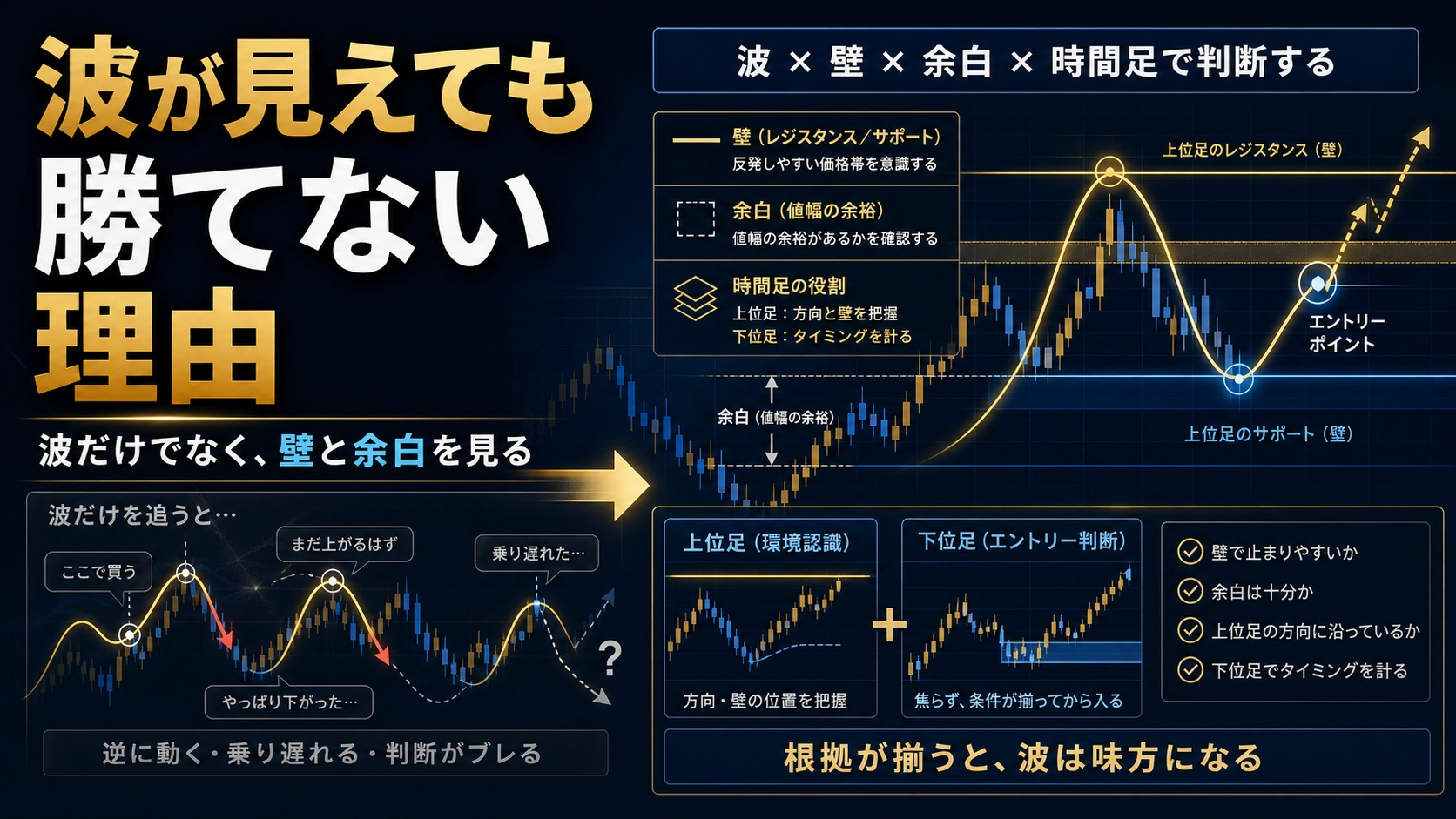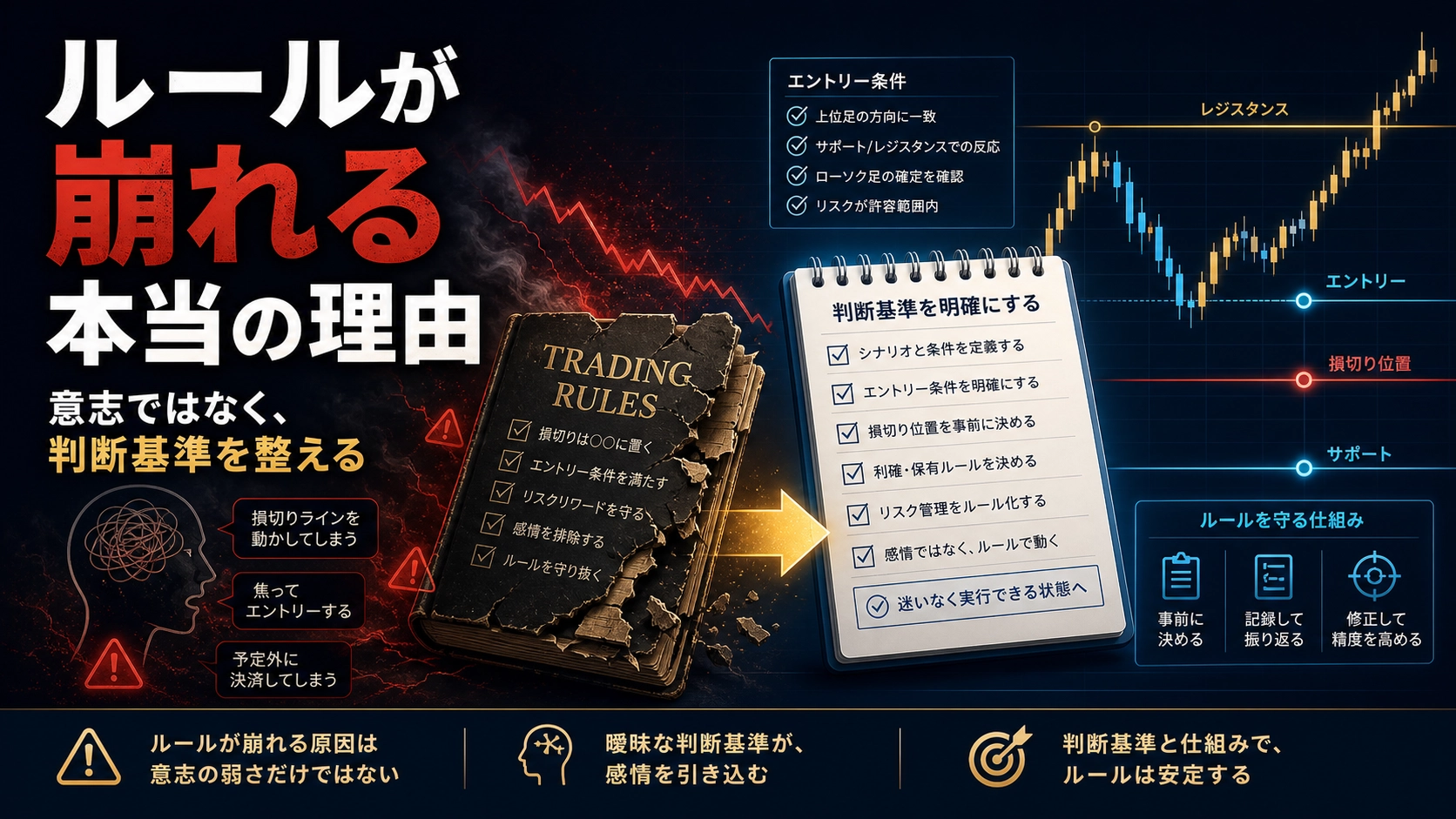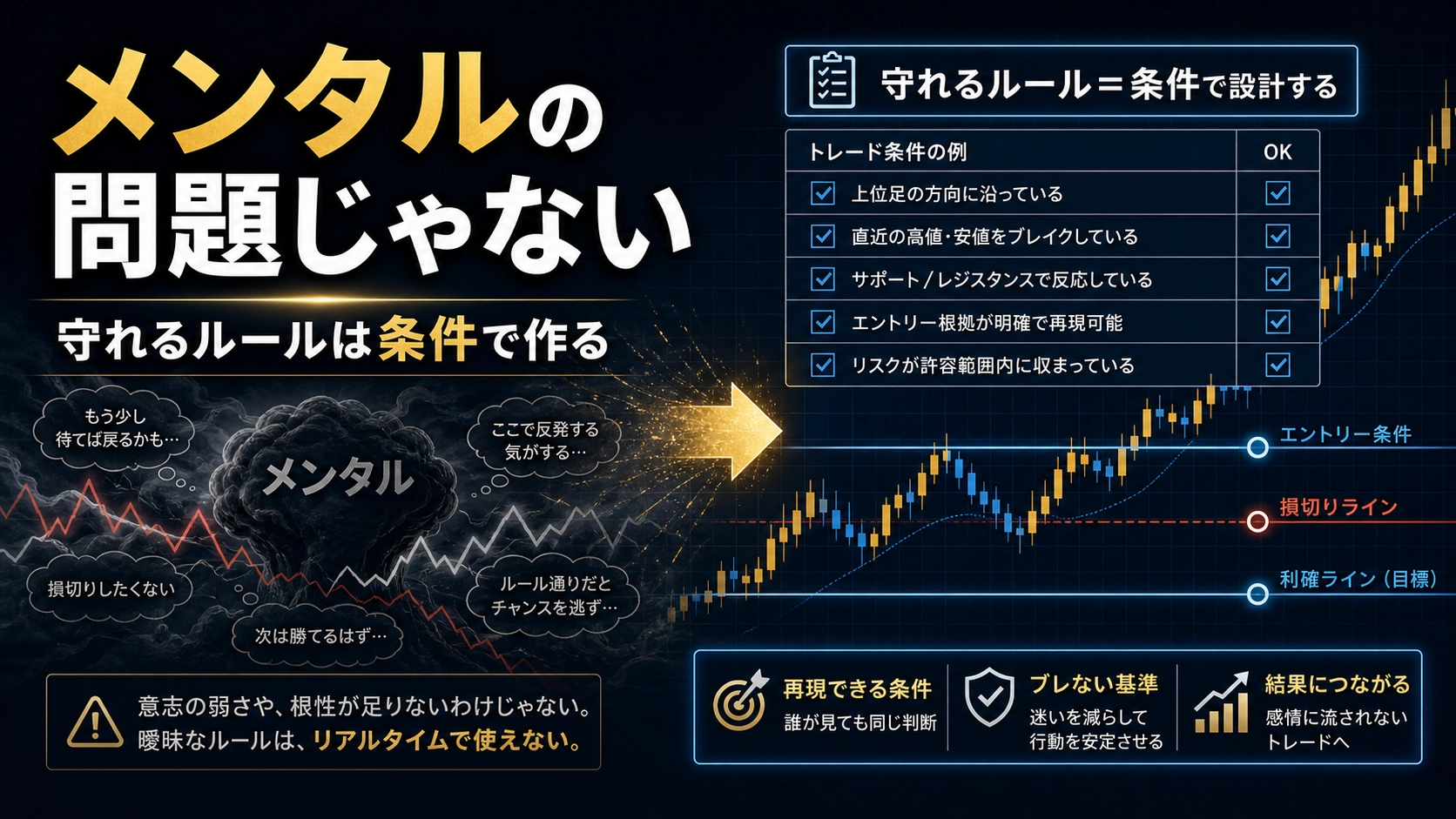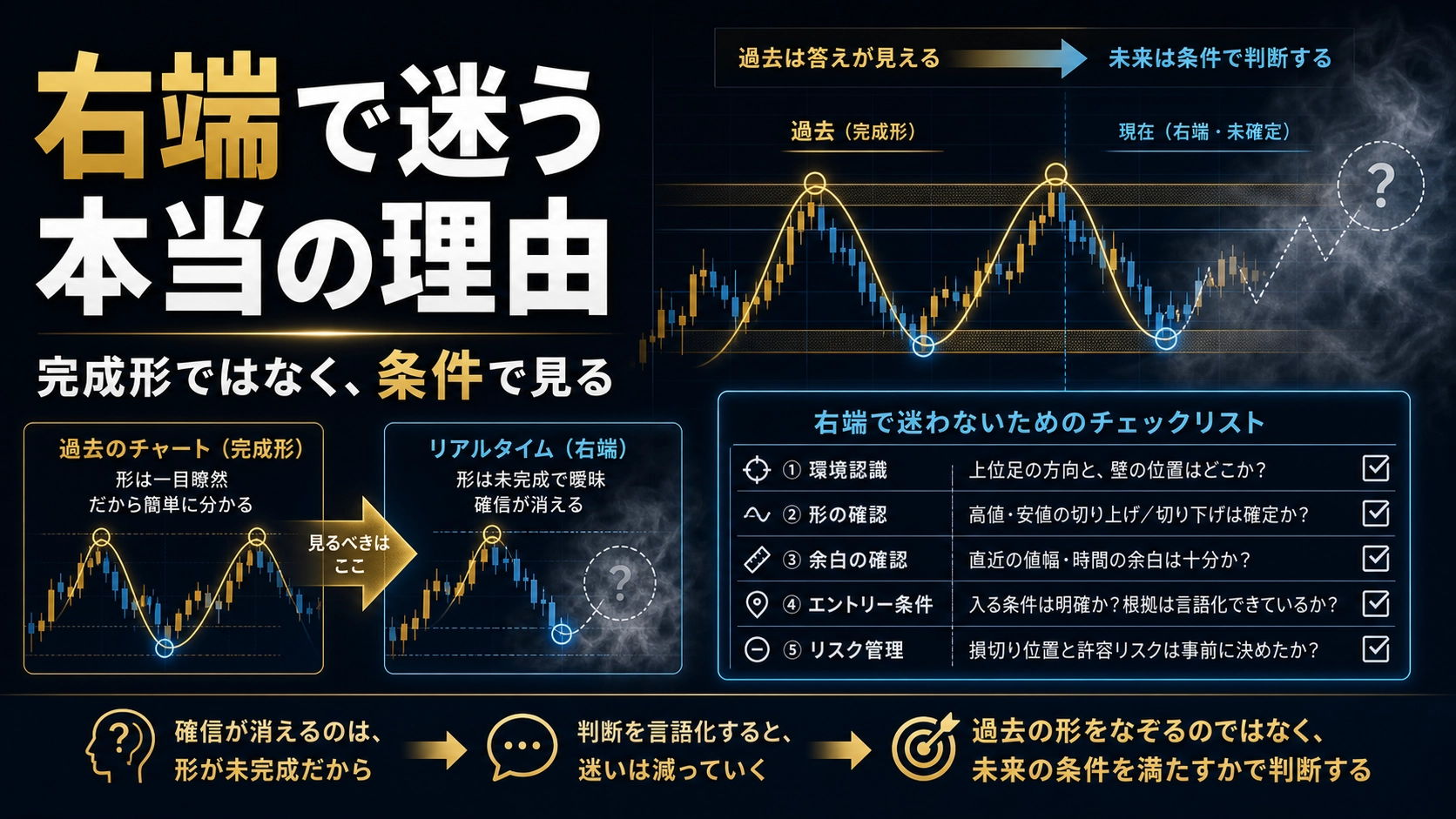

The Real Reason You Hesitate at the Right Edge, Even When You Feel a “Form Has Emerged”
At the right edge, being indecisive isn’t because you lack knowledge or have little experience. Today, I’ll整理 the real cause behind it.
Good evening!
I’m Masashi.
From 18 years of experience, I’ve found that the more people struggle with cutting losses, the more they try to fix “the act of cutting losses itself.”
↓ A special feature on GOLD’s antidote medicines^^
Please join now while you still can.
? The true reason you hesitate at the right edge, even when you feel a pattern forming
Looking back at past charts, you realize, “Ah, this was the pattern.”
But when you actually look at the real-time right-edge chart, that conviction vanishes in an instant.
❌ “Is this really a pattern?”
❌ “Should I wait a bit longer?”
and, while you mull it over, you end up unable to move.
This isn’t about lacking knowledge or shallow experience.
I’ve wrestled with this hesitation for a long time too.
I tried changing indicators, increasing timeframes, and various methods, but the fundamental hesitation didn’t go away.
This time, I’ll talk about“Why you hesitate at the right edge,” and “what you truly must do to dispel that hesitation.”.
It’s not a flashy solution.
However, if you proceed without整理ing this, you’ll keep stumbling in the same place for years^^
1. The curious thing you can understand from past charts but hesitate at the right edge
I think this is something many people experience, butthe way your brain works when looking at past charts versus real-time right-edge is totally different.
? Past charts are viewed in a state where the results are already visible.
You’ve already identified where reversals happened, where the walls were, and you confirm, “Ah, that’s what the pattern looked like.”
This isa verification task, not a judgment task.
? On the other hand, the real-time chart reveals nothing about what will happen next.
You might sense, “this could be a pattern,” but because you don’t have words to back that sense up, you can’t be sure.
As a result, you end up in a loop of “wait a little longer” or “should I enter now,”a cycle of indecision.
? The ability to intuitively understand on past charts and to confidently judge at the right edge are entirely different skills
I’ve spent 18 years noticing this difference, and it took me a long time to realize it(;'∀')
There’s a gap that can’t be filled by just sense or experience alone, and what fills it isverbalization, you know.
2. Verbalizing your sense alone can change your judgments
When people hear “verbalization,” it might sound daunting.
Some may wonder, “How do I put my sense into words?”
But what you actually do is simple:“Compare the moment you entered with the moment you passed on, and write in one sentence what was different.”.
For example, imagine this:
✍️ “I entered because a pullback came and the lower timeframe showed momentum waning.”
✍️ “There was a pullback-like move, but on the higher timeframe the wall wasn’t in reach yet, so I passed.”
✍️ “It looked pattern-like, but the recent momentum was still strong, so I waited.”
There’s no need to use difficult technical terms, and you don’t need perfectly theoretical sentences.
Finish with one concrete sentence instead of stopping at a vague feeling.
This small step will gradually change your real-time judgment at the right edge.
✍️ Practicing to boil your sense into one sentence is the only way to dispel real-time hesitation
The moment I started to focus on this, I found a trading notebook filled with entries like“I entered simply because it looked good”, which shocked me(;'∀')
I realized this meant no real improvement was possible unless I changed something.
3. What happens if you can’t verbalize
When people talk about verbalization, I often get asked“Is that basically just creating rules?”.
It’s a bit different from rules.
Rules tend to be mechanical, like “Enter when condition A and B are met,” but verbalization is a bit earlier, more fundamental:“clearly stating what I’m seeing and what I’m judging right now”.
If you proceed without verbalization, what happens?
❌ A common issue is“I enter for different reasons each time”.
Today I might enter thinking the pattern formed, tomorrow I might enter thinking the flow is coming, and the day after that I might enter by intuition that “this will absolutely reverse”…
Even when reviewing, if it isn’t verbalized, there’s nothing to improve.
And you end up“looking for a new method again”.
I used to be trapped in this never-ending loop.
Every time I changed methods, I’d think, “This time for sure,” but since the core linguistic issue wasn’t solved, I’d still hesitate.
Even if you have more methods, without a judging axis you won’t know how to use them, which leaves you puzzled again(;'∀')
? It’s not a method problem, but the lack of a habit to verbalize your judgments
That realization became my turning point, allowing me to move forward, albeit indirectly.
4. Concrete ways to stop hesitating at the right edge through better reviews
So, how do you cultivate the habit of verbalization?
? The simplest method is to after a trade, write one line about “why I entered” and “why I passed.” .
This is not analysis or reflection, butrecording the reasons.
That’s all you need.
At first, you might not be able to put it into words well.
Sometimes you’ll just record, “It felt like a pattern.”
That’s fine. If you keep writing, you’ll gradually uncover the content of that vague feeling.
✅ “I watched the moment I came out of the moving average and then came back in.”
✅ “I confirmed that the higher timeframe was close to a wall.”
✅ “I observed momentum waning on the lower timeframe.”
When you can articulate these kinds of phrases, when a similar situation arises, you’ll be able to compare it with,“Oh, this is the same situation as then”.
That sense of comparison is what leads to confidence at the right edge.
? Verbalization is not a judgment record, but a process to uncover your own criteria
When validating against past charts, write one sentence about “why this moment is considered a pattern.”
In doing so, past validation shifts from mere “result verification” to“verbalization of judgment criteria”.
It may sound dull, but as this accumulates, hesitation at the right edge gradually reduces.
After 18 years, I can say that with certainty^^
5. Should you trust your sense or your verbalization?
We’ve talked a lot about verbalization, but“So should I stop trusting my sense?”is a question some have.
? With long experience, sometimes a sense comes before you can verbalize it—like, “this is going to work,” or “this isn’t ready yet.”
I believe that sense itself is very important.
However,that sense is refined through verbalization
As you accumulate words describing experiences, the precision of your sense improves.
If you try to refine sense without verbalization, that sense can morph into“desire” and “bias”.
The feeling of wanting something to go up can masquerade as a sense that “the pattern that makes it go up has formed.”
I’ve experienced this many times too(;'∀')
⚖️ Verbalization is necessary to trust your sense
By verbalizing, you can test your senses.
When you understand what you were actually looking at, your sense and verbalization gradually align.
Once you reach that state, hesitation at the right edge almost disappears.
Decisions like “enter here” or “wait here” come out smoothly without hesitation.
The path to that point is steady, butthere really isn’t a shortcut, in my view^^
6. What becomes visible when you can verbalize
As you establish a verbalization habit, you’ll see not only “what you’re looking at” but also“what you were missing.”.
? For example, when things aren’t going well, reviewing your records can reveal“at some point, your judgment criteria started to drift.”.
? When markets become highly volatile, you often make different judgments than usual
Having verbalized records makes these“your own quirks”
Conversely, if the records aren’t verbalized, you’re left with only a vague sense that “things aren’t going well,”
and even if you try to improve, you won’t know where to change, leading you to switch methods again.
Verbalization can be used not only to analyze successes but also to identify the causes of failures.
Write a single line answering questions like, “Why did I enter and why did it stop?,” and so on, in your own words.
? This accumulation will eventually become ‘your own trading manual’
By continually verbalizing your judgments,you’ll shift from chasing answers on charts to aligning yourself with the market.
If you have a solid judging axis inside you, the chart becomes not a place to seek answers but a place to confirm.You confirm things
Summary
To summarize, the real reason you hesitate at the right edge isn’t lack of knowledge or experience, but the absence of a habit to verbalize your sense..? If what you think you understand from past charts doesn’t translate into real-time conviction, it’s because you skip the process of verbalization.
Try this on yourself:
✔ “Are you 最近 writing down why you entered?”
✔ “Are you summarizing in one sentence why you passed?”
If you aren’t doing this,start by writing one line today.
At first, it can be “vague,” but keep writing and you’ll gradually see the content of that vagueness.
? Verbalization isn’t flashy, but it’s the only way to dispel right-edge hesitation
? If you want to organize both verbalization habits and your judging axis together,look at “The Market’s Answer.”.
It isn’t about flashy techniques, but about how to create your own judgment axis.This is a course designed around that concept^^
? More details here
https://www.gogojungle.co.jp/tools/ebooks/77829
? We also created a free AI tool that analyzes trades. Feel free to try it
https://trade-ai-free.streamlit.app/
【A Classic Technique for Big Gains】
▼ GOLD’s antidote manual
https://www.gogojungle.co.jp/tools/ebooks/50406
? Free gift|Partial manual公開
https://www.gogojungle.co.jp/info/22533