

The fear behind【伸びているのにロット追加できない】the truth of that fear
Even though it’s growing, you can’t add more not because you lack courage. Today I’ll talk about the true nature of that fear.
Good evening!
This is Masashi.
In 18 years of trading, what I’ve noticed is that the biggest gap between those who win and those who don’t is the “judgment at the moment of extension.”
↓ A feature on GOLD has been organized as a special^^
Please join now while you can.
Even though it’s growing, you can’t add more. The true face of that fear
“If I add here, I could take even more.”
Even though I know that, my fingers won’t move.
❌ When a position is extending, trying to enter more strangely makes the body stop.
Analytically, I know this is a moment to add.
But for some reason I can’t enter.
This isn’t a technical issue.
I’ve faced this wall for years myself.
I could read charts, but when the pattern appeared, my body stiffened.
The feeling of “What if my existing profits disappear?” comes first, and overrides logical judgment.
This time,Why I can’t take on an additional position (pyramiding), the true nature of that fear and how to organize my thinking.
This isn’t a technical discussion,it’s about the trader’s psychology and the structure of thought, really^^
1. The fear of “profits disappearing” stops judgment
The reason you can’t add a position is,almost everyone experiences the same.
?“I’m scared that the unrealized profit I have will be eaten by the adverse move of the added position.”
That’s basically it.
Logically, the risk of an added position is determined by its own stop-loss width.
The profits of the already-held position should be considered separately from that.
But even when you understand it, emotions won’t allow it.
?The feeling of “I want to protect the profits I have now” blocks the action of making a new decision.
As the position grows, the thought “isn’t this enough yet?” or “don’t be greedy here” grows louder in my head.
Before calculating risk accurately,emotions take the brakes first.
But think about it.
If before adding a position you shift the stop of the existing position to break-even,a condition of “not losing” is already secured.
Then you can enter a new position with a new stop loss width.
This isn’t fundamentally different from doing two separate trades.
So why does fear arise?
The answer is“I’m calculating the profits already held together with the risk of the added position.”.
? This confusion spoils correct judgment
2. Separating current profits from future risk
To become able to pyramid without fear, first organize the way you count things“How you categorize the numbers”.
? The earlier-entered position, when the stop is moved to break-even, is treated as“a finished trade”.
We don’t know yet how far profits will extend, but we are in a not-losing state.
? And then, the added position is“a new trade”, decided with a clean slate.
Unrealized profit from the preceding position should not be used as“a factor in deciding whether to add”.
As soon as you mix them, judgment begins to distort.
? What I realized after 18 years is thathumans have a strong tendency not to want to lose what they already have.
The urge to preserve what you’ve obtained is instinctive and not inherently bad.
But in trading, that instinct often interferes with correct action.
Not “If I add I might lose,” but“the risk of the added position is already contained within its stop-loss width”.
If you can shift to this way of thinking, fear of pyramiding fades considerably.
⚖️ Unrealized profits are excluded from judgment. Only ask if the added position’s stop-loss width makes the risk worthwhile
✍️ A helpful practice is to write the preceding position and the added position on“separate notes”.
Just the entry price and the stop loss position.
Don’t write unrealized profits.
Only look at the added position’s stop loss to determine if it’s a worthwhile risk.
Just this changes the quality of judgment^^
3. Waiting for a pattern and the fear of missing the chance are two different issues
Another related worry is“I can’t jump in the moment a pattern appears”.
This also stems from the same fear.
The feeling of “What if I’m wrong?” or “What if I hit the stop again?” freezes the body.
I used to feel this many times and regret it (;'∀')
When I began to be able to wait, I still found I couldn’t move the moment a pattern appeared.
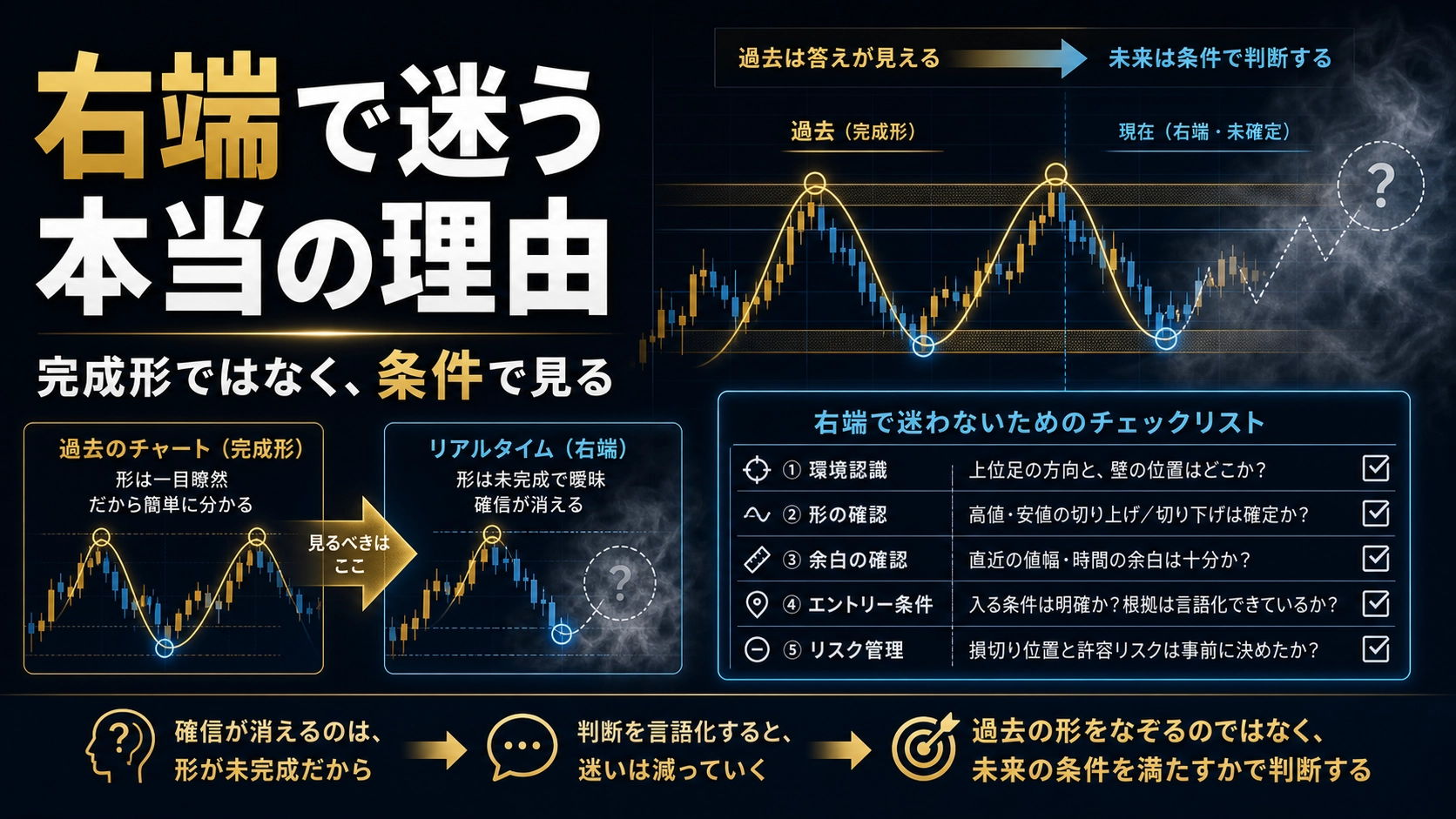
Doubting “Is this really a pattern?”, I would check and end up moving.
? The key here is not to be dragged by the result of not entering..
If you regret not entering, the next time you’ll feel rushed to enter even without confirmation.
That rush leads to entering in uncertain situations in the next trade.
? Regretting one missed entry fuels rushing the next
Being able to wait for a pattern and being able to enter without hesitation when it appears are two separate steps.There needs to be practice for both.Even if you can do the former, the latter requires more practice and you need to build familiarity for each.
Be patient, take steps gradually.
Rushing only wastes time.
After 18 years, I’ve ingrained this honestly^^
4. The gap between “knowing” and “being able to do”
The pyramiding approach, when explained, makes most people say“I see.”.
✅ Move the preceding position to break-even
✅ Enter the added position with new risk
✅ Think of them as separate
It’s simple.
But when you sit in front of the chart, whether you can actually do it isan entirely different matter.
? There is a deep gap between “knowing” and “being able to do”
To bridge this gap,repetitions and reflectionsare everything.
There is no magic shortcut; you must see the scenarios repeatedly and compare your decisions with the results.
? It took me three years to verify this.
I repeated until I vomited, trimming away what was hindering me.
As a result, I realized that the two major causes were“too much information” and “unstable judgment criteria.”.
?More information does not make judgments easier.
When you narrow to what’s necessary, you begin to approach “being able.”
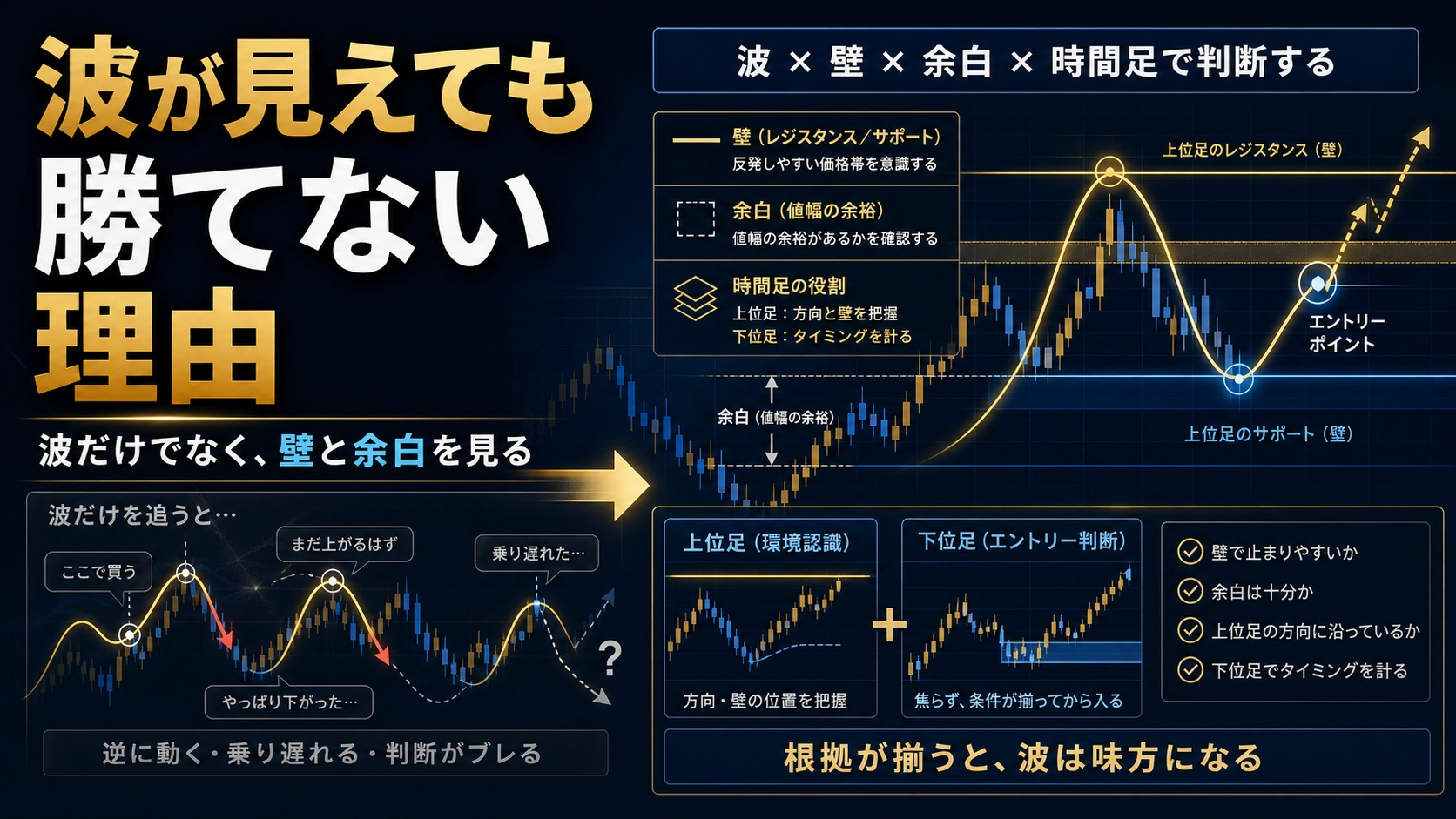
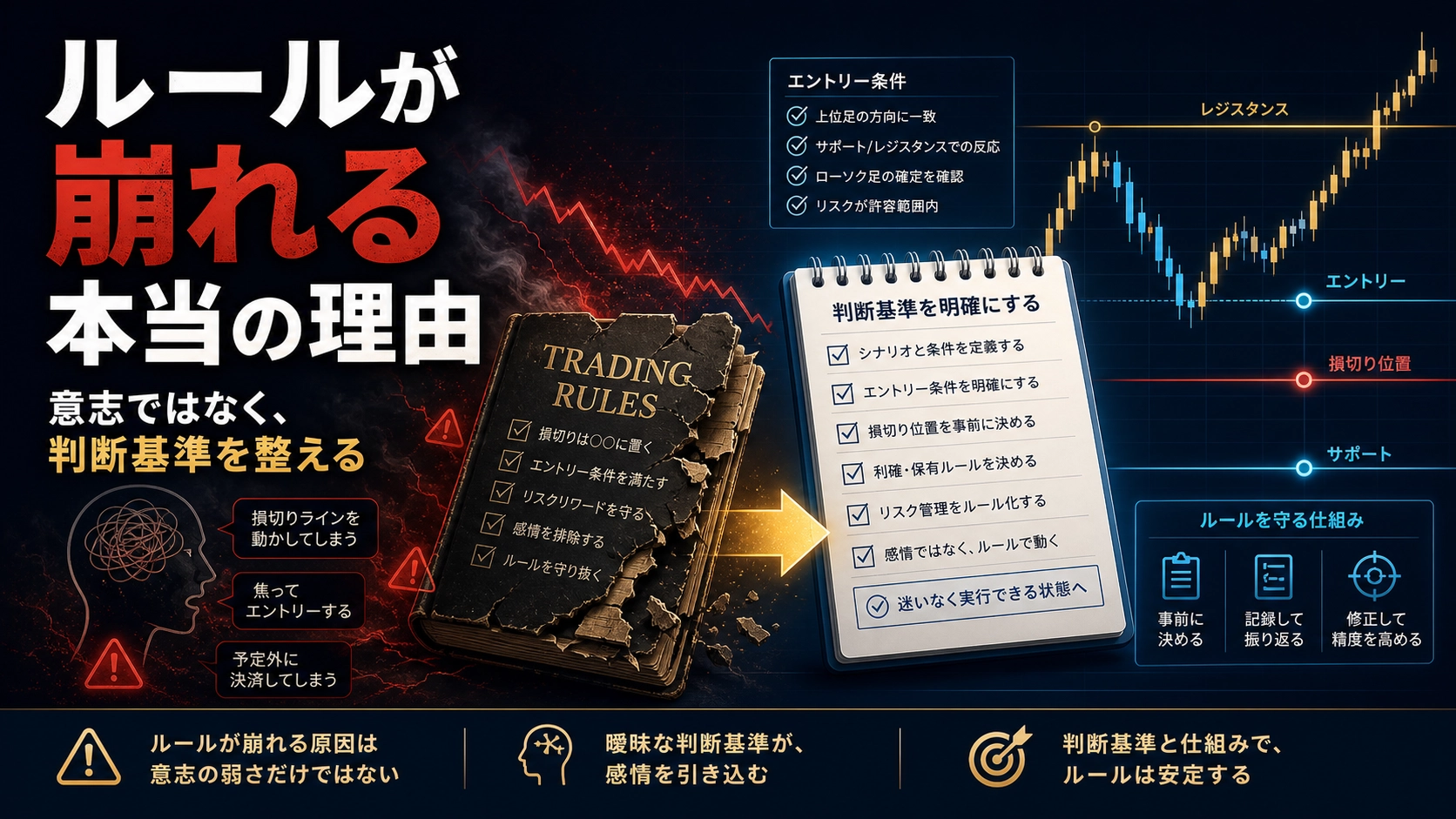
The pyramiding discussion aside, many concerns of “unable to add,” “unable to enter,” and “unable to wait” stem from either lacking a judgment axis or having a criterion you can trust.
? You don’t see where the wall is.
? You have no standard for which pattern to enter.
5. Not erasing fear, but learning to handle fear
People often say they want to eliminate fear, butI think that goal is somewhat off.
? Fear arises where there is risk.
Where there is risk, fear will naturally appear.
That in itself is a normal reaction and not something to erase.
? The important thing is“even with fear, don’t let judgment drop”.
Feeling fear when you can’t add or when a pattern appears isn’t because fear itself is the problem..
The problem is being pulled by fear and not being able to carry out the planned action.
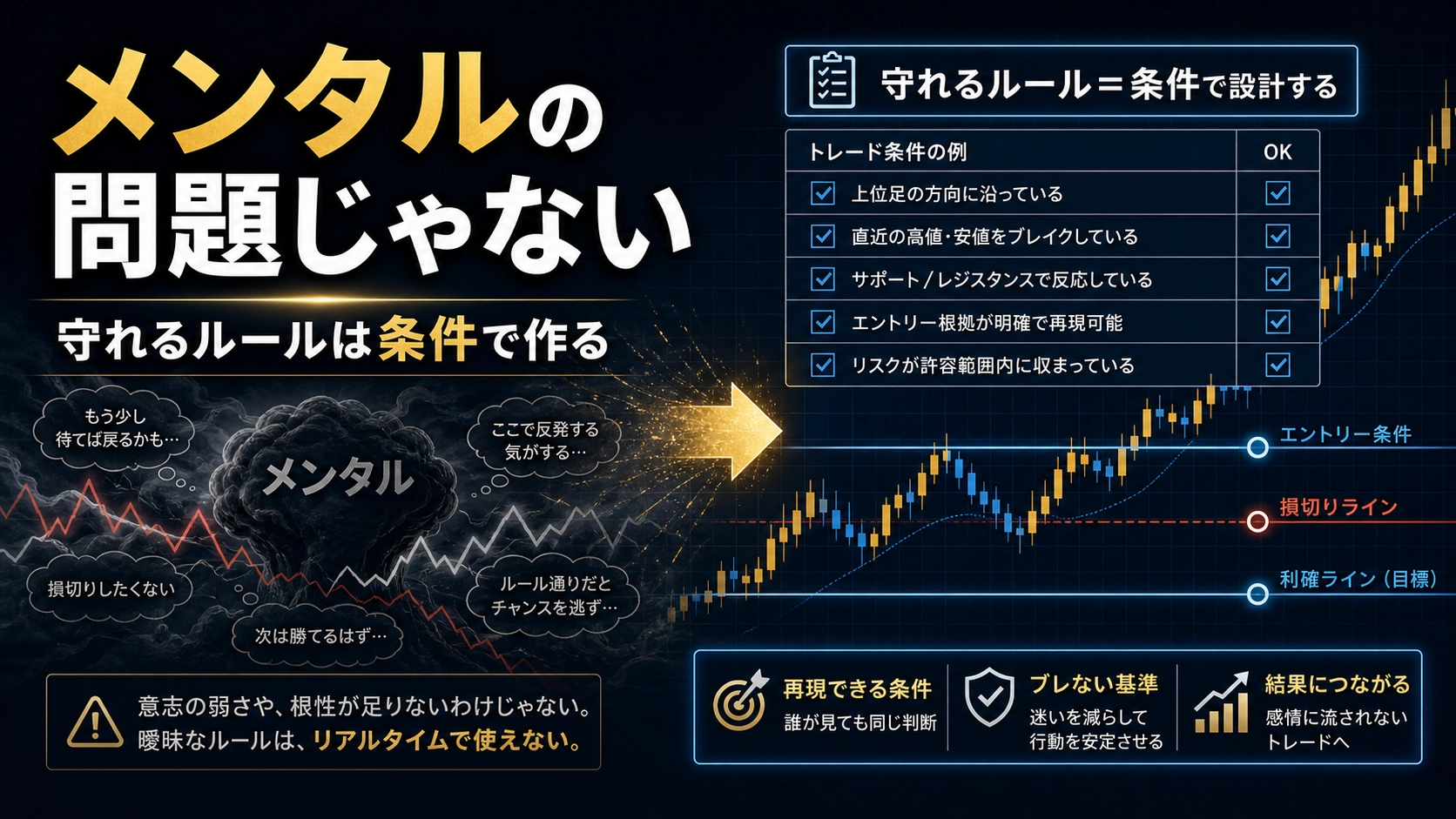
Conversely, if you already have a clear rule for “what to do when this pattern appears,”you can follow that action even if fear arises.
? If the judgment axis is vague, fear slips in. If the axis is clear, you can just do what you decided
Rather than trying to eliminate fear,build a system that allows you to act with fear.
After 18 years, there are still moments when I feel fear.
Even so, I can act because I have the standard of “This is what I do in this situation.”
How to build that standard
is, in my view, the real theme for a trader’s growth^^
Summary
This time I wrote about why you can’t add an extra position (pyramiding) and how to organize the psychology and thinking behind it.
? Separate the unrealized profits of the preceding position from the risk of the added position..
Even though you understand this logically as the correct answer, emotions interfere in front of actual charts.
That is the real form of “cannot do it.”
✍️ If you apply it to yourself
“Why couldn’t I enter? Why was the adverse move scary?”, articulating each question becomes the first step to closing the gap.
Instead of reviewing outcomes,reflect on the emotions before making a judgment.
Often that is where the answers lie.
? Be patient, but don’t stop. Keep steadily going
?“How to build a judgment axis”, and “how to use the wall”“the market’s answer.”
It may not be flashy, butyou’ll be able to sense your own growing ability to judge^^
If you’re curious, take a look.
? For details
https://www.gogojungle.co.jp/tools/ebooks/77829
? I also created a free AI tool for trade analysis. Please try it
https://trade-ai-free.streamlit.app/
【Classic techniques for explosive profits】
▼ GOLD Miracle Drug Manual
https://www.gogojungle.co.jp/tools/ebooks/50406
? Free gifts|Partial manual released
https://www.gogojungle.co.jp/info/22533


Is it OK?