

[The Real Reason It Collapses as Soon as the Lot is Raised] 18 Years of True Records
It wasn’t the method itself that collapsed when I raised the lot size, even though I was winning with a small lot. Today I’ll talk about the real reason behind that.
Good evening!
This is Masashi.
From trading for 18 years, I’ve noticed that the biggest difference between those who win and those who collapse occurs when you “increase the lot size.”
↓ A feature on GOLD with a special antidote was organized^^
Please join now while you can.
The Real Reason It Collapses the Moment You Increase the Lot Size|18 Years of Real Experience
“When I used to win with a small lot, the moment I increased the lot size I collapsed.”
Haven’t you experienced this too?
❌ Your win rate started to rise.
❌ You felt the sense of being on the right track.
❌ You thought “It’s about time to go all-in” and increased the lot, but suddenly you stopped winning.
At first you think it’s just bad timing.
But the same thing happens over and over.
The collapse after raising the lot isn’t a problem with the method. The “axis” is tested, and only then do the cracks appear.That’s what it is.
In this article, to explain the real reason you collapse when you raise the lot,we will dissect it through the structure of your mindset and habits.
It’s not about technique.
It’s about your“inner state”.
1. What changed the moment you raised the lot
Before and after increasing the lot, thechart movements did not change.
The market moves the same way.
The wall positions and the shape of the waves haven’t changed since yesterday.
? But your inner state has changed.
? “If this hits a stop-loss here, I’ll be cut more than usual.”
The moment this thought sinks in, your decision speed changes.
Normally you would follow the rules without hesitation, but you hesitate and wait a bit longer.
Or conversely, you may exit early to cut losses.
As a result,the method remains the same, but your actions change.
? When you raise the lot, the collapse happens because your own habits are amplified
I did this myself in the past (;'∀')
In the small lot you did well for three months and thought, “Now I can do it,” so you raised the lot.
In the first week you dumped everything.
You thought, “The method no longer fits,” and began looking for another method.
But the real cause wasn’t the method.
? When the lot increases,the parts you had been able to tolerate emotionally become intolerable.
For example, when you have a floating loss.
With a small lot you might think, “Oh well.”
But with a larger lot, the same floating loss makes your body react.
Your heart rate rises. Fear of what will happen if you push it further ahead comes first.
This sense of fear is something everyone has.
The problem is that the mechanism to control this feeling isn’t built inside you, and you just raise the lot anyway.
Haven’t you ended up like this too?
⚠ “It used to go well with a small lot, but for some reason once I increased the lot I started to doubt.”
⚠ “The stop-loss decision gets slower, or conversely faster.”
⚠ “I’m winning, but the sense of achievement comes after anxiety.”
All these come from the same root.
As the lot changes, the sense of “real-time tension” arises, and that reveals previously hidden habits all at once.
Before talking about charts, I want you to honestly examine this first.
2. The true structure of the “somehow I was winning” state
When you were winning with a small lot, was the method really working?
To be honest.
? Part of the reason you were winning with a small lot is that the environment kept losses small, so you could stay calm.
The environment was producing calmness.
Perhaps you weren’t calm because of you, but simply because the amount was small enough that emotions didn’t move.
This structure is
?Small lot → emotions don’t shake → you act according to the rules → you win → you wrongly think the method matches
this flow.
? “Winning” wasn’t because of the method, but because emotions didn’t shake
This doesn’t negate the method.
Whether the method is good or bad, if your emotions are shaking, it collapses.That is the essence.
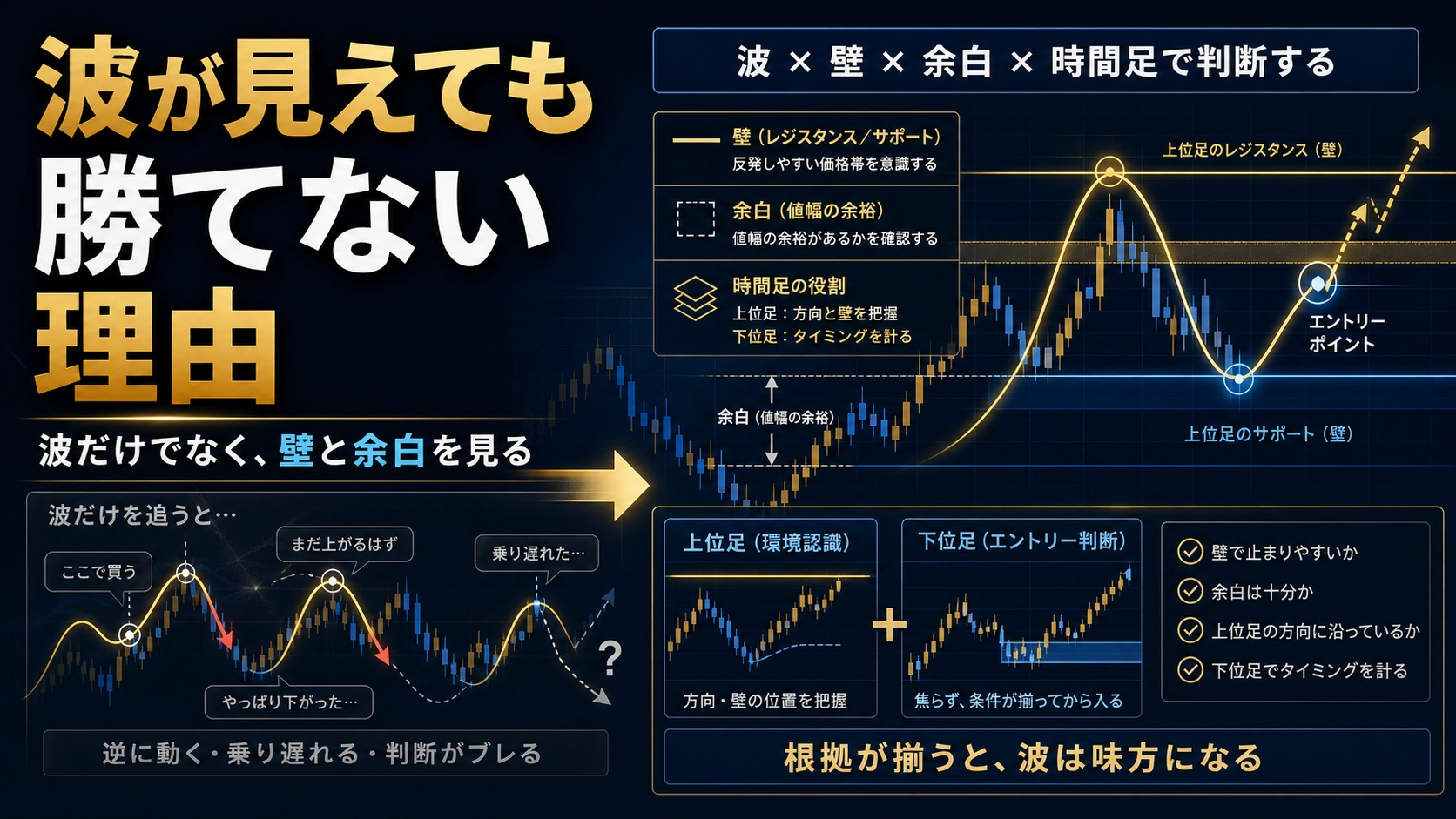
? I’ve always valued the concept of “the wall” in trading, and even if you notice it, the moment you raise the lot the phenomenon of hesitating at the wall occurs.
If you look at the chart, the wall is visible.
But the fear of “I’ll be cut more if I stop-loss here” comes first, so you wrap up before reaching the wall.
Or you realize it after you’ve crossed the wall and jump on late.
⚖️ Even if you have a habit of switching between lower and higher time frames to confirm, when your emotions shakewhat you see each time you switch changes.
You’re looking at the same chart, but when you’re afraid you see bad news, and when you’re greedy you see good news.
You fall into a loop of “let me check again” or “one more time” or “I’ll pass after all.”
As soon as this checking loop increases, the quality of your judgments has already declined.
? The reason the checking loop grows is because you’re anxious.
The anxiety comes fromyour axis not keeping up with the lot size.
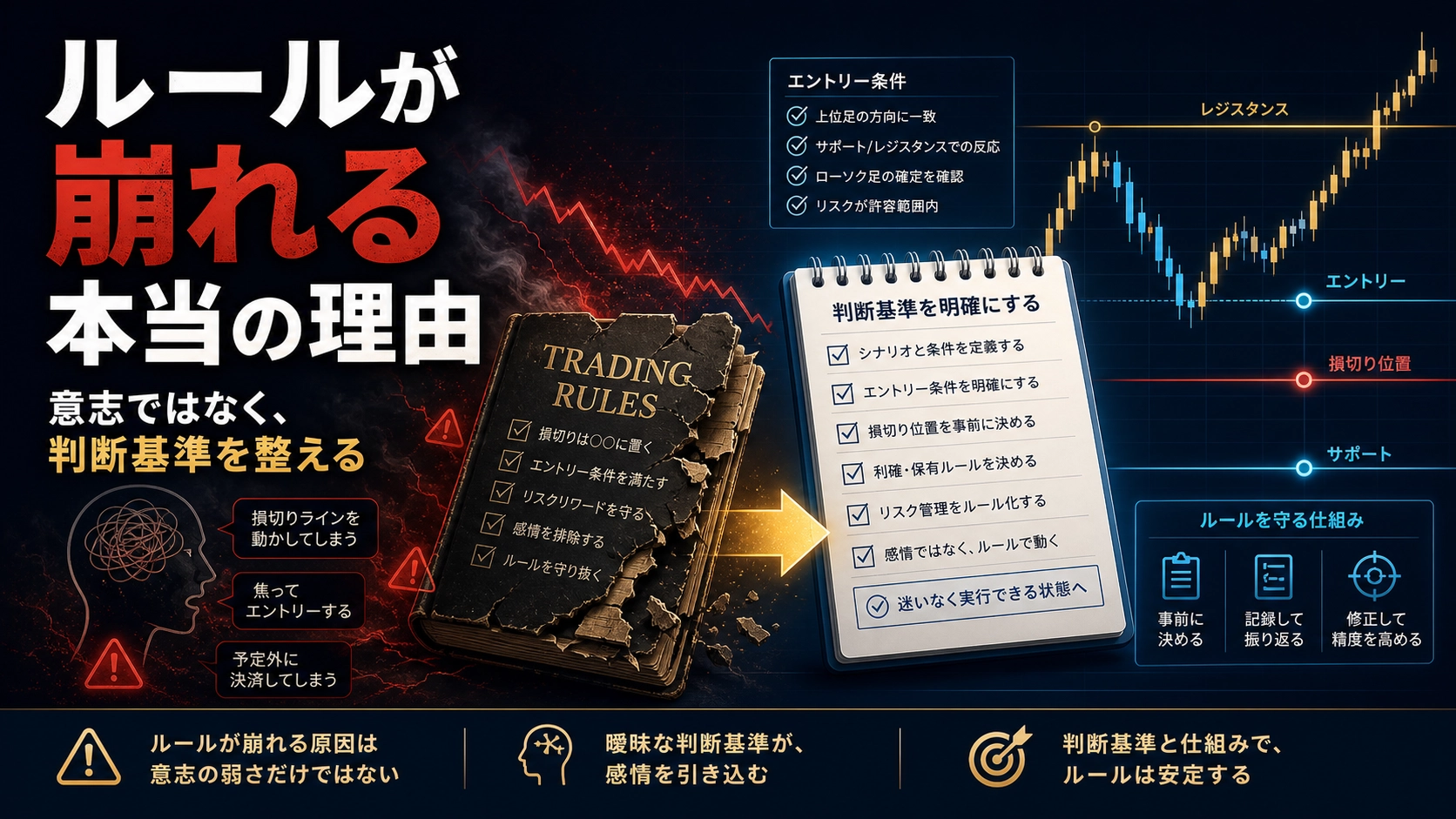
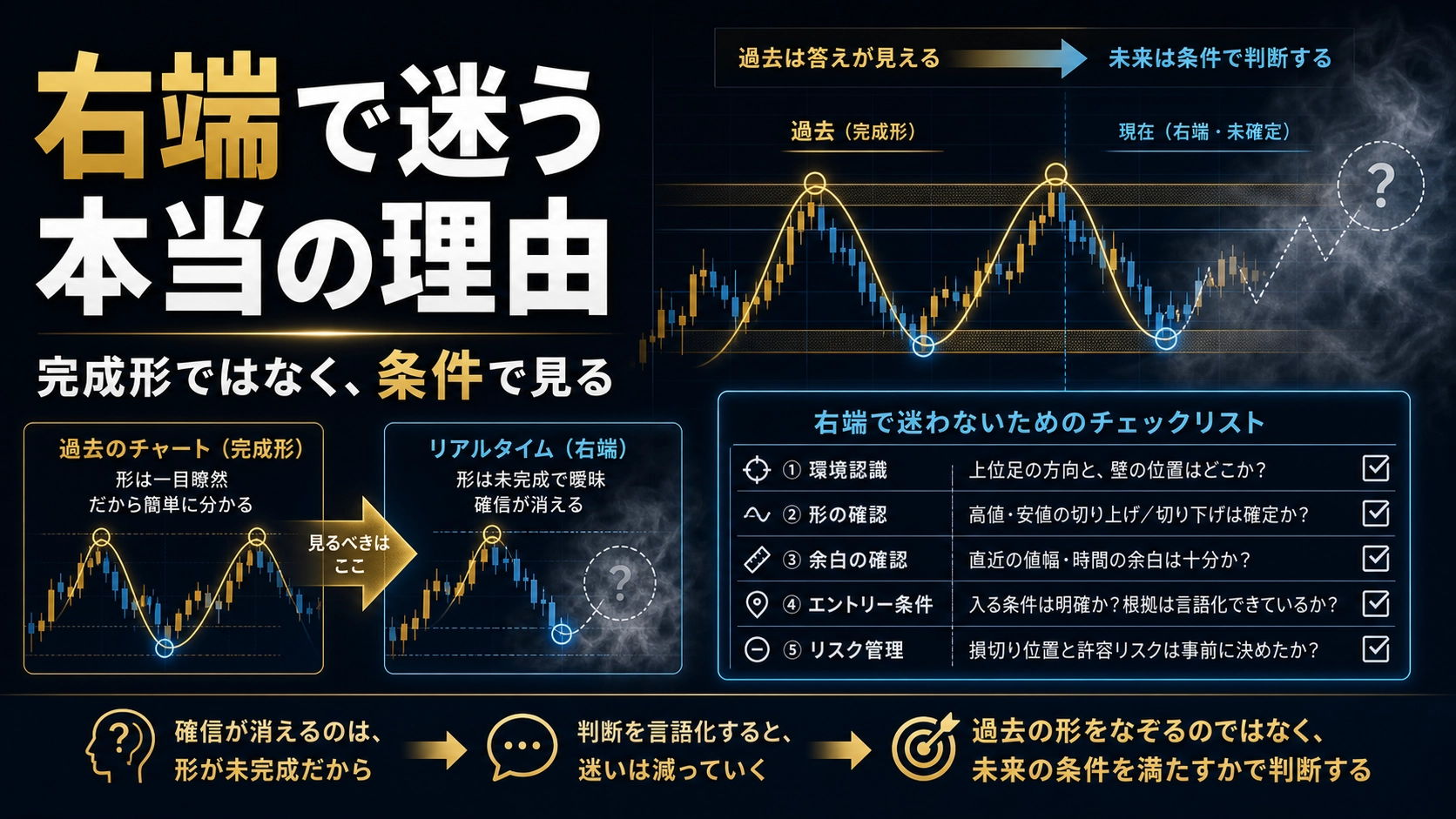
If your axis hasn’t caught up, it means you haven’t reached a state where “where to enter, where to cut, and why that place” stay constant even when emotions tremble.
With a small lot you could move even without a fixed axis because emotions didn’t shake.
When you become a big lot and emotions shake, you first realizethat there was no axis.
I believe this is the essential structure of why raising the lot collapses.
3. People who keep winning do it differently: how they raise the lot
Winning traders vs collapsing traders.
What’s different isthe way they raise the lot.
❌ The collapsing trader thinks“I’ve started winning, so I’ll raise the lot”.
? The winning trader thinks“Because I can make the same judgments without emotions now, I’ll raise the lot”.
This difference may look similar, but its content is completely different.
? “Becoming able to win” and “being able to make the same judgments without emotions” are separate things
? The collapsing pattern peoplelook at the results to decide to raise the lot.
Last month was positive. This month you’re still winning. So you think you can go ahead, logically.
? The patterns of those who keep winning arelooking at the process to decide to raise the lot.
Over the past three months, did you act according to the rules?
When doubt appeared, what did you base your decision on?
When emotions trembled, how did you handle it?
Reviewing these and confirming reproducibility before raising.
❌崩れる人:「10 consecutive wins, so I’ll double the lot」
?勝てる人:「10 entries, 9 times I acted as planned. I know why I failed the 1 time emotion won. I’ll continue like this for one month before deciding next steps」
Another big difference is
When you raise the lot, your reaction to losses is different。
❌崩れる人:「I raised the lot, so I was scared and moved differently. Maybe the method didn’t fit」
?勝てる人:「Raising the lot caused emotions to shake. Next time, I’ll decide what to do when it shakes, before raising」
The latter doesn’t attribute the cause to the method.
They seek the cause in“their own state”.
After 18 years, I think markets don’t move the same and predictions aren’t accurate.
But,you can design how you move yourself.
Winning people don’t try to control the market.
They have a system to control themselves..
I think this is the fundamental difference.
✍️ If you raise with a “somehow winning” state, that “somehow” collapses and you can’t respond.
People who can verbalize why they are winningcan also verbalize the cause of collapse, so they fix it faster.
4. How to raise the lot with an anchor (axis)
So, how can you achieve a method that won’t collapse when you raise the lot?“A method to raise the lot without collapsing”.
There’s no need to change your method.
Nor do you need to change your chart-reading from the ground up.
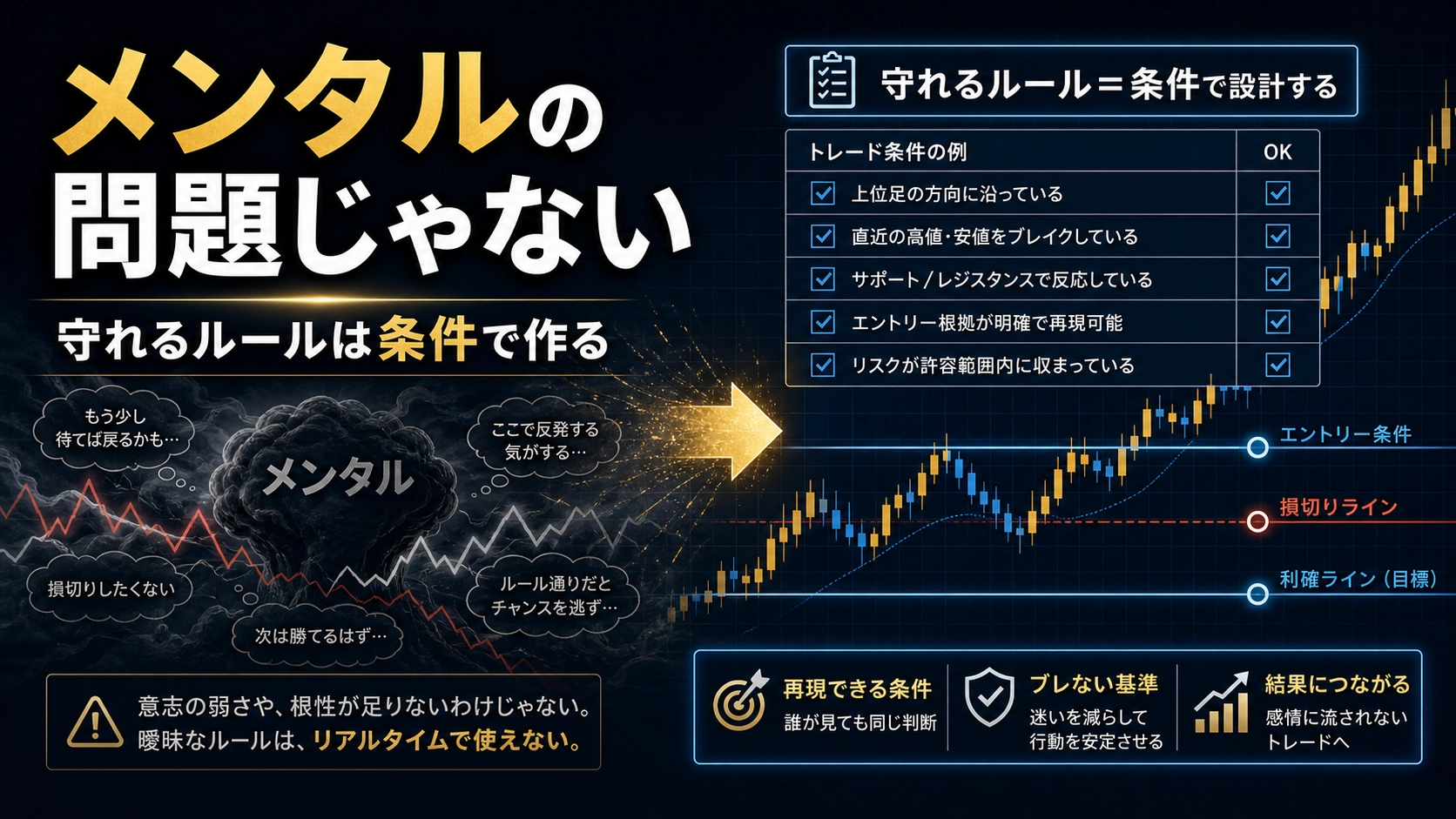
? What you should change are two things“the habit of verbalizing your rationale” and “the rules for actions when emotions shake”.
✍️First, about the rationale.
“Because it looks like a good shape”
“The chart looks clean”
“If I enter here, it seems I’ll win”
These kinds of rationales seem to work when emotions are calm.
But when your lot increases and emotions shake,“the vague sense” disappears before emotions.
If the rationale is “vague,” doubt arises.
Doubt makes your actions waver.
Wavering actions collapse results.
✍️ Does your rationale have the strength to withstand emotional swings? That is what is tested when you raise the lot
⚖️Next, the rules for actions when emotions shake.
Just the act of alternating is not wrong.
? In the lower time frame, assess the current situation, in the higher time frame assess wall positions and wave state, then return to the lower frame to decide entry.
That flow is correct.
But when emotions shake, each cycle reveals something different.
Even though you look at the same chart, fear makes you see bad material and greed makes you see good material
? Use the higher time frame only for“checking wall positions and wave state”.
It’s crucial to confirm this when emotions shake.
On the higher frame, only verify where the wall is and the current wave state.
Do not rely on anything else on the higher frame.
Clarifying this role becomes an “anchor”for when emotions shake.
✅ I can see the wall
✅ I’ve confirmed the wave state
✅ Now decide on entry in the lower frame
Together, this sequence becomes a routine that doesn’t change even when emotions shake, reducing judgment drift when raising the lot.
It isn’t flashy.
But as this accumulates, you develop an “anchor that doesn’t waver even when emotions shake.”^^
5. What you can do starting tomorrow — 5 steps to build your axis
? Honestly, the “preparation” to raise the lot can start today.Practice the following with your current lot size, and raise only after confirming reproducibility.
✅Step 1: Review the last 10 trades and write down your rationale
・Describe in one sentence why you entered there
・Practice writing it in words other than “it looked good” or “the pattern was nice”
・Express it in your own words, e.g., “Because I was near the wall” or “the wave was about to turn”
✅Step 2: Identify your pattern when emotions shake
・When you have a floating loss, what do you want to do (cut early or add more)?
・When you’re on a winning streak, what do you want to do (increase lot size)?
・When you’re on a losing streak, what do you want to do (doubt the method, quit)?
・Just writing this pattern on paper lets you realize, “Oh, it’s this pattern again” when the same thing happens later.
✅Step 3: Fix the roles of the lower and higher time frames
・Lower time frame role: confirm current situation and judge entries
・Higher time frame role: confirm wall position and wave state
・Do not mix these roles. Do not search for entry timing on the higher frame. Do not judge walls on the lower frame
・Just fixing these roles will improve the quality of your entries and exits
✅Step 4: Decide a rule to stop when you notice emotions shaking
・When you feel your heart rate rise, step away from the chart for a moment (1–2 minutes is fine)
・Decide not to make judgments when emotions are shaking
・Record the win-rate of trades entered while emotions were shaking (it’s almost always low)
✅Step 5: Decide the conditions to raise the lot by process, not by numbers
・Instead of “after X consecutive wins, raise,” use “after I have moved according to the rules X times in a row.”
・A definition of “moved according to the rules” is “the rationale is verbalized, and emotions did not change it.”
・Decide this standard yourself and write it in your notebook or notes app.
✍️ 90% of people who collapse after raising the lot skip this process and raise the lot only
Please try these five steps.
It’s plain, but those who raise only after the process is built are less likely to collapse.
That’s all there is to it ^^
Summary
The reason it collapses when you raise the lot isn’t the method itself..
? When you were on a small lotthe reason you “somehow won” was because your environment suppressed emotional swings, so naturally, once you raised the lot, your true self appeared.
✍️ What’s important isverbalizing your rationale andsystematizing the rules for action when emotions shake.
? It isn’t that the market changed. Raising the lot is a test of your inner state
First, try it with your current lot size from Step 1.
There’s no need to rush.
Once your axis is solid, the timing to raise the lot will become obvious naturally ^^
? If you want to go deeper into the topics I’ve discussed—“verbalizing rationale,” “how to use the wall,” “how to build your decision axis”—please see the material I spent two years compiling,“The Answers of the Market”.
This isn’t about flashy techniques, but about addressing the root questions like “why do I keep making the same mistakes?” and “where should I rebuild?”
I won’t hype it up with loud ads.
But many readers have told me that they finally understood their own problems, which is true ^^
? Details here
https://www.gogojungle.co.jp/tools/ebooks/77829
? We also created a free AI tool for trading analysis. Please try it
https://trade-ai-free.streamlit.app/
【Classic techniques for massive profits】
▼ GOLD Special Cure Manual
https://www.gogojungle.co.jp/tools/ebooks/50406
? Free gift|Partial release of the manual
https://www.gogojungle.co.jp/info/22533


Is it OK?