
A story about how people change from the day they stop seeking the Holy Grail【The Day I Quit Searching for the Holy Grail】
Even if you change your method again and again, you don’t calm down because you’re weak-willed. Today I’ll talk about the true form of that loop.
Good evening!
This is Masashi.
I’ve been trading for 18 years,and the more you’re losing, the more people go looking for a “better method.” In reality, it’s the opposite.
↓A feature on GOLD with a special remedy was published ^^
Please join now while there’s still time.
The day I stopped chasing the Holy Grail and how people change
“There must be a better method”── Don’t you know someone who kept changing indicators for years thinking that?
❌ Try MACD, then Bollinger Bands, RSI, moving averages…
If you read online that “this is the strongest,” you try it, and if it doesn’t work, you search for the next thing.
I’ve experienced this loop myself more than ten years ago (;'∀')
The reason you can’t find the Holy Grail isn’t that the grail is hidden. The concept of a Holy Grail itself is misaligned with the essence of the market.No, that’s the truth.
In this article, I’ll share the mechanism of why the Holy Grail search never ends and the mindset to break free from it.
This isn’t about techniques.It’s about thinking.
But once you understand this, your view of the market may change dramatically ^^
1. The trap of always thinking, “This time I’ll get it right,”
Please review your trading notes and bookmarks once.
The number of techniques you’ve tried, the types of indicators used, the amount of books and videos read—likely it’s a lot.
But how about your results?
?Is the amount of information proportional to your account balance?
To be honest.
Most of the time, it isn’t.
Rather, the more knowledge you accumulate,“I don’t know which is correct”is the state many people fall into.
? The more knowledge you accumulate, the more choices you have, and the more you wander. That’s the truth of “studying but not winning.”
Try to imagine concretely.
❌ One day you entered based on a rule: “Sell when RSI exceeds 70.”
It stopped your loss. Then you think, “Maybe RSI alone is weak. Let’s add MACD.”
Then it stopped your loss again. “Maybe I should also look at Bollinger Bands?”
This is the cycle.
When one tool seems not to work, you immediately try to reinforce with another tool.
But as a result, the conditions become so complex that you face another problem: you can’t wait until all conditions line up.
I went through this cycle too (;'∀')
One month I focused on head-and-shoulders, the next month I learned Fibonacci, the following month I tried Elliott Wave…
Each isn’t wrong knowledge.
But if you try to be mindful of all of them at once, every time you look at a chart you see a different pattern“appearing”in front of you.
?Seeing too much is actually the most dangerous statein this context.
“This pattern looks right today.” “No, this other signal is giving me the signal.”
Thus you unconsciously choose interpretations that suit you.
If you get stopped out, you regret, thinking, “That interpretation was correct,” and try another method next time.
Haven’t you experienced this loop?
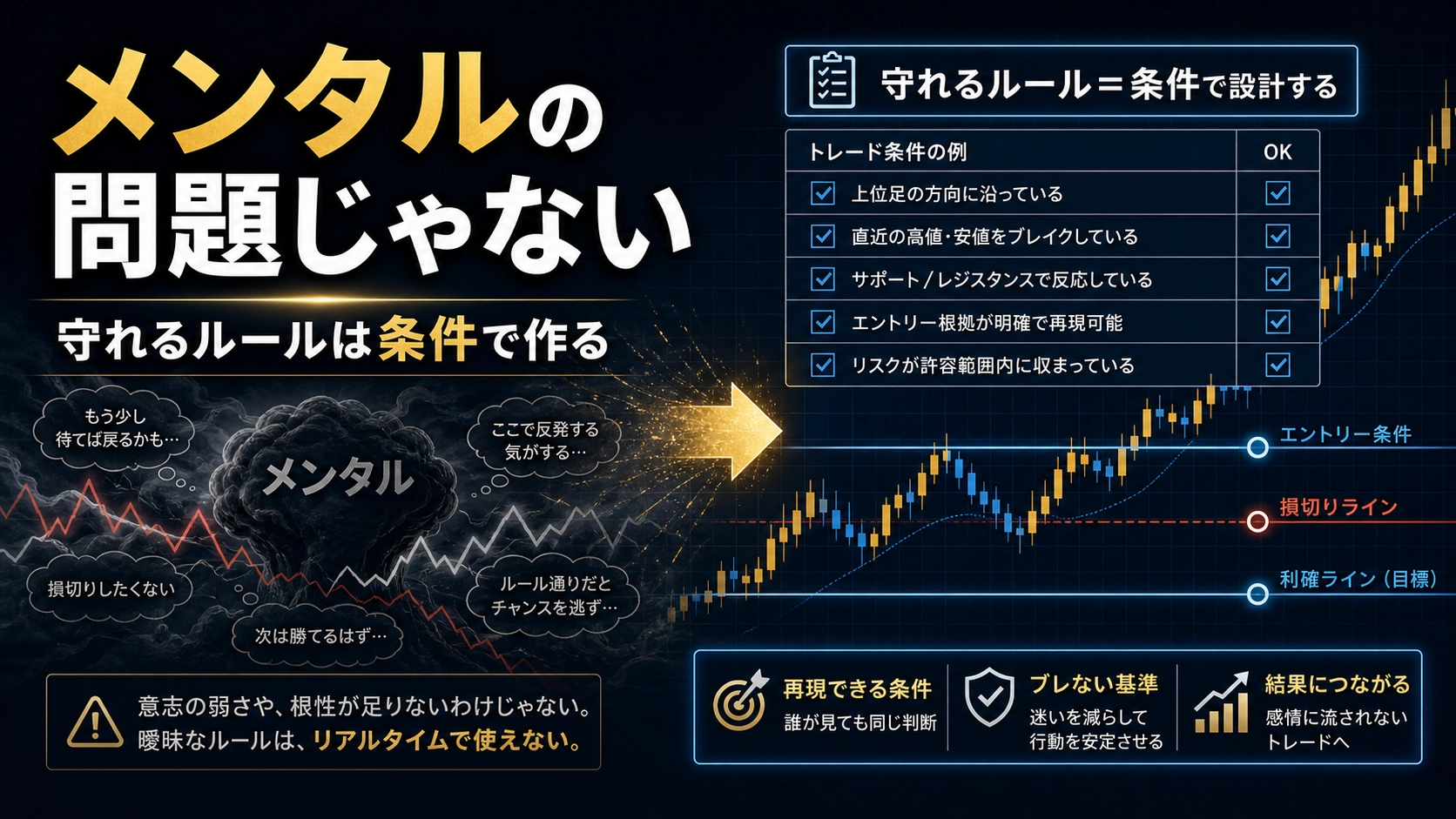
The Holy Grail search doesn’t end not because of weak will or lack of talent.
The very mindset of thinking “there must be something better” is the cause of the loopitself.
Whether you can realize this is the first critical branching point, I think.
2. Why we keep searching for the “next method”
Let’s dig a bit deeper into why you can’t stop chasing the Holy Grail.
On the surface it seems like “you search for a new method because you’re losing.”
But the real cause lies deeper.
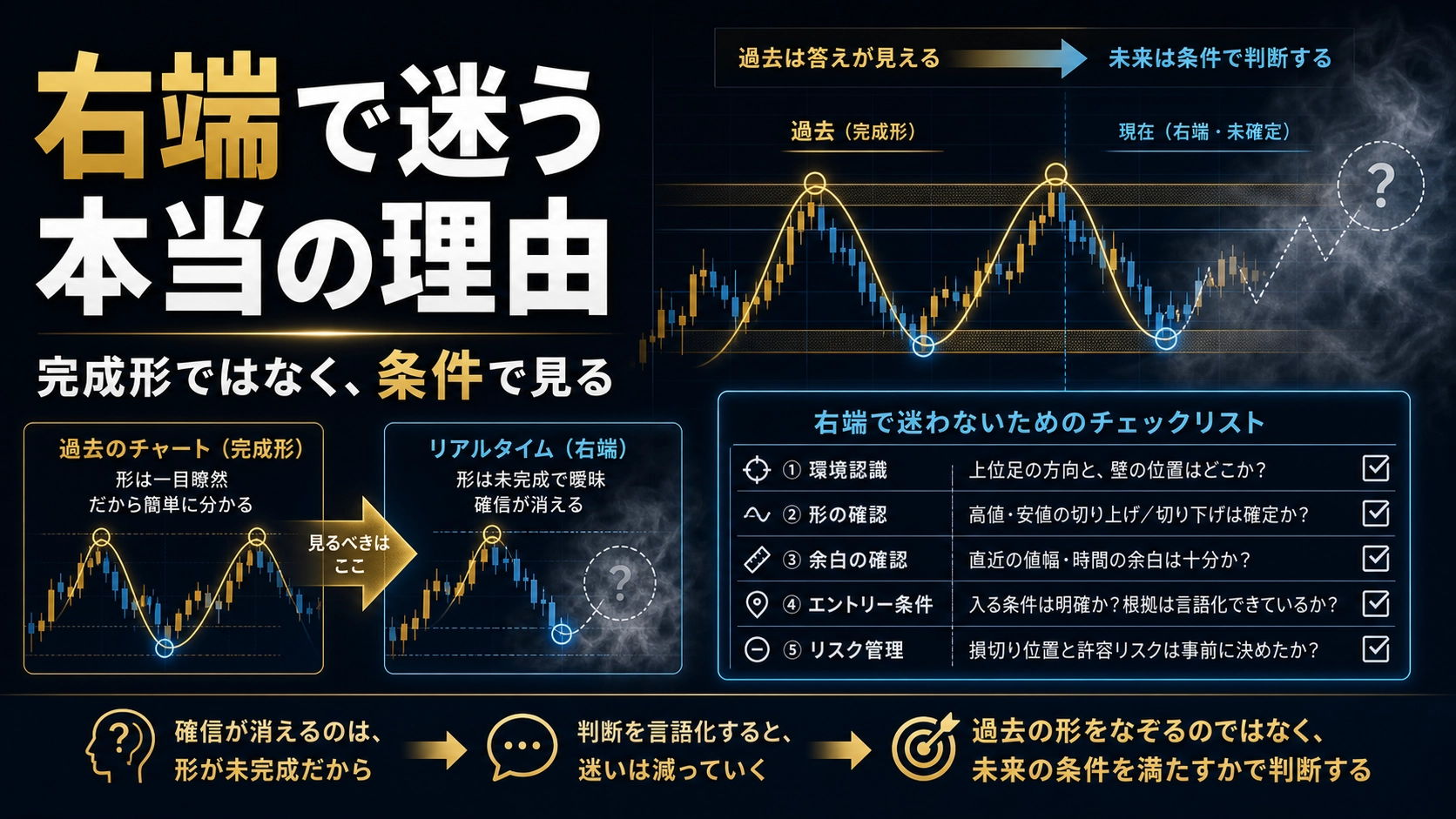
? It’s the thinking structure of “seeking answers to market movements.”“You’re looking for a method that can explain why it moved here.”.
? As long as you’re seeking a method that can explain why it moved here, you won’t break free from the loop
Let me explain what that means.
Many traders seek, in the chart movements, a question of “Why?”“Why did it reverse here?”“Why did it break out here?”
They keep searching for tools that answer this “why.”
Increasing indicators, learning new patterns, all are quests for a tool that explains the motion’s reason.
But there is a fundamental problem here.
?Market movements can be explained after the fact by anything.
“RSI was overheated here so it reversed” “There was a support line here so it stopped” — if you say it, it seems plausible.
But under the same conditions, the next time it may not be the same.
In other words, you think you’ve explained it, but in reality it isn’t functioning.
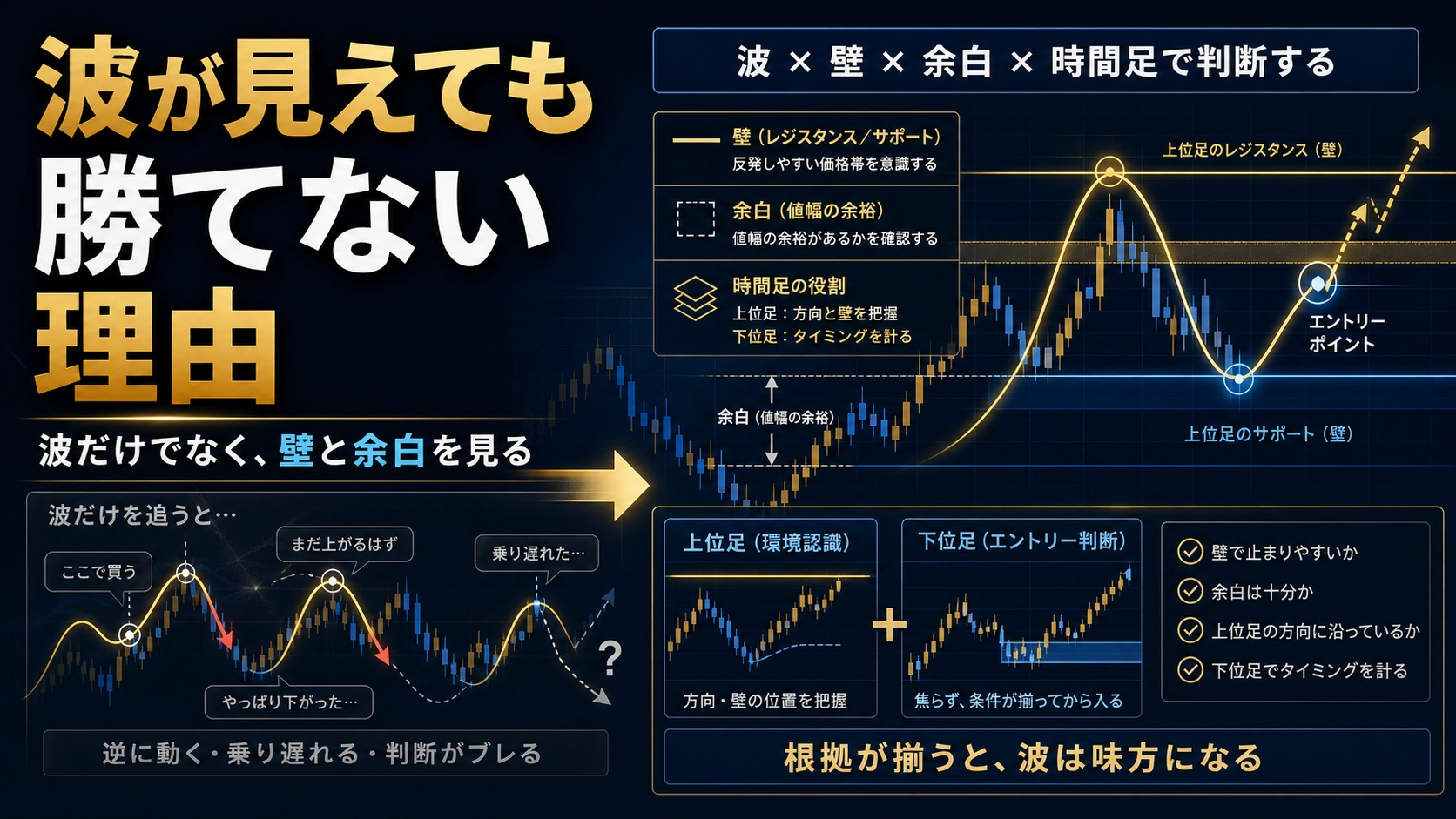
? What’s happening here is“ignoring the walls and waves structure and chasing only the surface price movement.”.
?Walls
?Waves
If you enter without correctly understanding these two, there will be no reproducibility, even with indicators.
If you don’t understand the structure, you’ll always have doubts like, “Was this really the right move?”
Because of doubts, you search for the next method.
The next method still leaves doubts—that’s the mechanism by which the Holy Grail search never ends.
The method isn’t the problem.
Because you’re not looking at the structure, no matter what you use, you feel “it’s still not enough.”.
This is the exact part I spent over ten years getting to.
Not changing tools, but changing what you look at.
That alone can completely change how you see the market.
3. The winners aren’t searching
Let’s shift perspective a bit and consider what long-term successful traders have in common.
What they share isn’t that their method is amazing or that they have special indicators.
Rather, it’s often that what they use is so simple it’s almost disappointing..
So, what’s different?
? Winners “can wait until the market takes a form that suits them,” while losers try to fit themselves into the market
This difference might be everything.
Let’s compare concretely.
❌【Losing patterns】
・When you open a chart, you start looking for a place to enter
・When movement begins, you hurry in not to miss out
・If you’re stopped out, you look for a reason and add new rules
・Rules become so many that judgment slows
?【Winning patterns】
・When you open a chart, you just confirm the current state
・First determine whether it’s a place to gamble; if not, don’t touch it
・Even if stopped out, you just confirm whether it followed rules, and you don’t change the method
・There’s less to do, so decisions are fast
? In one line, this difference is“whether you are looking or not”.
Losing traders are always in a “looking for something” state.
They look for entry opportunities, look for winning methods, look for the cause of losses.
Because they keep searching, they always feel something is missing.
Because it’s missing, they look for something else again.
Winning traders don’t“look for it.”They “decide” where they will trade.
They decide where they will gamble.
? There is a wall.
? The waves are moving in that direction.
Just confirm whether these two are aligned.
If they’re not aligned, don’t touch.
That’s all.
It sounds simple, doesn’t it.
But most people take a detour before reaching this simplicity.
They think, “If I add more conditions, accuracy will improve,” and end up going the wrong way…
I wasn’t an exception either (-_-;)
When I peeled away and realized that “this alone is enough,” I finally felt the sense of fighting the market disappear.
I shifted to aligning with the market, and that change in mindset was profound ^^
4. Reading the market with “walls” and “waves”
So, concretely, how should you change your thinking?
Here I’ll explain at a conceptual level.
Specific steps and entry conditions are summarized in the “answer to the market,” so here I’ll focus on why this approach is used.
? In reading the market, there are two things I value2of them.
“Walls”── understand these two states.
?About Walls
Walls are places where price has stopped many times in the past.
When you look at a chart, you may notice spots where it’s repeatedly paused.
That’s the place.
Walls can be found by anyone. You don’t need special tools.
But finding them doesn’t mean you can use them effectively.
“Noticing a wall” and “being able to use it to decide” are two completely different things.
The important thing is, when you know a wall’s location, what state you should be trading in.
If you don’t know this, even if you find a wall, you’ll end up thinking, “Then what should I do?”
?About Waves
Waves are the current market’s direction and momentum.
Are they moving upward, downward, or is movement paused and oscillating?
This state determineswhether it’s a good moment to trade.
If you ignore the wave’s state and enter, even with a wall, it may not work.
This is often the cause of getting stopped out when you entered because of the wall.
About alternating timeframes
Flipping between lower and higher timeframes is the only way to improve decision accuracy.
✔ On the lower timeframe, confirm what the current movement is.
✔ On the higher timeframe, confirm the wall’s position and the wave’s state.
✔ Then return to the lower timeframe to judge again.
Repeating this back-and-forth is necessary because each timeframe has its own role.
If you mix up higher and lower timeframes and look at them for the same purpose, you won’t get an answer no matter how many times you flip.
⚖️ Separate their roles and alternate. This alone reduces the feeling that you can’t see the current state
Reduce what you look at instead of increasing your tools.
Once you switch in this direction, your doubts should begin to fade ^^
5. How to end Holy Grail hunting starting tomorrow
The mindset is understood.
But then, “So what should I do starting tomorrow?”
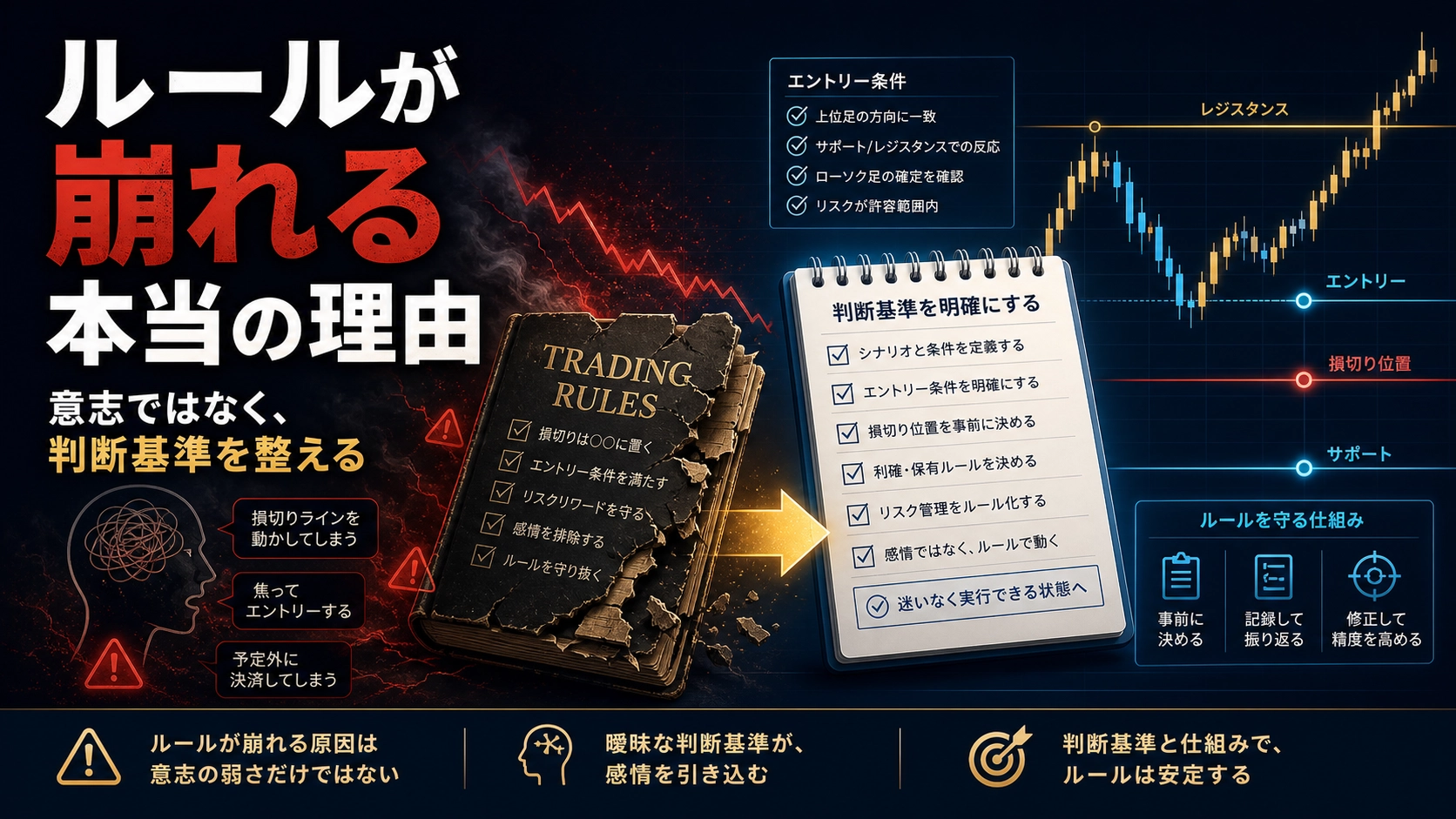
?Ending the Holy Grail search with willpower won’t work. End it with a system.Here are concrete steps.
✅Step 1: Inventory the methods you’re currently using
Write down all indicators, rules, and patterns you use in trading on paper.
If you keep it in your head, you may think it isn’t that much, but when you write it out you’ll often be surprised at how much there is (;'∀')
After writing, check whether you could explain each item’s purpose in one sentence.
If you can’t explain it, you’re probably using it just because it feels like it.
✅Step 2: Create a period where you intentionally zero out “time to look for a new method”
Just one week will do.
Eliminate the time to research new methods, watch new videos, or change indicators—remove all of it.
Impose a constraint: “Only use what’s already available.”
At first, it will feel uncomfortable.
But that discomfort is exactly what has kept you chasing the Holy Grail.
✅Step 3: When looking at a chart, start with “current state confirmation”
Decide what to do first when you open a chart.
Start by confirming “what state the market is in now.”
Where are the walls? What is the wave’s direction?
Just confirm those and decide whether it’s a place to trade.
Stop thinking, “Is there any entry opportunity?”— changing this mindset will change how you see things.
✅Step 4: Practice alternating between lower and higher timeframes
Before entering, always alternate between lower and higher timeframes to confirm.
Check the current state on the lower timeframe, then the wall and wave on the higher timeframe, then return to the lower timeframe to decide.
Initially, it’s okay if it takes time.
The goal is to make alternating a habit.
✅Step 5: Record “days you didn’t touch”
In your trading journal, record not only the days you entered but also“days you didn’t touch”as well.
Being able to decide, “There wasn’t a place to gamble today,” is a proper trade.
Not feeling guilty about not trading reduces the urge to trade hastily.
As the urge decreases, “randomly entering” also declines.
✍️ None of these are flashy. But by continuing, the impulse to search for the next method quiets down
Summary
The Holy Grail doesn’t exist, not because it’s hidden, but becausethe idea of chasing a Holy Grail from the start is itself flawed.
? Stop seeking answers from charts,? grasp the walls and? waves’ structure, and move only where you can win.
Within that simple repetition, reproducibility arises.
Stop increasing techniques and try reducing what you look at.
It may feel uneasy at first.
But you’ll likely feel the lack of confusion increasing very soon ^^
? The day you stop chasing is the day your trading begins to change
? The ideas I’ve shared in this article—the concepts of “walls,” “waves,” and “timeframe alternating”—are summarized more deeply and systemically in“The Answer to the Market”.
It’s not just concepts; it includes practical criteria for how to use them.
If you’re looking to end Holy Grail hunting soon, please take a look ^^
? More details here
https://www.gogojungle.co.jp/tools/ebooks/77829
? I also created a free AI tool for trade analysis. Please feel free to try it out
https://trade-ai-free.streamlit.app/
【Classic techniques for massive gains】
▼ GOLD Special Remedy Manual
https://www.gogojungle.co.jp/tools/ebooks/50406
? Free gift | Partial manual released
https://www.gogojungle.co.jp/info/22533