
【Cutting losses isn’t tuition!】An 18-year trader speaks about the essence
“Cutting losses = failure” is something you think, you won’t learn anything from the market. Today I’ll share a story about changing that viewpoint.
Good evening!
This is Masashi.
After trading for 18 years, I feel the biggest difference between people who win and those who don’t is how they handle cutting losses.
↓ A feature on GOLD with a special program^^
Please join in while you can.
? Cutting losses is not tuition|18-year trader explains the essence
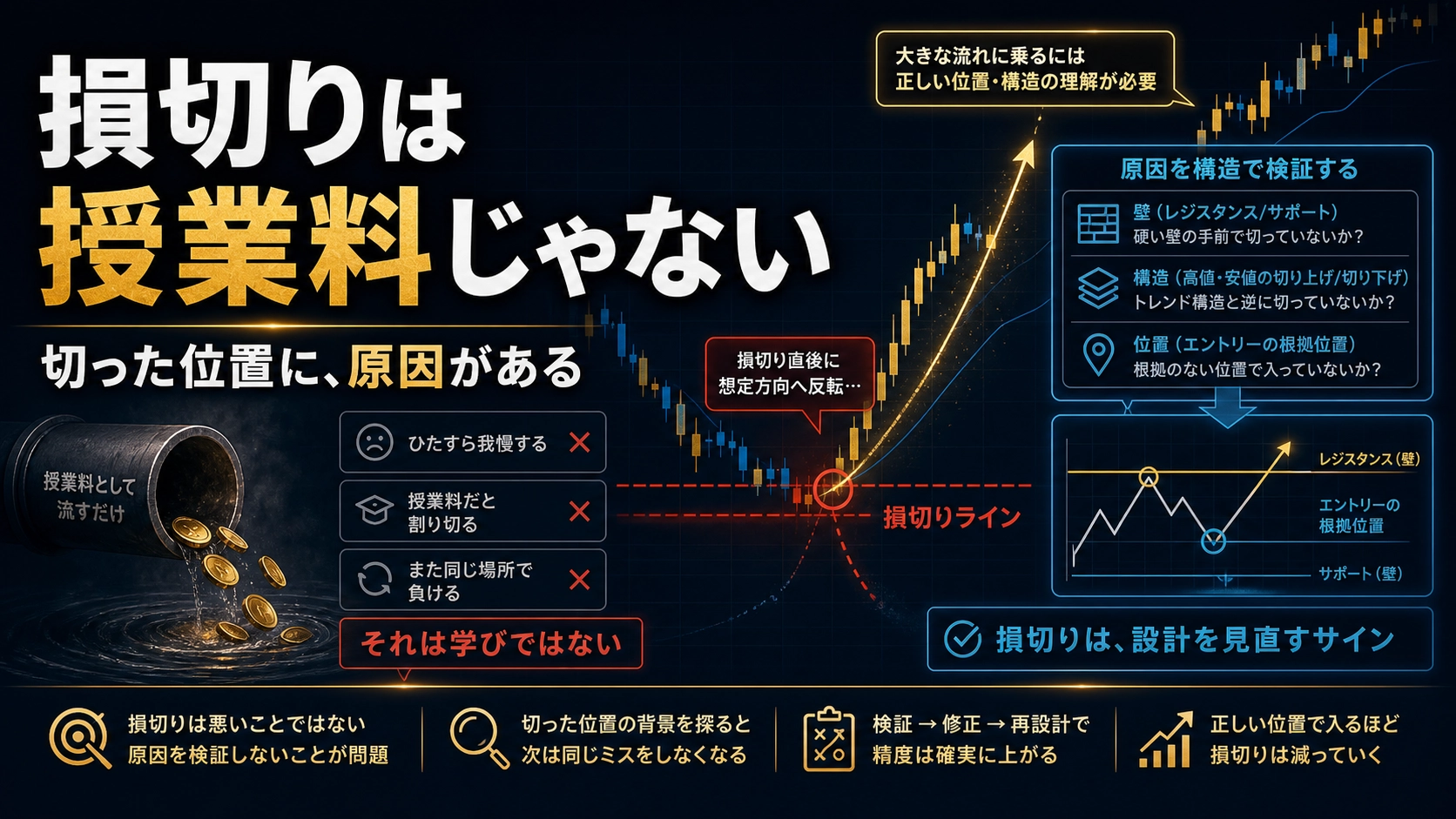
Right after cutting losses, the market moves in the direction I expected.
I think this isn’t something that happens once or twice.
❌“Why did I cut it?”
❌“I should have waited a little longer.”
We regret that, decide to endure a little more next time.
Then, when we endure, it moves in the opposite direction and becomes a big loss.
This loop never seems to break (;'∀')
As long as you think of cutting losses as “failure,” there is nothing you can learn from the market.
In this article, I’ll focus on changing your“fundamental perception”of cutting losses.
This isn’t about technicals.
We’ll dig into the fundamental misalignment in how losing traders approach cutting losses.
Just organizing this part might slightly change how you approach trading^^
1. Why “cutting losses again” accumulates
When I started trading, cutting losses felt like“the loss itself”.
Money decreases. Positions disappear.
Nothing good comes from it, just a failure.
I used to think that too (;'∀')
So every time I cut, I’d feel down, close the chart at the end of the day, and try to distract myself somewhere.
I think many people can relate to that feeling.
? And this is where the problem begins.
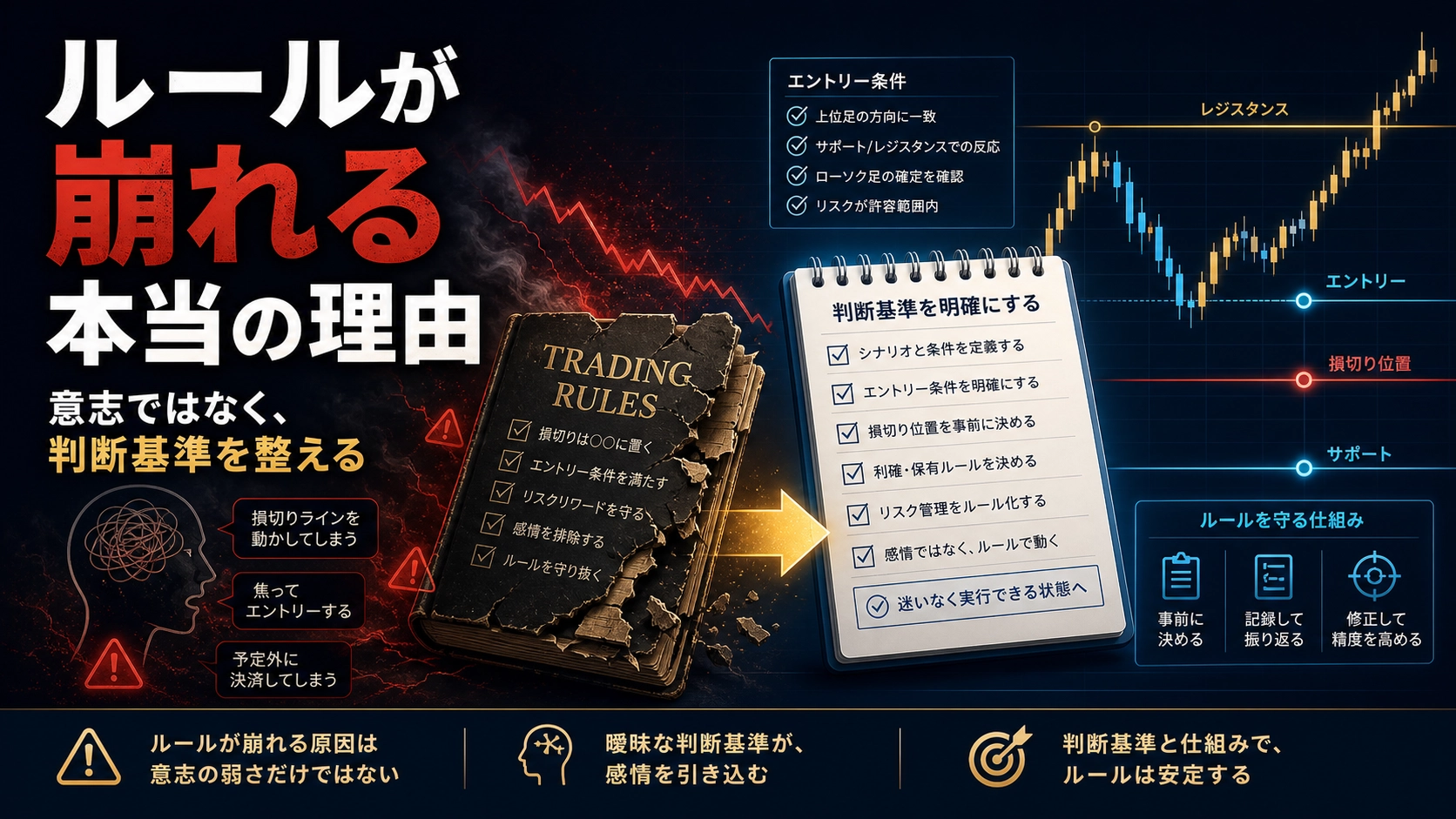
If you process cutting losses as “failure,” youlearn nothing from that loss.
If you don’t reflect on “why you entered here” and “why you cut here,” you move on to the next trade.
What happens as a result?
? You enter in the same place, in the same way, and cut in the same way again.
This repeats over and over.
“I cut again. Why does this always happen?”
Even so, you don’t deepen your understanding of the cause.
To be precise,“you don’t know how to dig deeper”
There’s a common pattern many traders fall into.
❌Revenge trading right after a cut
❌Try to widen the stop loss next time
❌Bring the regret of “If only I had held on then” into the next trade
All of these come from viewing cuts as “failures.”
? When emotions move every time you cut, you’re still fighting the market
Aren’t you like this too?
✔Aren’t you avoiding taking positions because cutting losses scares you?
✔Aren’t you prolonging losses, holding onto drawdown?
✔Aren’t you regretting “I should have waited a bit longer” after cutting?
If any of these apply, this article is for you.
Cutting losses aren’t losses.
But“the reason why cutting losses isn’t a loss” is something few can articulate.
Let’s organize that together.
2. The mental structure that makes cutting losses a “failure”
Why do we view cutting losses negatively?
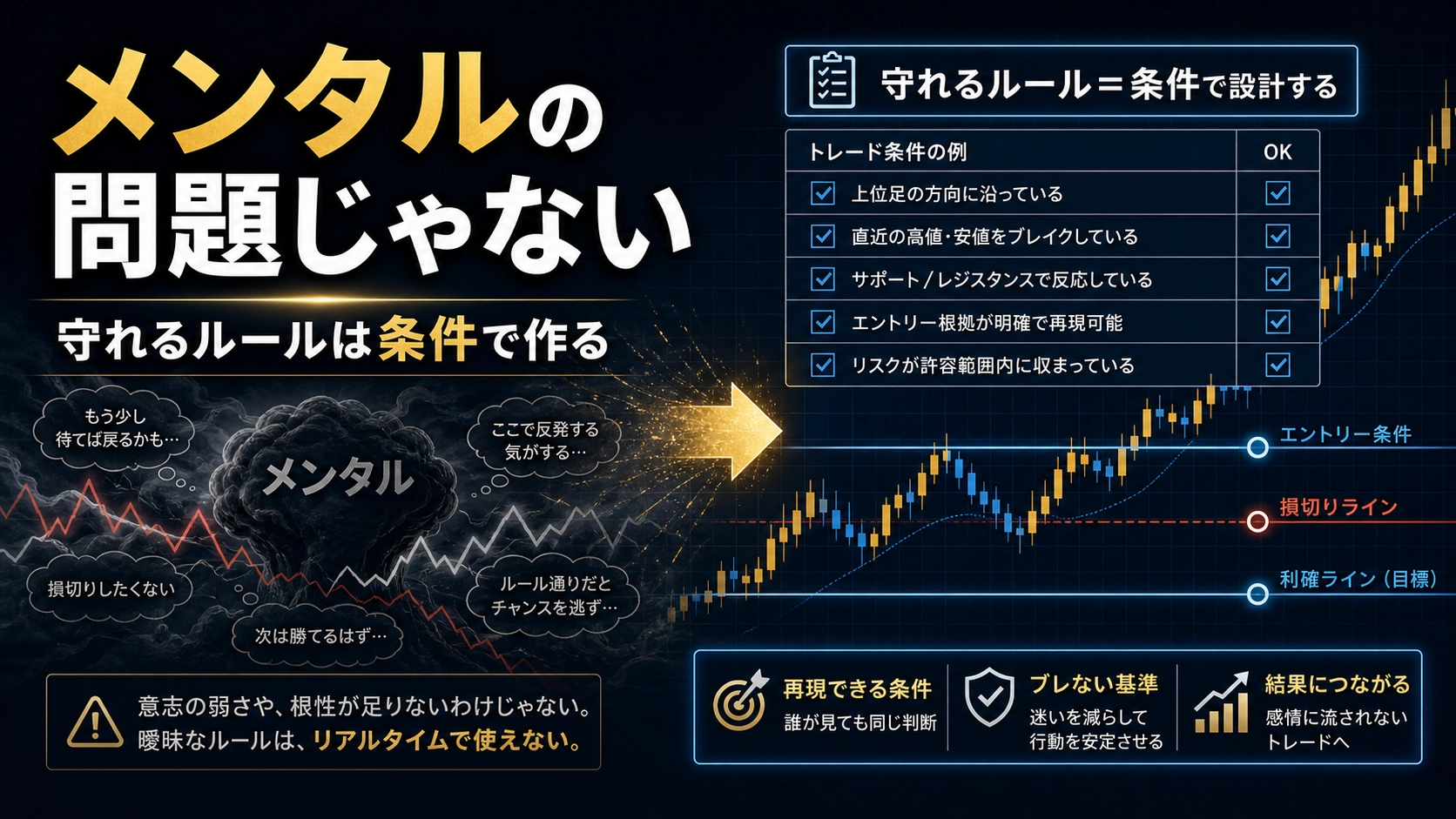
People tend to think it’s an emotional issue, but in fact it isn’t.
? At the root is the trader’s“misplaced premise”about trading.
Many traders trade with this thinking:
“This place seems to be going up, so I’ll buy”
“This pattern looks like it will go down, so I’ll sell”
?They are entering from a forecast
Trades based on forecasts become a binary bet of hit or miss.
Cutting losses then means the trade missed the mark = failed, and the structure is complete.
Therefore, cutting losses becomes an experience of “loss.”
? As long as you premise on forecast, cutting losses will forever remain a “failure”
To understand this, I’ll briefly discuss market structure.
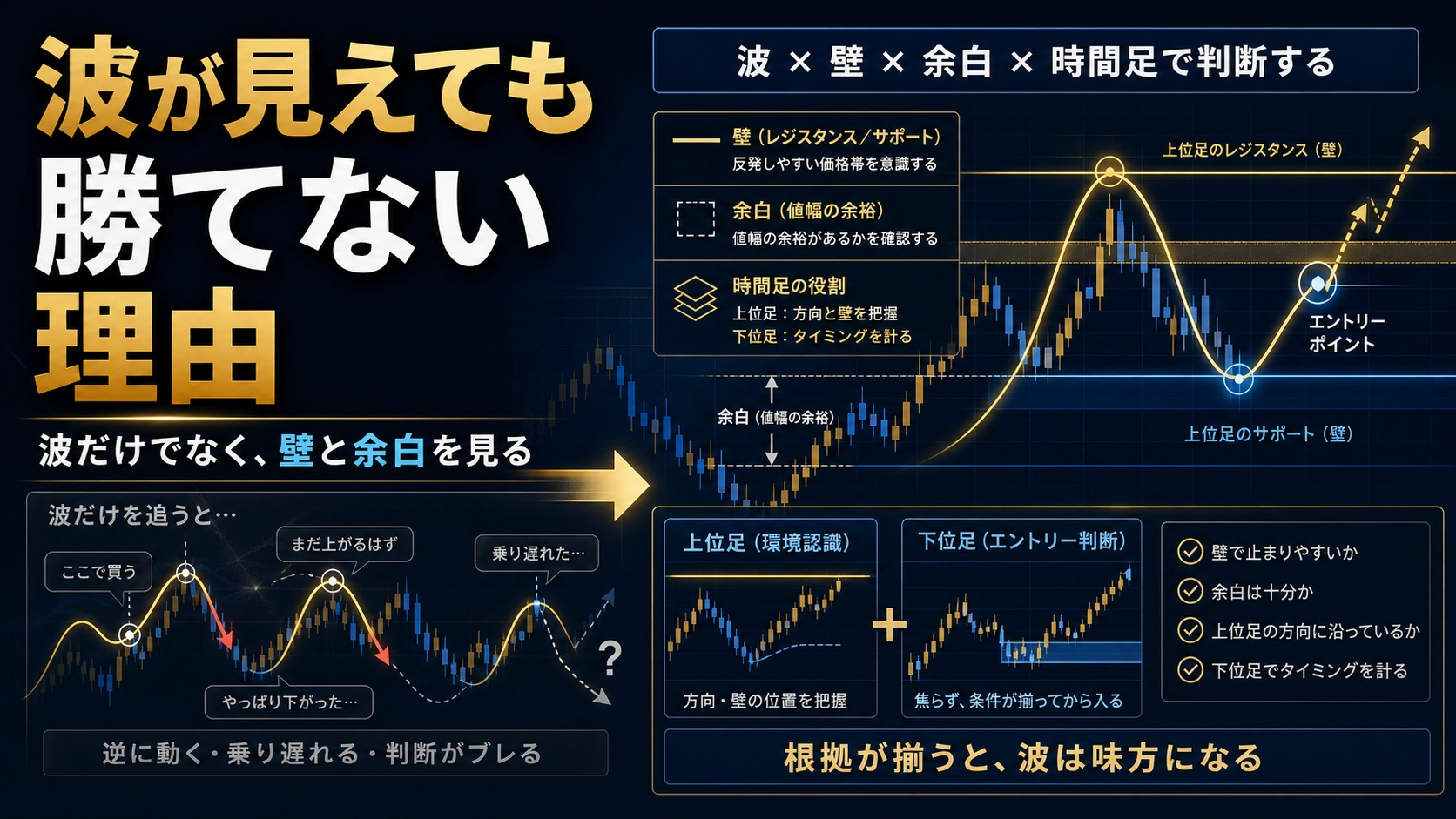
?There is a“wall” in the market.
A price level that has repeatedly bounced off in past movements.
A place where it has stopped many times.
A place where buyers and sellers fiercely contest.
Near such walls, market moves tend to change.
?Then there isa wave.
The market doesn’t move in a straight line; it goes up and back, down and back, repeatedly.
Within that wave, there are places you should enter and places you should not.
Instead of judging by this “wall” and “wave change,” if you judge by forecast, you’ll miss what’s happening.
“I’ll enter because it’s near the wall and I expect a rebound,”
or
? You’re not adapting to the market; you’re trying to fit the market to you
In other words, cutting losses often occurs because the理由 for the entry was weak from the start.
Cutting losses isn’t the problem; the way you entered was the problem.
Recognizing this is the turning point that turns cutting losses into learning.
3. How winning traders use cutting losses
After 18 years, there is something common among traders who keep winning.
Their emotional response to cutting losses is clearly different.
❌For losing traders, after-cut thinking:
“Why did I cut it?”
“I should have waited a bit longer.”
“Next time I’ll hold on longer.”
?For winning traders, after-cut thinking:
“The move was different from my expectation. Where did it diverge?”
“It didn’t stop before the wall. I might have misread the wave state.”
“Next time I’ll pay attention to this.”
As you can see, the former handles with“emotions”, while the latter processes with“information”
?Handling cuts with emotion leads to regret. Handling them as information leads to learning
To be concrete.
For example, suppose you bought at a certain price range.
That area was believed to be a “wall.”
But in reality, the price broke through the wall and went down.
It cut.
❌A losing trader ends here: “The wall didn’t work, unlucky me.”
?A winning trader asks here“Why did the wall break?”
✔Was there momentum toward the wall in the wave state?
✔When toggling between lower and higher timeframes, was it really a trade state?
✔
Such questions can be asked because from the start there was a clear understanding of“which structure I entered from”.
In other words, because there is a basis for the entry, you can explore the reason for a miss.
If you enter without a basis, then the miss reason will be “just luck.”
?What is the true nature of “just a feeling”?
It is“entering based on your own sense without looking at market structure”.
The difference between winning traders and others may not be a difference in skill.
It’s the difference in whether you can articulate, before entry, “why here?”.
4. A mindset that turns cutting losses into an entry fee
There is a saying that cutting losses are the entrance fee for learning.
I love this phrasing, though few fully understand it.
Entrance fee means money paid to obtain something.
If you pay money and gain nothing, that’s just a waste.
? The same for trading cuts: what you gain should justify what you’ve lost.This is the key.
? Cuts that you accept as entrance fees only become a cost if you’re not ready to learn
What should you learn?
This is the focal point.
There are two main things you can learn from cutting losses.
? One is“I entered a place I shouldn’t have”.
? The other is“It was okay to enter, but the market state changed”.
The former means the entry basis collapsed.
The latter means the entry basis existed, but the movement was unforeseen.
✅ The former’s cut leads to learning to change your next entry method.
✅ The latter’s cut leads to learning to sharpen your ability to notice unforeseen moves.
Both are learnings that come from having a cut first.
So, how do you create an entry basis?
⚖️Check the current price move on the lower timeframe → Check the wall position and wave state on the higher timeframe → Return to the lower timeframe to decide entry.
In this back-and-forth, confirm whether this is a place you can bet on.
The role of the higher timeframe is to focus on verifying the wall position and the wave state.
If you get too involved there, your judgments become more complex.
Check the current state on the lower timeframe, filter on the higher timeframe, and then judge again on the lower timeframe.
If this flow is broken, your entry basis remains fuzzy.
An entry made with ambiguity yields no learning from the resulting cut.
Only cuts with clear basis provide information that improves the next trade
✅ 5. Five actions to turn cutting losses into learning from tomorrow
“I understand. Then what should I do starting tomorrow?”
For those who’ve read this far and wonder that, here are specific actions.
?Changing your mindset alone won’t change anything. Your actions must change, and only then will trading change.
✅Step 1: Before entry, be able to state in one sentence why here
Explain not “it seems to go up,” but “there’s a wall, the wave direction aligns, and I can see the movement on the lower timeframe, so that’s why.”
If you can’t verbalize it, your entry has no basis.
At first it’s tough, but just doing this will change your trading accuracy.
✅Step 2: If you cut, don’t reflect immediately afterward
What I’m mindful of is that after a cut, emotions are moving.
Reflecting in that state leads to emotional analysis.
I recommend waiting a bit to review calmly.
✅Step 3: Split the reason for the cut into “before entry” and “after entry”
Separate whether it was a problem before entry (the basis was weak) or after entry (an unforeseen move) so you can see what to improve next.
If you don’t do this, everything ends as “bad luck.”
✅Step 4: Do the lower-to-higher-to-lower timeframe checks every time
Check the current state on the lower timeframe, verify the wall and wave on the higher timeframe, then return to the lower timeframe to decide entry.
Skip this back-and-forth and you’ll end up entering with no real basis.
It may feel tedious, but skipping this check yields entries with little to no basis.
✅Step 5: Record your cut. Record the situation, not the amount
Record not “how much did I lose,” but “what state was I in when I entered, and why did I cut.”
As this accumulates, you’ll see patterns in when you cut.
Once you see the patterns, simply avoiding them reduces your cuts.
?You don’t need to do all five at once. Start with Step 1 tomorrow
Summary
Cutting losses aren’t a failure.
But to turn cutting losses into learning“entry with a basis”is a prerequisite.
? Entering without basis means you can learn nothing even if you cut.
? Entering with basis means you understand why you cut.
? If you know the reason, your next trade will change.
This isthe true meaning of “cutting losses is the entrance fee to learning.”.
? From the day you accept cutting losses, trading begins to change gradually
You don’t have to rush.
You don’t have to change everything at once.
FirstPut into words “why here?”Start there, and see what happens^^
? If you want to dive deeper into the concepts in this article—“wall,” “wave,” and “alternating between lower and higher timeframes”—check out“The Market’s Answer”for more.
It’s not a method explanation, but a study material to build your own judgment axis.
It isn’t flashy, but it will help you stop second-guessing yourself^^
? For more details here
https://www.gogojungle.co.jp/tools/ebooks/77829
? We also created a free AI tool for trade analysis. Feel free to try it out
https://trade-ai-free.streamlit.app/