buffalo USDJPY_M5

- Whole period
- 2 years
- 1 year
- 6 months
- 3 months
- 1 month
Real Performance
※Displays results including swaps and fees
Forward testing (Profit)
Monthly Statistics
- Jan
- Feb
- Mar
- Apr
- May
- Jun
- Jul
- Aug
- Sep
- Oct
- Nov
- Dec
Calendar for Months
About EA's Strategy
Translating...
It's better to have no discretionary elements when running an EA
Buffalo is fundamentally based on my discretionary trading method.
Therefore, technical analysis is fundamental, but it is necessary to be cautious about indicators.
However, when operating the EA, if I have to be in front of the chart just because of the indicators,"It's faster to do it discretionarily."I tend to think.
Taking that into account, I have added restrictions to the logic to allow for as much unattended operation as possible, eliminating the need to manually stop the EA.
As I am also a discretionary trader, after installation,"There is no discretion such as stopping operation during indicators or around the New Year."I believe that is the essence of the EA,
and it is basically designed for unattended operation.
However, since positions will be held even when spreads widen during indicators, if you are uneasy about operating during major indicators, you may stop it manually.
Hybrid type with separate logic for buying and selling
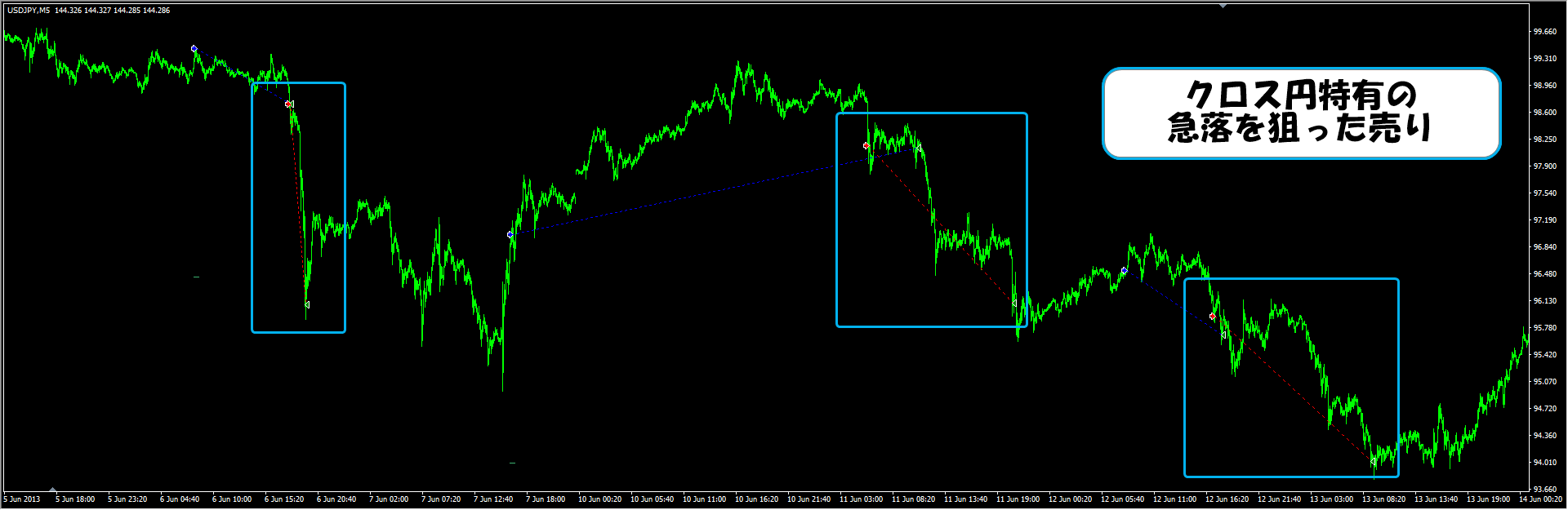
Originally, the EA was established with just one logic, but I divided the logic for buying and selling to respond to the unique sharp declines of cross-currency pairs.
While retaining some functionality to chase the original trend, it has become possible to enter during sharp declines.
It cannot target all sharp declines, but it can capture some sharp declines that have precursors.
Extend where you can, cut quickly where you should
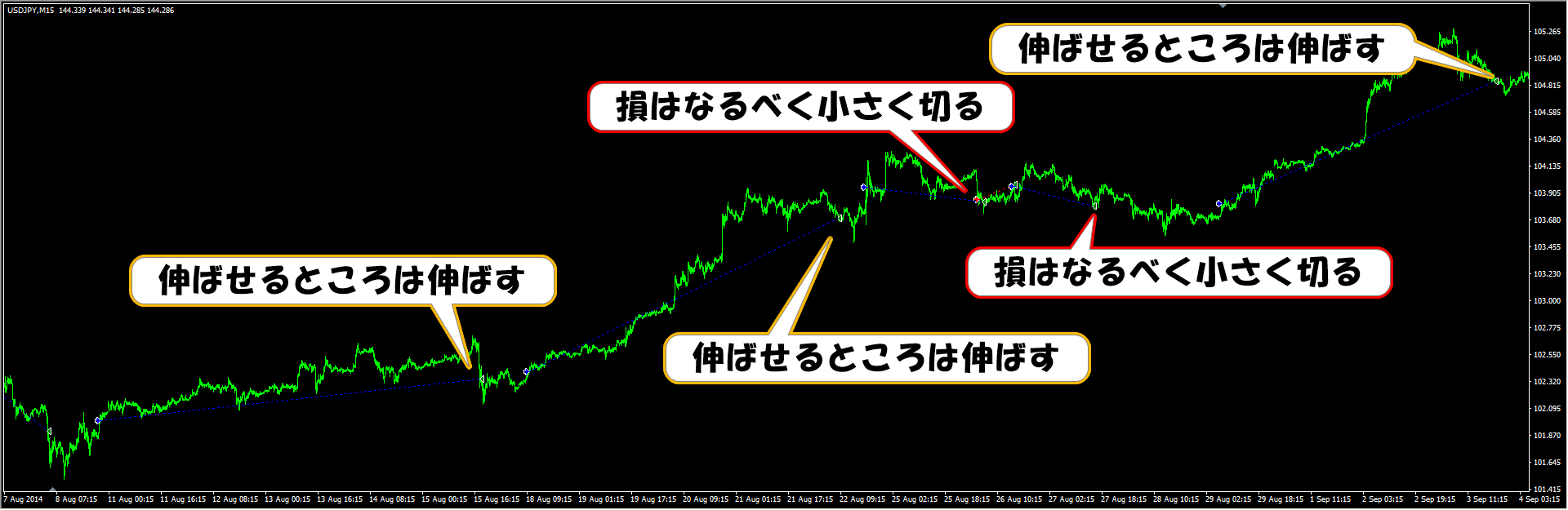
One of the drawbacks of trend-following EAs is that they tend to delay cutting losses.
To improve this, I have set it up to grasp short-term trends while observing long-term trends, allowing for extensions where possible and quick cuts where necessary.
As a result, even with a low win rate, it is possible to achieve small losses and large profits, leaving a total profit.
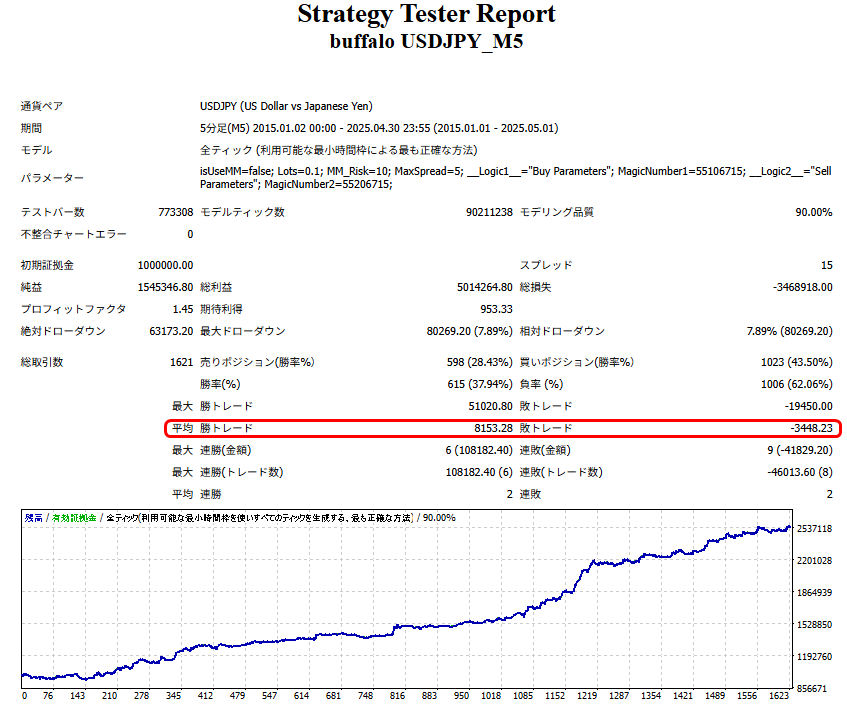
Profit of 2: Loss of 1 or more completely reproduced by the EA!
This EA is far from the typical "small gains and big losses" and aims to minimize losses while maximizing profits.
While the win rate is low, it focuses on the ratio of profits to losses, designed to steadily increase assets.
Continuously chase during long-term trends
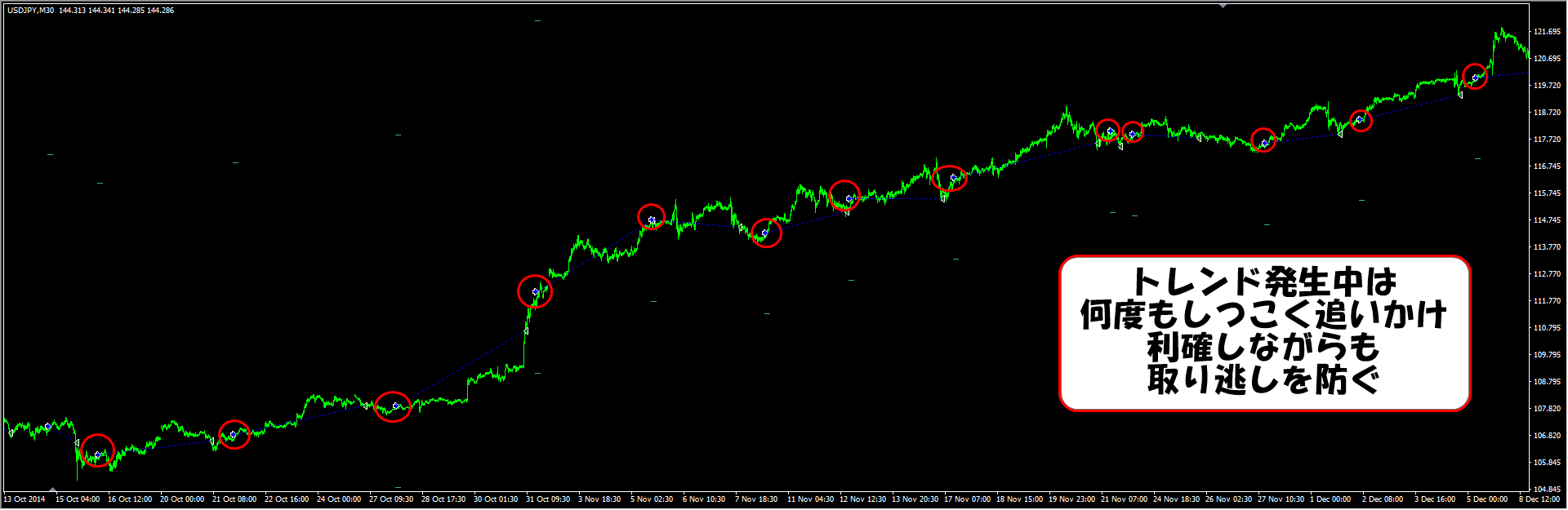
Buffalo will enter when it detects the occurrence of a trend through its internal logic.
After entry, if there are indications of the end of the trend on short-term charts, it will take profits, but if the long-term trend judgment has not collapsed, it will enter again each time there are signs of trend occurrence
and will continue to chase the trend.
This allows for securing profits where possible while preventing missed trends, operating in a way that minimizes unrealized gains.
Equipped with a compound interest function in response to many user requests!
Not only has it performed well in backtesting, but it has also shown good results after the start of forward testing,and we have incorporated a compound interest function that many users have requested.
The compound interest function adopted this time allows for setting only the maximum risk per trade against the account balance to minimize the risk of account failure.
For example, if the allowable risk is set to 10%, with an account margin of 1 million yen, the risk per trade is 100,000 yen, and the corresponding lot size will be set automatically.
(The maximum stop loss is set (fixed) at 300 pips, so it will start with 0.33 lots for 1 million yen and 0.03 lots for 100,000 yen.)
If the account margin increases due to the EA or additional deposits, the lot size will automatically increase accordingly.
Conversely, if the account margin decreases, entries will be made with a reduced lot size, so please be aware of this.
However, since it is no longer possible to set individual lots for each logic, if current users prefer individual lots for each logic instead of the compound interest function,
you can continue to use it as before by not updating.
Customers purchasing from now on should understand that it is no longer possible to set lots for each logic before purchasing.
Lot settings are possible if the compound interest function is not used. The lots for the two logics can no longer be adjusted separately.
The recommended risk tolerance for using the compound interest function from the developer's side is"3%.".
High recovery factor
One of the characteristics of Buffalo is its high recovery factor.
The recovery factor refers to"the recovery power (ryoku) until it returns after experiencing a drawdown."This is what it means.
EAs will inevitably experience drawdown periods.
However, if the recovery factor is high, the speed of capital recovery is fast even after experiencing a drawdown, reducing the anxiety that makes you want to stop operation.
Buffalo's recovery factor is 19.25 over the past 10 years. On average per year,"1.86."It can be seen from the test results that even after a drawdown, it recovers within about six months.
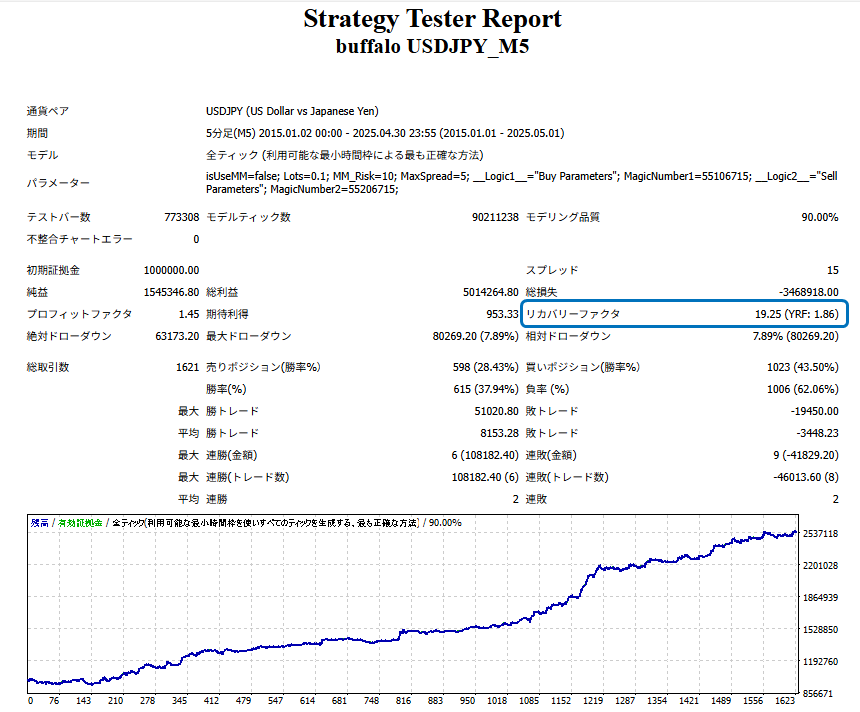
About parameters
The parameters that can be set include the magic number and risk tolerance, along with a spread filter.
The initial value for the spread filter is set to 5 pips, allowing you to set it so that no trades are made during times of spread widening, such as during indicator announcements.
If you want to trade even during indicators, set it to a larger value like 10 pips.
If you do not want to trade when the spread widens even slightly, please set it to about 1.5 times the average spread of your broker.
Next, please set separate magic numbers for buying and selling.
Also,the recommended lot size is 0.1 lots (10,000 currency) with a preparation fund of 1 million yen.
In the theoretical values of backtesting, both absolute drawdown and maximum drawdown do not exceed 100,000 yen, but there is no guarantee that they will not exceed in the future, so
I recommend operating with the recommended lot size.
Caution
This EA does not guarantee profits. Please understand that there may be losses exceeding past tests depending on future market conditions.
Backtesting has been conducted with a fixed spread of 1.5 pips. There is a risk that results will significantly worsen with spreads exceeding this.
Other than the lot, the parameter values are set to recommended settings. Please conduct performance after changing settings at your own risk.
Price: $157.44 (taxed)
¥24,800(taxed)
●Payment



Sales from : 10/30/2023 02:28
Price: $157.44 (taxed)
¥24,800(taxed)
●Payment
Just like discretionary trading, there are those that decide trading and settlement timings by combining indicators, those that repeatedly buy or sell at certain price (pips) intervals, and trading methods that utilize market anomalies or temporal features. The variety is as rich as the methods in discretionary trading.
To categorize simply,
・Scalping (Type where trades are completed within a few minutes to a few hours),
・Day Trading (Type where trades are completed within several hours to about a day),
・Swing Trading (Type where trades are conducted over a relatively long period of about 1 day to 1 week)
・Grid/Martingale Trading (Holding multiple positions at equal or unequal intervals and settling all once a profit is made. Those that gradually increase the lot number are called Martingale.)
・Anomaly EA (Mid-price trading, early morning scalping)
However, a substantial advantage of automated trading is its ability to limit and predict risks beforehand.
[Risk]
Inherent to forex trading are the trading risks that undeniably exist in automated trading as well.
・Lot Size Risk
Increasing the lot size forcibly due to a high winning rate can, in rare instances, depending on the EA, lead to substantial Pips loss when a loss occurs. It is crucial to verify the SL Pips and the number of positions held before operating with an appropriate lot.
・Rapid Market Fluctuation Risk
There are instances where market prices fluctuate rapidly due to index announcements or unforeseen news. System trading does not account for such unpredictable market movements, rendering it incapable of making decisions on whether to settle in advance or abstain from trading. As a countermeasure, utilizing tools that halt the EA based on indicator announcements or the VIX (fear index) is also possible.
[Benefits]
・Operates 24 hours a day
If there is an opportunity, system trading will execute trades on your behalf consistently. It proves to be an extremely convenient tool for those unable to allocate time to trading.
・Trades dispassionately without being swayed by emotions
There is an absence of self-serving rule modifications, a common human tendency, such as increasing the lot size after consecutive losses in discretionary trading or, conversely, hastily securing profits with minimal gains.
・Accessible for beginners
To engage in Forex trading, there is no prerequisite to study; anyone using system trading will achieve the same results.
[Disadvantages]
・Cannot increase trading frequency at will
Since system trading operates based on pre-programmed conditions, depending on the type of EA, it might only execute trades a few times a month.
・Suitability may vary with market conditions
Depending on the trading type of the EA, there are periods more suited to trend trading and periods more suited to contrarian trading, making consistent results across all periods unlikely. While the previous year might have yielded good results, this year's performance might not be as promising, necessitating some level of discretion in determining whether it is an opportune time to operate.
・MT4 (MetaTrader 4. An account needs to be opened with a Forex company that offers MT4.)
・EA (A program for automated trading)
・The operating deposit required to run the EA
・A PC that can run 24 hours or a VPS (Virtual Private Server), where a virtual PC is hosted on a cloud server to run MT4.
Additionally, there are both demo and real accounts available. You can experience trading with virtual money by applying for a demo account. After opening a real account, you select the connection server assigned by the Forex broker, enter the password, and log in to the account.
When you deposit money into your account using the method specified by the forex broker, the funds will be reflected in your MT4 account, and you can trade.
Firstly, download the purchased EA file from your My Page on GogoJungle. You will download a zip (compressed) file, so right-click to extract it and retrieve the file named ‘◯◯◯ (EA name)_A19GAw09 (any 8 alphanumeric characters).ex4’ from inside.
Next, launch MT4 and navigate to ‘File’ → ‘Open Data Folder’ → ‘MQL4’ → ‘Experts’ folder, and place the ex4 file inside. Once done, close MT4 and restart it. Then, go to the upper menu ‘Tools’ → ‘Options’, and under ‘Expert Advisors’, ensure ‘Allow automated trading’ and ‘Allow DLL imports’ are checked, then press OK to close.
The necessary currency pair and time frame for the correct operation of the EA are specified on the EA sales page. Refer to this information and open the chart of the correct currency pair time frame (e.g., USDJPY5M for a USD/Yen 5-minute chart).
Within the menu navigator, under ‘Expert Advisors’, you will find the EA file name you placed earlier. Click to select it, then drag & drop it directly onto the chart to load the EA. Alternatively, you can double-click the EA name to load it onto the selected chart.
If ‘Authentication Success’ appears in the upper left of the chart, the authentication has been successful. To operate the EA, you need to keep your PC running 24 hours. Therefore, either disable the automatic sleep function or host MT4 on a VPS and operate the EA.
If you want to use it with an account other than the authenticated one, you need to reset the registered account.
To reset the account, close the MT4 where the Web authentication is registered, then go to My Page on GogoJungle > Use > Digital Contents > the relevant EA > press the ‘Reset’ button for the registration number, and the registered account will be released.
When the account is in a reset state, using the EA with another MT4 account will register a new account.
Also, you can reset the account an unlimited number of times.
→ Items to Check When EA is Not Operating
1 lot = 100,000 currency units
0.1 lot = 10,000 currency units
0.01 lot = 1,000 currency units
For USD/JPY, 1 lot would mean holding 100,000 dollars.
The margin required to hold lots is determined by the leverage set by the Forex broker.
If the leverage is 25 times, the margin required to hold 10,000 currency units of USD/JPY would be:
10000*109 (※ at a rate of 109 yen per dollar) ÷ 25 = 43,600 yen.
・Risk-Return Ratio: Total Profit and Loss during the period ÷ Maximum Drawdown
・Maximum Drawdown: The largest unrealized loss during the operation period
・Maximum Position Number: This is the maximum number of positions that the EA can theoretically hold at the same time
・TP (Take Profit): The set profit-taking Pips (or specified amount, etc.) in the EA's settings
・SL (Stop Loss): The set maximum loss pips (or specified amount, etc.) in the EA's settings
・Trailing Stop: Instead of settling at a specified Pips, once a certain profit is made, the settlement SL is raised at a certain interval (towards the profit), maximizing the profit. It is a method of settlement.
・Risk-Reward Ratio (Payoff Ratio): Average Profit ÷ Average Loss
・Hedging: Holding both buy and sell positions simultaneously (Some FX companies also have types where hedging is not allowed)
・MT4 Beginner's Guide
・Understanding System Trading Performance (Forward and Backtesting)
・Choosing Your First EA! Calculating Recommended Margin for EAs
・Comparing MT4 Accounts Based on Spread, Swap, and Execution Speed
・What is Web Authentication?
・Checklist for When Your EA Isn't Working