ゴトー日仲値ドル円EA

- Whole period
- 2 years
- 1 year
- 6 months
- 3 months
- 1 month
About EA's Strategy
Trade only on Gotoh days and Fridays. (If the goto day is Saturday or Sunday, the day before or the day before the goto day)
About Logic
This EA uses the advantage of the "Tokyo market middle price" on Gotoh days and Fridays.
Since there are many corporate and bank fund settlements on goto days, it is said that the demand for dollars rises and the dollar tends to appreciate against the yen.
The same phenomenon can be seen on Friday.
What is the Tokyo Mid-market Price?
The Tokyo Mid-market Price is the standard price used by banks and other financial institutions for foreign exchange transactions.
It is determined by financial institutions based on the exchange rate at 9:55 a.m. Japan Standard Time.
When you travel abroad, there is a gap between the exchange rate for converting Japanese yen into foreign currencies and the rate for converting foreign currencies back into Japanese yen.
The exchange rate determined at the middle rate will be applied for that day unless there is a major fluctuation in exchange rates after that day.
What is GOTO-DAIKI?
Goto-days are days with the number 5 and 10. (Goto-days are days with a 5 and a 10 (5, 10, 15, 20, 25, and 30 days).
The price of the dollar tends to rise toward the middle of the Tokyo market (9:55 a.m. EDT) because of the large number of corporate settlements on GOT-DAY.
After 10:00 a.m., the market tends to calm down and the dollar/yen tends to fall.
If the day of the auction is a Saturday, the settlement of the company is usually on the preceding Sunday.
Buy the dollar, which tends to rise toward the middle of the Tokyo market, and
Sell dollar-yen, which tends to fall after 10:00 a.m. daily time.
In other words, we will trade for the days and times when it is easy to make a profit.
The logic is fairly simple, but the simplicity of the logic makes it easy to generate profits over the long term.
The winning rate is not very high, so losses can be compounded in the short term.
Average profit on winning trades > average loss on losing trades
and thus can accumulate profits in the long run.
Back Test Results
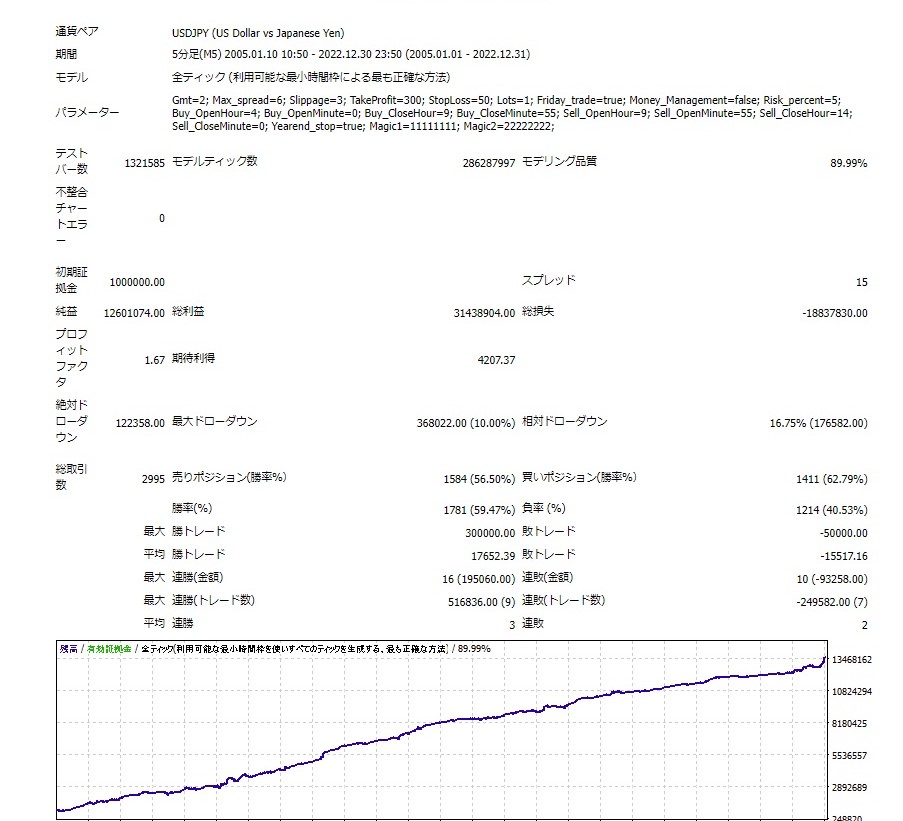
2005-2022 1Lot operation
Initial margin 1,000,000 yen
Net profit 12.6 million yen
Profit factor 1.67
Maximum drawdown 10%.
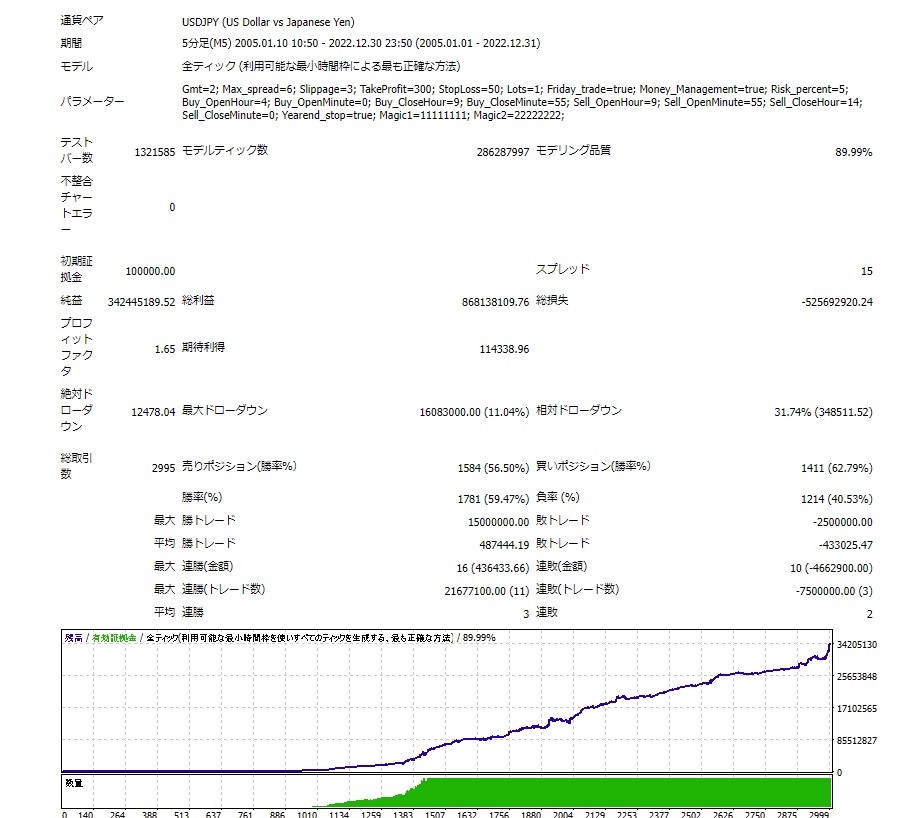
2005 - 2022 Compound interest
Initial margin 100,000 yen
Net income 340 million yen
Profit factor 1.65
Maximum drawdown 11.04
Parameter Setting
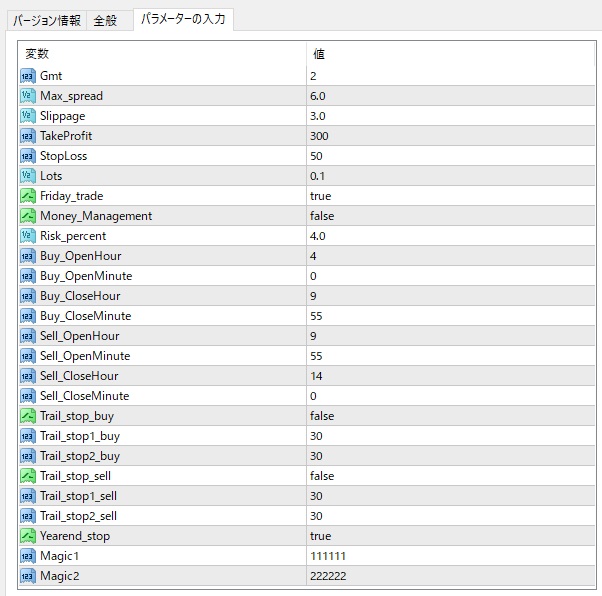
Gmt : Adjust the time difference from Greenwich Mean Time.
Max_spread : Maximum spread
Slippage : Slippage
TakeProfit : Take Profit
StopLoss : Stop Loss
Lots : Number of lots
Friday_trade : If "true" is selected, trade on Friday.
Money_Management : If "true" is selected, the compound interest mode is activated.
Risk_percent : Percentage of lot increase in compound mode
Buy_OpenHour : Open buy position (hour)
Buy_OpenMinute : Open buy position (minute)
Buy_CloseHour : Close buy position (hour)
Buy_CloseMinute : Close buy position (minute)
Sell_OpenHour : Sell position open (hour)
Sell_OpenMinute : Sell position open (minute)
Sell_CloseHour : Sell position closed (hour)
Sell_CloseMinute : Sell position closed (minute)
*Please enter all times in Japan time.
For open buy positions, use "0-8"; for open sell positions, use "9~".
Yearend_stop: If "true" is selected, no trades will be made during the year-end and New Year holidays (December 23 to January 7 )
Magic1 : The magic number of a buy position
Magic2 : The magic number of a sell position
What is Gmt?
Gmt indicates the number of hours difference from Greenwich Mean Time.
This number varies from forex firm to forex firm.
When "Gmt" is set to either "2" or "3," the EA automatically adjusts for winter and summer time, so there is no need to change manually when the seasons change.