ゴートゥーエブリデイ

- Whole period
- 2 years
- 1 year
- 6 months
- 3 months
- 1 month
Forward testing (Profit)
Monthly Statistics
- Jan
- Feb
- Mar
- Apr
- May
- Jun
- Jul
- Aug
- Sep
- Oct
- Nov
- Dec
Calendar for Months
About EA's Strategy
Translating...
Campaign in progress (until February 20, 2023)
There is no correlation between the Oceania Brothers, which relies on the AUD/NZD's retroactivity for long-term trades, and GoToEveryday, which relies on the economic activity of the MAC to make short-term trades.
In order to diversify between Oceania Brothers and GoToEveryday, as well as for your continued patronage, we are offering a discounted price for the first three months of GoToEveryday sales.
29,800 yen → 24,800 yen
Try to put together a portfolio with Oceania Brothers, which has a high diversification and correlation effect.
In accordance with my own policy, I will not make any price quotations in the future that would impair my prior interests.
Oceania Brothers prices may go up, but they will not go down, and GoToEveryday will not campaign again.
We do not want to disadvantage prior buyers by having them say, "If the price goes down, I shouldn't have bought it.
Background of Production
I always ask myself, "Is there any way to use the powerful weapon of FX leverage as an investment rather than a speculation?" I am always thinking "Is there any way to use the powerful weapon of FX leverage as an investment rather than a speculation?
After the first "Oceania Brothers," we developed 37 EAs in about 2 years to see if we could create a new logic, but none of them worked well when back-tested over a long period of time, or failed to generate profit when forward-tested even though back-tested well, so we put them in storage. I had to put them in storage.
And the 38th one is this second system trade, "Go to Everyday".
I thought this logic would be a level of system trading that I could sell in my mind, so I decided to release it to the public.
Point 1)
Trade at the middle market based on actual demand.
Just as the first "Oceania Brothers" falls under the genre of "repeat trades," "Go to Everyday" falls under the genre of "middle price trades.
The NAKANE is the daily exchange rate published by banks and other financial institutions at 10:00 a.m. every day. Based on this rate, companies doing business with foreign countries exchange yen into dollars for dollar-denominated settlements.
This middle price is determined by the rate at 9:55 AM.
Business transactions tend to be concentrated on the last day of the month. On the days falling on the 5th and 10th, companies request payment to their banks in advance, and these payments are often settled at the time when the middle market price is determined.
If there is a lot of dollar buying at that time, USD/JPY is expected to rise toward 9:55 AM. This is called an "intermediate price trade" to follow this trend.
While there are many indicators that are difficult to explain, the middle price trade, backed by actual demand for economic activity, is said to have certain advantages.
Point #2.
Align technical analysis.
If USD/JPY really does go up every day towards 9:55, why leave it to the EA in the first place?"
Why are there so many different methods of middle market trading? Is there a difference?"
In fact, the "middle price" phenomenon is relatively vague and weak for a well-known fundamental.
Questions about the mid-price trade
What if the real demand was not buying dollars, but selling dollars?"
Now that we know it's going up toward 9:55, when does it start going up?"
"Does it go up every day? If it's fifty days, does it go up every day?"
How confident can I be in buying USD/JPY when the whole world is trending toward a stronger yen?"
Is it also significant when there are larger fundamentals than the MAC, such as the employment report or CPI release the night before?"
In a nutshell, a middle price trade is not simple and raises a number of questions.
We developed "Go to Everyday" thinking that we could win if we could find a significant law, back-test it, adjust parameters, confirm reproducibility by forward testing, and turn it into an EA.
Winning rate for a simple mid-price trade
Let's express a simple mid-price trade in terms of win rate.
Buy 3 hours before each day and sell at 9:54 a.m.: 53% win rate
A difference that is almost random is called an "error," while a difference for which we can find meaning in the evidence is called a "significant difference," and 53% may be close to an error.
Trading limited to 50 days: 56% win rate
Theoretically, if the win rate is greater than 50%, the more you repeat the more profit you should get, according to the "law of large numbers". However, 56% is a bit discouraging, isn't it?
Trading limited to 50 days and Fridays: 74% win rate
A 74% win rate can definitely be called a significant difference and would be quite favorable to the trade.
But how many times a year can you trade "fifty days and Fridays"?
In "Go to Everyday," technical analysis is also used to determine when it is appropriate to enter the market and when it is the right time to buy.
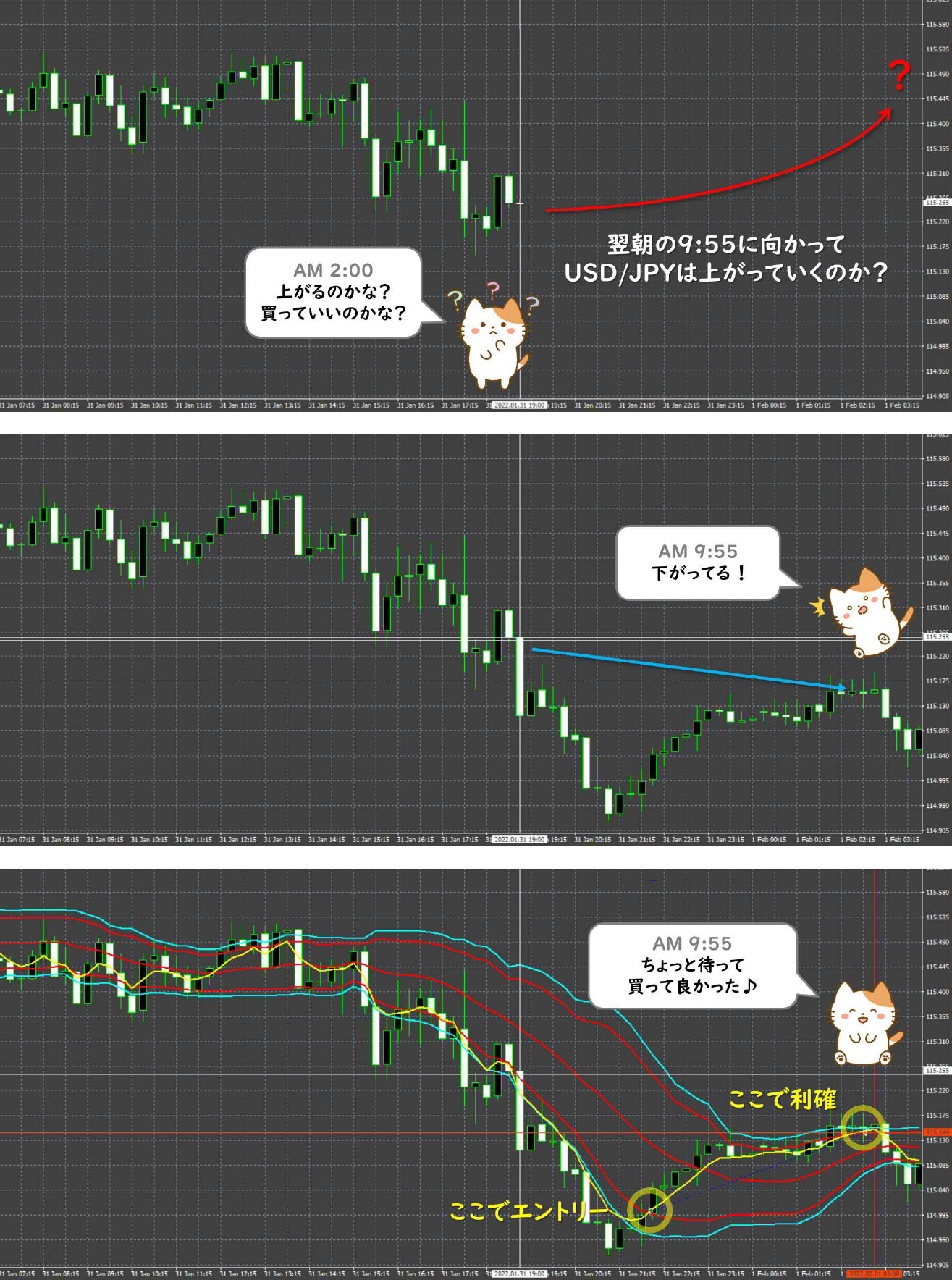
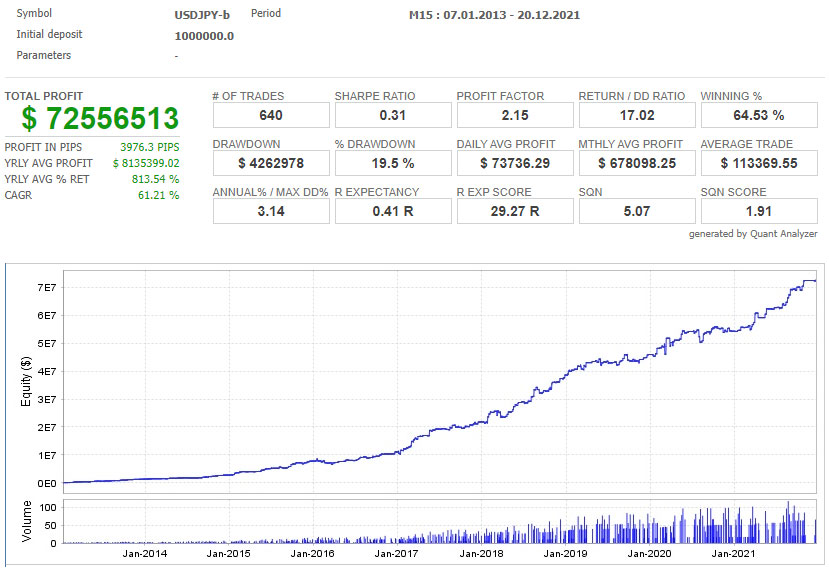
This resulted in a consistent 66% win rate overall and 74% on the fiftieth and Friday.
Although not a constant winner like the Oceania Brothers, repeated trades at this winning rate have resulted in a CAGR (compound annual growth rate) of 34.27% and a total return of 1,319% over 9 years, while keeping the maximum drawdown in the 6% range. (Back-tested with a domestic firm with 25x leverage)
Point (iii).
Tune in "every day of the week, every fifty days, and every month."
The phenomenon of the middle price has different characteristics for each day of the week, each fifty-day period, and each month.
In "Go to Everyday," the number of lots, entry conditions, and profit/loss conditions can be adjusted according to their nature.
First, let's look at what trends we see.
Trends by day of the week
First, let's look at the trends for each day of the week.
The columns of the table are, from left to right: CAGR (compound annual growth rate/annual interest rate), net profit (in yen), win rate, profit factor, maximum drawdown, total number of trades, and trend (graph).
If the trend is rightward, we intuitively know that the middle price trade is advantageous.
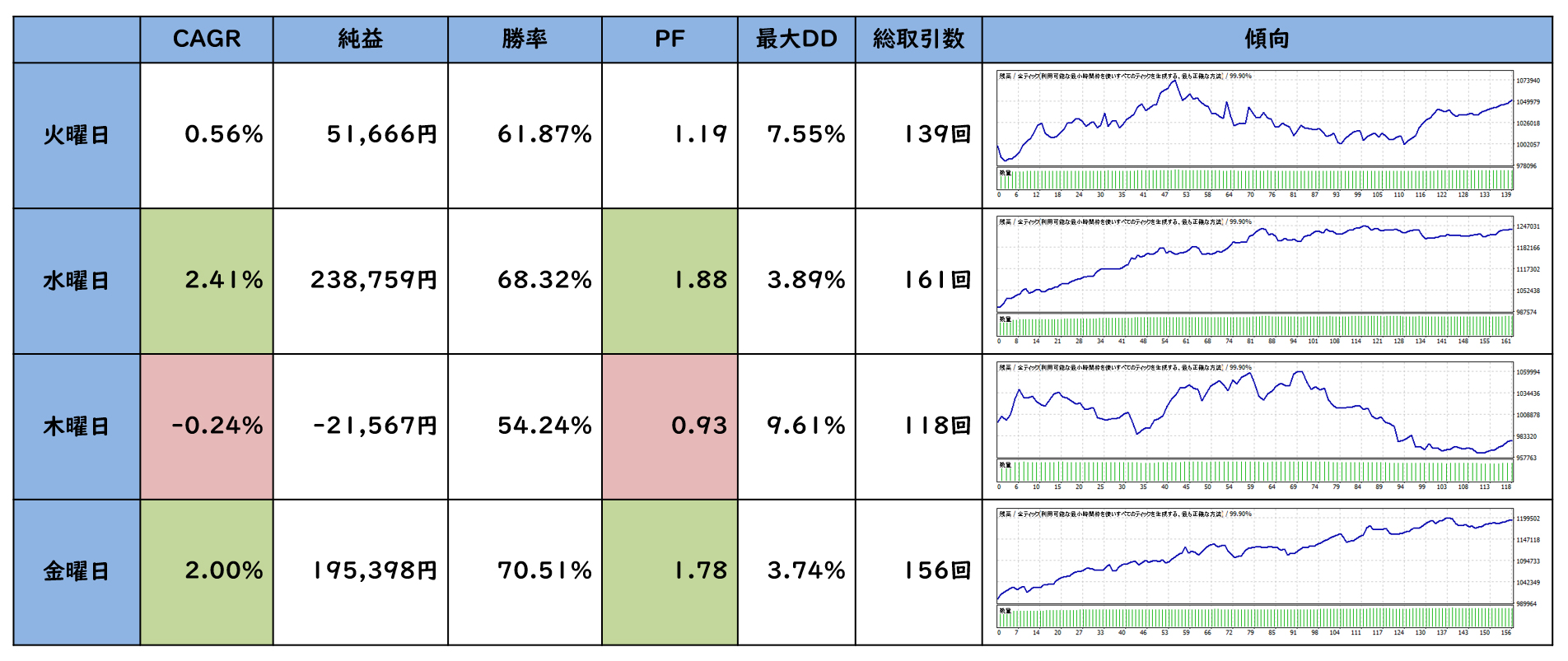
It is very clear in the trend graph. We found that there is a marked difference by day of the week.
We found that the logic favors Friday, the last business day of the week, as well as Wednesday, the middle of the week, for firms that have Saturdays and Sundays off, and conversely, it does not work well on Thursdays.
In "Go to Everyday," the number of lots can be adjusted to match this day-of-week trend.
Trends every 50 days
Next is the trend for every fifty days, which is generally considered favorable.
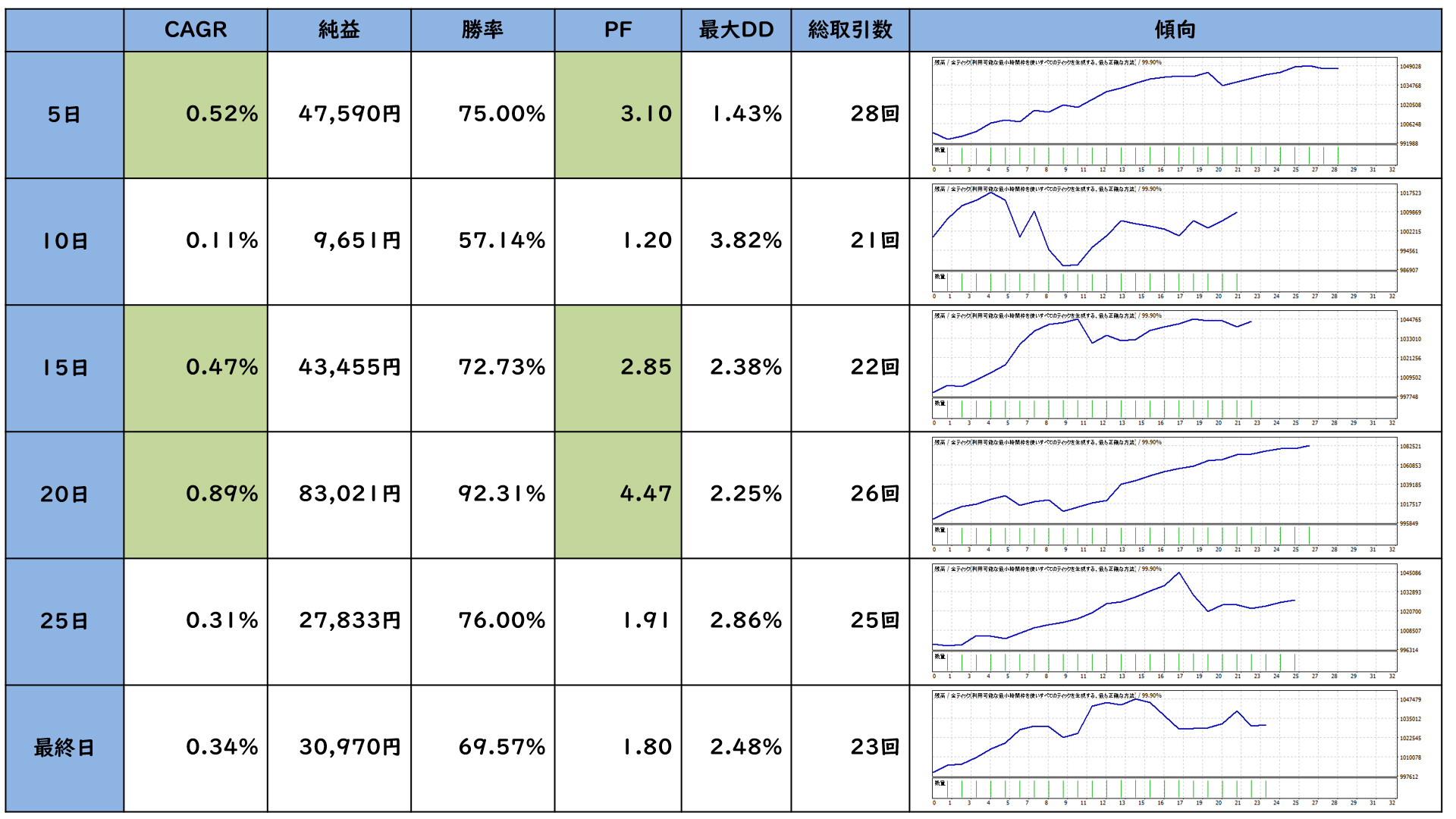
As expected for a fifty-day period, there are many straight lines that are easily righted compared to the days of the week. The average win rate is also 74%.
The day of the week comes around 4-5 times a month, while the date comes around only once a month, so the total number of transactions and net profit is lower, but it is still advantageous.
We found that the 5th, 15th, and 20th days were particularly significant. The number of lots should be adjusted for this 50-day trend as well.
By the way, the last day of the month refers to the 30th or 31st. In February, the last day of the month is the 28th, and in leap years, the last day of the month is the 29th.
monthly
As a further major indicator, differences exist from month to month.
After weighting the predominance of days of the week and fifty days of the week, let's look at the differences by month.
The first is from January to June.

Apparently, May is not a good month and the other months are favorable.
This is followed by July through December.
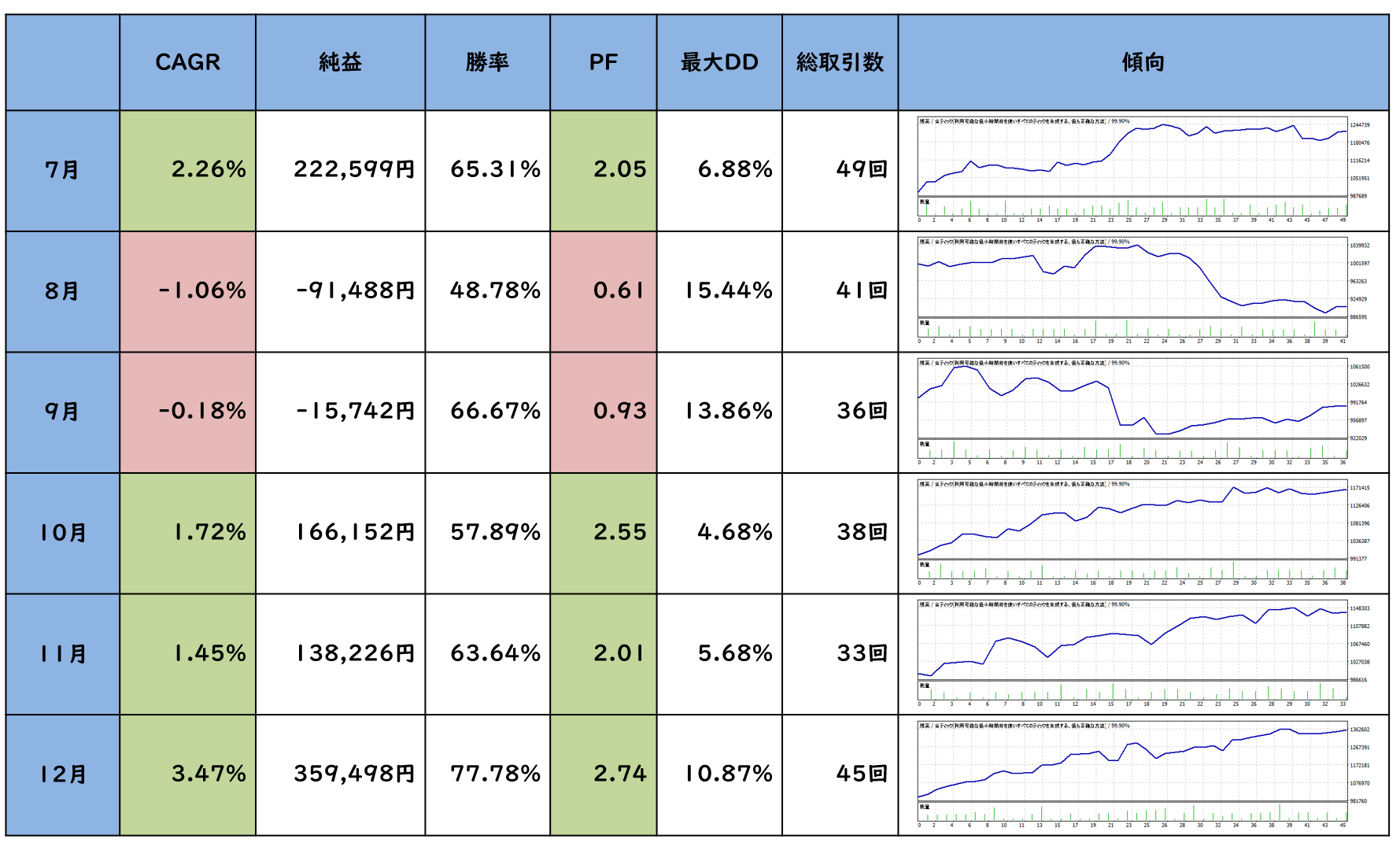
We found that an easy mid-price trade in August was largely negative, while the end of the year was advantageous.
In "Go to Everyday," significant monthly differences are converted into entry, gain, and loss conditions and handled with the aim of extending profits while reducing risk.
It also allows for compound interest to compensate for the low number of entries as it examines them.
Point (iv).
"You can set a day when you will not trade."
No matter how much we optimize conditions by day of the week, by fifty days, or by month, we cannot beat the fundamentals of a wave larger than the middle price.
For example, the day after the FOMC releases its monetary policy, the USD/JPY will fluctuate wildly, and the significance of the middle price will be drowned out.
Therefore, "Go to Everyday" allows you to set a day when you do not trade by writing it in advance in the settings file.
In addition to Japanese holidays, where no real demand is expected, the FOMC meeting dates are written in advance.
If other economic indicators or fundamentals of concern are expected, the trade can be avoided by adding the date to the file in advance.
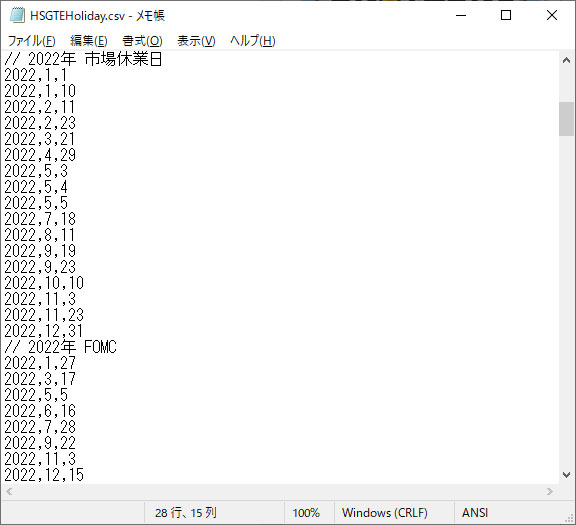
About the configuration file
Define the days for which you do not want to make entries, one per line, with the dates separated by commas.
The file name is HSGTEHoliday.csv and should be placed in "MT4 folder/MQL4/Files/HSGTEHoliday.csv" when executed.
When backtesting, place the file as "MT4 folder/tester/files/HSGTEHoliday.csv".
Point (5).
Uncorrelated to Oceania Brothers.
The last point is that it is uncorrelated with the Oceania Brothers.
The key to building a portfolio using multiple EAs is the "diversification effect" and the "correlation effect.
dispersion effect
The first, "diversification effect," is the well-known theory that risk can be reduced by holding multiple assets, familiarly known as "don't put all your eggs in one basket.
However, if you diversify into assets that move in the same way, the risk reduction effect will be limited no matter how diversified you are.
Example of no dispersion effect
For example, suppose there is a repeating EA for USD/JPY and a repeating EA for EUR/JPY.
You may feel that you are diversified with different currencies, but if a social phenomenon such as "global depreciation of the yen" occurs, you will both have large unrealized losses.
This phenomenon occurs because both EAs are repeaters against the yen, and even though they are diversified, the high correlation is insufficient to reduce risk.
correlation effect
The second "correlation effect" means that if you build a portfolio with logics that move differently, you can reduce risk (in the case of EAs, total drawdowns will be reduced).
Think of an individual investor using an EA as the president of a company. The CEO does not want to work, so he/she makes money and logic work for him. In other words, the EA is an employee.
You have hired Mr. Oceania Brothers as your first employee and Ms. GoToEveryday as your second employee.

The two are each given a budget and asked to earn money by performing their duties.
At this point, what if these two employees have similar skills and personalities and are assigned similar tasks?
That's right. They make a mistake at the same time, they lose money at the same time, and the company is out of business.

If we are going to have them do similar work in the first place, why not just have one employee and increase the budget (number of lots in EA)?

If you are going to hire two employees, it is more stable for the company to have them perform completely different tasks with completely different skills and personalities.
Of course, in the short term, there may be periods when both of you will lose money, but in the long run, the probability that both of you will make mistakes at the same time is low, reducing the risk.

The larger the number of these employees, the better the diversification effect, but it is a prerequisite that each employee, or EA, is trustworthy. The employees should be as clear as possible about their origins (or logic in the case of EA) and make as few mistakes as possible.
It took me more than two years to find a reliable method instead of unnecessarily increasing the number to build a portfolio!
There is no correlation between "Oceania Brothers," which relies on the AUD/NZD retroactivity for long-term trades, and "GoToEveryday," which relies on the economic activity of the MAC to make short-term trades. The diversification and correlation effect is high, so please try to put a portfolio together.
Back Tests / Domestic Contractors
The following are the results of a backtest using the domestic FX firm OANDA Japan with the default values of the parameters.
The following are only the results of back-testing against historical data, and the default values of the parameters do not guarantee safety against forced losses.
Back Tests / Domestic Contractors
This is the result of a 9-year (January 1, 2013 - December 31, 2021) back test with an initial margin of 1 million yen.
In nine years, one million yen has become 14,190,000 yen.
- Net income: 13.19 million yen
- Total number of transactions: 515
- Profit factor: 2.27
- Maximum drawdown: 6.44%.
- Winning percentage: 66.41
- CAGR: 34.27%.
- Total return: 1,319%.
parameter
The parameters that can be specified for "Go to Everyday" are as follows
basis
The following are basic parameters.
Even when operating at the default values, adjust the compounding factor for compounding and the simple lot number for simple interest operation to match the initial margin and leverage.
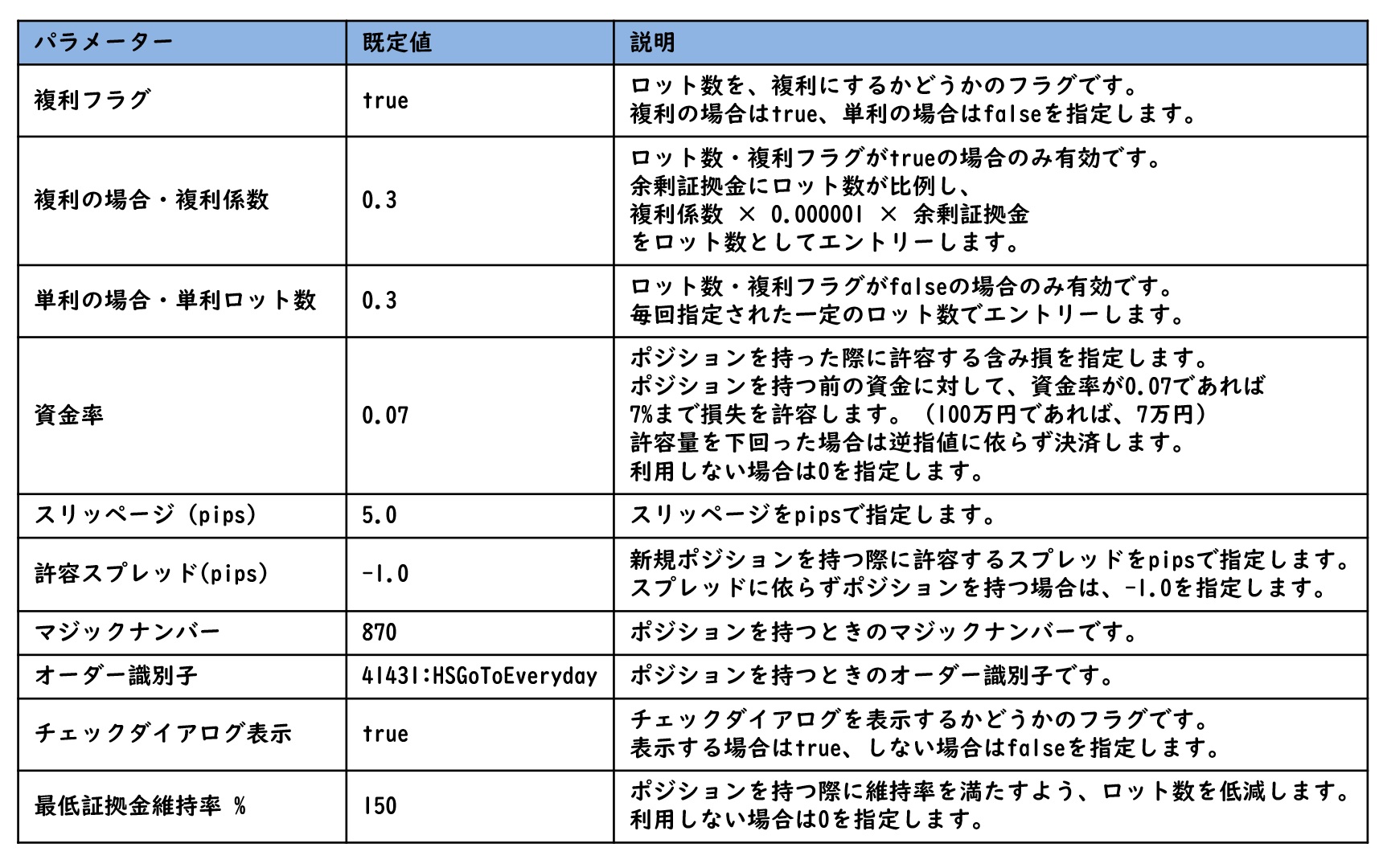
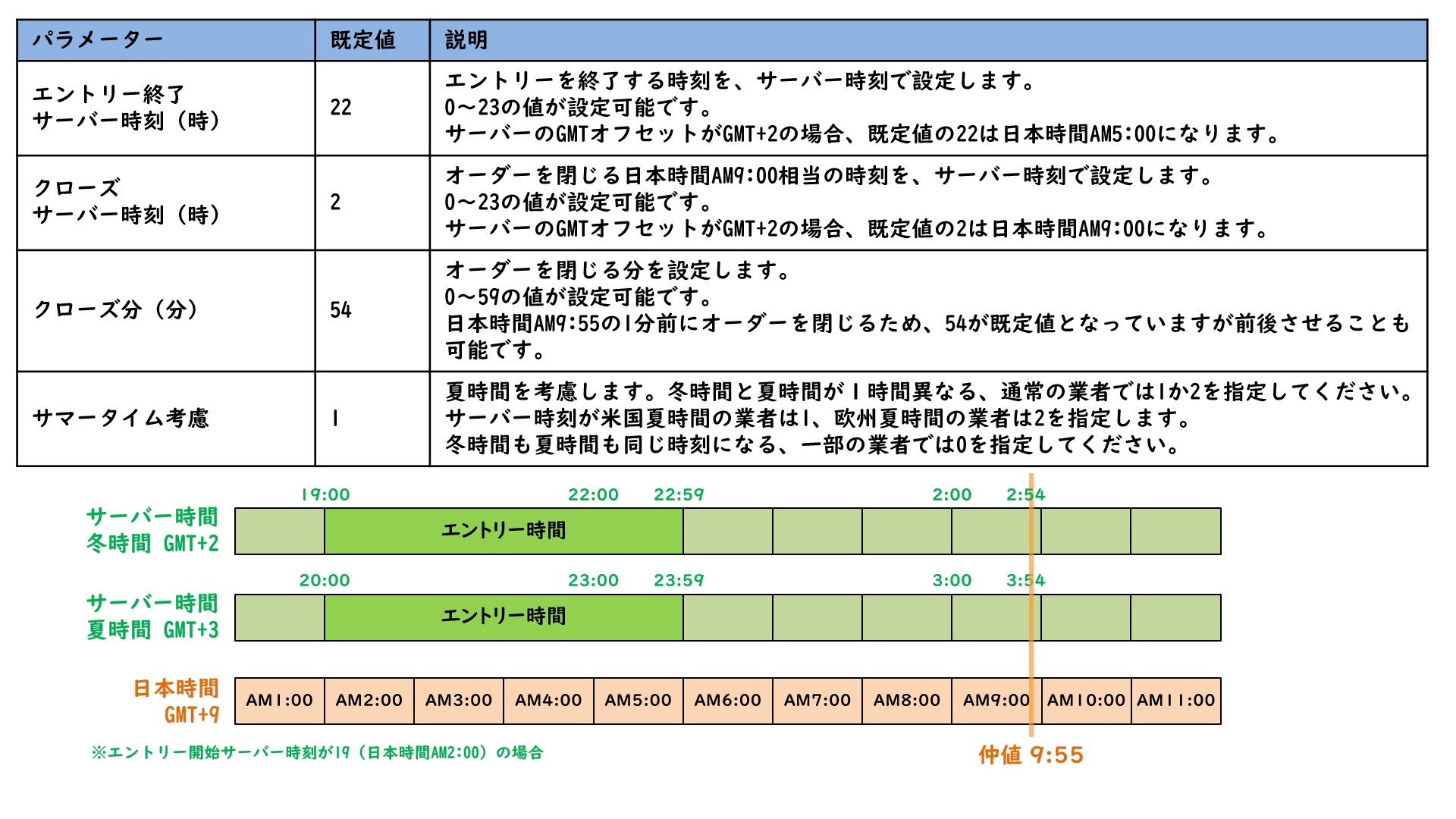
time
Set the time to be used for entry and close. Check the server time of the vendor you are using and set the time.
Lot Factor / Day of Week
Specify the lot factor for each day of the week. The lot factors for the day of the week and fifty days are summed and multiplied by the number of lots.
If significance is expected for each day of the week, set a larger value.

Lot Factor, 50 days
Specify the lot factor for each fifty-day period. The lot factors for the day of the week and the fifty days are summed and multiplied by the number of lots.
If significance is expected by 50 days, set a larger value.

decision MA
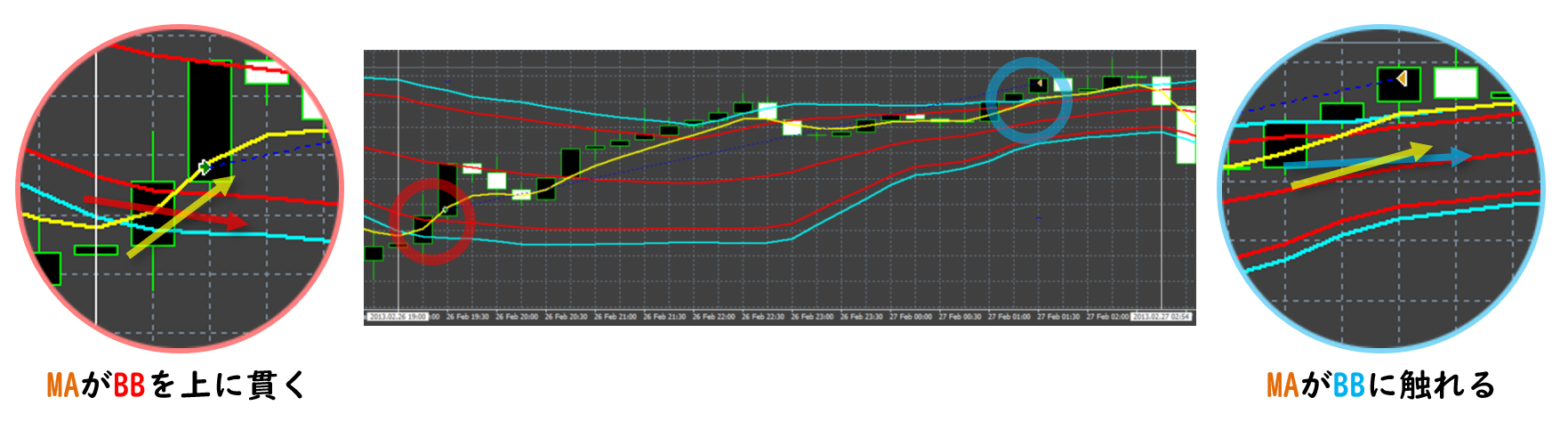
Specify the MA to be used to determine the intersection with Bollinger Bands.

Class Number / Month
Specify the class number to which each month is assigned.

Class Details
Specify the deviation of the Bollinger band and the profit/loss pips to be used for entry and close for each class.
The smaller the number for the entry condition, the greater the risk/reward for the close condition.
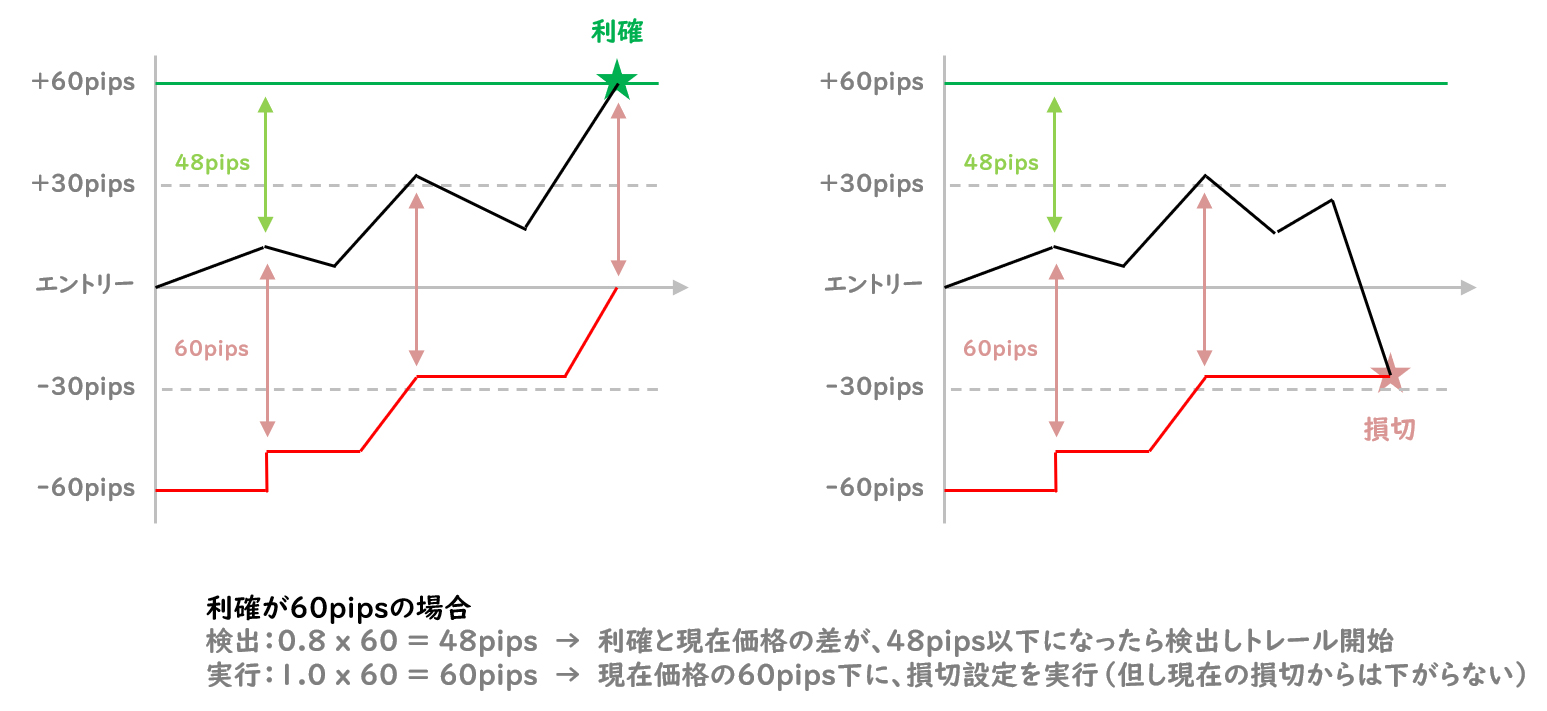
A trailing stop is available that automatically updates the stop loss level to reduce the amount of loss in the event of a loss.
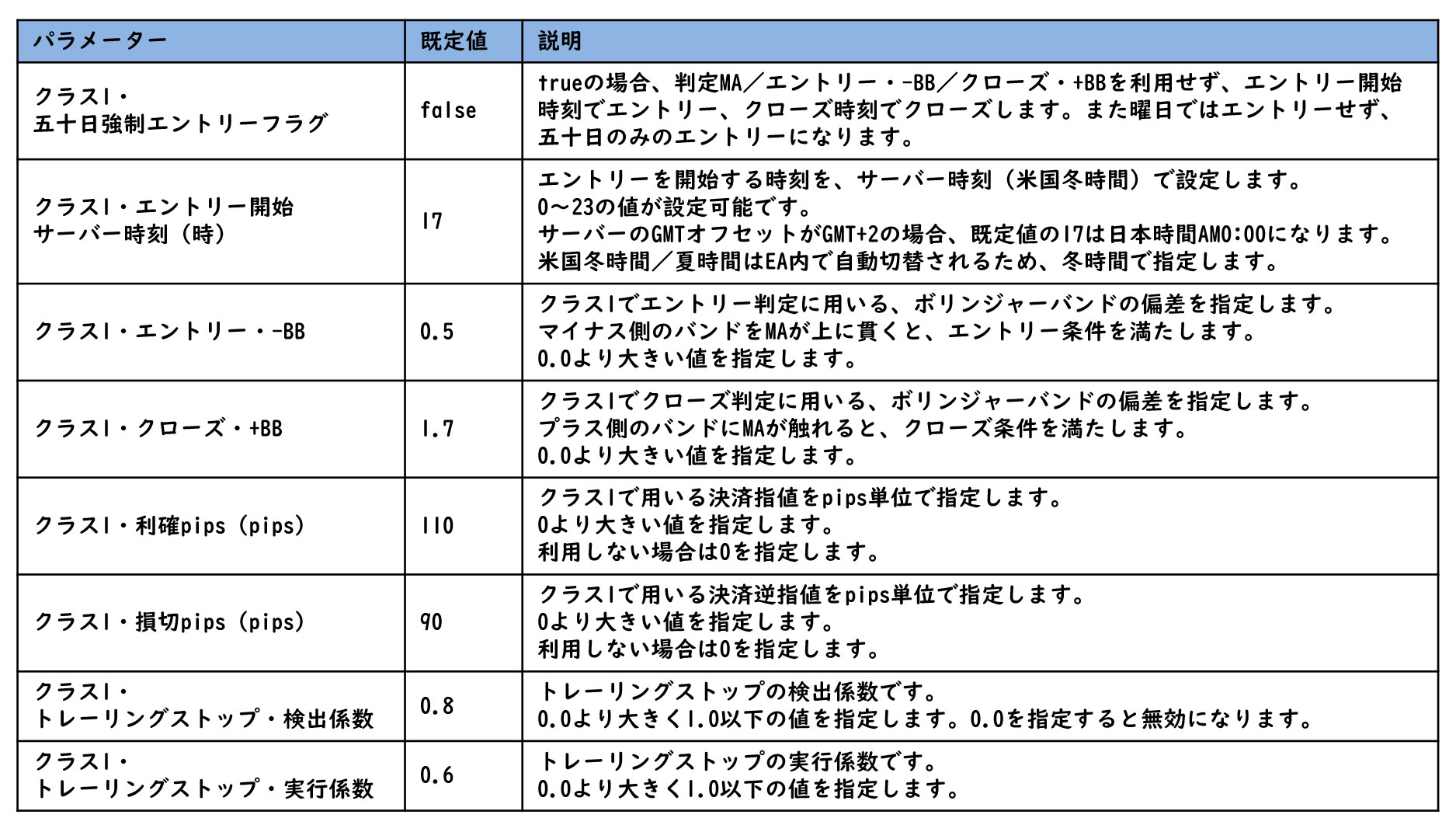
For Class 1, see below.
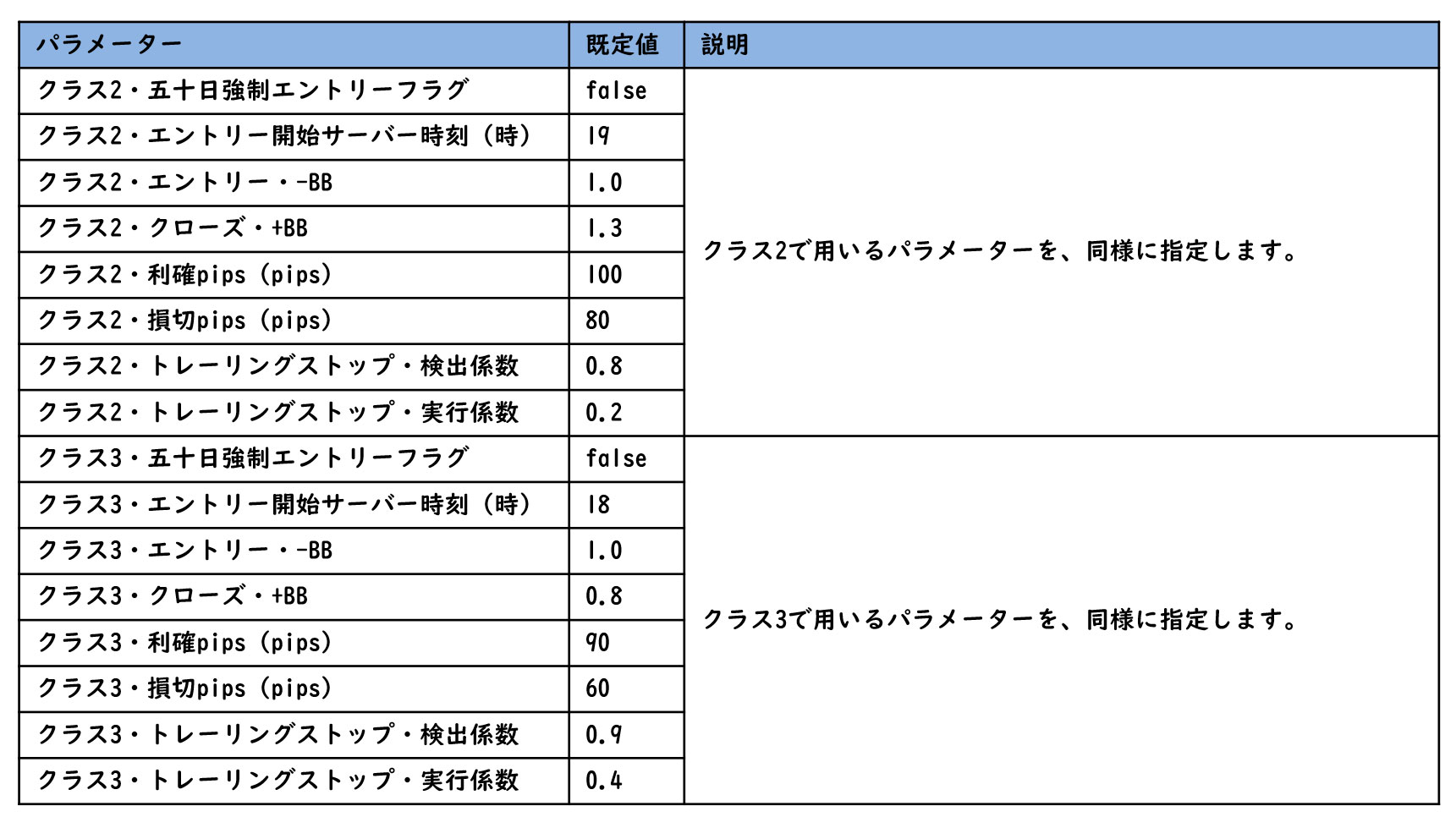
Classes 2 through 5 are specified in the same manner.

Supported Currency Pairs
Only USD/JPY is supported.
Corresponding vendor
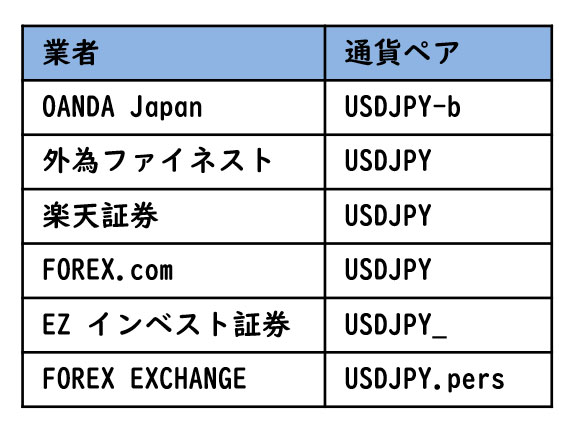
We intend to design the system to work with any vendor that handles USD/JPY.
The author has confirmed the operation with the following vendors
Domestic Contractors
The coupon will expire in 5 days.
Price: $157.23 (taxed)
¥24,800(taxed)
●Payment



Sales from : 12/22/2022 22:35
Price: $157.23 (taxed)
¥24,800(taxed)
●Payment
Just like discretionary trading, there are those that decide trading and settlement timings by combining indicators, those that repeatedly buy or sell at certain price (pips) intervals, and trading methods that utilize market anomalies or temporal features. The variety is as rich as the methods in discretionary trading.
To categorize simply,
・Scalping (Type where trades are completed within a few minutes to a few hours),
・Day Trading (Type where trades are completed within several hours to about a day),
・Swing Trading (Type where trades are conducted over a relatively long period of about 1 day to 1 week)
・Grid/Martingale Trading (Holding multiple positions at equal or unequal intervals and settling all once a profit is made. Those that gradually increase the lot number are called Martingale.)
・Anomaly EA (Mid-price trading, early morning scalping)
However, a substantial advantage of automated trading is its ability to limit and predict risks beforehand.
[Risk]
Inherent to forex trading are the trading risks that undeniably exist in automated trading as well.
・Lot Size Risk
Increasing the lot size forcibly due to a high winning rate can, in rare instances, depending on the EA, lead to substantial Pips loss when a loss occurs. It is crucial to verify the SL Pips and the number of positions held before operating with an appropriate lot.
・Rapid Market Fluctuation Risk
There are instances where market prices fluctuate rapidly due to index announcements or unforeseen news. System trading does not account for such unpredictable market movements, rendering it incapable of making decisions on whether to settle in advance or abstain from trading. As a countermeasure, utilizing tools that halt the EA based on indicator announcements or the VIX (fear index) is also possible.
[Benefits]
・Operates 24 hours a day
If there is an opportunity, system trading will execute trades on your behalf consistently. It proves to be an extremely convenient tool for those unable to allocate time to trading.
・Trades dispassionately without being swayed by emotions
There is an absence of self-serving rule modifications, a common human tendency, such as increasing the lot size after consecutive losses in discretionary trading or, conversely, hastily securing profits with minimal gains.
・Accessible for beginners
To engage in Forex trading, there is no prerequisite to study; anyone using system trading will achieve the same results.
[Disadvantages]
・Cannot increase trading frequency at will
Since system trading operates based on pre-programmed conditions, depending on the type of EA, it might only execute trades a few times a month.
・Suitability may vary with market conditions
Depending on the trading type of the EA, there are periods more suited to trend trading and periods more suited to contrarian trading, making consistent results across all periods unlikely. While the previous year might have yielded good results, this year's performance might not be as promising, necessitating some level of discretion in determining whether it is an opportune time to operate.
・MT4 (MetaTrader 4. An account needs to be opened with a Forex company that offers MT4.)
・EA (A program for automated trading)
・The operating deposit required to run the EA
・A PC that can run 24 hours or a VPS (Virtual Private Server), where a virtual PC is hosted on a cloud server to run MT4.
Additionally, there are both demo and real accounts available. You can experience trading with virtual money by applying for a demo account. After opening a real account, you select the connection server assigned by the Forex broker, enter the password, and log in to the account.
When you deposit money into your account using the method specified by the forex broker, the funds will be reflected in your MT4 account, and you can trade.
Firstly, download the purchased EA file from your My Page on GogoJungle. You will download a zip (compressed) file, so right-click to extract it and retrieve the file named ‘◯◯◯ (EA name)_A19GAw09 (any 8 alphanumeric characters).ex4’ from inside.
Next, launch MT4 and navigate to ‘File’ → ‘Open Data Folder’ → ‘MQL4’ → ‘Experts’ folder, and place the ex4 file inside. Once done, close MT4 and restart it. Then, go to the upper menu ‘Tools’ → ‘Options’, and under ‘Expert Advisors’, ensure ‘Allow automated trading’ and ‘Allow DLL imports’ are checked, then press OK to close.
The necessary currency pair and time frame for the correct operation of the EA are specified on the EA sales page. Refer to this information and open the chart of the correct currency pair time frame (e.g., USDJPY5M for a USD/Yen 5-minute chart).
Within the menu navigator, under ‘Expert Advisors’, you will find the EA file name you placed earlier. Click to select it, then drag & drop it directly onto the chart to load the EA. Alternatively, you can double-click the EA name to load it onto the selected chart.
If ‘Authentication Success’ appears in the upper left of the chart, the authentication has been successful. To operate the EA, you need to keep your PC running 24 hours. Therefore, either disable the automatic sleep function or host MT4 on a VPS and operate the EA.
If you want to use it with an account other than the authenticated one, you need to reset the registered account.
To reset the account, close the MT4 where the Web authentication is registered, then go to My Page on GogoJungle > Use > Digital Contents > the relevant EA > press the ‘Reset’ button for the registration number, and the registered account will be released.
When the account is in a reset state, using the EA with another MT4 account will register a new account.
Also, you can reset the account an unlimited number of times.
→ Items to Check When EA is Not Operating
1 lot = 100,000 currency units
0.1 lot = 10,000 currency units
0.01 lot = 1,000 currency units
For USD/JPY, 1 lot would mean holding 100,000 dollars.
The margin required to hold lots is determined by the leverage set by the Forex broker.
If the leverage is 25 times, the margin required to hold 10,000 currency units of USD/JPY would be:
10000*109 (※ at a rate of 109 yen per dollar) ÷ 25 = 43,600 yen.
・Risk-Return Ratio: Total Profit and Loss during the period ÷ Maximum Drawdown
・Maximum Drawdown: The largest unrealized loss during the operation period
・Maximum Position Number: This is the maximum number of positions that the EA can theoretically hold at the same time
・TP (Take Profit): The set profit-taking Pips (or specified amount, etc.) in the EA's settings
・SL (Stop Loss): The set maximum loss pips (or specified amount, etc.) in the EA's settings
・Trailing Stop: Instead of settling at a specified Pips, once a certain profit is made, the settlement SL is raised at a certain interval (towards the profit), maximizing the profit. It is a method of settlement.
・Risk-Reward Ratio (Payoff Ratio): Average Profit ÷ Average Loss
・Hedging: Holding both buy and sell positions simultaneously (Some FX companies also have types where hedging is not allowed)
・MT4 Beginner's Guide
・Understanding System Trading Performance (Forward and Backtesting)
・Choosing Your First EA! Calculating Recommended Margin for EAs
・Comparing MT4 Accounts Based on Spread, Swap, and Execution Speed
・What is Web Authentication?
・Checklist for When Your EA Isn't Working