アノマリーマスター

- Whole period
- 2 years
- 1 year
- 6 months
- 3 months
- 1 month
Real Performance
※Displays results including swaps and fees
Forward testing (Profit)
Monthly Statistics
- Jan
- Feb
- Mar
- Apr
- May
- Jun
- Jul
- Aug
- Sep
- Oct
- Nov
- Dec
Calendar for Months
About EA's Strategy
Translating...
summary
This EA is a dedicated USDJPY EA consisting of multiple logics. It is equipped with a unique filter so that entries are not made under dangerous conditions. Therefore, it is possible to operate it with complete abandon, and even EA beginners can use it with peace of mind.
results
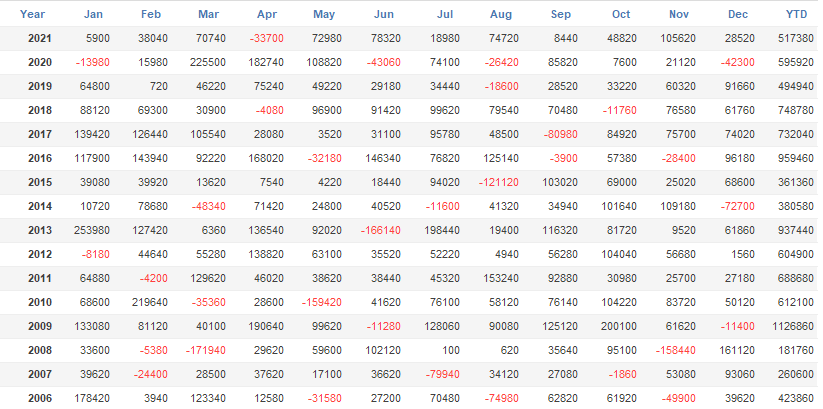
We have not lost on a yearly basis since 2006. In addition, the monthly win rate has exceeded 80%.
setting (of a computer or file, etc.)
Basically, you only need to set up the top section, Main Setting. In the following sections, you can change detailed settings. The default settings are what I consider to be the best settings.
Main Setting
Comment (default: Anomaly Master)
This is the comment displayed in the log. The item number "28923:" is added at the beginning.
Magic Number 1 (initial value: 10001)
Magic Number 2 (initial value: 10002)
Magic Number 3 (initial value: 10003)
Magic Number 3 (initial value: 10003) ・Magic Number 4 (initial value: 10004)
These are the magic numbers for Logic 1 to 4.
Please set them so that they do not overlap with other logics of this EA or other EAs running in the same MT4.
Lot (Default: 1.0)
This is the trading lot size.
Please change to an appropriate value for the amount of funds.
Summer Time Type (Default: USA)
This is the type of daylight saving time. Change the value according to the forex broker you use.
Select "USA" for American style, "British" for British style, or "None" if there is no daylight saving time.
Spread (pips) (Default value: 2.0)
This is the upper limit of the spread.
If the spread exceeds this value, entry will not be made.
Slippage (pips) (Default: 5.0)
This is the upper limit of the slip page.
If the slip page exceeds this value, entry will not be made.
Logic 1 Setting
Logic 1 (initial value: true)
Change to false if logic 1 is not used.
Take Profit(pips)(Default:20.0)
Take profit value.
Use Variable Stoploss (initial value: true)
If you do not want to use variable stop loss, change this to false.
If true, the stop loss is set to the highest price from 1:00 server time of the day to the entry time.
If false, the value of Max Stop Loss will be used as the stop loss value.
Min Stop Loss(pips)(Default:10.0)
This is the minimum value when using variable stop loss.
Max Stop Loss(pips)(Default:20.0)
This is the maximum value when using variable stop loss.
Offset(pips)(Default:0.5)
The position of the variable stop loss is shifted by this value.
For example, if Offset is 0.5 and the highest price of the day is 113.300, the stop loss will be set at 113.305.
Close Hour(Default:8)
Close Minute(Default:0)
Set the time of settlement.
Close Logic 1 (initial value: true)
Close Logic 1 Start Hour (initial value: 5)
Close Logic 1 Start Minute (initial value: 0)
Sets whether or not to use Close Logic 1 and at what time it is triggered in server time.
Close Logic 2 (initial value: true)
Close Logic 2 Start Hour (initial value: 6)
Close Logic 2 Start Minute (initial value: 0)
This is the setting for whether or not to use Close Logic 2 and at what time it is triggered in server time.
Use Summer Time to Close Logic (Default: true)
If true, the settlement time is delayed by one hour in server time during daylight saving time.
That is, if Close Hour is 8, the settlement time will be 8:00 server time in winter time, but 9:00 server time in summer time.
This also applies to Start Hour in Close Logic 1 and 2.
If set to false, Close Hour will settle at the set server time even in summer time.
Tuesday (default: true)
Wednesday (default: true)
Thursday (default: true)
Friday (default: true)
You can set whether to enter on Tuesday, Wednesday, Thursday, and Friday.
Monday is not entered because of its low advantage.
Japan Holiday Filter (default: true)
If true, entries will not be made on Japanese holidays.
As of version 1.21, it supports holidays up to the year 2022.
This filter will be updated annually.
In case it is not updated for some reason, please set the holiday to the specified date filter described below.
USA Holiday Filter(Default:true)
If true, entries will not be made on U.S. holidays.
(Since U.S. holidays are regular, this filter will work even if I do not update it unless this rule is changed.
Original Filter 1 (default: true)
Original Filter 2 (default: true)
Original Filter 3 (default: true)
These are my original filters. If you don't use it, please set it to "false".
Logic 2 Setting
Logic 2 (initial value: true)
If you do not use Logic 2, change to false.
Take Profit(pips)(Default:30.0)
This is the take profit value.
Use Variable Stoploss (initial value: true)
If you do not want to use variable stop loss, change this to false.
If true, the stop loss is set to the highest price from 1:00 server time of the day to the entry time.
If false, the value of Max Stop Loss will be used as the stop loss value.
Min Stop Loss(pips)(Default:15.0)
This is the minimum value when using variable stop loss.
Max Stop Loss(pips)(Default:30.0)
This is the maximum value when using variable stop loss.
Offset(pips)(Default:0.5)
The position of the variable stop loss is shifted by this value.
For example, if Offset is 0.5 and the highest price of the day is 113.300, the stop loss will be set at 113.305.
Entry Start Day (Default: 23)
This is the start day of Logic 2.
Close Hour (initial value: 8)
Close Minute (initial value: 0)
Set the settlement time.
Close Logic 1 (initial value: true)
Close Logic 1 Start Hour (initial value: 5)
Close Logic 1 Start Minute (initial value: 0)
Sets whether or not to use Close Logic 1 and at what time it is triggered.
Close Logic 2 (initial value: true)
Close Logic 2 Start Hour (initial value: 6)
Close Logic 2 Start Minute (initial value: 0)
This is the setting for whether or not to use Close Logic 2 and at what time it is activated.
Use Summer Time to Close Logic (initial value: true)
If true, the settlement time is delayed by one hour in server time during daylight saving time.
That is, if Close Hour is 8, the settlement time will be 8:00 server time in winter time, but 9:00 server time in summer time.
This also applies to Start Hour in Close Logic 1 and 2.
If set to "false", Close Hour will settle at the set server time even in summer time.
Tuesday (default: true)
Wednesday (default: true)
Thursday (default: true)
Friday (default: true)
You can set whether to enter on Tuesday, Wednesday, Thursday, and Friday.
Monday is not entered because of its low advantage.
Japan Holiday Filter (initial value: true)
If true, entries will not be made on Japanese holidays.
As of version 1.21, it supports holidays up to the year 2022.
This filter will be updated annually.
In case it is not updated for some reason, please set the holiday to the specified date filter described below.
USA Holiday Filter (default: true)
If true, entries will not be made on U.S. holidays.
Since U.S. holidays are regular, this will work even if I do not update it unless this rule changes.
Logic 3 Setting
Logic 3 (default: true)
If you do not use Logic 3, change to false.
Take Profit(pips)(Default:50.0)
This is the take profit value.
Stop Loss(pips)(Default:40.0)
This is the stop loss value.
Entry Start Day (initial value: 23)
The start date of Logic 3.
Entry Hour (initial value: 2)
Entry Minute (initial value: 0)
Entry time setting.
Use Summer Time to Entry Hour (initial value: false)
If true, entry time is delayed by one hour in server time during daylight saving time.
That is, if Entry Hour is set to 2, entry will be made at 2:00 server time during winter time, but at 3:00 server time during summer time.
If false, entry will be made at the set server time even in summer time.
Close Hour(Default:8)
Close Minute (default: 0)
Set the settlement time.
Close Logic 1 (initial value: true)
Close Logic 1 Start Hour (initial value: 5)
Close Logic 1 Start Minute (initial value: 0)
Sets whether or not to use Close Logic 1 and at what time it is triggered.
Close Logic 2 (initial value: true)
Close Logic 2 Start Hour (initial value: 6)
Close Logic 2 Start Minute (initial value: 0)
This is the setting for whether or not to use Close Logic 2 and at what time it is activated.
Use Summer Time to Close Logic (initial value: true)
If true, the settlement time is delayed by one hour in server time during daylight saving time.
That is, if Close Hour is 8, the settlement time will be 8:00 server time in winter time, but 9:00 server time in summer time.
This also applies to Start Hour in Close Logic 1 and 2.
If set to false, Close Hour will settle at the set server time even in daylight savings time.
Monday (default: true)
Tuesday (default: false)
Wednesday (default: false)
Thursday(initial value:false)
You can set whether or not to enter on Monday, Tuesday, Wednesday, and Thursday.
No entry is made on Fridays, as Logic 1 and 2 have priority.
Japan Holiday Filter (initial value: true)
If true, entries will not be made on Japanese holidays.
As of version 1.21, it supports holidays up to the year 2022.
This filter will be updated annually.
In case it is not updated for some reason, please set the holiday to the specified date filter described below.
USA Holiday Filter (default: false)
If true, entries will not be made on U.S. holidays.
Since U.S. holidays are regular, this will work even if I do not update it unless this rule changes.
Logic 4 Setting
Logic 4 (default: true)
Change to false if logic 4 is not used.
Take Profit(pips)(Default:60.0)
This is the take profit value.
Stop Loss(pips)(Default:60.0)
This is the stop loss value.
Use Logic Entry (initial value: true)
This is the setting for whether or not to use logic entry.
If false, entry is made at the time set in Entry End Hour and Entry End Minute.
Entry Start Hour (default: 21)
Entry Start Minute (initial value: 0)
Entry End Hour (initial value: 23)
Entry End Hour (initial value: 23) ・Entry End Minute (initial value: 0)
The start and end time of a logic entry can be set.
Close Minute(Default:55)
Allows you to set the time at which the trade will close at 9:00 a.m. Japan Standard Time (JST).
If the value is set to 56 or higher, the value is reset to 55.
Entry Stop Day (Default: 25)
Entry will not be made after the set date.
Since Logic 4 is a day-straddling logic, the default setting is that entries are made until the settlement on the 25th.
If you wish to operate until the end of the month, set a value of 32 or higher.
Monday (default: true)
Tuesday (default: true)
Wednesday (initial value: true)
Thursday (initial value: true)
You can set whether to enter on Monday, Tuesday, Wednesday, or Thursday.
Since Logic 4 is a cross-day logic, if Thursday is set to false, entries that are closed on Friday will not be made.
Japan Holiday Filter (default: true)
If true, entries will not be made on Japanese holidays.
As of version 1.21, it supports holidays up to the year 2022.
This filter will be updated annually.
In case it is not updated for some reason, please set the holiday to the specified date filter described below.
USA Holiday Filter (default: true)
If true, entries will not be made on U.S. holidays.
Since U.S. holidays are regular, this will work even if I do not update it unless this rule changes.
Original Filter (Default: true)
My original filter. If you do not use it, set it to false.
Money Management Setting
Money Management (default: false)
To use the compound interest function, change to "true".
Money Management Type (default: balance)
This is the type of money used to calculate the lot size for the compounding function.
Balance is the account balance, and FreeMargin is the excess margin.
Risk (default: 1.0)
The number of lots per 1,000,000 yen.
Minimum Lot (Default: 0.1)
Minimum lot number.
Maximum Lot (Default value: 5.0)
The maximum number of lots.
Number Of Digits (Default: 2)
The number of decimal places to be used in lot calculations.
Common Filter Setting (common to all logics)
Nenshi Filter (initial value: true)
If true, no entry is made at the beginning of the year.
Nenshi Entry Start Day
If the Nenshi Filter is true, entries will be made from this day.
Nenmatsu Filter (initial value: false)
If true, entries are not made at the end of the year.
Nenmatsu Last Entry Day (initial value: 23)
If the Nenmatsu Last Entry Day filter is true, this will be the last entry day.
Specified Day Filter (common filter for all logics)
Specified date filter.
Entries will no longer be made on the set month and day.
You can set this filter for 5 days.
Since Logic 4 is a cross day logic, entries on the day before the set month and day will be eliminated.
For example, if Stop Month 1 is set to 3 and Stop Day 1 is set to 15
Logic 1, 2, and 3 will eliminate entries on March 15, while Logic 4 will eliminate entries on March 14.
precautions
Please use with vendors that use summer time GMT+3 and winter time GMT+2. Most forex brokers use this GMT, but there are a few that differ.
Upgrade Information
1.2Parameter Release
Addition of variable stop loss
Addition of Settlement Logic
Fine-tuning of filters
Enhanced error handling
1.1
Add compound interest function
Change parameters from Japanese to English (to prevent garbled characters)
The coupon expires today.
Price: $190.45 (taxed)
¥30,000(taxed)
●Payment



Sales from : 04/28/2021 01:23
Price: $190.45 (taxed)
¥30,000(taxed)
●Payment
Just like discretionary trading, there are those that decide trading and settlement timings by combining indicators, those that repeatedly buy or sell at certain price (pips) intervals, and trading methods that utilize market anomalies or temporal features. The variety is as rich as the methods in discretionary trading.
To categorize simply,
・Scalping (Type where trades are completed within a few minutes to a few hours),
・Day Trading (Type where trades are completed within several hours to about a day),
・Swing Trading (Type where trades are conducted over a relatively long period of about 1 day to 1 week)
・Grid/Martingale Trading (Holding multiple positions at equal or unequal intervals and settling all once a profit is made. Those that gradually increase the lot number are called Martingale.)
・Anomaly EA (Mid-price trading, early morning scalping)
However, a substantial advantage of automated trading is its ability to limit and predict risks beforehand.
[Risk]
Inherent to forex trading are the trading risks that undeniably exist in automated trading as well.
・Lot Size Risk
Increasing the lot size forcibly due to a high winning rate can, in rare instances, depending on the EA, lead to substantial Pips loss when a loss occurs. It is crucial to verify the SL Pips and the number of positions held before operating with an appropriate lot.
・Rapid Market Fluctuation Risk
There are instances where market prices fluctuate rapidly due to index announcements or unforeseen news. System trading does not account for such unpredictable market movements, rendering it incapable of making decisions on whether to settle in advance or abstain from trading. As a countermeasure, utilizing tools that halt the EA based on indicator announcements or the VIX (fear index) is also possible.
[Benefits]
・Operates 24 hours a day
If there is an opportunity, system trading will execute trades on your behalf consistently. It proves to be an extremely convenient tool for those unable to allocate time to trading.
・Trades dispassionately without being swayed by emotions
There is an absence of self-serving rule modifications, a common human tendency, such as increasing the lot size after consecutive losses in discretionary trading or, conversely, hastily securing profits with minimal gains.
・Accessible for beginners
To engage in Forex trading, there is no prerequisite to study; anyone using system trading will achieve the same results.
[Disadvantages]
・Cannot increase trading frequency at will
Since system trading operates based on pre-programmed conditions, depending on the type of EA, it might only execute trades a few times a month.
・Suitability may vary with market conditions
Depending on the trading type of the EA, there are periods more suited to trend trading and periods more suited to contrarian trading, making consistent results across all periods unlikely. While the previous year might have yielded good results, this year's performance might not be as promising, necessitating some level of discretion in determining whether it is an opportune time to operate.
・MT4 (MetaTrader 4. An account needs to be opened with a Forex company that offers MT4.)
・EA (A program for automated trading)
・The operating deposit required to run the EA
・A PC that can run 24 hours or a VPS (Virtual Private Server), where a virtual PC is hosted on a cloud server to run MT4.
Additionally, there are both demo and real accounts available. You can experience trading with virtual money by applying for a demo account. After opening a real account, you select the connection server assigned by the Forex broker, enter the password, and log in to the account.
When you deposit money into your account using the method specified by the forex broker, the funds will be reflected in your MT4 account, and you can trade.
Firstly, download the purchased EA file from your My Page on GogoJungle. You will download a zip (compressed) file, so right-click to extract it and retrieve the file named ‘◯◯◯ (EA name)_A19GAw09 (any 8 alphanumeric characters).ex4’ from inside.
Next, launch MT4 and navigate to ‘File’ → ‘Open Data Folder’ → ‘MQL4’ → ‘Experts’ folder, and place the ex4 file inside. Once done, close MT4 and restart it. Then, go to the upper menu ‘Tools’ → ‘Options’, and under ‘Expert Advisors’, ensure ‘Allow automated trading’ and ‘Allow DLL imports’ are checked, then press OK to close.
The necessary currency pair and time frame for the correct operation of the EA are specified on the EA sales page. Refer to this information and open the chart of the correct currency pair time frame (e.g., USDJPY5M for a USD/Yen 5-minute chart).
Within the menu navigator, under ‘Expert Advisors’, you will find the EA file name you placed earlier. Click to select it, then drag & drop it directly onto the chart to load the EA. Alternatively, you can double-click the EA name to load it onto the selected chart.
If ‘Authentication Success’ appears in the upper left of the chart, the authentication has been successful. To operate the EA, you need to keep your PC running 24 hours. Therefore, either disable the automatic sleep function or host MT4 on a VPS and operate the EA.
If you want to use it with an account other than the authenticated one, you need to reset the registered account.
To reset the account, close the MT4 where the Web authentication is registered, then go to My Page on GogoJungle > Use > Digital Contents > the relevant EA > press the ‘Reset’ button for the registration number, and the registered account will be released.
When the account is in a reset state, using the EA with another MT4 account will register a new account.
Also, you can reset the account an unlimited number of times.
→ Items to Check When EA is Not Operating
1 lot = 100,000 currency units
0.1 lot = 10,000 currency units
0.01 lot = 1,000 currency units
For USD/JPY, 1 lot would mean holding 100,000 dollars.
The margin required to hold lots is determined by the leverage set by the Forex broker.
If the leverage is 25 times, the margin required to hold 10,000 currency units of USD/JPY would be:
10000*109 (※ at a rate of 109 yen per dollar) ÷ 25 = 43,600 yen.
・Risk-Return Ratio: Total Profit and Loss during the period ÷ Maximum Drawdown
・Maximum Drawdown: The largest unrealized loss during the operation period
・Maximum Position Number: This is the maximum number of positions that the EA can theoretically hold at the same time
・TP (Take Profit): The set profit-taking Pips (or specified amount, etc.) in the EA's settings
・SL (Stop Loss): The set maximum loss pips (or specified amount, etc.) in the EA's settings
・Trailing Stop: Instead of settling at a specified Pips, once a certain profit is made, the settlement SL is raised at a certain interval (towards the profit), maximizing the profit. It is a method of settlement.
・Risk-Reward Ratio (Payoff Ratio): Average Profit ÷ Average Loss
・Hedging: Holding both buy and sell positions simultaneously (Some FX companies also have types where hedging is not allowed)
・MT4 Beginner's Guide
・Understanding System Trading Performance (Forward and Backtesting)
・Choosing Your First EA! Calculating Recommended Margin for EAs
・Comparing MT4 Accounts Based on Spread, Swap, and Execution Speed
・What is Web Authentication?
・Checklist for When Your EA Isn't Working