This item is not currently on sale.
Pound君 Hige Hunter EA
- Whole period
- 2 years
- 1 year
- 6 months
- 3 months
- 1 month
Profit
:
-510,150JPYProfit Factor
:
0.35Rate of return risk
?
:
-0.52Average Profit
:
1,687JPYAverage Loss
:
-27,106JPYBalance
?
:
489,850JPYRate of return (all periods) ?
:
-24.56%Win Rate
:
85.06%
(148/174)
Maximum Position
?
:
11Maximum Drawdown
?
:
45.97%
(973,509JPY)
Maximum Profit
:
101,900JPYMaximum Loss
:
-143,013JPYRecommended Margin
?
:
2,077,420JPYUnrealized P/L
:
0JPYDeposit
?
:
1,000,000JPYCurrency
:
JPY- Account
Operable Brokers
Usable with MT4-adopting brokers.
※EA measurement is stopped
Forward testing (Profit)
Product Statistics
Product Comments
Monthly Statistics
2026
2025
2024
2023
2022
- Jan
- Feb
- Mar
- Apr
- May
- Jun
- Jul
- Aug
- Sep
- Oct
- Nov
- Dec
Calendar for Months
About EA's Strategy
Translating...
Currency Pairs
[USD/JPY]
Trading Style
[Swing Trading]
Maximum Number Position
12
Maximum Lot
0.54
Chart Time Frame
M5
Maximum Stop Loss
0
Take Profit
0
Straddle Trading
Yes
Application Type
Metatrader Auto Trading
Other File Usages
No
1. Overview
The "Pound-kun Hige Hunter" indicator has returned as an EA.
This is an EA that can generate stable profits by taking advantage of the features of "Pound-kun Hige Hunter," which is a powerful tool in a range market (i.e., reverse direction at wave peaks and bottoms).
2. Characteristics
This is a nanpin type EA.
The user can specify the maximum number of times of nan-pinning and the lot multiplier for each time.
Small money mode and loss-cut mode are available.
Back-tested for the past 20 years to verify that there are no breakdowns.
The currency pair is USDJPY. 5-minute charts are used.
Since both sides of the trade will be traded, please use a brokerage firm that supports both sides of the trade.
3. Logic
The logic of the "Pound-kun Hige Hunter" indicator is used as is for the Entry condition of the EA.
The Entry condition of the EA is that the arrow of the "Pound-kun Hige Hunter" indicator appears and that the deviation from the long-term moving average line exceeds the specified value (threshold), either up or down.
The "Pound-kun Hige Hunter" indicator is also used for the Exit of the EA, and when the indicator is in the opposite direction of the Entry direction, if there is even a small profit, the profit will be taken.
If the market moves in the opposite direction of the position held, the difference between the previous Entry price and the closing price exceeds a certain range, the market will be expanded. If the market moves further in the opposite direction, the repeat of the repeat will be done up to the specified number of times.
When the "Pound-kun Hige Hunter" indicator appears, if there is a total profit, all positions held are closed.
The indicator has a mode to close out all positions after a specified time has elapsed since the last position was held, regardless of whether there is a profit or loss. (This is a safety measure to prevent losses from escalating.) Normally, this function is turned off.
In order to ensure profit settlement, the system will close a position after a specified time has elapsed from the time when the last position was held, if there is even a small profit. (This function can also be turned ON/OFF.)
If the unrealized profit is more than the specified maximum profit, the function to immediately close the position is also added. (This function can also be turned ON/OFF.)
In addition to the logic of "Pound-kun Hige Hunter," which has an advantage in range-backward trading, we have incorporated here and there a mechanism to ensure profit by doing some more rapid pinning in small lots.
4. Parameters
Default Setting Value Description
1. Lots 0.01 Initial lot size
Auto_Lots false Auto_Lots enabled
Base_Funds 600000 Auto_Lots Base funds for Lots calculation
4. xf_1 1 1st lot multiplier
5. xf_2 1 2nd lot multiplier
6. xf_3 2 3rd lot multiplier
7. xf_4 3 4th lot multiplier
8. xf_5 5 5th lot multiplier
9. xf_6 8 6th lot multiplier
10. xf_7 13 7th lot multiplier
11. xf_8 21 8th lot multiplier
12. xf_9 34 9th lot multiplier
13. xf_10 55 Tenth lot multiplier
14. xf_11 89 11th lot multiplier
15. xf_12 144 12th lot multiplier
16. max_cnt0 8 Maximum number of positions
17. k_wd0 150 Width to next buy (pips)
18. U_WD0 500 Range to next buy-sell (pips)
19. low_AB_mode false Small money mode Enable
20. LAB_LC false With loss-cut
21. LC_K1 6. Buy loss cut activated
22. LC_U1 3 Sell Loss Cut Trigger
23. K_WD1 160 Small Buy Step Width
24. U_WD1 500 Small Sell Step Width
25. KAIRI_TH1 3.2 Upper Divergence Threshold
26. KAIRI_TH2 -1.4 Lower deviation threshold
27. corner 0 Display position
28. max_Gain_Exit true Maximum gain closeout valid
29. max_Gain 230000 Maximum Gain
30. Time_Gain_Exit true Time Gain Settlement
31. Time_Exit false Settlement over time
32. Exit_TM 700 Elapsed time specification (hr)
33. TM_GAIN 200 Amount of profit
34. MAGICNUM_ON true Magic number Valid
35. KAI KAI_ON true Buy side valid
36. URI URI true Sell-side valid
MA_P1 20 Short-term Moving Average Period
38. MA_P2 75 Medium-term Moving Average Period
39. MA_P3 200 Long-term Moving Average Period
40. MA_MODE 1 Mode of moving average
41. HIFE_F 6.4 Coefficient to be considered as a mustache
42. STC_%K 44. Stochastic %k
43. STC_U_TH 92. Stochastic upper limit
44. STC_L_TH 10 Stochastic lower limit
45. STC_U_BORDER 88 Stochastic Upper BORDER
46. STC_L_BORDER 20 Stochastic lower BORDER
47. send mail false Send Mail
48. MAGICNUMBER 12300007 Magic number
49. Mail_Header Hige Hunter EA mail header character
50. Buy_Gain Buy_Gain Buy Gain Color
51. Buy_Loss Aqua Color of unrealized buy loss
52. Sell_Gain Color of unrealized gain Color of unrealized gain
53. color of Sell_Loss Tomato Color of unrealized loss
54. No_Position DarkGray No Color for no position
55. Result_color Lime Result display color
56. CL_Buy_Avg DeepSkyBlue Color of the buy average horizontal line
57. CL_Sell_Avg Sell_Avg Orange Color of the sell average horizontal line
Always start with a minimum initial lot size of 0.01 lots. Increase the initial number of lots when you have sufficient funds.
An Auto_Lots function is also included. Normally, Auto_Lots is set to false. If it is set to true, the initial number of lots will be increased in proportion to the balance when the fund balance is more than twice the Base_Funds.
The coefficient of Namping is specified by xf_1 to xf_12. The default is the Fibonacci sequence (1,1,2,3,5,8,13,21,....) The number of lots is set to The initial number of lots multiplied by this factor is the number of lots for the next entry. Of course, the user is free to change this number, so those with ample funds may change it to 1,2,4,8,16,32,64 (martingale), etc., but we do not recommend it.
The maximum number of positions is 8 by default. If the initial lot size is 0.01, the maximum number of lots held is 0.54.
The width until the next nanpin can be specified independently for buying and selling.
Please refer to 6. for more information on the small amount mode.
Entry is not made unless the divergence between the long-term moving average and the candlestick is greater than the threshold value.
The difference between Time_Gain_Exit and Time_Exit is that Time_Gain_Exit will close if there is a profit after a period of time, while Time_Exit will close unconditionally after a period of time. Normally, Time_Gain_Exit is set to ON (true) and Time_Exit is set to OFF (false).
MAGICNUM_ON is provided to avoid interference with other EAs.
MAGICNUM_ON is normally set to true. If you want to close all positions, including manually added positions, set it to false, and the EA's settlement operation will be executed for all USDJPY positions.
Normally, the EA will execute both buy and sell, but if you want to buy only or sell only, please set KAI and URI to false respectively.
Parameters MA_P1 through MA_P3 specify the period of the moving average.
MA_MODE is 1 to use an exponential moving average.
HIGE_F is 6.1, which specifies a slightly spicy mustache detection. The larger this value is, the more narrowly focused on candlesticks with long beards.
The STC%K to STC_L_BORDER indicators have the same contents as the "Pound Your Beard Hunter" indicator, but the upper side has been changed to a slightly tighter setting.
The color settings of the screen display can be freely changed by the user. The color of the display changes between unrealized gains and unrealized losses.
When a position is held, a dotted horizontal line is drawn in a different color at the buy and sell average positions.
5. How to use "Nan-Pin" successfully
Nan-pinning is scary. It is true that "I'm afraid of nan-pinning, and I don't want to use a martingale. The nan-pin method is inherently dangerous. If the market moves in one direction, unrealized losses will increase rapidly. In other words, nan-pinning is poison. However, both poison and medicine can be used, and if you use it well, you can create an EA with a higher win rate and a higher PF (profit factor) than a normal EA.
Start with the smallest number of lots.
Avoid volatile currency pairs.
Set a limit on the number of times you can stop and start trading.
Basic design that can withstand extreme market fluctuations such as XXX shock.
For example, if you divide the interval between past highs and lows (or zeros if extreme) into n equal parts, and prepare sufficient funds to prevent collapse even in the worst case scenario, and then design a nanpin design, you can create an EA that will not collapse, but the financial efficiency will be extremely poor.
However, this will make it extremely inefficient. In short, the most important thing is a sense of balance between financial efficiency and risk.
6. Small Money Mode
Since this EA is a nanpin type EA, it requires a certain amount of total funds. However, for users with a small amount of funds, we have provided a small amount of funds mode. When this setting is turned on, the number of lots and the number of pick-and-pin coefficients will be changed for small funds. Also, the Step width for increasing positions is set independently.
In the small amount mode, the initial number of lots is fixed at 0.01 and the nanpin factor is fixed at 1. When loss-cut is turned ON, the number of positions is increased up to the specified maximum number of individual buy/sell positions, and when loss-cut is turned OFF, the maximum number of positions is increased up to the specified maximum number of positions.
For example, if loss-cut is OFF and the maximum number of positions is 12, the number of lots will be repeated up to 11 times. The maximum number of lots held will be 0.12 lots (12 positions of 0.01 lots).
In small capitalization mode, loss-cut conditions can be specified separately for buying and selling. When the maximum number of positions specified is reached, the position will be closed even if there is a loss.
If Loss-Cut Yes is specified in the small amount mode, the positions held will be closed at a loss when the condition exceeds the specified number of positions. For example, if LC_K1 is 6, the position will be held until the number of buy positions reaches 6, but when the next buy condition is reached, the number of positions will be 7 (exceeding the specified 6), and loss-cut loss will be triggered.
(Note that in normal mode, loss-cut is not activated.)
7. Execution Screen
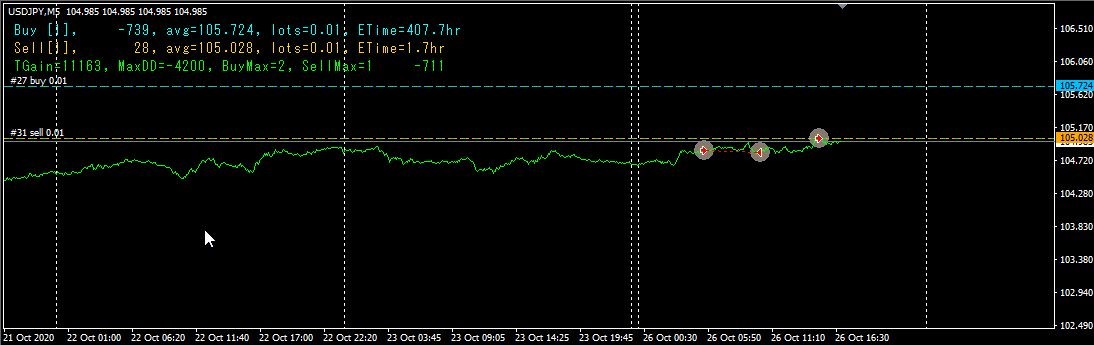 Figure 1.
Row 1: Buy: [number of positions], profit/loss, average value, total number of lots, elapsed time
Row 2: Sell: [number of positions], profit/loss, average, total number of lots, elapsed time
Row 3: Total profit, maximum drawdown, maximum number of positions (buy, sell), current profit/loss
8. Comparison of the three modes of backtest results
The longer the backtest period, the better, but since too long a period takes time to verify, we set the test period to 20 years. This is because we wanted to verify whether or not the system could withstand the 2008 Lehman Shock, the 2015 China Shock, etc. (In a 10-year period, the system would have to withstand the Lehman Shock and the 2015 China Shock. (A 10-year period does not allow us to test the resilience to the Lehman shock.)
Figure 1.
Row 1: Buy: [number of positions], profit/loss, average value, total number of lots, elapsed time
Row 2: Sell: [number of positions], profit/loss, average, total number of lots, elapsed time
Row 3: Total profit, maximum drawdown, maximum number of positions (buy, sell), current profit/loss
8. Comparison of the three modes of backtest results
The longer the backtest period, the better, but since too long a period takes time to verify, we set the test period to 20 years. This is because we wanted to verify whether or not the system could withstand the 2008 Lehman Shock, the 2015 China Shock, etc. (In a 10-year period, the system would have to withstand the Lehman Shock and the 2015 China Shock. (A 10-year period does not allow us to test the resilience to the Lehman shock.)
 Figure 2.
Figure 2 shows the results for the normal mode (period: January 1, 1999~October 31, 2020)
Figure 2.
Figure 2 shows the results for the normal mode (period: January 1, 1999~October 31, 2020)
 Figure 3.
Figure 3 shows the results of the small funds mode (duration is the same as the normal mode)
Figure 3.
Figure 3 shows the results of the small funds mode (duration is the same as the normal mode)
 Figure 4.
Figure 4 shows the small capital mode + with loss-cut (the period is the same as the normal mode).
Losses were cut several times during the process, but the total ended up in the positive.
Figure 4.
Figure 4 shows the small capital mode + with loss-cut (the period is the same as the normal mode).
Losses were cut several times during the process, but the total ended up in the positive.
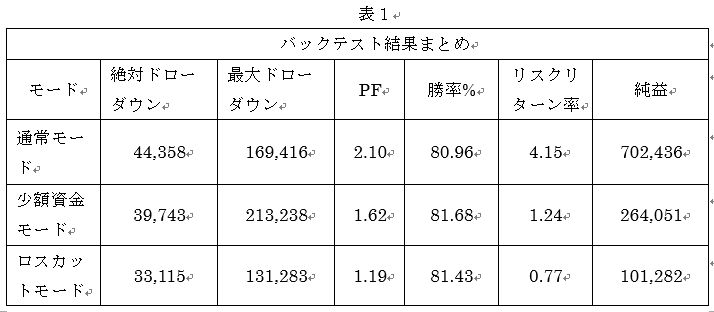 The absolute drawdown values are in the order of Normal Mode > Small Funds Mode > Loss Cut Mode. (PF is the Profit Factor).
Both the small capital mode and the loss-cut mode are considered to have some effect in lowering the absolute drawdown.
Overall, we can conclude that the Normal mode is still the best. In the back test, the initial margin was set at 1,000,000 yen in the normal mode and 100,000 yen in the small capital and loss-cut modes.
9. Funds management
Let us examine the fund management by looking at the table in the summary of back-test results in 8.
According to the back-test results for approximately 20 years from 1999 to October 2020, the maximum drawdown is approximately 170,000 yen in normal mode, so we will prepare approximately 170,000 yen for the drawdown. In addition to this, you will need to provide margin for your positions. The amount of margin will vary depending on the leverage of the brokerage firm, but since the leverage is 25 times at domestic brokerages, you will need about 4300 yen to hold a 0.01 lot USDJPY position. (Calculated assuming 1$=106 yen)
The maximum lot size in Normal mode is 0.54 lots (assuming a maximum position size of 8). Therefore, the margin requirement is 4,300 * 54 = 232,200 yen.
(In the case of highly leveraged foreign brokerage firms, the margin requirement is much lower, as it is about 120 yen to hold 0.01 lots, etc.)
The total of the above is approximately 410,000 yen (170,000 + 240,000), which is the amount of funds required to execute the normal mode.
To be on the safer side, there is also the idea of using 2 times the maximum drawdown + the required margin as the starting capital. In this case, 17 * 2 + 24 = 58, which is 580,000 yen as the required funds.
Therefore, the total funds required to avoid bankruptcy for 20 years can be calculated as 600,000 yen per initial lot size of 0.01. If the total funds reach 1.2 million yen, the initial lot size can be raised to 0.02.
In the small funds mode, the maximum number of positions is 12, so the maximum number of lots is 0.12. In this case, the margin requirement is 4300 * 12 = 51,600. Since the absolute drawdown in small capital mode is 39,700, it seems that you can manage to operate with just 100,000 yen in prepared funds. If possible, the maximum drawdown should be taken into account, but since we only have a small amount of money, we will prepare the minimum amount of money that can withstand the absolute drawdown and increase the amount of money while running it. (That's high risk!).
In loss-cut mode, the maximum number of positions is 8, so the maximum lot size is 0.08 lots. In this case, the margin requirement will be 4300 * 8 = 34,400, allowing you to operate with even smaller funds.
The above is only an estimate based on historical data and does not guarantee future safety. Also, the results may differ depending on when you start back-testing.
We recommend that you prepare sufficient funds and operate in normal mode.
10. We have considered a more aggressive investment method.
Although the risk is higher, this method is for those who want to increase their funds efficiently with a small amount of money. (Of course, this method cannot withstand a 20-year long-term back test. Please be prepared for the risk.)
The absolute drawdown values are in the order of Normal Mode > Small Funds Mode > Loss Cut Mode. (PF is the Profit Factor).
Both the small capital mode and the loss-cut mode are considered to have some effect in lowering the absolute drawdown.
Overall, we can conclude that the Normal mode is still the best. In the back test, the initial margin was set at 1,000,000 yen in the normal mode and 100,000 yen in the small capital and loss-cut modes.
9. Funds management
Let us examine the fund management by looking at the table in the summary of back-test results in 8.
According to the back-test results for approximately 20 years from 1999 to October 2020, the maximum drawdown is approximately 170,000 yen in normal mode, so we will prepare approximately 170,000 yen for the drawdown. In addition to this, you will need to provide margin for your positions. The amount of margin will vary depending on the leverage of the brokerage firm, but since the leverage is 25 times at domestic brokerages, you will need about 4300 yen to hold a 0.01 lot USDJPY position. (Calculated assuming 1$=106 yen)
The maximum lot size in Normal mode is 0.54 lots (assuming a maximum position size of 8). Therefore, the margin requirement is 4,300 * 54 = 232,200 yen.
(In the case of highly leveraged foreign brokerage firms, the margin requirement is much lower, as it is about 120 yen to hold 0.01 lots, etc.)
The total of the above is approximately 410,000 yen (170,000 + 240,000), which is the amount of funds required to execute the normal mode.
To be on the safer side, there is also the idea of using 2 times the maximum drawdown + the required margin as the starting capital. In this case, 17 * 2 + 24 = 58, which is 580,000 yen as the required funds.
Therefore, the total funds required to avoid bankruptcy for 20 years can be calculated as 600,000 yen per initial lot size of 0.01. If the total funds reach 1.2 million yen, the initial lot size can be raised to 0.02.
In the small funds mode, the maximum number of positions is 12, so the maximum number of lots is 0.12. In this case, the margin requirement is 4300 * 12 = 51,600. Since the absolute drawdown in small capital mode is 39,700, it seems that you can manage to operate with just 100,000 yen in prepared funds. If possible, the maximum drawdown should be taken into account, but since we only have a small amount of money, we will prepare the minimum amount of money that can withstand the absolute drawdown and increase the amount of money while running it. (That's high risk!).
In loss-cut mode, the maximum number of positions is 8, so the maximum lot size is 0.08 lots. In this case, the margin requirement will be 4300 * 8 = 34,400, allowing you to operate with even smaller funds.
The above is only an estimate based on historical data and does not guarantee future safety. Also, the results may differ depending on when you start back-testing.
We recommend that you prepare sufficient funds and operate in normal mode.
10. We have considered a more aggressive investment method.
Although the risk is higher, this method is for those who want to increase their funds efficiently with a small amount of money. (Of course, this method cannot withstand a 20-year long-term back test. Please be prepared for the risk.)
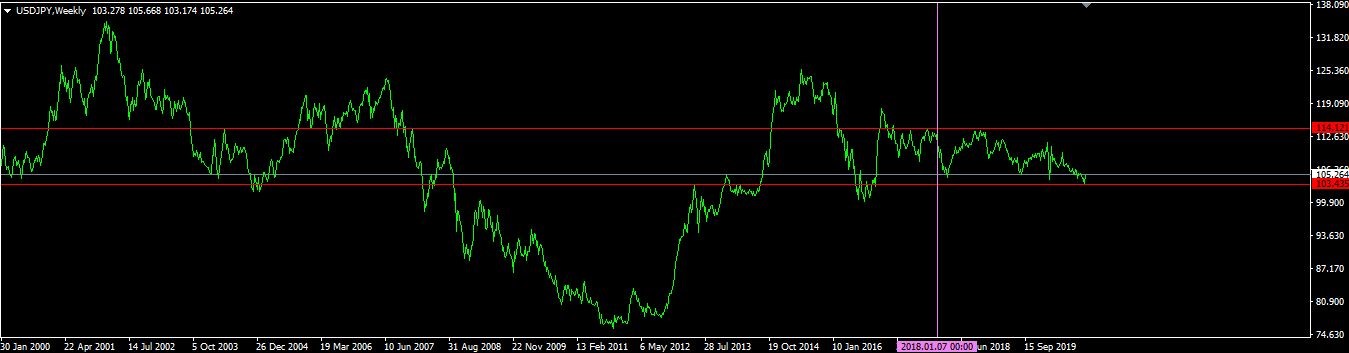 Figure 5.
Figure 5 shows the weekly chart of the dollar-yen (for the period 2000~2020): from a high of 134 yen in January 2002, the rate fell to 75 yen in October 2011, then back to 125 yen in May 2015, and has been trending slightly lower since.
The purple vertical line is at January 2018; since 2018, the dollar-yen rate has been within the range of the two red horizontal lines (103-114 yen). If the fluctuation of the dollar-yen rate is within the range of about 10 yen, then it is possible to change the parameters of the EA to increase the rate of return.
The parameters are changed as follows.
Normal mode K_WD0 = 49, U_WD0 = 11
Small Money Mode K_WD1 = 45, U_WD1 = 10
I ran a backtest for the period January 1, 2018 to October 31, 2020. (Note that the loss-cut mode is not shown in the table, as no loss-cut was triggered during this period.)
Starting funds were set at 100,000 yen for both modes.
As expected, with 100,000 yen in the normal mode, the market did not go bankrupt, but it was a very difficult situation. The relative drawdown was 93.6%, which was quite dangerous. In normal mode, it is better to prepare more sufficient funds.
On the other hand, in the small capital mode, the performance is quite good.
Figure 5.
Figure 5 shows the weekly chart of the dollar-yen (for the period 2000~2020): from a high of 134 yen in January 2002, the rate fell to 75 yen in October 2011, then back to 125 yen in May 2015, and has been trending slightly lower since.
The purple vertical line is at January 2018; since 2018, the dollar-yen rate has been within the range of the two red horizontal lines (103-114 yen). If the fluctuation of the dollar-yen rate is within the range of about 10 yen, then it is possible to change the parameters of the EA to increase the rate of return.
The parameters are changed as follows.
Normal mode K_WD0 = 49, U_WD0 = 11
Small Money Mode K_WD1 = 45, U_WD1 = 10
I ran a backtest for the period January 1, 2018 to October 31, 2020. (Note that the loss-cut mode is not shown in the table, as no loss-cut was triggered during this period.)
Starting funds were set at 100,000 yen for both modes.
As expected, with 100,000 yen in the normal mode, the market did not go bankrupt, but it was a very difficult situation. The relative drawdown was 93.6%, which was quite dangerous. In normal mode, it is better to prepare more sufficient funds.
On the other hand, in the small capital mode, the performance is quite good.
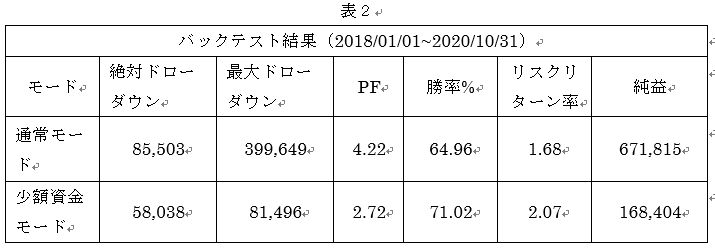 The backtest results for the normal and small funds modes are shown in the figure.
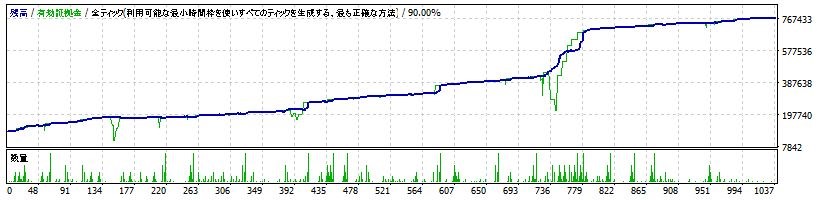 Figure 6 (Normal mode)
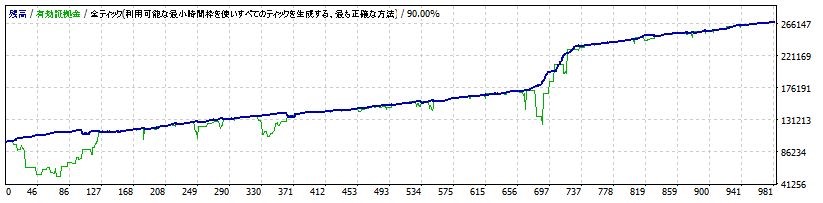 Figure 7 (small funds mode)
11. Verification of automatic lot
Normal mode
Figure 7 (small funds mode)
11. Verification of automatic lot
Normal mode
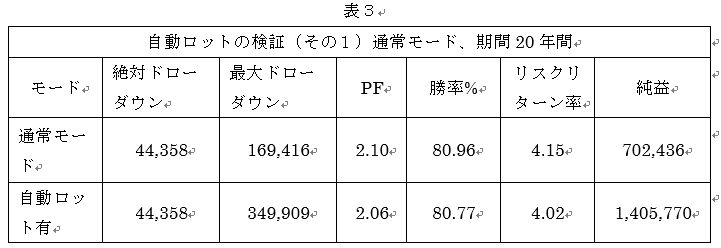 Running the backtest with an automatic lot (Base_Funds=600,000, initial margin 1,000,000, K_WD0=150, U_WD0=500), the net profit was approximately double the initial lot fixed. (The period of the backtest was 20 years, 1999/01/01~202020/10/31)
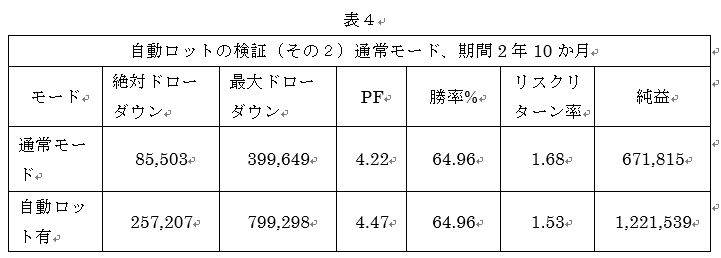 Running the backtest with automatic lots (Base_Funds=600,000, initial margin 1,000,000, K_WD0=49,U_WD0=11), the net profit was approximately double the initial lot fixed.
(The period of the backtest was 2 years and 10 months, 01/01/2018~31/10/2020)
Automatic lot in small funds mode
Running the backtest with automatic lots (Base_Funds=600,000, initial margin 1,000,000, K_WD0=49,U_WD0=11), the net profit was approximately double the initial lot fixed.
(The period of the backtest was 2 years and 10 months, 01/01/2018~31/10/2020)
Automatic lot in small funds mode
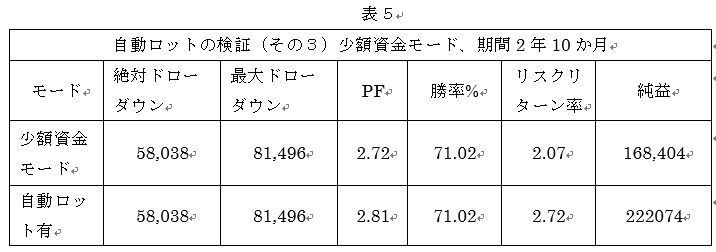 I ran the backtest in small funds mode with auto lots (Base_Funds=100,000, initial margin 100,000, K_WD1=45, U_WD1=10). The net profit was about 1.32 times higher with automatic lot trading than without. (The period of the backtest is 2 years and 10 months, 2018/01/01~202020/10/31)
If we restrict the period to the last 10 months, we get the following
I ran the backtest in small funds mode with auto lots (Base_Funds=100,000, initial margin 100,000, K_WD1=45, U_WD1=10). The net profit was about 1.32 times higher with automatic lot trading than without. (The period of the backtest is 2 years and 10 months, 2018/01/01~202020/10/31)
If we restrict the period to the last 10 months, we get the following
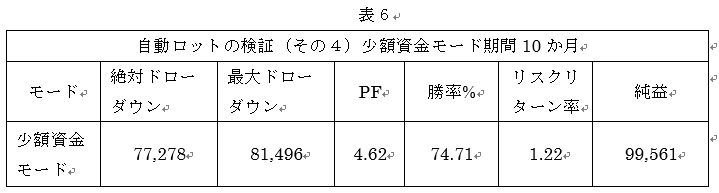 (with automatic lot, backtest period of 10 months, 2020/01/01~202020/10/31)
In the example with a shorter backtest validation period, the absolute drawdown value increases, but the maximum drawdown value remains unchanged. Thus, we can see that the maximum drawdown occurred during this period. The value of the absolute drawdown will differ depending on what day and year you start the back test. When managing funds, it is better to consider the maximum drawdown value as the basis rather than the absolute drawdown value.
In 10 months, the initial margin of 100,000 yen doubled to 199,561 yen, but the relative drawdown was 78.2%, so you should also consider that the situation was quite risky.
(with automatic lot, backtest period of 10 months, 2020/01/01~202020/10/31)
In the example with a shorter backtest validation period, the absolute drawdown value increases, but the maximum drawdown value remains unchanged. Thus, we can see that the maximum drawdown occurred during this period. The value of the absolute drawdown will differ depending on what day and year you start the back test. When managing funds, it is better to consider the maximum drawdown value as the basis rather than the absolute drawdown value.
In 10 months, the initial margin of 100,000 yen doubled to 199,561 yen, but the relative drawdown was 78.2%, so you should also consider that the situation was quite risky.
 Figure 8 (small funds mode, 10-month period)
Since users can freely change each parameter of this EA, it can be flexibly adapted from "long-term stable type" to "short-term high-risk high-return type," depending on the settings. It is left to the user to decide which operation method to implement.
Figure 8 (small funds mode, 10-month period)
Since users can freely change each parameter of this EA, it can be flexibly adapted from "long-term stable type" to "short-term high-risk high-return type," depending on the settings. It is left to the user to decide which operation method to implement.
Figure 1.
Row 1: Buy: [number of positions], profit/loss, average value, total number of lots, elapsed time
Row 2: Sell: [number of positions], profit/loss, average, total number of lots, elapsed time
Row 3: Total profit, maximum drawdown, maximum number of positions (buy, sell), current profit/loss
8. Comparison of the three modes of backtest results
The longer the backtest period, the better, but since too long a period takes time to verify, we set the test period to 20 years. This is because we wanted to verify whether or not the system could withstand the 2008 Lehman Shock, the 2015 China Shock, etc. (In a 10-year period, the system would have to withstand the Lehman Shock and the 2015 China Shock. (A 10-year period does not allow us to test the resilience to the Lehman shock.)
Figure 2.
Figure 2 shows the results for the normal mode (period: January 1, 1999~October 31, 2020)
Figure 3.
Figure 3 shows the results of the small funds mode (duration is the same as the normal mode)
Figure 4.
Figure 4 shows the small capital mode + with loss-cut (the period is the same as the normal mode).
Losses were cut several times during the process, but the total ended up in the positive.
The absolute drawdown values are in the order of Normal Mode > Small Funds Mode > Loss Cut Mode. (PF is the Profit Factor).
Both the small capital mode and the loss-cut mode are considered to have some effect in lowering the absolute drawdown.
Overall, we can conclude that the Normal mode is still the best. In the back test, the initial margin was set at 1,000,000 yen in the normal mode and 100,000 yen in the small capital and loss-cut modes.
9. Funds management
Let us examine the fund management by looking at the table in the summary of back-test results in 8.
According to the back-test results for approximately 20 years from 1999 to October 2020, the maximum drawdown is approximately 170,000 yen in normal mode, so we will prepare approximately 170,000 yen for the drawdown. In addition to this, you will need to provide margin for your positions. The amount of margin will vary depending on the leverage of the brokerage firm, but since the leverage is 25 times at domestic brokerages, you will need about 4300 yen to hold a 0.01 lot USDJPY position. (Calculated assuming 1$=106 yen)
The maximum lot size in Normal mode is 0.54 lots (assuming a maximum position size of 8). Therefore, the margin requirement is 4,300 * 54 = 232,200 yen.
(In the case of highly leveraged foreign brokerage firms, the margin requirement is much lower, as it is about 120 yen to hold 0.01 lots, etc.)
The total of the above is approximately 410,000 yen (170,000 + 240,000), which is the amount of funds required to execute the normal mode.
To be on the safer side, there is also the idea of using 2 times the maximum drawdown + the required margin as the starting capital. In this case, 17 * 2 + 24 = 58, which is 580,000 yen as the required funds.
Therefore, the total funds required to avoid bankruptcy for 20 years can be calculated as 600,000 yen per initial lot size of 0.01. If the total funds reach 1.2 million yen, the initial lot size can be raised to 0.02.
In the small funds mode, the maximum number of positions is 12, so the maximum number of lots is 0.12. In this case, the margin requirement is 4300 * 12 = 51,600. Since the absolute drawdown in small capital mode is 39,700, it seems that you can manage to operate with just 100,000 yen in prepared funds. If possible, the maximum drawdown should be taken into account, but since we only have a small amount of money, we will prepare the minimum amount of money that can withstand the absolute drawdown and increase the amount of money while running it. (That's high risk!).
In loss-cut mode, the maximum number of positions is 8, so the maximum lot size is 0.08 lots. In this case, the margin requirement will be 4300 * 8 = 34,400, allowing you to operate with even smaller funds.
The above is only an estimate based on historical data and does not guarantee future safety. Also, the results may differ depending on when you start back-testing.
We recommend that you prepare sufficient funds and operate in normal mode.
10. We have considered a more aggressive investment method.
Although the risk is higher, this method is for those who want to increase their funds efficiently with a small amount of money. (Of course, this method cannot withstand a 20-year long-term back test. Please be prepared for the risk.)
Figure 5.
Figure 5 shows the weekly chart of the dollar-yen (for the period 2000~2020): from a high of 134 yen in January 2002, the rate fell to 75 yen in October 2011, then back to 125 yen in May 2015, and has been trending slightly lower since.
The purple vertical line is at January 2018; since 2018, the dollar-yen rate has been within the range of the two red horizontal lines (103-114 yen). If the fluctuation of the dollar-yen rate is within the range of about 10 yen, then it is possible to change the parameters of the EA to increase the rate of return.
The parameters are changed as follows.
Normal mode K_WD0 = 49, U_WD0 = 11
Small Money Mode K_WD1 = 45, U_WD1 = 10
I ran a backtest for the period January 1, 2018 to October 31, 2020. (Note that the loss-cut mode is not shown in the table, as no loss-cut was triggered during this period.)
Starting funds were set at 100,000 yen for both modes.
As expected, with 100,000 yen in the normal mode, the market did not go bankrupt, but it was a very difficult situation. The relative drawdown was 93.6%, which was quite dangerous. In normal mode, it is better to prepare more sufficient funds.
On the other hand, in the small capital mode, the performance is quite good.
The backtest results for the normal and small funds modes are shown in the figure.
Figure 6 (Normal mode)
Figure 7 (small funds mode)
11. Verification of automatic lot
Normal mode
Running the backtest with an automatic lot (Base_Funds=600,000, initial margin 1,000,000, K_WD0=150, U_WD0=500), the net profit was approximately double the initial lot fixed. (The period of the backtest was 20 years, 1999/01/01~202020/10/31)
Running the backtest with automatic lots (Base_Funds=600,000, initial margin 1,000,000, K_WD0=49,U_WD0=11), the net profit was approximately double the initial lot fixed.
(The period of the backtest was 2 years and 10 months, 01/01/2018~31/10/2020)
Automatic lot in small funds mode
I ran the backtest in small funds mode with auto lots (Base_Funds=100,000, initial margin 100,000, K_WD1=45, U_WD1=10). The net profit was about 1.32 times higher with automatic lot trading than without. (The period of the backtest is 2 years and 10 months, 2018/01/01~202020/10/31)
If we restrict the period to the last 10 months, we get the following
(with automatic lot, backtest period of 10 months, 2020/01/01~202020/10/31)
In the example with a shorter backtest validation period, the absolute drawdown value increases, but the maximum drawdown value remains unchanged. Thus, we can see that the maximum drawdown occurred during this period. The value of the absolute drawdown will differ depending on what day and year you start the back test. When managing funds, it is better to consider the maximum drawdown value as the basis rather than the absolute drawdown value.
In 10 months, the initial margin of 100,000 yen doubled to 199,561 yen, but the relative drawdown was 78.2%, so you should also consider that the situation was quite risky.
Figure 8 (small funds mode, 10-month period)
Since users can freely change each parameter of this EA, it can be flexibly adapted from "long-term stable type" to "short-term high-risk high-return type," depending on the settings. It is left to the user to decide which operation method to implement.
Sales from
:
05/26/2021 07:11
Purchased
:
0
times
Price: $152.45 (taxed)
¥24,000(taxed)
Provider/Distributor:
Sales site:
GogoJungle
●Payment



Forward Test
Back Test
Sales from : 05/26/2021 07:11
Purchased
:
0
times
Price: $152.45 (taxed)
¥24,000(taxed)
Provider/Distributor:
Sales site:
GogoJungle
●Payment
About Forex Automated Trading
What is Forex Automated Trading (MT4 EA)?
Forex Automated Trading refers to trading that is automated through programming, incorporating predetermined trading and settlement rules. There are various methods to conduct automated trading, but at GogoJungle, we deal with Experts Advisors (hereinafter referred to as EA) that operate on a trading platform called MT4.
Trading Types of Forex Automated Trading
There are various types of EAs (Expert Advisors) for different trading types that can be used on MT4.
Just like discretionary trading, there are those that decide trading and settlement timings by combining indicators, those that repeatedly buy or sell at certain price (pips) intervals, and trading methods that utilize market anomalies or temporal features. The variety is as rich as the methods in discretionary trading.
To categorize simply,
・Scalping (Type where trades are completed within a few minutes to a few hours),
・Day Trading (Type where trades are completed within several hours to about a day),
・Swing Trading (Type where trades are conducted over a relatively long period of about 1 day to 1 week)
・Grid/Martingale Trading (Holding multiple positions at equal or unequal intervals and settling all once a profit is made. Those that gradually increase the lot number are called Martingale.)
・Anomaly EA (Mid-price trading, early morning scalping)
Just like discretionary trading, there are those that decide trading and settlement timings by combining indicators, those that repeatedly buy or sell at certain price (pips) intervals, and trading methods that utilize market anomalies or temporal features. The variety is as rich as the methods in discretionary trading.
To categorize simply,
・Scalping (Type where trades are completed within a few minutes to a few hours),
・Day Trading (Type where trades are completed within several hours to about a day),
・Swing Trading (Type where trades are conducted over a relatively long period of about 1 day to 1 week)
・Grid/Martingale Trading (Holding multiple positions at equal or unequal intervals and settling all once a profit is made. Those that gradually increase the lot number are called Martingale.)
・Anomaly EA (Mid-price trading, early morning scalping)
Risks, Advantages, and Disadvantages of Forex Automated Trading
When engaging in Forex, there are risks in automated trading just as there are in discretionary trading.
However, a substantial advantage of automated trading is its ability to limit and predict risks beforehand.
[Risk]
Inherent to forex trading are the trading risks that undeniably exist in automated trading as well.
・Lot Size Risk
Increasing the lot size forcibly due to a high winning rate can, in rare instances, depending on the EA, lead to substantial Pips loss when a loss occurs. It is crucial to verify the SL Pips and the number of positions held before operating with an appropriate lot.
・Rapid Market Fluctuation Risk
There are instances where market prices fluctuate rapidly due to index announcements or unforeseen news. System trading does not account for such unpredictable market movements, rendering it incapable of making decisions on whether to settle in advance or abstain from trading. As a countermeasure, utilizing tools that halt the EA based on indicator announcements or the VIX (fear index) is also possible.
[Benefits]
・Operates 24 hours a day
If there is an opportunity, system trading will execute trades on your behalf consistently. It proves to be an extremely convenient tool for those unable to allocate time to trading.
・Trades dispassionately without being swayed by emotions
There is an absence of self-serving rule modifications, a common human tendency, such as increasing the lot size after consecutive losses in discretionary trading or, conversely, hastily securing profits with minimal gains.
・Accessible for beginners
To engage in Forex trading, there is no prerequisite to study; anyone using system trading will achieve the same results.
[Disadvantages]
・Cannot increase trading frequency at will
Since system trading operates based on pre-programmed conditions, depending on the type of EA, it might only execute trades a few times a month.
・Suitability may vary with market conditions
Depending on the trading type of the EA, there are periods more suited to trend trading and periods more suited to contrarian trading, making consistent results across all periods unlikely. While the previous year might have yielded good results, this year's performance might not be as promising, necessitating some level of discretion in determining whether it is an opportune time to operate.
However, a substantial advantage of automated trading is its ability to limit and predict risks beforehand.
[Risk]
Inherent to forex trading are the trading risks that undeniably exist in automated trading as well.
・Lot Size Risk
Increasing the lot size forcibly due to a high winning rate can, in rare instances, depending on the EA, lead to substantial Pips loss when a loss occurs. It is crucial to verify the SL Pips and the number of positions held before operating with an appropriate lot.
・Rapid Market Fluctuation Risk
There are instances where market prices fluctuate rapidly due to index announcements or unforeseen news. System trading does not account for such unpredictable market movements, rendering it incapable of making decisions on whether to settle in advance or abstain from trading. As a countermeasure, utilizing tools that halt the EA based on indicator announcements or the VIX (fear index) is also possible.
[Benefits]
・Operates 24 hours a day
If there is an opportunity, system trading will execute trades on your behalf consistently. It proves to be an extremely convenient tool for those unable to allocate time to trading.
・Trades dispassionately without being swayed by emotions
There is an absence of self-serving rule modifications, a common human tendency, such as increasing the lot size after consecutive losses in discretionary trading or, conversely, hastily securing profits with minimal gains.
・Accessible for beginners
To engage in Forex trading, there is no prerequisite to study; anyone using system trading will achieve the same results.
[Disadvantages]
・Cannot increase trading frequency at will
Since system trading operates based on pre-programmed conditions, depending on the type of EA, it might only execute trades a few times a month.
・Suitability may vary with market conditions
Depending on the trading type of the EA, there are periods more suited to trend trading and periods more suited to contrarian trading, making consistent results across all periods unlikely. While the previous year might have yielded good results, this year's performance might not be as promising, necessitating some level of discretion in determining whether it is an opportune time to operate.
Equipment and Environment Needed for Automated Trading Operation
The requirements for operating automated trading (EA) on MT4 are as follows:
・MT4 (MetaTrader 4. An account needs to be opened with a Forex company that offers MT4.)
・EA (A program for automated trading)
・The operating deposit required to run the EA
・A PC that can run 24 hours or a VPS (Virtual Private Server), where a virtual PC is hosted on a cloud server to run MT4.
・MT4 (MetaTrader 4. An account needs to be opened with a Forex company that offers MT4.)
・EA (A program for automated trading)
・The operating deposit required to run the EA
・A PC that can run 24 hours or a VPS (Virtual Private Server), where a virtual PC is hosted on a cloud server to run MT4.
Installation of MT4 and Account Login
If you open an account with a forex broker that supports MT4, you can use MT4 as provided by that forex broker. MT4 is a stand-alone type of software that needs to be installed on your computer, so you download the program file from the website of the FX company where you opened the account and install it on your computer.
Additionally, there are both demo and real accounts available. You can experience trading with virtual money by applying for a demo account. After opening a real account, you select the connection server assigned by the Forex broker, enter the password, and log in to the account.
When you deposit money into your account using the method specified by the forex broker, the funds will be reflected in your MT4 account, and you can trade.
Additionally, there are both demo and real accounts available. You can experience trading with virtual money by applying for a demo account. After opening a real account, you select the connection server assigned by the Forex broker, enter the password, and log in to the account.
When you deposit money into your account using the method specified by the forex broker, the funds will be reflected in your MT4 account, and you can trade.
How to Install EA on MT4
To set up an EA when you purchase it through GogoJungle, follow the steps below:
Firstly, download the purchased EA file from your My Page on GogoJungle. You will download a zip (compressed) file, so right-click to extract it and retrieve the file named ‘◯◯◯ (EA name)_A19GAw09 (any 8 alphanumeric characters).ex4’ from inside.
Next, launch MT4 and navigate to ‘File’ → ‘Open Data Folder’ → ‘MQL4’ → ‘Experts’ folder, and place the ex4 file inside. Once done, close MT4 and restart it. Then, go to the upper menu ‘Tools’ → ‘Options’, and under ‘Expert Advisors’, ensure ‘Allow automated trading’ and ‘Allow DLL imports’ are checked, then press OK to close.
The necessary currency pair and time frame for the correct operation of the EA are specified on the EA sales page. Refer to this information and open the chart of the correct currency pair time frame (e.g., USDJPY5M for a USD/Yen 5-minute chart).
Within the menu navigator, under ‘Expert Advisors’, you will find the EA file name you placed earlier. Click to select it, then drag & drop it directly onto the chart to load the EA. Alternatively, you can double-click the EA name to load it onto the selected chart.
If ‘Authentication Success’ appears in the upper left of the chart, the authentication has been successful. To operate the EA, you need to keep your PC running 24 hours. Therefore, either disable the automatic sleep function or host MT4 on a VPS and operate the EA.
Firstly, download the purchased EA file from your My Page on GogoJungle. You will download a zip (compressed) file, so right-click to extract it and retrieve the file named ‘◯◯◯ (EA name)_A19GAw09 (any 8 alphanumeric characters).ex4’ from inside.
Next, launch MT4 and navigate to ‘File’ → ‘Open Data Folder’ → ‘MQL4’ → ‘Experts’ folder, and place the ex4 file inside. Once done, close MT4 and restart it. Then, go to the upper menu ‘Tools’ → ‘Options’, and under ‘Expert Advisors’, ensure ‘Allow automated trading’ and ‘Allow DLL imports’ are checked, then press OK to close.
The necessary currency pair and time frame for the correct operation of the EA are specified on the EA sales page. Refer to this information and open the chart of the correct currency pair time frame (e.g., USDJPY5M for a USD/Yen 5-minute chart).
Within the menu navigator, under ‘Expert Advisors’, you will find the EA file name you placed earlier. Click to select it, then drag & drop it directly onto the chart to load the EA. Alternatively, you can double-click the EA name to load it onto the selected chart.
If ‘Authentication Success’ appears in the upper left of the chart, the authentication has been successful. To operate the EA, you need to keep your PC running 24 hours. Therefore, either disable the automatic sleep function or host MT4 on a VPS and operate the EA.
In Case You Want to Change the Account in Use
EAs from GogoJungle can be used with one real account and one demo account per EA.
If you want to use it with an account other than the authenticated one, you need to reset the registered account.
To reset the account, close the MT4 where the Web authentication is registered, then go to My Page on GogoJungle > Use > Digital Contents > the relevant EA > press the ‘Reset’ button for the registration number, and the registered account will be released.
When the account is in a reset state, using the EA with another MT4 account will register a new account.
Also, you can reset the account an unlimited number of times.
If you want to use it with an account other than the authenticated one, you need to reset the registered account.
To reset the account, close the MT4 where the Web authentication is registered, then go to My Page on GogoJungle > Use > Digital Contents > the relevant EA > press the ‘Reset’ button for the registration number, and the registered account will be released.
When the account is in a reset state, using the EA with another MT4 account will register a new account.
Also, you can reset the account an unlimited number of times.
Solutions for Errors During Web Authentication or Non-Functional Account Trading
If you encounter an error with Web authentication, or if the EA is trading on GogoJungle's forward performance page but not on your own account, there could be various reasons. For more details, please refer to the following link:
→ Items to Check When EA is Not Operating
→ Items to Check When EA is Not Operating
About the Size of Trading Lots
In Forex trading, the size of a lot is usually:
1 lot = 100,000 currency units
0.1 lot = 10,000 currency units
0.01 lot = 1,000 currency units
For USD/JPY, 1 lot would mean holding 100,000 dollars.
The margin required to hold lots is determined by the leverage set by the Forex broker.
If the leverage is 25 times, the margin required to hold 10,000 currency units of USD/JPY would be:
10000*109 (※ at a rate of 109 yen per dollar) ÷ 25 = 43,600 yen.
1 lot = 100,000 currency units
0.1 lot = 10,000 currency units
0.01 lot = 1,000 currency units
For USD/JPY, 1 lot would mean holding 100,000 dollars.
The margin required to hold lots is determined by the leverage set by the Forex broker.
If the leverage is 25 times, the margin required to hold 10,000 currency units of USD/JPY would be:
10000*109 (※ at a rate of 109 yen per dollar) ÷ 25 = 43,600 yen.
Glossary of Automated Trading
・Profit Factor: Total Profit ÷ Total Loss
・Risk-Return Ratio: Total Profit and Loss during the period ÷ Maximum Drawdown
・Maximum Drawdown: The largest unrealized loss during the operation period
・Maximum Position Number: This is the maximum number of positions that the EA can theoretically hold at the same time
・TP (Take Profit): The set profit-taking Pips (or specified amount, etc.) in the EA's settings
・SL (Stop Loss): The set maximum loss pips (or specified amount, etc.) in the EA's settings
・Trailing Stop: Instead of settling at a specified Pips, once a certain profit is made, the settlement SL is raised at a certain interval (towards the profit), maximizing the profit. It is a method of settlement.
・Risk-Reward Ratio (Payoff Ratio): Average Profit ÷ Average Loss
・Hedging: Holding both buy and sell positions simultaneously (Some FX companies also have types where hedging is not allowed)
・Risk-Return Ratio: Total Profit and Loss during the period ÷ Maximum Drawdown
・Maximum Drawdown: The largest unrealized loss during the operation period
・Maximum Position Number: This is the maximum number of positions that the EA can theoretically hold at the same time
・TP (Take Profit): The set profit-taking Pips (or specified amount, etc.) in the EA's settings
・SL (Stop Loss): The set maximum loss pips (or specified amount, etc.) in the EA's settings
・Trailing Stop: Instead of settling at a specified Pips, once a certain profit is made, the settlement SL is raised at a certain interval (towards the profit), maximizing the profit. It is a method of settlement.
・Risk-Reward Ratio (Payoff Ratio): Average Profit ÷ Average Loss
・Hedging: Holding both buy and sell positions simultaneously (Some FX companies also have types where hedging is not allowed)
Useful related pages
・How to Install MT4 EA (Expert Advisor) and Indicators
・MT4 Beginner's Guide
・Understanding System Trading Performance (Forward and Backtesting)
・Choosing Your First EA! Calculating Recommended Margin for EAs
・Comparing MT4 Accounts Based on Spread, Swap, and Execution Speed
・What is Web Authentication?
・Checklist for When Your EA Isn't Working
・MT4 Beginner's Guide
・Understanding System Trading Performance (Forward and Backtesting)
・Choosing Your First EA! Calculating Recommended Margin for EAs
・Comparing MT4 Accounts Based on Spread, Swap, and Execution Speed
・What is Web Authentication?
・Checklist for When Your EA Isn't Working