Leverage Theory

Sales performance 171 Book
Review ★ 3.0
(4)
Trading Style
- Whole period
- 2 years
- 1 year
- 6 months
- 3 months
- 1 month
Profit
:
796,067JPYProfit Factor
:
1.40Rate of return risk
?
:
1.45Average Profit
:
1,757JPYAverage Loss
:
-6,551JPYBalance
?
:
1,796,067JPYRate of return (all periods) ?
:
47.48%Win Rate
:
83.89%
(1234/1471)
Maximum Position
?
:
7Maximum Drawdown
?
:
25.57%
(548,335JPY)
Maximum Profit
:
61,140JPYMaximum Loss
:
-108,530JPYRecommended Margin
?
:
1,676,560JPYUnrealized P/L
:
-467JPYDeposit
?
:
1,000,000JPYCurrency
:
JPY- Account
Operable Brokers
Usable with MT4-adopting brokers.
About EA's Strategy
Currency Pairs
[USD/JPY]
Trading Style
[Scalping]
[Day Trading]
Maximum Number Position
10
Maximum Lot
100
Chart Time Frame
M5
Maximum Stop Loss
0
Take Profit
0
Straddle Trading
No
Application Type
Metatrader Auto Trading
Other File Usages
No
About Leverage Theory
Leverage Theory was created with the desire for an EA that can steadily earn with a small amount of margin.
First, please take a look at the details below.
Backtest Conditions: Initial Margin of 100,000 yen
Initial Lot Size: 0.01 Lot (1 Lot = 100,000 currency)
Spread: 2.0 pips (USD/JPY trading)
Under these conditions, we devised a logic to maximize stable earnings. The backtest results conducted annually from 2007 to 2020 are as follows.
ーーーーーーーーーーーーーーーーーーーーーーーーーー
・2007: Win Rate 80.15% PF: 1.32 Profit:¥32,923
・2008: Win Rate 84.39% PF: 2.68 Profit:¥42,173
・2009: Win Rate 82.22% PF: 1.47 Profit:¥36,548
・2010: Win Rate 82.17% PF: 1.75 Profit:¥30,663
・2011: Win Rate 77.84% PF: 2.44 Profit:¥38,749
・2012: Win Rate 76.00% PF: 1.90 Profit:¥21,837
・2013: Win Rate 83.82% PF: 1.70 Profit:¥48,854
・2014: Win Rate 82.35% PF: 2.26 Profit:¥30,756
・2015: Win Rate 82.05% PF: 2.17 Profit:¥35,082
・2016: Win Rate 84.18% PF: 1.71 Profit:¥41,261
・2017: Win Rate 78.99% PF: 1.69 Profit:¥36,026
・2018: Win Rate 79.58% PF: 1.55 Profit:¥26,783
・2019: Win Rate 80.60% PF: 2.09 Profit:¥20,863
・2020: Win Rate 79.49% PF: 1.37 Profit:¥15,707
ーーーーーーーーーーーーーーーーーーーーーーーーーー
(The results are based on operations starting with a margin of 100,000 yen from January 1 to December 31 of each year.)
Over 14 years, even when starting from 1 each year, the account never went bankrupt,and we have successfully increased the account funds by 1.2 to 1.4 times in one year.(Annual interest rate of 20% to 40%)
Since the sales started in May 2019, we have also maintained a public forward tradewith "almost zero losing months", continuing to have14 years of positive balance until May 2021.
Why can we achieve such results with a small margin,
the reason is," thorough capital management in the system × winning trading logic."This is what we have realized.
Introduction to Leverage Theory
Leverage Theory is a martingale type EA that only takes long positions in USD/JPY.The basic trading method is very simple; we enter long positions when we think the USD/JPY chart is going to rise. After entering, if there is a profit, we close the position and secure the profit.
On the other hand, if the price moves against us after entry, we buy on dips when we think the decline has paused, lowering the average acquisition price, and when the total profit of the position becomes positive, we close it and secure the profit.
See? It's simple, right?
However,the essence of Leverage Theory lies in this "method of martingale."
By the way, in discretionary trading, we often do trades like this, right?
The reason why martingale is generally considered dangerous is that the timing of the martingale can actually be too early, leading to an increase in unrealized losses after the martingale, resulting in a sudden large loss.
In discretionary trading, you have to think about how much to martingale and at what timing, so without experience and sense, it can easily lead to dangerous martingale situations, and I have experienced painful moments in discretionary trading many times. (And for some reason, I keep repeating the same mistakes...)
But I thought, if we could somehow use statistics to find a winning martingale method and points, we could win, right? After much trial and error from various angles,I discovered that if you martingale at a certain point, it becomes easier to win..
The result of this is the creation of Leverage Theory.
However, no matter how statistically favorable it may be, martingale is still martingale.
Unlike a single position EA, there is a possibility of account bankruptcy if a mistake is made.
Therefore, what should be considered is trading with an appropriate amount of capital.
In FX, since leverage can be applied, it is possible to operate with a large amount even with a small amount of capital.
Therefore, while it can yield quick profits compared to other investments if successful, it is also a high-risk investment (speculation).
In such a high-risk FX investment (speculation), if we use the even riskier martingale method, the only way to lower the risk value is to reduce the operating amount.
However, if we reduce the operating amount, it becomes difficult to enjoy the thrill of quick profit acquisition. This is a conflicting situation.
When I was creating Leverage Theory, I did not have the capacity to operate a large amount, so I wanted to martingale but also wanted to keep the operating amount low.
While thinking about how to manage this,I discovered that if I balance the amount of positions to martingale, it can work well.
After experimenting many times to find out how much to operate in relation to the initial margin and how to martingale to minimize the risk of account bankruptcy, I found that with the logic of Leverage Theory, starting with 1,000 currency against a margin of 100,000 yen can generate stable profits even over a period of more than 10 years.
This discovery made it possible to enjoy the thrill of quick profits in FX, which should originally be conflicting, even from a small amount.
It enabled quick earning, which is the essence of FX..
Key Points of Leverage Theory
The most important aspect I focused on while creating Leverage Theory was to create an EA that can operate stably with an initial margin of 100,000 yen and a spread of 2 pips.FX has the image that you can start with a small amount and earn a lot, but in reality, to earn a decent amount, a relatively large margin is required.However, for those who are thinking of trying FX or who cannot prepare much surplus capital from the start, it can be daunting to prepare a margin of 500,000 yen or 1,000,000 yen all at once.
I believe starting with around 100,000 yen is just right for trial use. Therefore, I was particular about enabling operations to start with a margin of 100,000 yen.
Additionally, I designed the logic assuming a wider spread of 2 pips, but even in the relatively narrow spread USD/JPY market, there are moments when the spread can widen significantly depending on the time of day.
This EA is perfect for those who want to start operating from a small amount, just for pocket money..
Explanation of Leverage Theory Parameters
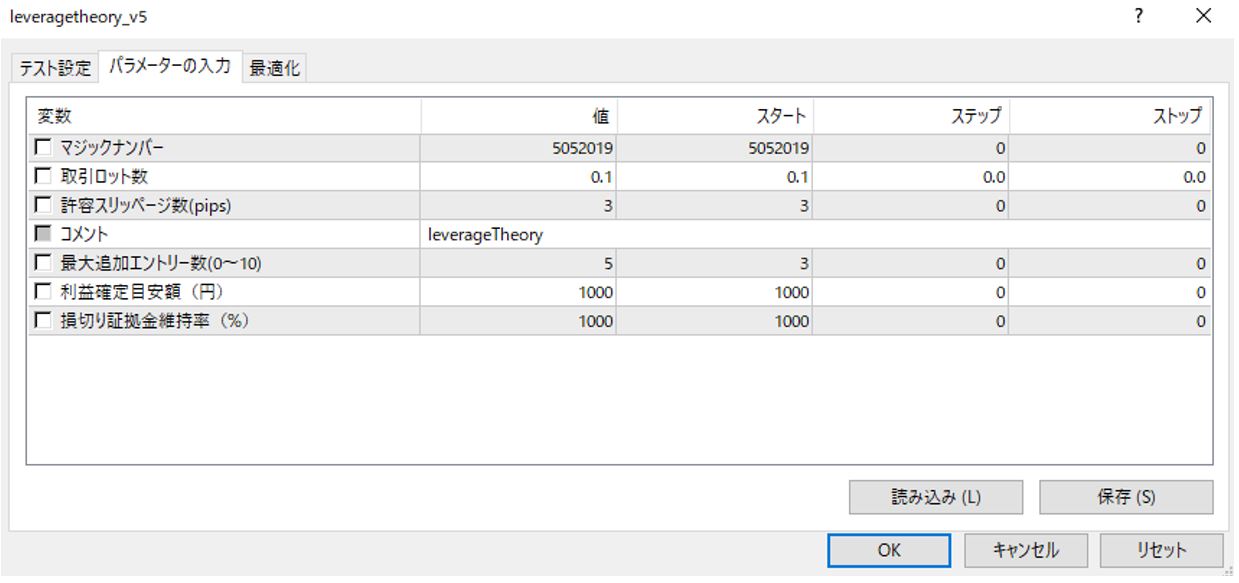
Magic Number:This is the identification number of the EA.
Trading Lot Size:This is the trading lot size of the EA. By default, it is set to 0.1 Lot (10,000 currency).
Allowed Slippage:This is the allowable slippage.
Comment:You can add comments to the positions held by Leverage Theory. By default, the EA name is included. (You can change it yourself)
Maximum Additional Entry Count (0~10):You can set the number of additional entry positions when Leverage Theory has unrealized losses between 0 and 10. If you set it to 0, no additional entries will be made.
Profit Target Amount (Yen):This determines the unrealized profit level at which Leverage Theory will close the position to secure profit.
Stop Loss Margin Maintenance Rate (%):If the margin maintenance rate of the FX account operating Leverage Theory falls below the set value here, Leverage Theory will close the position with the largest unrealized loss to restore the margin maintenance rate.For detailed settings of each parameter,
please refer to the Leverage Theory Setting Manual included as a bonus.
Backtest Verification
Whether the EA has the capability for actual operation is assessed through backtesting.
Therefore, to ensure reliable verification, we use the paid softwareTickStory, which has a modeling quality of 99.9% for the chart data used in verification.
By using high-quality chart data, we conduct backtesting in a state that is as close to zero deviation from the real chart as possible.
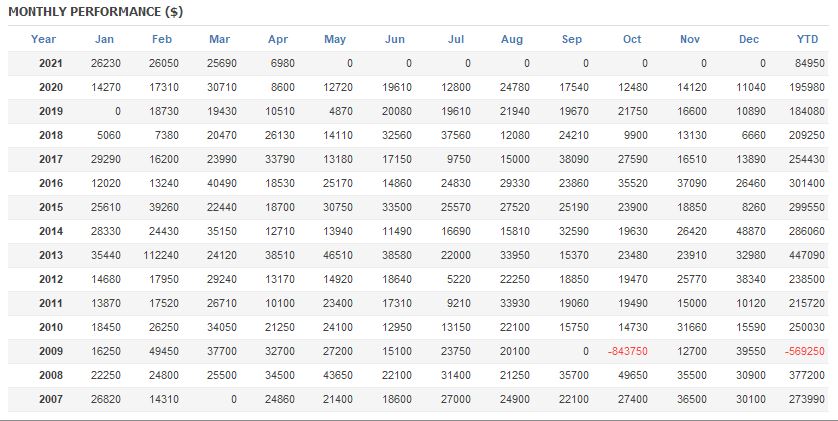
<Monthly Performance>
Monthly backtest results from January 1, 2007, to May 5, 2021 (Verification results of Leverage Theory v5)
In the backtest results produced by Quant Analyzer,
including the results from May 2019 when sales started to May 2021 (latest), there have been almost no monthly losses, demonstrating very stable performance.
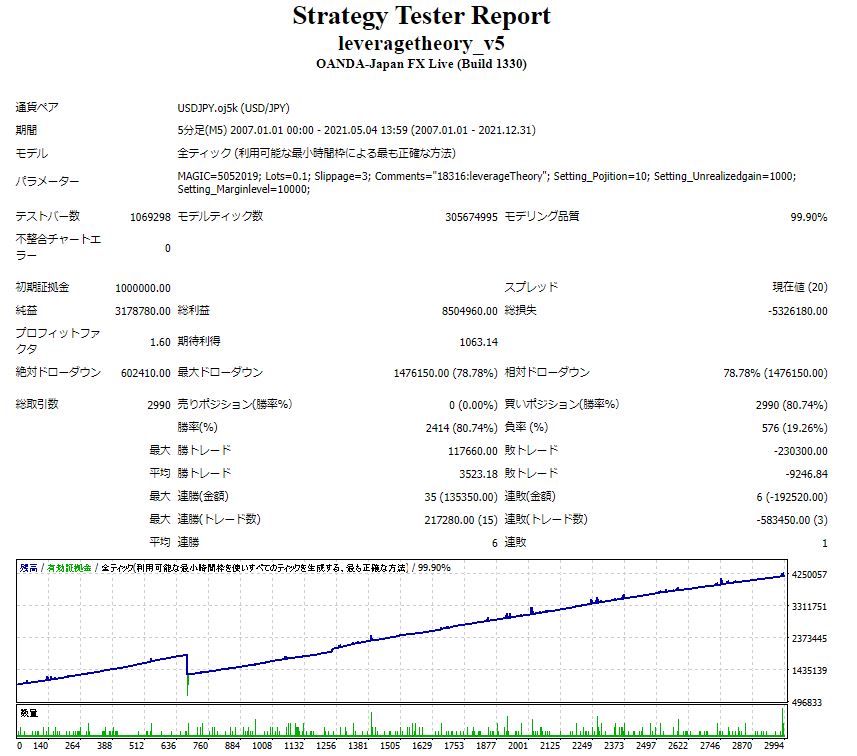
<Annual Performance>
Backtest results from January 1, 2007, to May 5, 2021 (Verification results of Leverage Theory v5)
In this verification result, the maximum additional entry count was set to "10 positions", and the stop loss margin maintenance rate was set to "10,000%"during the backtest.
There were points where the margin maintenance rate fell below 10,000%, leading to deep stop losses,but without a single account bankruptcy, we were able to steadily accumulate profits and generate long-term profits.
Frequently Asked Questions
Q1: Can it be used with any broker?A1: There are no restrictions on brokers, so it can be used regardless of domestic or overseas, or server time differences.
Q2: Can it be used with any currency pair or time frame?
A2: There are no restrictions on the currency pairs or time frames for trading within the program, so it can operate without errors. However, Leverage Theory is designed to operate on the USD/JPY 5-minute chart, so please use it on charts/time frames other than the USD/JPY 5-minute chart at your own risk..
Q3: What spread do you anticipate?
A3: We anticipate spreads of up to 2.0 pips. Of course, if you use it with a narrower spread, you can expect better results than the published backtest.
Q4: Are there any positions carried over the weekend?
A4: Due to the nature of the logic, there is a possibility of holding positions across days. However, by adjusting leverage and lot size from the account funds, stable operation is possible, so I believe there is no particular problem.
Q5: Is it necessary to change settings for summer time/winter time?
A7: Yes, it is possible.
A8: With the update of Leverage Theory v5, a function was added to prevent immediate bankruptcy by closing the position with the largest unrealized loss when the margin maintenance rate of the operating account falls below a certain level. The line for activating the stop loss can be determined by the user through parameters, so for example, if the margin maintenance rate falls below 10,000%, you can set it to close positions that may lead to large losses.
Q9: I am worried about the number of martingale positions increasing too much.
A9:With the update of Leverage Theory v5, the maximum number of martingale positions was changed from 20 positions to 10 positions. Additionally, the number of additional positions can now be determined by the user through parameters, so it will no longer increase unexpectedly.
Peace of Mind Benefits
For those who purchase Leverage TheoryLeverage Theory Setting Manual is included.
It clearly explains how to adjust parameters and safe margin amounts, so there is no need to worry about not being able to operate due to not understanding how to use it.