

Italy vs European Commission, an explanation of the real intentions behind the budget plan!
Regarding Italy's budget, the European Commission is scheduled to publish an opinion and a report. It has become a topic.
The European Commission's handling of Italy is attracting attention not only from Italy but from many EU member states.
If the response to Italy is mishandled, it could lead to the collapse of the EU and a recurrence of the European financial crisis.
The situation demands a delicate judgment.
If Italy does not review this budget, the European Commission is said to impose sanctions.
I think the sanction money will be painful, but what is truly frightening is the reassessment of Italy's credit rating by rating agencies.
If treated as junk, banks, insurers, and pension funds would have no choice but to offload Italian government bonds unconditionally.
Please refer to previous articles regarding ratings
↓↓↓↓↓↓↓↓↓
Moody's rating announcement, Italy downgraded! – Explain FX, what ratings mean –
If Italian bonds become junk, it would resemble a repeat of the Greek shock. It would be more than just a Greek shock. Greece's economic size is about one-tenth that of Italy. If an Italy shock occurs, it could be many times larger than Greece's. In that case, the EU's collapse could be unavoidable. If the EU collapses, it might not be just a collapse; it could trigger a global recession on a scale similar to the Lehman Brothers collapse. Therefore,the European Commission cannot allow the Italian budget deficit to widen. To reduce the deficit, it is pushing for austerity and for a balanced budget (zero deficit, surplus) to be mandatory. For Italy, the target in 2019 was to reduce the deficit to 0.8% of GDP.
There is indeed a rule in the EU that the budget deficit should be within 3.0% of GDP. However, to avoid a repeat of the Greek shock, the European Commission temporarily aims for a zero deficit.
In response, the current Italian government says that the mandate for austerity and a balanced budget (zero deficit, surplus) was decided by the previous administration, and the current government did not promise such. They have prepared a budget with a deficit of 2.4% of GDP. This is a bargaining point between the European Commission's 0.8% and Italy's 2.4%.
If the Italian budget is approved without sanctions, I think criticism will come from EU member states.
After the Greek crisis, the European Commission accepted austerity, endured a difficult period, and finally reduced the fiscal deficit. Other countries have also accepted the obligation to pursue austerity and a balanced budget, and are working hard. If Italy alone receives a lenient approach, it will naturally be criticized.
Being too strict with Italy and provoking backlash is not good, nor is expanding the deficit and downgrading it; being lenient is also not good. It's a difficult situation.
Italy's motives
Italy says the budget deficit this time is to expand fiscal spending for economic recovery.
Also, EU rules set a 3.0% deficit-to-GDP ratio, and the current budget is 2.4% of GDP, so they argue they are within the rules.
On the surface, for the sake of domestic economic recovery!
the real motive is to lay groundwork for next year's European elections.
Next year, the European Parliament elections are scheduled. Also, many European Commission key figures are to be elected.
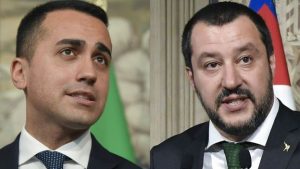
In that context, Italy's Deputy Prime Minister Salvini is aiming for a strong showing of the far-right in the European Parliament.
Also,he aims for the presidency of the European Commission.
Currently, a new EU-leaning party led by Merkel is dominant in Germany.
However, Chancellor Merkel recently lost in the German domestic elections, and her support has declined. She has announced she will resign as party leader by the end of the year and will step down from the chancellor position when her term ends. Although her support in the European Parliament has decreased, there is unlikely to be a successor who can replace Merkel yet. President Macron of France is making efforts too, but lacks experience and sufficient support.
Salvini, Italy's Deputy Prime Minister, sees this as an opportunity to push for anti-EU, far-right gains in the European Parliament.
Not only Salvini, but also Marine Le Pen, who contested Macron for the French presidency in 2016, is growing steadily in support in France. Her poll numbers exceed Macron's. Additionally, Steve Bannon, the former Trump campaign adviser, has moved his base to Europe and aims to connect far-right leaders across Europe.
Therefore, Italy's budget proposal is intentionally causing confusion to hinder the European Commission and to gain support for far-right parties. So, before a genuine fiscal crisis or downgrade to junk status occurs, a compromise will likely be found.
Apart from the number of seats in the European Parliament, Salvini is also aiming for the presidency of the European Commission.
The European Commission President is one of the most powerful positions in the EU.
Next year is the year when Mario Draghi's term as ECB President ends. It has long been considered likely that the German central bank governor, Jens Weidmann, would be a strong successor. However, Merkel is actively supporting placing a German in the European Commission President position, even if it means giving up the ECB chair. The influence and power of the European Commission President are thus very large.
There were reports that Salvini is aiming for the European Commission Presidency. If that happens, it would not be just a matter of far-right gains in the European Parliament. Therefore, he is trying to disrupt with this budget proposal.
I believe this is Salvini's true intention to seek the European Commission presidency.