

Annual interest 1000%! This year's second new work Super Winners, with a new logic that can also function as a single-position EA, aims for explosive profits!
I would like to introduce in detail the second new EA of this year, “Super Winners,” which I briefly mentioned at the end of yesterday’s article.
For those who haven’t read yesterday’s article, please click here.
https://www.gogojungle.co.jp/finance/navi/articles/65420
Now, let’s get straight to the main topic.
As I wrote in the previous article, the EA “Nami-nori Kinjiro” was built with the opposite logic to learn from SuperRecovery’s poor performance, but I remained concerned about the high number of positions until the end.
And there is the endless desire to aim for large profits with Auto Lot.
When you add up SuperRecovery and Nami-nori Kinjiro, they can take up to 20 positions in total.
There aren’t always conditions that align to that extent, but in the parameters, Super Recovery uses 10 long positions and 10 short positions, totaling 20 positions.
Nami-nori Kinjiro has a maximum total of 21 positions for long and short combined.
So, although the two above are built on completely different logics, they are similar in terms of position count limits.
I wanted a logic that works with a single position!
It didn’t take long to arrive at that thought.
When Nami-nori Kinjiro settled down, the idea came: “Yes! Let me create a new indicator with a profit even for a single-position setup.”
GuppyEA originally emerged in May 2023, and then it was also created from an indicator.
Creating the indicator first was to observe the timing of signals and to see, in actual forward testing, when the signals are confirmed.
Let’s look at the history of the indicator in three stages.
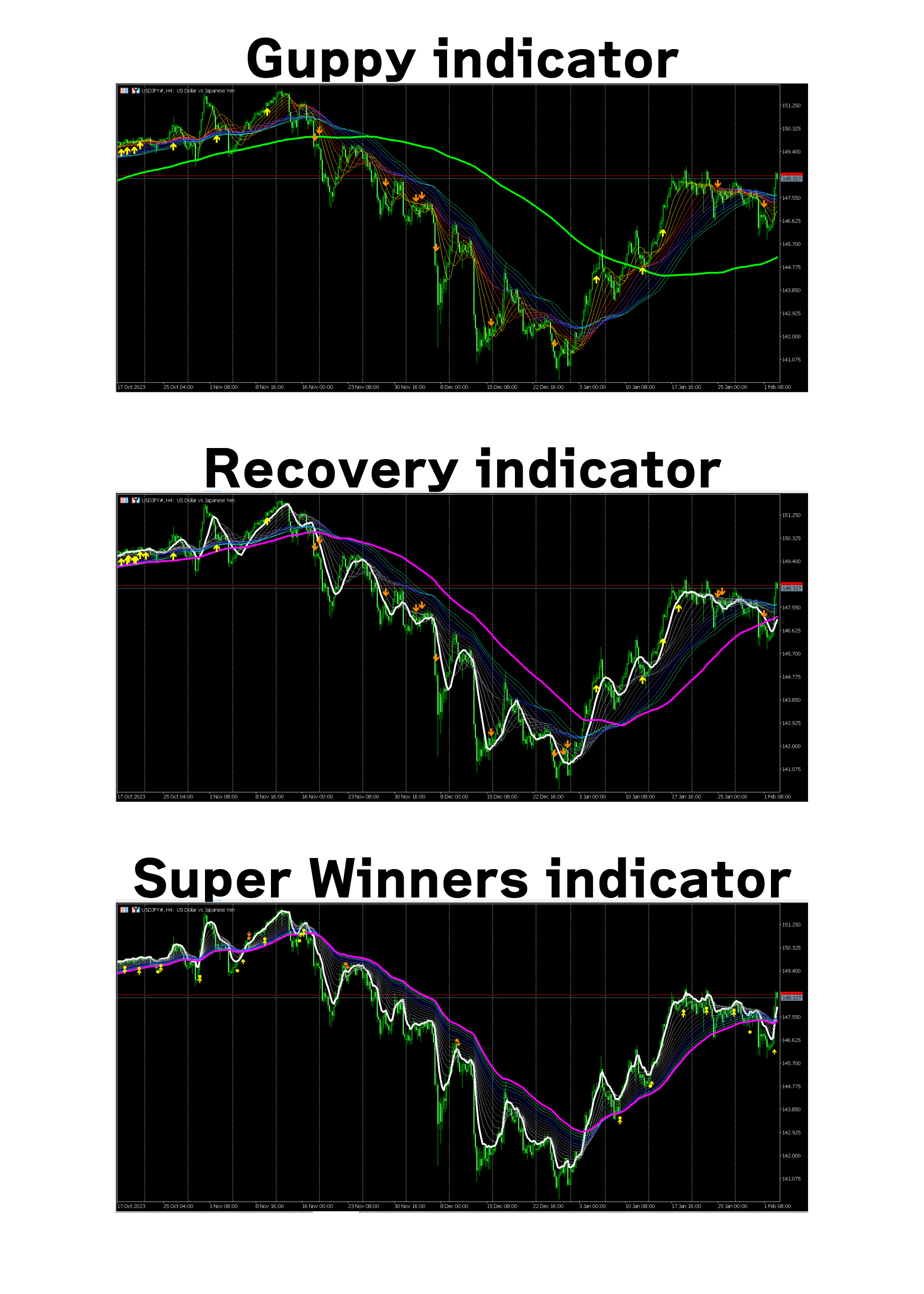
The above figure shows the evolution in three stages: the first Guppy indicator born in May 2023, the Recovery indicator revised from that logic, and the basic logic of the Super Winners indicator that I’m introducing this time.
A common feature is that all use moving averages.
The upper two in the figure share essentially the same basic logic, but the recently introduced Super Winners indicator is completely different, so you can see that the signal positions and timings are different.
Three common points: even though the EMA periods are six on the USD/JPY four-hour chart, the timing differs for the latest indicator at the bottom.
Let’s compare the Recovery indicator (previous) and the new Super Winners indicator by recent signals only.
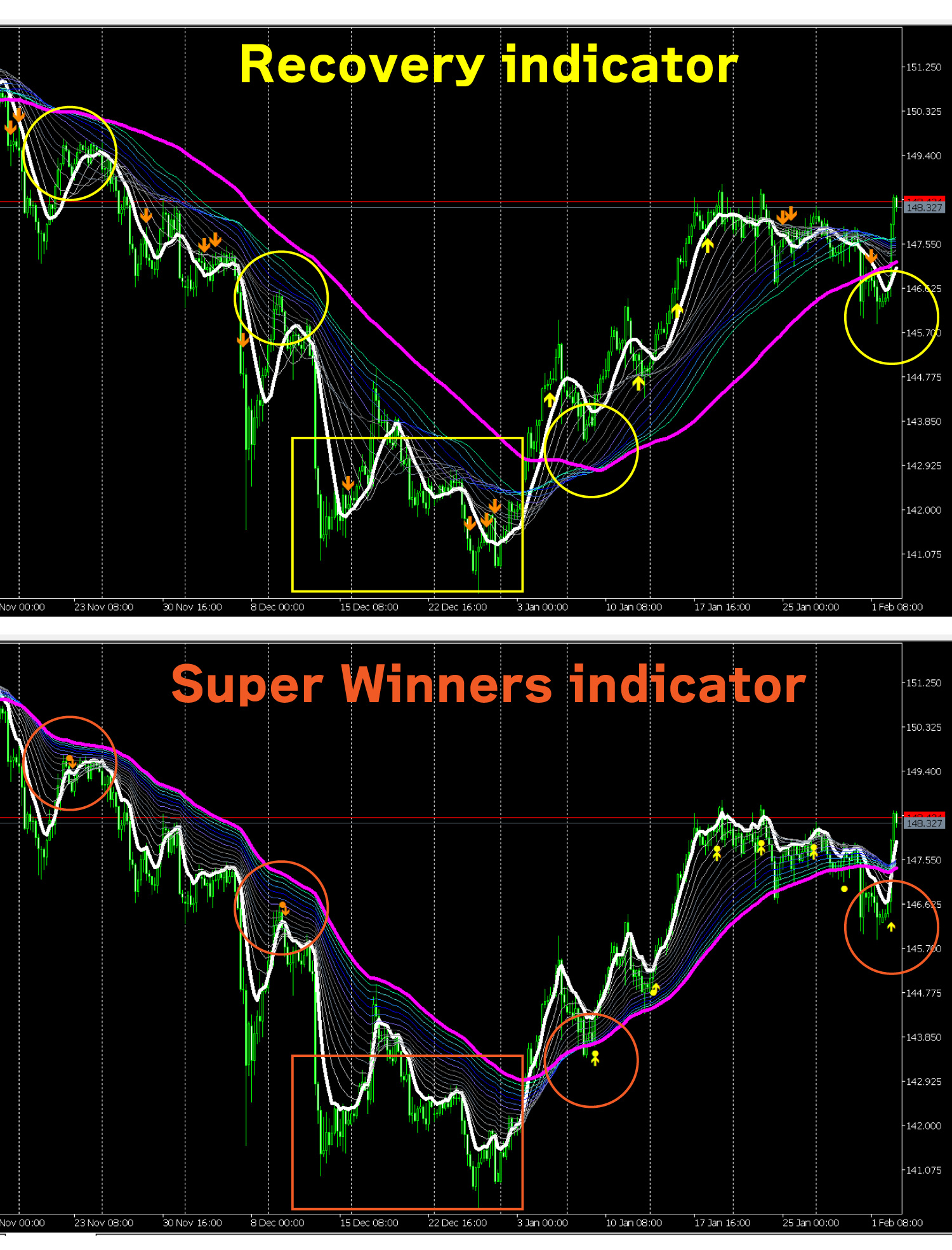
If you compare the circled areas on the upper and lower charts, you’ll see that the signal confirmation points are completely different.
In the upper old indicator Recovery, there is no signal inside the circle, but in the lower new Super Winners, the signal is at the best timing.
This isn’t a revision of the Recovery indicator; rather, you can see that the Super Winners indicator was rebuilt from scratch this time.
In particular, when comparing the four-hour USD/JPY bottom area in the charts, the Recovery indicator shows many signals at the bottom, whereas the new Super Winners in the lower chart shows no signals at the bottom at all.
In other words, entering at the initial movement when the trend starts to turn could lead to large profits.
Moreover, for the new indicator where signals appear neatly at pullbacks and retracements, unfortunately, the old indicator’s signals aren’t often at the optimal timing.
And after completing the new Super Winners indicator, this is the EA version.
First, please try the single-position Low set file.
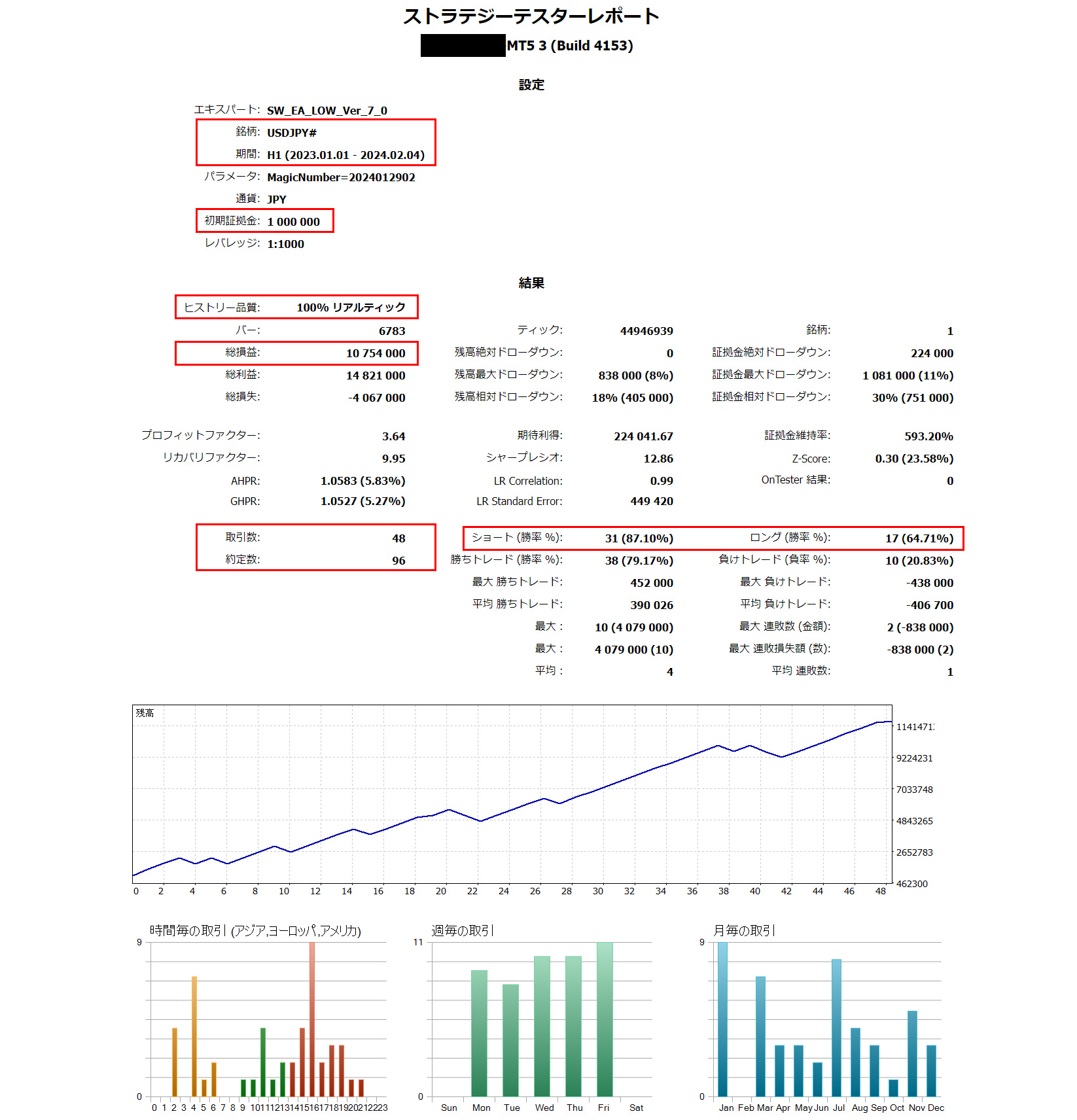
The above figure shows the backtest results of Super Winners LOW.set traded automatically from January 1, 2023 to February 4, 2024.
An initial capital of 1,000,000 yen grows to over 10,000,000 yen in one year.
The MT5 history quality indicates extremely high reliability.
The reason the test period was limited to one year is that, as explained in yesterday’s article, I optimized it to avoid the big rally of 2022.
2023’s market was more challenging, so I optimized it for the most recent year.
Conversely, the parameters do not work for the big rally of 2022.
Being a single-position type, there is only one position for both selling and buying.
The test results use a 40 pips stop and 40 pips take profit, so the risk-reward is quite tight at 1:1.
Here are the most recent trading histories.
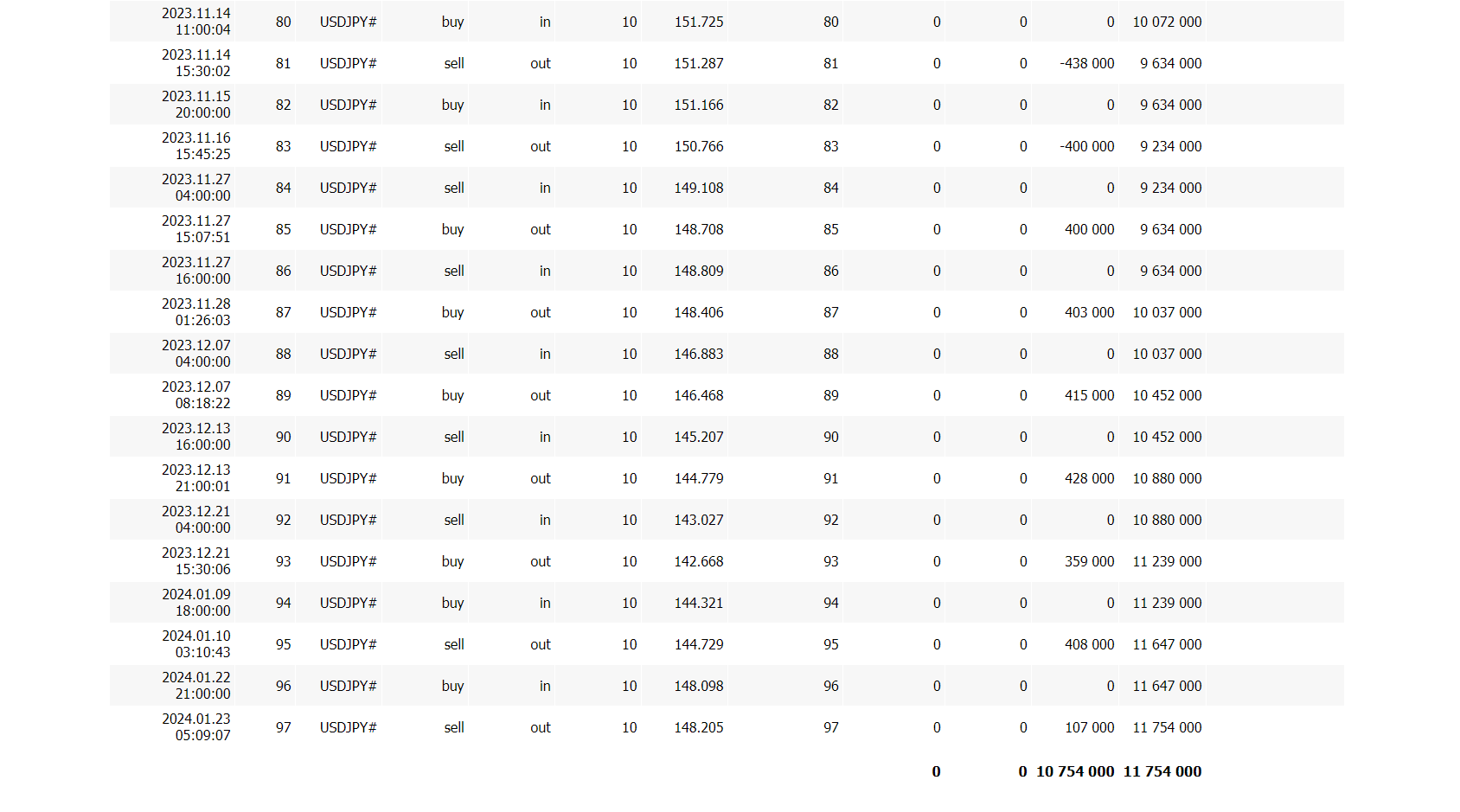
Trailing and MA-based settlements are also used, so occasionally profits may be realized before TP 40 pips, but in most cases, losses and profits are around 40 pips each.
Prices slip, so please tolerate a small deviation.
An initial capital of 1,000,000 yen grows to over 10,000,000 yen in one year, which is quite favorable for a single-position setup.
Win rate is 87% for short and 64% for long, and considering the risk-reward is 1:1, the profits remain substantial.
The number of trades in one year is 48, which averages about 4 per month or about once a week.
Based on its stability, this file is designated as LOW set.
What happens if you use Auto Lot with this win rate?
Here it is.
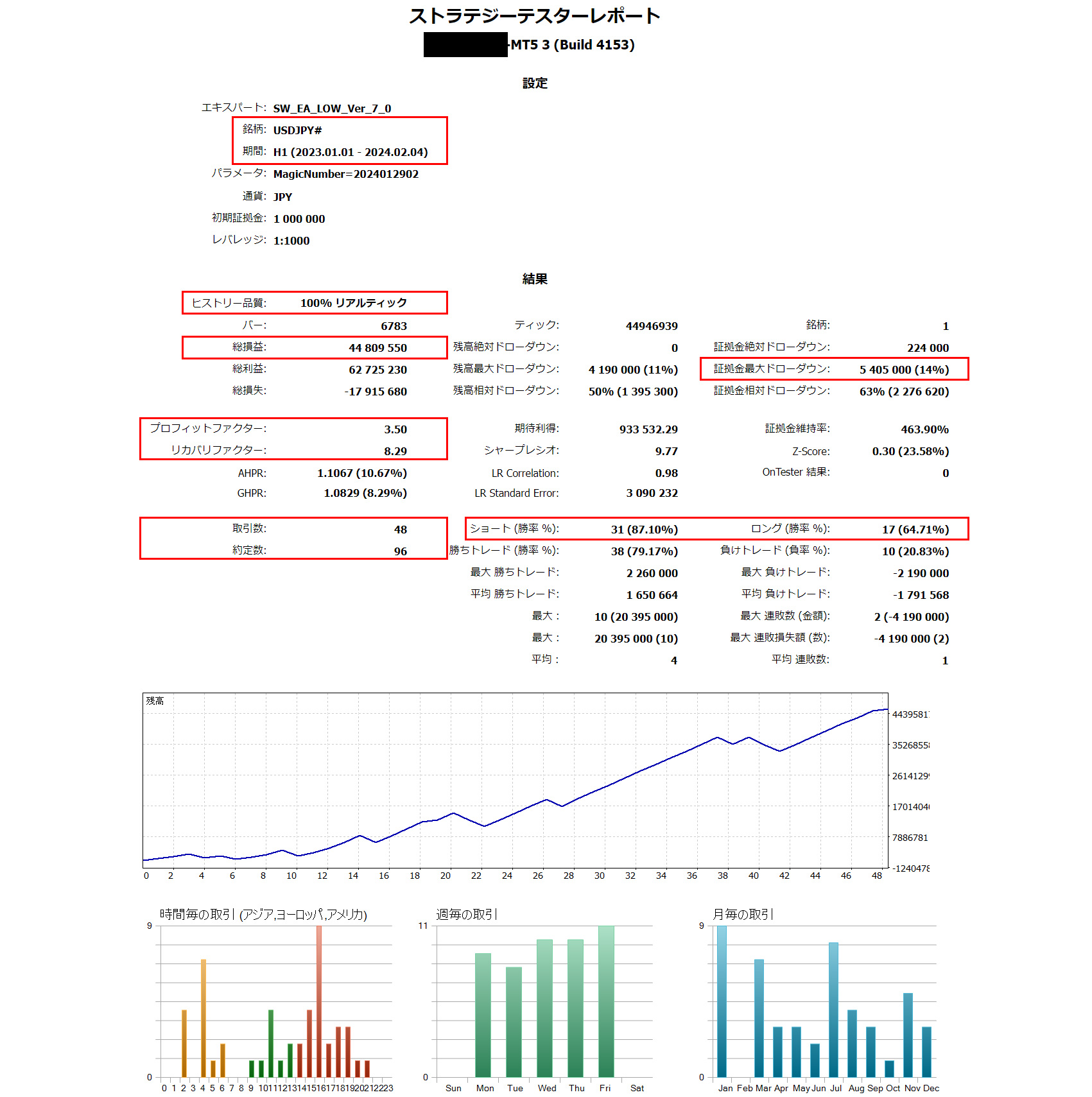
The above figure shows backtest results for Super Winners from January 1, 2023 to February 4, 2024.
Unlike Super Recovery, which timed lower-timeframe signals in the same direction as higher-timeframe signals, this new Super Winners trades only on the hourly chart.
Using Auto Lot with Risk 100%, this is a very high-risk setting with 1,000,000 yen in margin to 1,000,000 units.
One loss of 40 pips could bankrupt the account if there are three consecutive losses.
In last year’s test results, there were only two consecutive losses, but in actual operation, a risk percentage of one-tenth would be safer.
An initial capital of 1,000,000 yen grows to 44,000,000 yen in one year.
Win rate remains high like the single-position setup: 87% for short and 64% for long, with a surprisingly high win rate given a 1:1 risk-reward.
Typically, high-win-rate EAs either incur large losses or repeat small profits without setting stops, but this EA is different.
With a high win-rate of 40 pips stop and 40 pips take profit, it is quite rare, isn’t it?
Drawdown is around 14%, which is reasonably low.
However, the downside is that it is optimized for 2023, so whether it will perform the same this year is uncertain and may not work for 2022 or earlier.
It is designed under the assumption of a large-range market like last year.
Even a 10-year backtest would not guarantee this year’s performance, but the principle remains.
Gogojungle’s rules require using TDS historical data and presenting at least two years of test results, so the main parameters will come from the High set file described below.
We will use TDS historical data with the High set file to undergo Gogojungle’s final sales review.
Now, let’s look at the default test results using the High set file.
First, the two-year test results for Gogojungle submission, from January 1, 2022 to February 4, 2024.
First, we’ll look at fixed lots.
Auto Lot is not used, so it will not automatically adjust lot sizes according to balance.
The maximum number of positions is five longs and five shorts; given the high risk, this is the reason for using the HIGH set file.
Hedging is not prohibited, so there is the possibility of holding 5 short and 5 long positions, totaling 10 positions, but since the stop loss is only 35 pips, in many cases positions will be one-directional only.
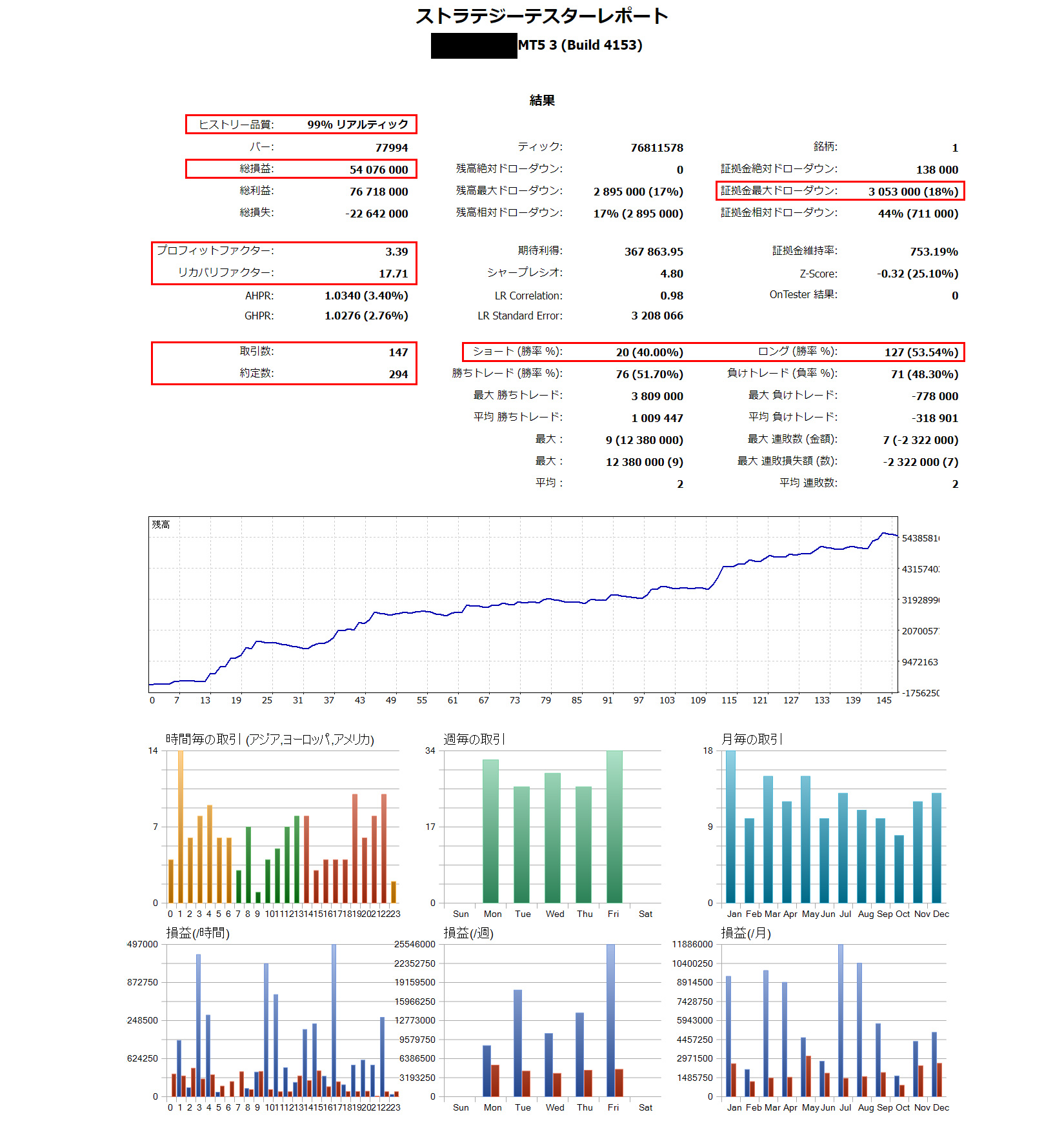
The above figure shows the MT5 backtest results with Super Winners.
Please note the areas enclosed in red boxes.
History quality is 99%.
An initial capital of 1,000,000 yen grows to over 54,000,000 yen in two years.
The number of trades over two years is 147, so on average about 73.5 per year, which translates to about 6 per month when divided by 12 months.
Since this is an average, monthly fluctuations exist, but compared with the LOW set file, the annual average is about 2 more trades per year, roughly 6 per month.
A notable feature is the risk-reward ratio.
The LOW set file was 1:1, whereas the HIGH set file is 1:8.
In the HIGH set file, the stop loss is 35 pips, so the maximum feature is that the reward is eight times that, at 280 pips.
In other words, the risk-reward is 35 pips: 280 pips.
Because the stop loss is 35 pips, the win rate decreases; it is 40% for shorts and 53% for longs.
Of course, there are multiple exit strategies before take profit, including trailing exits and exit on opposing signals.
Anyway, the logic that can grow from 1,000,000 yen to 54,000,000 yen through auto-lot compounding is attractive.
If you reduce risk for domestic accounts, profits would be about one-tenth of that.
Drawdown is 18%, which is reasonably acceptable.
What about just the one-year period for the HIGH set file in 2023?
SuperRecovery had a total profit of over 500 million yen in 2022, but 66,000 yen in 2023.
Super Winners’ total profit for 2023 is here.
An initial capital of 1,000,000 yen grows to over 25,000,000 yen in one year.
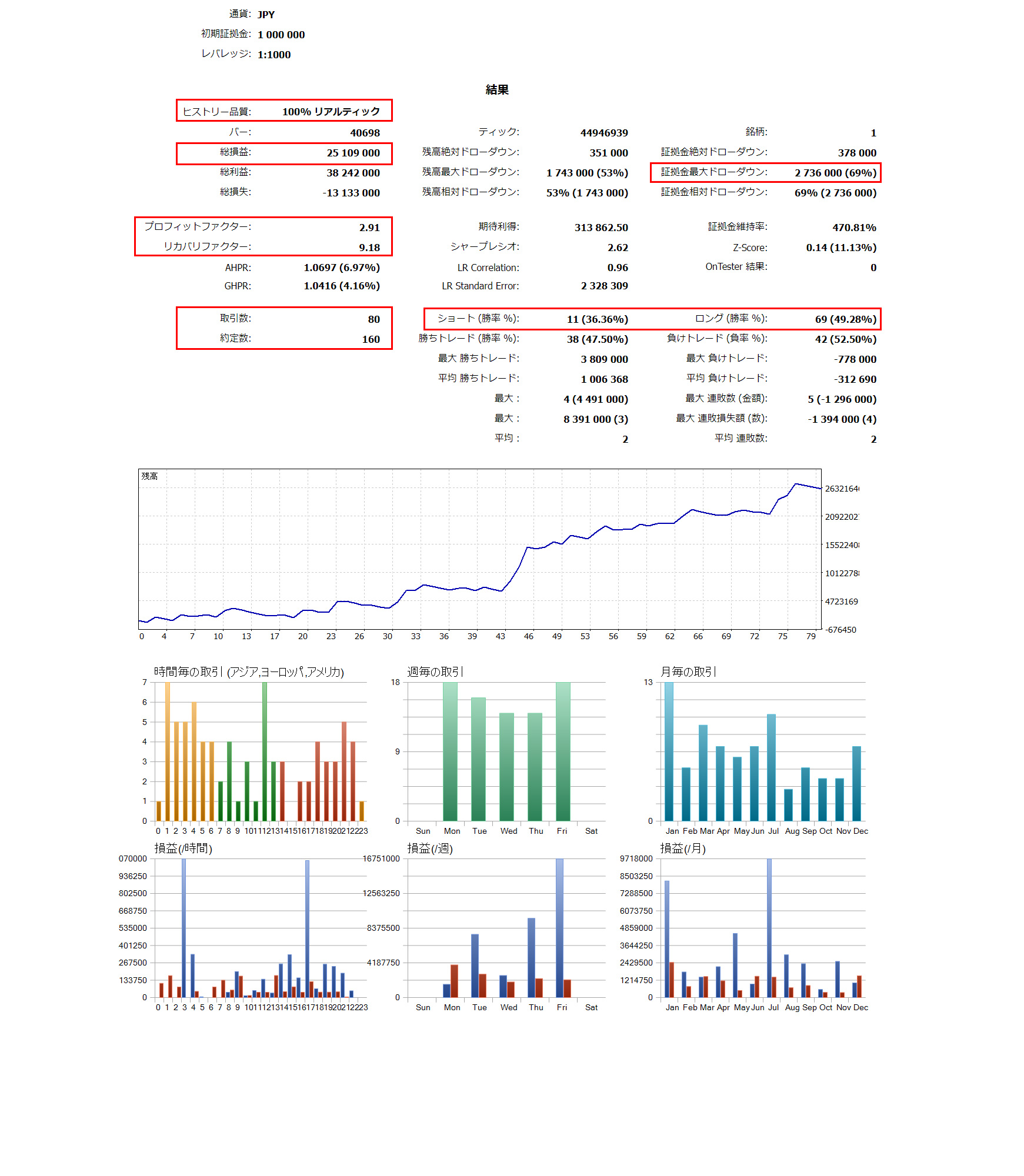
The number of take-days in one year was 80, so about 6 per month.
Over the two years since 2022, it was 54,000,000 yen, which means the performance in 2023's range market was about the same as in 2022’s big market; the performance remained consistent.
All of the above tests restrict to fixed lots with a maximum of five longs and five shorts held simultaneously.
What would happen if we apply auto-lot compounding to this condition?
Here it is.
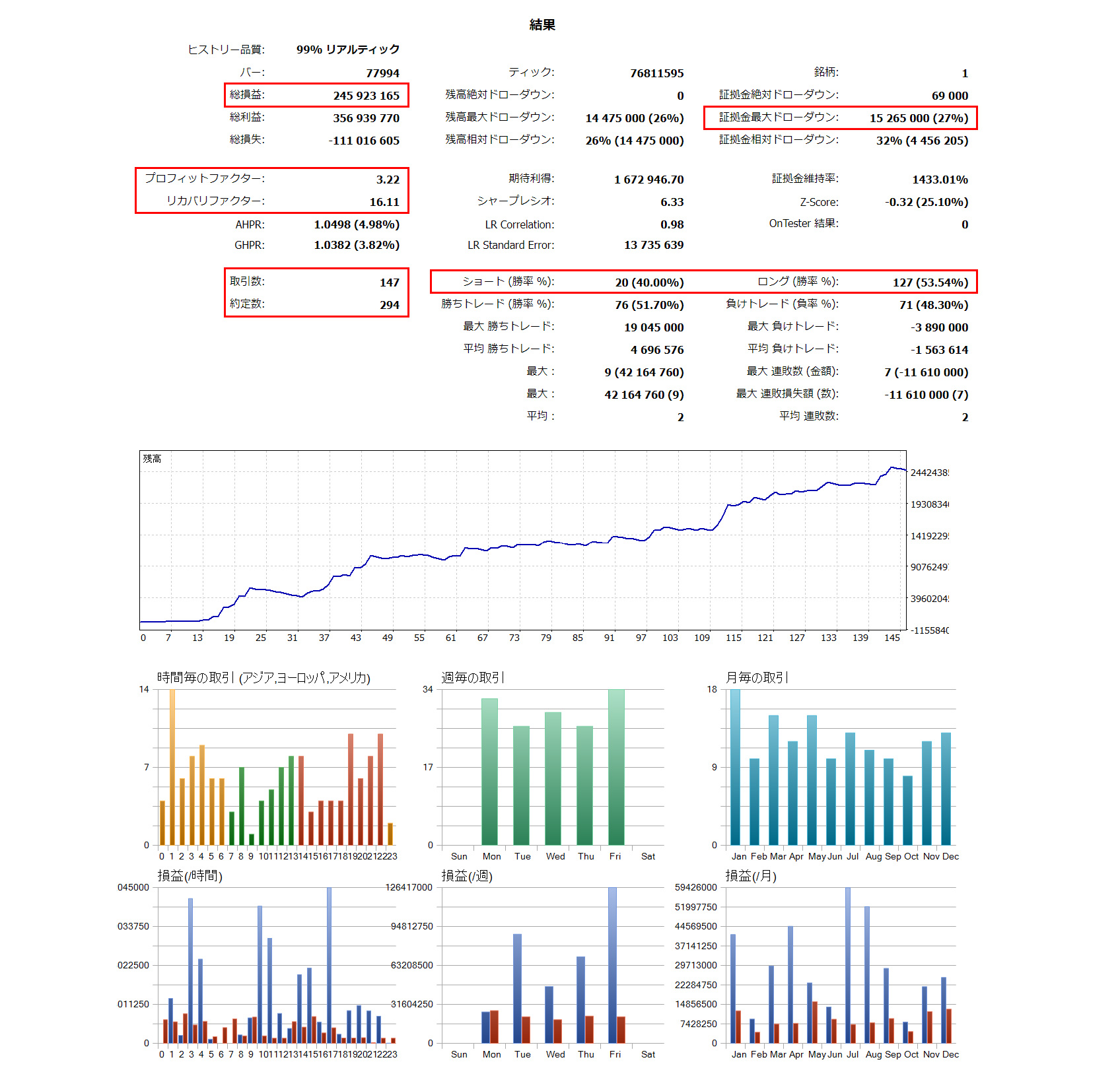
The test results from January 1, 2022 to February 4, 2024 are shown above.
An initial capital of 1,000,000 yen grows to over 244,500,000 yen in two years.
What about in 2023 alone?
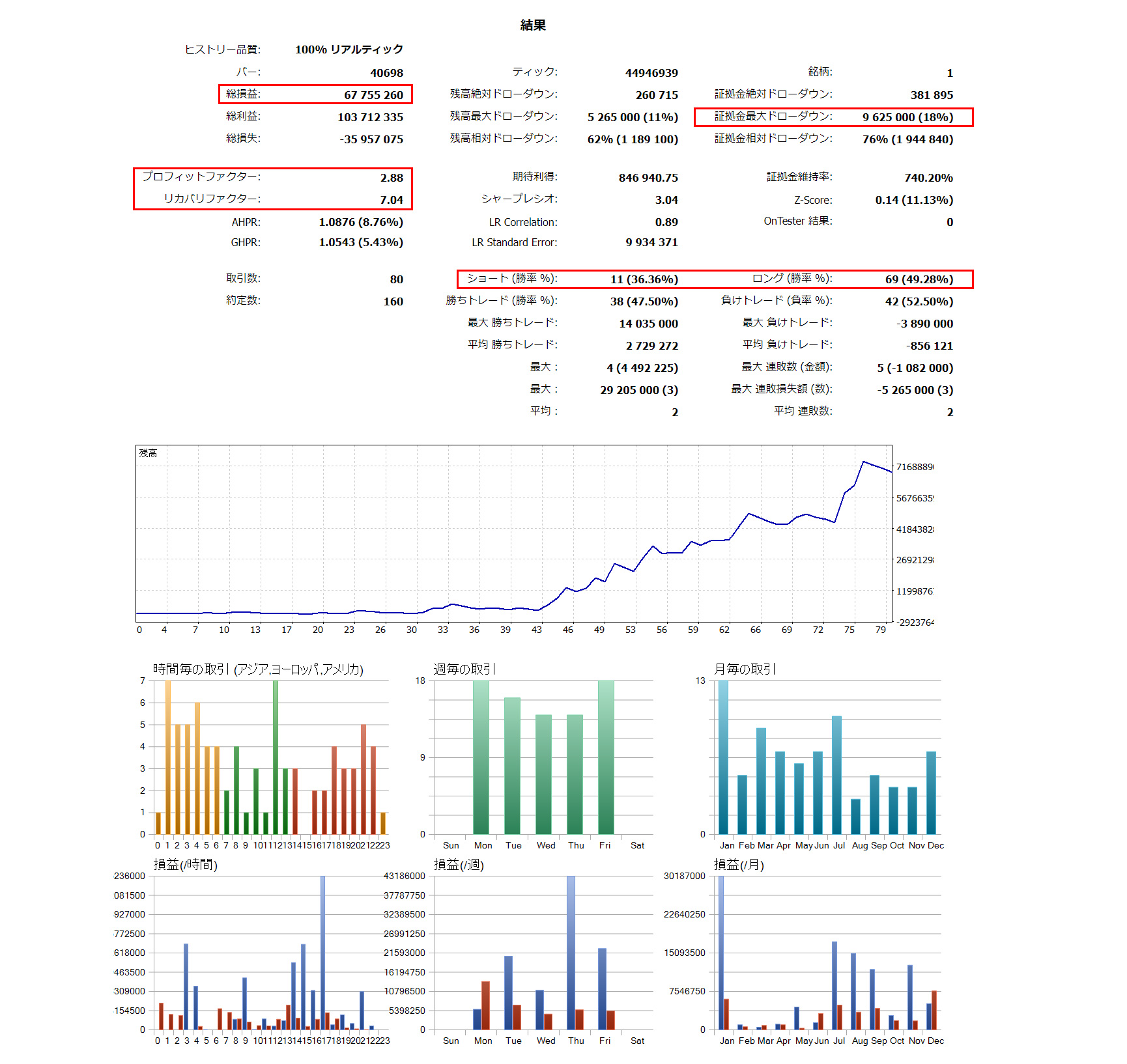
Last year, 2023, 1,000,000 yen grew to over 67,000,000 yen.
And now it continues to forward testing this year.
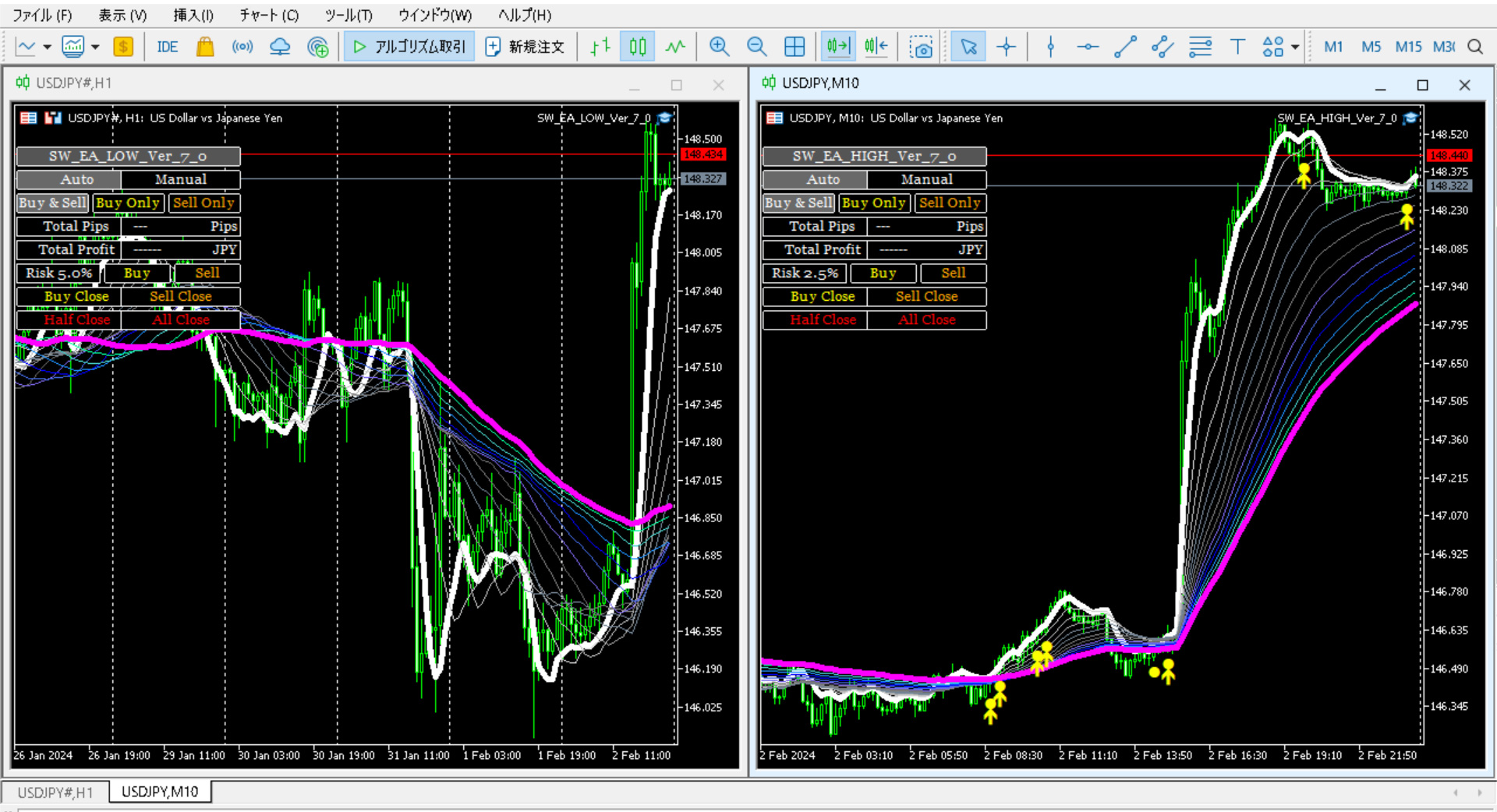
In my case, I set risk to about half of the above and installed the Low set file Super Winners on two USD/JPY charts while running another instance of the EA on the same account using the High set file on a second USD/JPY chart, two screens running the two EAs.
Finally, regarding price, we will offer a special price to Super Recovery purchasers.
As promised, the “Nami-nori Kinjiro” EA will be offered at 10,000 yen.
And the latest work, the “Super Winners” EA, will be uploaded free of charge.
Furthermore, as explained above, the two set files “LOW” and “HIGH” will also be included with Super Winners.
The price for those who are not Super Recovery purchasers is as follows.
The “Nami-nori Kinjiro” EA is priced at 48,000 yen.
The “Super Winners” EA is also offered at 48,000 yen.
Both the two set files “LOW” and “HIGH” are included with Super Winners as well.
If you purchase both EAs at the same time, you will also receive the indicator “Super Winners” for 48,000 yen as a special gift.
There is no fixed discount period at this time, so you may carefully consider purchasing while watching Gogojungle’s forward tests, or if this article resonates with you, you may trust your intuition and buy as soon as sales begin.
Thank you for your continued support.
We also plan to provide a video explanation on YouTube in the near future, so please stay tuned for a while.
Have a good start to the week!