
The 8th Edition: Area Corrections and Judgment Criteria [FX Planner]

In the previous sections, we explained the sequence from entry preparation to completion using the area method. This time, we will teach the indispensable revision work to improve the accuracy of the area method and the criteria for making those judgments.
【The Essentials of the Area Method Practical Edition [FX Planner]】
・Episode 1: How to find high-entropy advantageous areas from the chart(Available for free)
・Episode 2: Thoroughly analyze the chart from candlesticks
・Episode 3: Thorough analysis of the chart from candlesticks — Area Method Explanation —
・Episode 4: How to think about and decide the acceptable range
・Episode 5: How to use the established acceptable range with the Area Method
・Episode 6: How to narrow the area width down to the acceptable range
・Episode 7: Things to do before and after entry
・Episode 8: Area revision and decision criteria
【Related Articles】
・The Essentials of Technical Analysis Episode 1: Grasp the psychology of buyers and sellers [FX Planner]
Episode 8 Index
1. Two points that differ depending on the person
2. Range is not a basis for judgment in a battle!
3. Judgments and revisions of the area
Two points that differ depending on the person
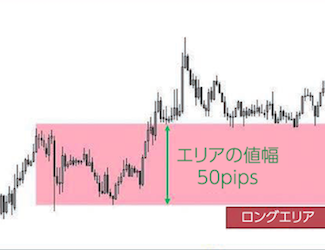
To review the area definition in the Area Method once more: “The upper bound of the long area is the high price, and the lower bound is the rate where buyers overpower sellers,” and “the upper bound of the short area is the rate where sellers overpower buyers, and the lower bound is the low.” The definitions for both upper and lower bounds are fixed, but can everyone draw the exact same area? Not necessarily. Since you need to judge those rates from the chart, different people may derive different areas.
To achieve stable profits in FX, it is important to repeatedly trade according to your own criteria. However, if the accuracy of the area is low, you cannot expect profits to remain even when you trade by that standard. In such cases, it is necessary to perform revision to improve accuracy, but how should you determine those revisions?