
Ichimoku Kinko Hyo Introduction | Episode 13 B, How to Use Y [Supervised by Tetsuo Hosoda (Sansei Ichimoku Yamabito)]

【Introduction to the Ichimoku Kinkō Hyō(Supervised by Sadao Hosoda, Sano-ichimonjōyama)】 Serialized article series (14 total)
・Part 1: The Origin of the Ichimoku Kinkō Hyō(Free)
・Part 2: The Three Waves and Time Relationships I
・Part 3: The Three Waves and Time Relationships II
・Part 4: What Can Be Understood from Time Relationships and Price Relationships
・Part 5: The Conversion Line and Base Line I
・Part 6: The Conversion Line and Base Line II
・Part 7: The Conversion Line and Base Line III
・Part 8: Leading Span and Lagging Span I
・Part 9: Leading Span and Lagging Span II
・Part 10: The 'Template' of Preparatory Configuration and the 9-Week Chart
・Part 11: 9-Week Chart and 9-Month Chart
・Part 12: The Real-time Line on a Weekly Scale: B, Y and the Naka-Base Line
・Part 13: How to Use B and Y
・Part 14: Content of the Original Text of the 'Ichimoku Kinkō Hyō'
Part 13 Table of Contents
1. B and Y indicate consolidation breakout
2. B and Y correspond to the waveform of consolidation breakout
3. It is important to wait for the second appearance
4. Consider the third wave as directional
5. Quick facts about the Ichimoku Kinkō Hyō
Profile of Sadao Hosoda (Hosoda Tessai)

Hosoda Tessai, President and Chief Researcher at Economic Fluctuation Institute. Inheriting the legacy of Sano-ichimonjōyama, he works to popularize the correct use of the Ichimoku Kinkō Hyō. He writes market commentary and charting lectures for the Ichimoku Kinkō Hyō Club organized by the Economic Fluctuation Institute. Every Monday on Radio NIKKEI Market Press, he broadcasts 'Technical Analysis from the Nikkei Average Ichimoku Kinkō Hyō.'
Official website:Ichimoku Kinkō Hyō Official Website | Economic Fluctuation Institute
Copyright of Ichimoku Kinkō Hyō is held by Economic Fluctuation Institute Co., Ltd., which also publishes the original text. For purchasing the original, please visit the official Ichimoku Kinkō Hyō website.
Services | Ichimoku Kinkō Hyō Official Website | Economic Fluctuation Institute
B and Y indicate consolidation breakout
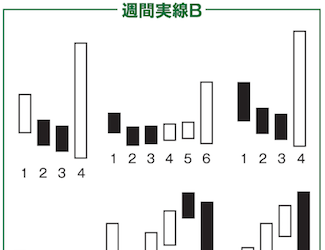
In the previous section, we explained B, Y and the Nakagendo line for the weekly real-line (weekly chart candle). Here is a recap of B and Y.
B and Y refer to how the weekly real-line is arranged: B is the movement where 3–5 depressed candles are broken through by one rally. Y is when a preceding candle’s price range is encompassed by a large bullish candle (or a large bearish candle). Both have the property of breaking away from a consolidation around a certain level, i.e., they tend to appear during consolidation breakout.
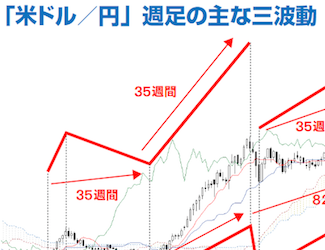
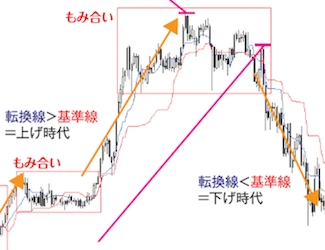
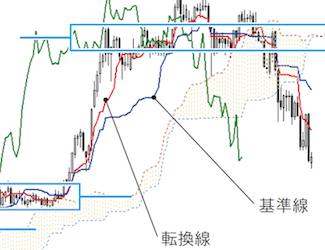
As shown in the illustration below, B and Y share the same meaning as the six standard waveforms of consolidation breakout. Market reversals occur when moving from an uptrend to a downtrend or from a downtrend to an uptrend, always passing through a consolidation pattern. When you switch the chart from a weekly to a daily basis, the waveforms become clearer, so please check them.
Note that B is viewed as the first buying opportunity, but as the downturn lengthens, the following rebound does not occur immediately; after going through the basic value of a “9” consolidation, the second buying opportunity appears. In other words, you should not jump in at the first appearance; you should trade on the second appearance.