

The greatest feature and drawback of Super Recovery lie in the EA’s number of trades and trading duration
I will explain the disadvantages of Super Recovery, which is scheduled for release soon.
Disadvantages are perceived differently by people and their characteristics are viewed differently, so they cannot be described universally.
As someone with 15 years of EA experience and having real-world tested hundreds of EAs, I will thoroughly explain what can be considered the most distinctive feature of Super Recovery.
I have recorded a video, so please watch it if you are interested.
This is a supplement to the content.
As stated in the title, the unique logic of Super Recovery was created as the culmination of my 15 years of involvement in EA trading.
I have recorded the video while speaking about my impressions after backtesting the developed EA and performing forward tests on real accounts.
I explain in the video the number of trades and trading period, but some people may feel that not taking any positions for 16 days is, in a sense, a drawback.
The background to the creation of such logic is deeply related to my confident experience with grid-type EA trading.
There are certainly many grid-nanpin-type EAs and grid-Martingale-type EAs that can earn to some extent.
However, the problem is that when a large trend continues with little or no pullbacks or retracements, the account tends to collapse in many cases.
This issue is not something I can claim my EA will never cause account drawdown, but for those who do not know grid, under certain conditions when there is unrealized loss, a method of continuously taking positions with a fixed pip width is sometimes referred to as grid.
Please look at the diagram below.
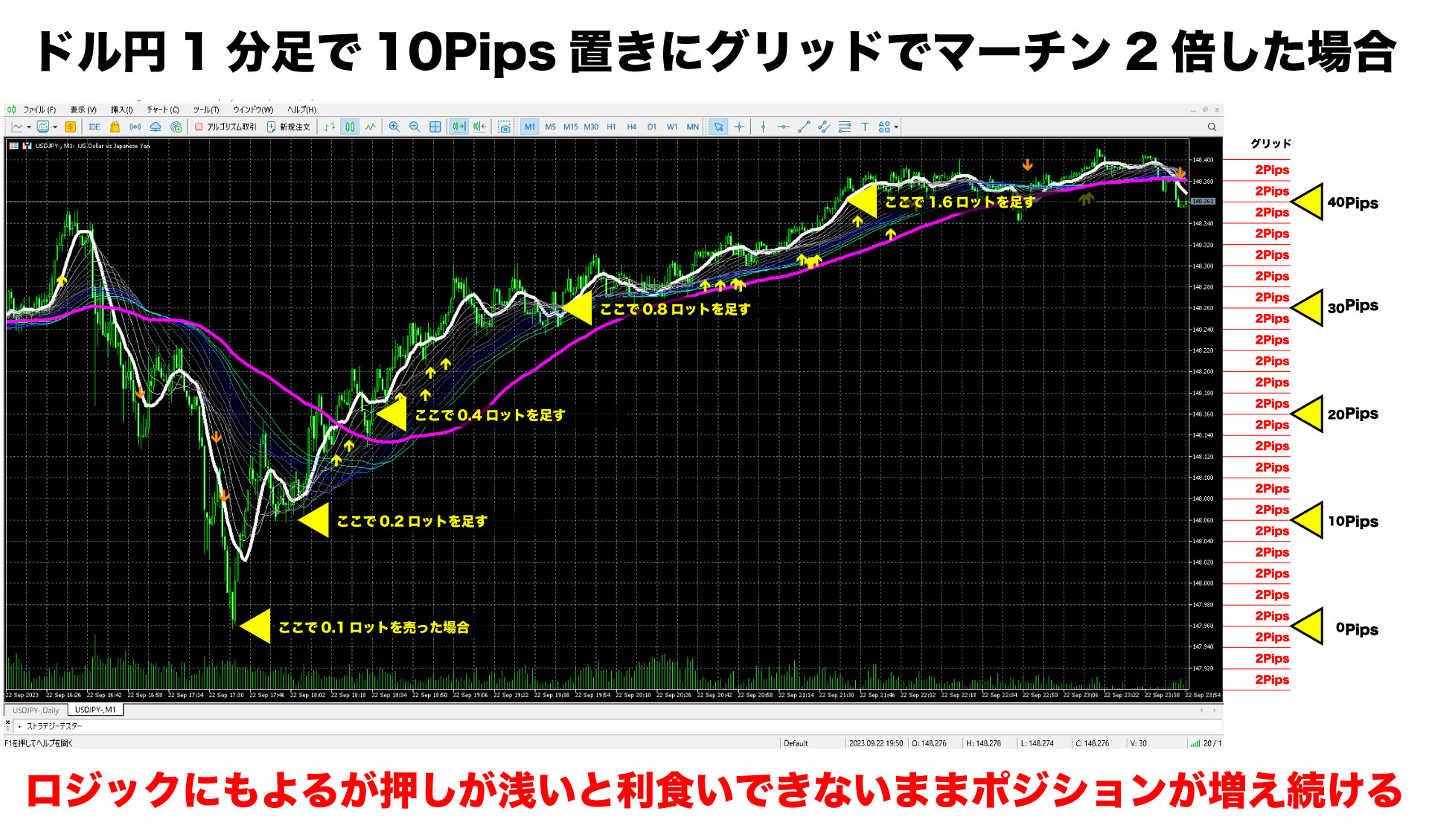
As in the figure, for example, 10 pips, though there are also cases of 15 pips.
For assets with large price ranges like gold, broader grids such as 20 pips may be used.
The problem here is that as long as there is unrealized loss, the number of positions keeps increasing almost without bound.
In the above figure, there is risk of rising 100 to 200 pips without pulling back.
From my experience, when funds are small, the probability of forced stop-out increases.
When funds are abundant, you may survive, but watching it is nerve-wracking.
A logic that maintains many positions without cutting losses may result in a large drawdown, but it is not rare for the account to collapse.
Even with a loss-cutting-heavy logic, once funds fall to a certain percentage, forced stop-out occurs, so in that sense, grid and conventional logic both carry the risk of account collapse.
From my personal experience, I have witnessed accounts collapse overnight when a strong trend persisted.
Of course, other factors besides the method contribute to that outcome.
For example, in cases of high leverage with limited funds, or high risk with large lot sizes relative to capital, things tend to occur.
Therefore, for EAs with monthly returns of 100% or 50%, it is encouraged to recover the principal early.
If the principal increases from 1,000,000 yen to 1,200,000 yen, the 200,000 yen withdrawal is a common fund management method in grid-nanpin and grid-Martingale methodologies.
Even with other methods, early recovery of the principal is a common methodology for all EAs.
Repeating this five times recovers the initial investment of 1,000,000 yen, so subsequent profits are pure profit, and afterward you can operate with high risk while knowing the account could collapse at any time (in the sense that the principal has been recovered).
While observing such logic, I wonder why there is no reverse version?
There may be something out there, but even after 15 years and hundreds of EA experiences, I have not encountered it.
That is why Super Recovery was born.
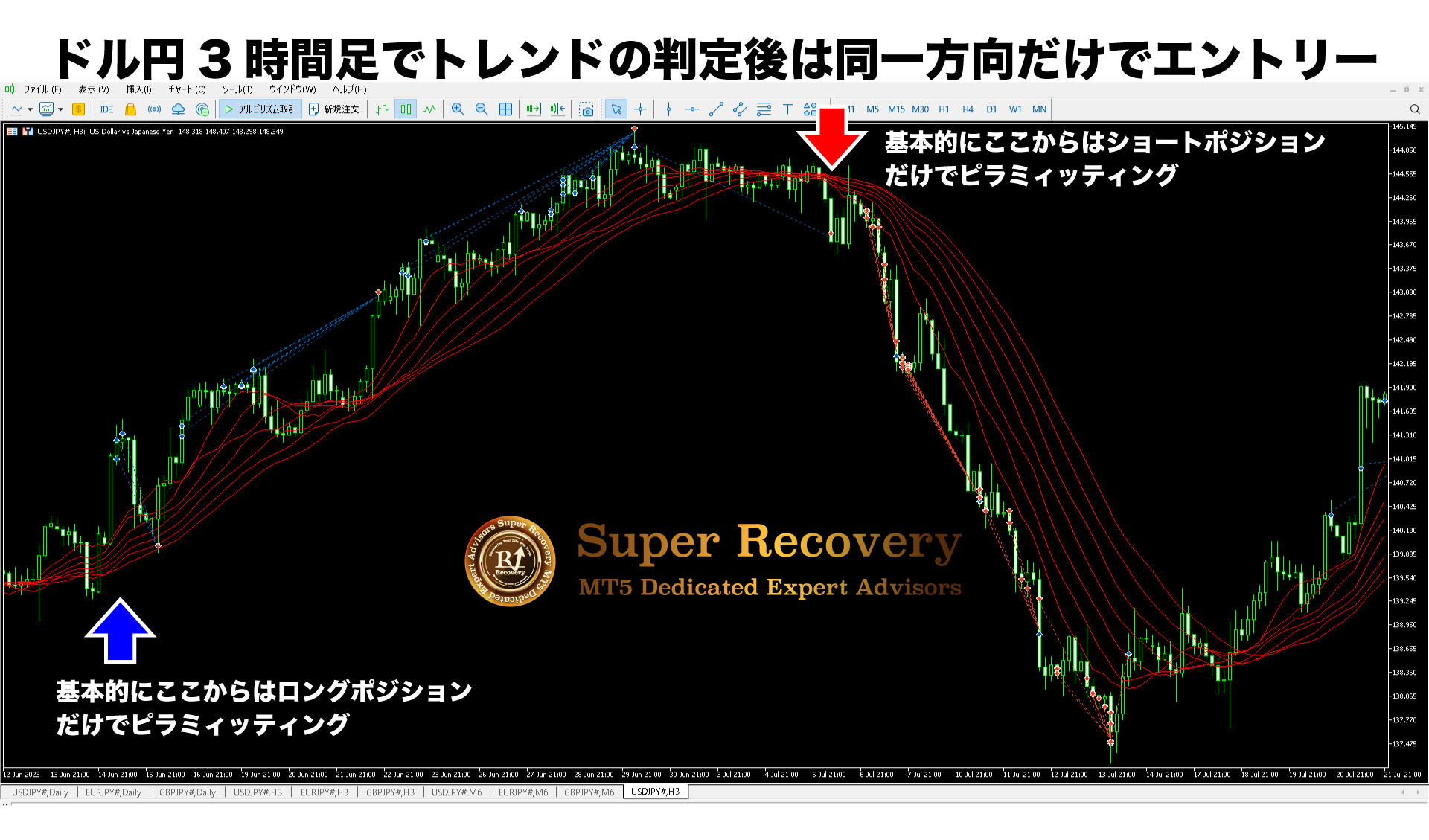
As will appear in the video, to drastically increase capital, a grid that tends to fail in extreme trends is used in a trend-following, pyramiding manner by adding positions as the trend continues.
I am fully aware of the merits of Martingale and averaging down; nevertheless, I concluded that the method of adding positions as profits exist without taking profits on a single position would explosively increase capital.
The challenge is a grid that profits in a ranging market.
In that case, Super Recovery tends to become negative, so I decided to rely heavily on breakeven exits.
It is a method of closing positions near zero gains or losses.
Once a trend begins, it is the opposite logic EA that can earn a lot with a grid.
That is Super Recovery.
See you again!