

From 1-minute to weekly trends, in one chart
Hello!
I am Satori, researching Binary FX.
Today, I will guide an example that displays the trend status from 1-minute to weekly on one chart in CloudFX.
The figure below shows an example of displaying the TrendMeter, bundled with CloudFX, from 1-minute to weekly on a single chart for the EUR/USD 15-minute chart.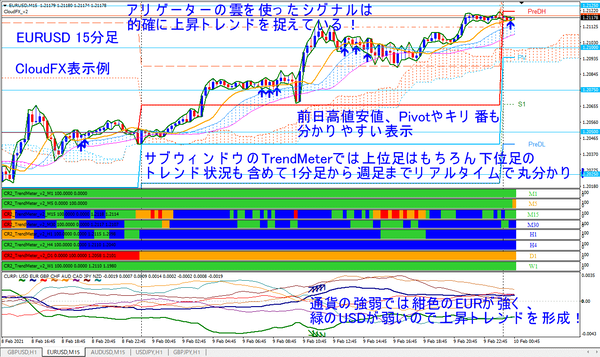
https://livedoor.blogimg.jp/fxmt4indicator/imgs/e/2/e2adf838-s.png
In the above figure, in the subwindow TrendMeter, the trend status of eight timeframes from 1 minute to weekly is shown on a single chart.
Uptrend judgment is made using the 5-period EMA and 21-period EMA. If the 5 EMA is above the 21 EMA and both have an upward slope, it is displayed in blue; if either is downward, it is shown in green.
Downtrend judgment is the opposite and is shown in red and orange.
For the lower timeframes, the 1-minute and 5-minute, the latest status is indicated by color.
For the same and higher timeframes, the past status and the latest status are indicated by color.
With version v2, support lines S1, S2, S3 and resistance lines R1, R2, R3 are also displayed, and Pivot Point and previous day's high and low lines are easier to view.
The indicators introduced today are as follows.For the lower timeframes, the 1-minute and 5-minute, the latest status is indicated by color.
For the same and higher timeframes, the past status and the latest status are indicated by color.
With version v2, support lines S1, S2, S3 and resistance lines R1, R2, R3 are also displayed, and Pivot Point and previous day's high and low lines are easier to view.
Scalping Indicator CloudFX
Thank you very much for reading up to here today.
Well then, please stay healthy!
Technical Trade Blog Ranking
///////////////////////////////////
Issuer: Binary & FX Technical Strategy Researcher
Satori Mind
Email: info at mark canary2.net
Blog Wave Riding: FX Waveshttp://fxmt4indicator.blog.jp/
///////////////////////////////////
※Register for the “FX Waves Free Email Magazine”
https://1lejend.com/stepmail/kd.php?no=UbHSvri
× ![]()