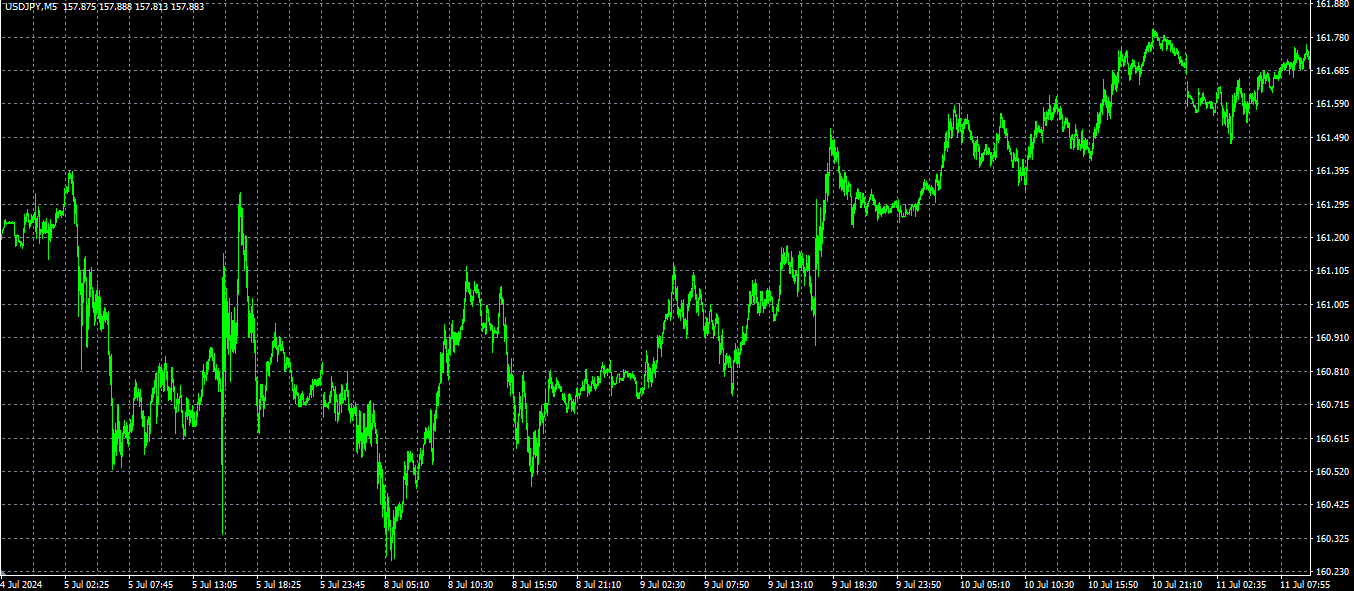

The market has neither a correct answer nor a direction from the start
Let me say this at the outset:
There is no correct answer from the start in the market.
The reason is that if there were a correct answer, automated trading would grow immediately.
However, with automated trading you must utilize money management to actually increase it.
In other words, the market behaves like a random walk,
and furthermore, it tends to move in a way that does not expand the logic of automated trading.
Certainly it moves with trends, but
we cannot know when it will move,
and first of all, the movement into that trend is not accurate.
So to put it simply,
chasing trends with trend-following will cause a lot of losses.
This means that if the trend movements are not accurate, you will suffer substantial stop losses.
It’s a simple matter, isn’t it?
The same thing happens with contrarian strategies—that’s all there is to it.
In other words, there is no invincibility or miracle in automated trading.
What you can achieve is around 4% monthly profit at best;
5% monthly is the maximum profit you might expect.
Because when you consider drawdown,
the market is such that neither trend-following nor contrarian nor range trading nor any trend reliably works forever.
If that happens, even with diversified automated trading logic you will still lose.
That’s where drawdown comes into play.
In drawdown, even with low risk, you can fall to around 18% or so.
The maximum drawdown that a stable logic experiences is about that much.
Even stable logic can reach that level.
However, a stable logic is
one that engages both trend-following and contrarian approaches with modest, settled settings for limits.
In other words, it is a universal way of interacting with the market.
Forex street and similar approaches particularly advocate such trades.
Therefore, even if performance is lackluster, it can still produce profits again.
Fundamentally, the market itself
depends on the market, but this dependency heavily shapes the mindset.
The dependency on the market is
based solely on how the market moves,
and it is driven by the relationship between price and time.
Technical analysis or
the idea of trend-following or contrarian strategies are not the basis.
In automated trading, stable logic tends to have more trends.
Ranges, after all, require timing.
However, trends are easier to time.
And why is that? Because
once you break out of the range, you get a trend.
In other words, you can avoid entering inside the box entirely.
Not making unnecessary entries gives you an advantage.
Now, returning to the initial point,
I said there is no correct answer in the market, but
this also means that a trend does not necessarily occur.
To put it more plainly,
even if you break out of such a box and enter into a trend, you may continue to lose in some markets.
Moreover, you will encounter markets where the trend does not continue.
Therefore, there is no correct answer in the market.
That is why, when considering markets that end partway,
any logic will experience drawdown,
and no matter how diversified your logic is,
during drawdown, all the diversified logics lose to the same extent.
The statement that there is no correct answer in the market
means you should be wary of simplistic trading mindsets.