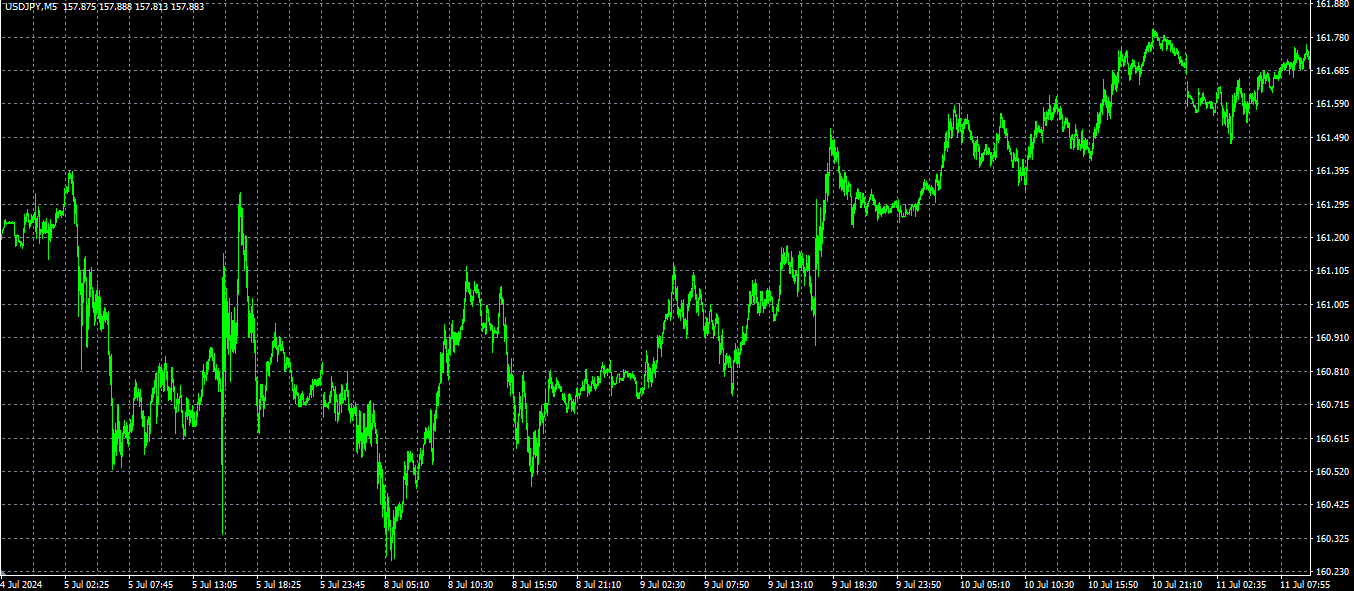

Both trailing trends and contrarian thinking are ultimately meaningless
If the direction is not determined, contrarian trading is effective
If the direction is determined, trend-following trading is effective
About the direction change, it’s just that
So if the direction is clear, it becomes about relentlessly aiming for the correct direction with only a small loss in one shot
Direction not determined → direction becomes determined → it won’t keep heading in that direction
In this decline, stop-losses wander
Direction not determined → contrarian traders profit
Direction determined → trend-following traders are in profit with unrealized gains
If it won’t head toward the direction, trend-following traders take losses while contrarian traders profit
If it heads toward the direction, trend-following traders make huge unrealized profits
Direction not determined = range
Direction determined = trend
If it won’t head toward the direction = small trend, medium range
If it heads toward the direction = medium trend, large trend
With this flow, the market is covered
In trends and ranges
It’s just an occurrence of short-term, medium-term, and long-term
We cannot know that tendency; if possible, it would be all profit, right?
Contrarian traders profit in small ranges
A small trend arrives, and without heading in a direction, it ends up being a medium-range, so contrarian traders profit again
That’s all there is to it
Reasons to adopt a direction-change logic
The logic of following or opposing the trend is too simplistic; there is no clear basis for an edge
Because the market frequently changes direction
First, contrarian trading profits, and finally trend-following profits — that’s all
Both become around zero
When doing fractal trading
It becomes a reverse-trend in the opposite direction at the top
When it becomes a medium-term trend, this logic becomes worthless
Therefore
Direction-change logic is the most effective
In a small trend, the short-term chart functions
In a medium trend, the medium-term chart functions
In a large trend, the long-term chart functions
If it’s a medium trend but you analyze the long-term chart, unrealized gains will be substantially reduced before taking profits
Profit-taking at a small trend position = meaningless
Because it isn’t more effective than a small-range trade
For profit-taking, it would be in the
positions of the medium trend or large trend
In the case of a medium trend, take profits at a temporary high/low
In the case of a large trend, take profits at a direction change
In contrarian trading
Profit is only possible in a small range and a medium range
In other words, the profit-taking levels in the positive and negative directions are completely opposite
There is no logic requiring a stop loss
A stop loss is merely a way to leave the losses to the machine
If losses become manual, that is unacceptable
In the opposite-direction logic
Namping (adding positions) occurs at the position of small-range trade → then middle-range trade
This is how it goes
If it moves against you further, it becomes a large range
Unrealized losses just keep increasing
The optimal profit-taking position is
In the middle range
Middle range means
During the formation of a small trend
The question is whether it will grow into a medium trend
Opposite-direction logic tends to fail
There must always be a proper-direction logic
Because eventually it will move toward the proper direction
Consider which direction is currently correct
In range markets, the opposite direction is the correct direction
And in trending markets, the correct direction is the correct direction
The best thing is simply to know which way it is heading now
With a proper-direction logic, in range markets you relentlessly pursue the correct direction with contrarian trades
Profit-taking is in the small range and the medium trend
In large trends, the probability of success is inherently low
Entering with one shot and then increasing the position only increases risk
Increasing is for profit-taking in the medium trend, a temporary high/low aiming strategy
A high/low is
Other than fractals and envelopes, there is nothing else to estimate
MA is at the 50 level as an oscillator, so estimating it would be intrusive
Envelopes are at positions like 60 or 40 as oscillators
For understanding market conditions, that is an analysis
Fractals are only support/resistance
Other market conditions are just gauging the strength of the moving average as envelope
The average market value should be just one; if there are multiple, it’s noise
Markets are such that
Even if the fractal does not function,
Ultimately, a market where fractals function will be established
Because Dow Theory is equivalent to “appearing at all times”
In the end, Dow Theory becomes valid = fractals function
While watching the average market value, you should supplement the current direction
Trading with fractals and Dow Theory is the true market analysis and technical analysis
I believe that
Noise is natural, but Dow Theory being valid is natural
Therefore, this fractal and envelope market analysis is extraordinarily effective in technical analysis
Market analysis exists simply to recognize what the true direction of the market is
If the market is not absolute, strengthening the recognition of the correct direction is what converts into profit