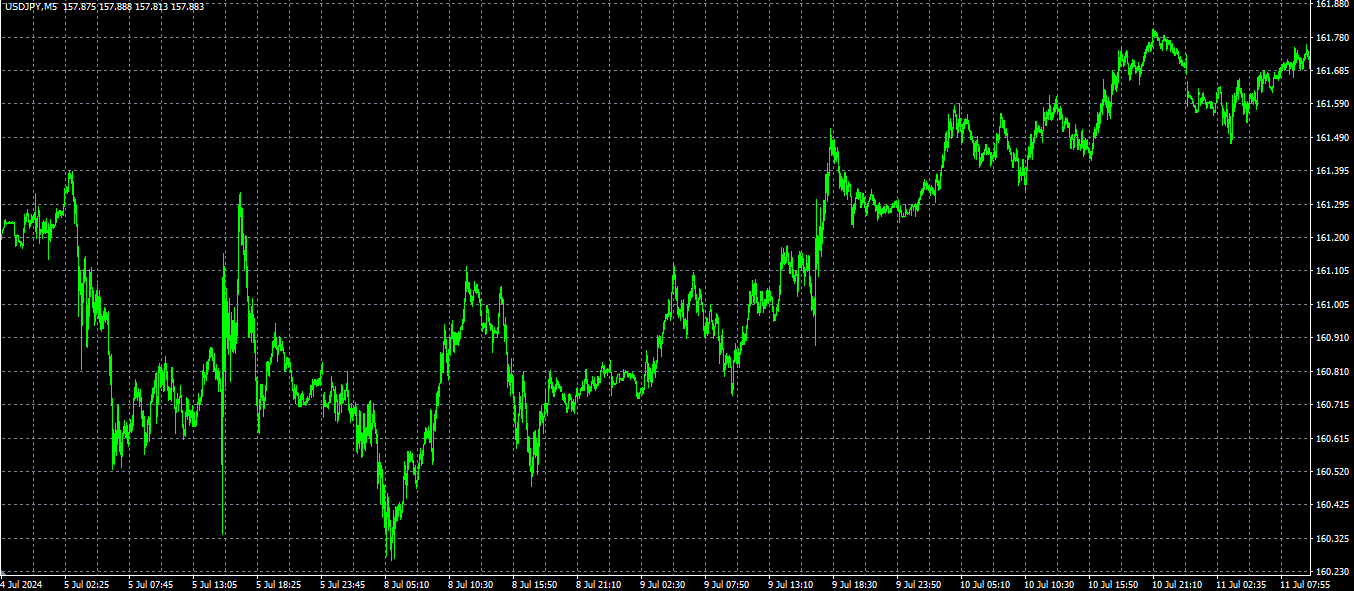

Explain the dangers of the Nampin Martingale
Martin has a lot of unrealized gains, but at the same time there are elements that generate a lot of unrealized losses.
In other words, negative factors. An increase in unrealized losses means a "quite negative element."
Since capital increases are the essence, the meaning tends to lean toward a "capital reduction trade."
If Martingale succeeds,
profits appear and total earnings end up positive, making full liquidation useful, but
the unrealized losses from the initial failure also increase.
Moreover, since you leave it unattended,
unlike a uniform averaging (drip) approach, unrealized losses become dramatically larger.
The meaningful approach is still the uniform averaging (drip) in the averaging buy strategy.
(That said, people who spam averaging are doing roughly the same trades as Martingale.)
Now, let's consider examples where profits occur and where failures end.
When profits occur (assuming profits are possible)
If Martingale succeeds, the profit is larger.
Since multiples succeed, profits come all at once.
If you do Martingale in binary options and it results in consecutive wins, it feels like profits surge and the logic seems meaningful.
Uniform averaging (drip) just yields normal profits.
However, that aligns with the scenario.
One could even say it is healthy.
What you are doing is not much different from a single shot.
Only the logic is different,
and with ultra-low lot trading, it can be regarded as a capital increase trade similar to a single shot.
(However, in markets with strong trends and with moves of 10 pips or more, you cannot endure it.)
Nevertheless, since profits have been made up to that point, considering total earnings over a week to a month, a clean cut loss is within feasible limits.
If it ends in a failure (a scenario where unrealized losses are left unattended)
Uniform averaging (drip) does not accumulate unrealized losses either.
Therefore, it does not become a high-risk trade.
With ultra-low lots, the mental state won’t go haywire.
In Martingale, you will bear unrealized losses corresponding to the Martingale multiples.
If it happens only once, that’s one thing, but repeated failures accumulate unrealized losses from Martingale.
In other words, you pile up a lot of risk.
(In other words, doing the opposite yields profits.
If you follow a trend-following counter-Martingale plus a first-entry stop 10 pips and a reverse-Martingale stop at a profitable level,
unrealized gains would continue to expand in the opposite direction.
However, performing such trades manually requires strong mental fortitude, so it is difficult.)
What I want to say with this trading logic is
if you only incur unrealized losses, you may run out of funds.
If you place unrealized losses with the Nanning (averaging) Martingale logic, you will run out of funds.
Profit and loss are evenly distributed in uniform averaging (drip),
and only when profit occurs does the Martingale portion generate profit,
and the unrealized losses from the Martingale portion accumulate only when you fail.
This is a characteristic of averaging that heavily uses Martingale.
In other words, averaging Martingale is a major negative factor in the negative direction.
To steer this toward profit,
the only effective approach is to adopt a reverse Martingale; implement the logic described above.
However, reverse Martingale ultimately involves embedding “consecutive wins” into the logic,
and if you do not achieve consecutive wins, there will be no profits.
And if you try to keep unrealized gains, the probability of further success becomes even lower.
In FX, where win rate is not that crucial,
reverse Martingale does not seem like a prudent logic.
↑
If you incorporate reverse Martingale into the logic (stop-loss trading),
you would need to wait at least three hours and then conduct a reverse Martingale stop-loss trade.
That seems to be the only effective method.
Reverse Martingale is a winning logic, but
if you do not fit it properly into the market, it ends up as a mere theoretical exercise.
Theoretical discussions are not limited to Nanning alone, nor only to Martingale.
Martingale is called a theoretical exercise because
it is easy to make a theory succeed in practice.
To understand the theoretical weakness of reverse Martingale
you need to observe the market to some extent and trade; otherwise the dire consequences are not understood.