
【US Stocks】Portfolio on March 6
Hello, I’m Leeman (@Lehman1980).
Six business days have passed since the last update, and the global trend is continuing to decline in stock prices.
The U.S. stock market peaked at 3,386 on February 19, and as of March 6 it has fallen about 13% from that high.
Compared with February 26, it is down about 5%.
In a single day, it has become a high-volatility roller coaster with moves of over 100 points,
so I regret not buying more while things were calm.
https://jp.investing.com/indices/us-spx-500-historical-data
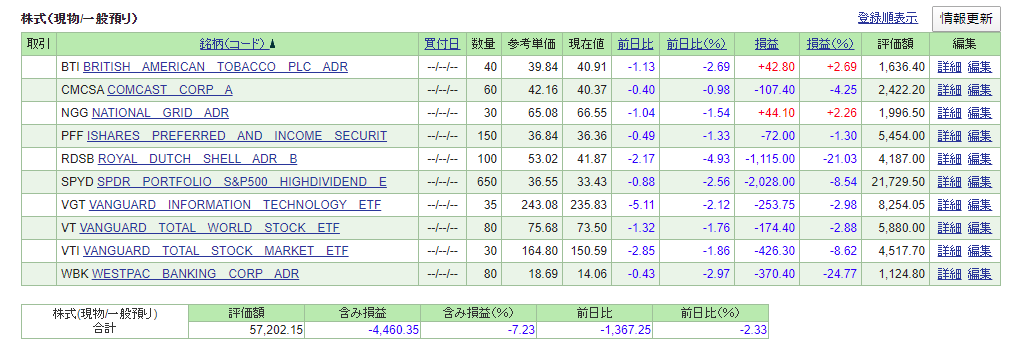
This is the SBI Securities account summary (as of March 6 close).
Current unrealized losses are as follows, and the cumulative profit/loss including realized gains and dividends shows a$2,500 lossas of now.
Until March 4, the cumulative profit/loss was positive, but it has turned negative for the first time in a long while, and the unrealized loss is at a record high.
Securities traded
Sold: ABBV, WBK
Bought: BTI, CMCSA, NGG, RDSB, SPYD, VT, VGT
This week’s trades were focused on buying back what was sold previously.
I think the pace of buying back was too fast, which is a point of reflection.
This past week, even if I were to buy back, I should have kept it to around $10,000.
Near-term stop-loss rules
Individual stocks: if unrealized losses exceed 6%, sell about 50%.
CMCSA is currently down a little over 4%.
RDSB & WBK are already down about 20%, so as an exception, they should be sold gradually.
ETFs: if unrealized losses exceed 12%, sell about 50%.
Thoughts on a rerouting market
I’ll briefly restate what was in the previous article in a compact form.
・Individual stocks: trim 50–100% of each position to reduce exposure..,
・ETFs: similar approach, but tolerate up to -10% unrealized loss.
・For buybacks, wait for market stabilization and then phase in increments.
・When buying back, also watch for lower purchase prices and higher expected yields.
・Individual investors have lower tolerance for pure losses than one might think.
・Moderate stop-losses and position adjustments can be effective. “Taking a break is also part of the market.”
This week’s stock topics
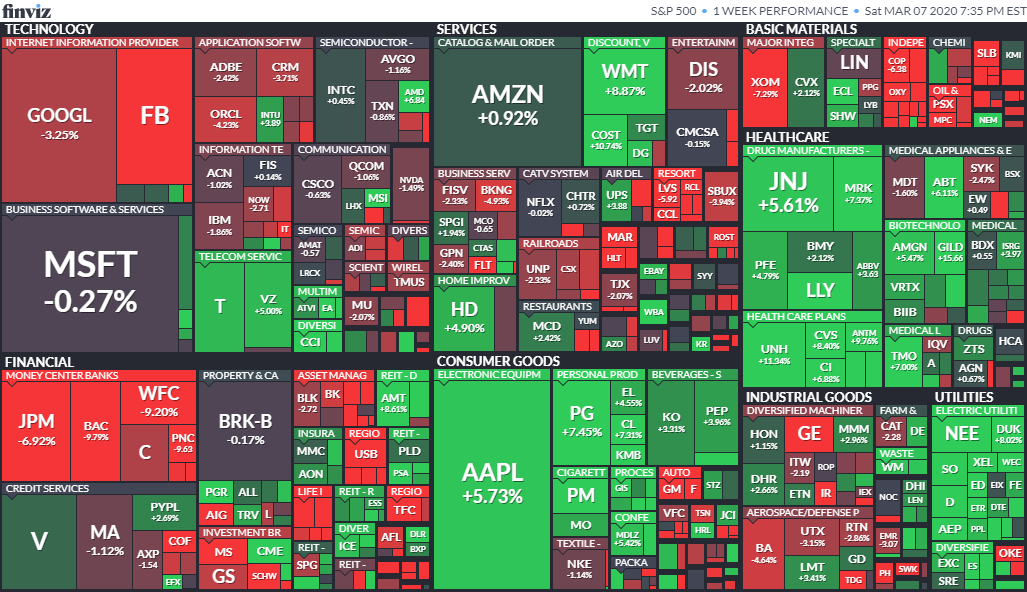
This is a heatmap of S&P 500 constituent stocks for this week (March 2–6). (Source: FINVIZ)
Last week was broadly down, but many stocks have rebounded on the reversal.
Around March 2, it’s rare for people to significantly add to positions, haha.
On March 3, the Democratic left candidate Sanders had a less strong result, while centrist Biden won, which is considered to be influential.
In sectors, Healthcare and Utilities and Consumer Dis staples rose. Meanwhile, Financials, Tech, and Energy generally fell.
The Fed cut rates by 0.50 percentage points, FF rate to 1–1.25%, and the 10-year Treasury yield has dropped to a record low below 0.7%, so the financial sector is expected to be tough going forward.
Easing policies are expected to continue, aiding corporate debt repayment and aiming for a soft recession.
On the other hand, with SPYD as my main holding, which includes REITs, I expect to benefit from rate cuts once the market settles.
Conclusion
The S&P 500 appears to have found a bottom around 2,900 for now.
(Intraday it dropped to 2,850.)
Next week, it would be good if prices form a higher low and establish a bottom, but I can’t say for sure yet.
Additionally, a rapid appreciation of the yen is progressing at present.
Some may view it as a good opportunity to convert to dollars, while others see it as a potential expansion of unrealized losses, and perspectives differ,
but I have converted about 1.2 million yen to dollars and am watching whether to do more conversions.
I think this sudden drop has been a good opportunity to reassess my own risk tolerance.
And it has reminded me again of the fear of unrealized losses continuing to widen.
Rather than trying to time the market, I want to stay in sync with the trend.