Hyper-practical! What are the concrete methods to create a winning trading logic?
Hello.
This is Guava.
Previous article discussed “price action.”
Not only analyzing candles,
but by reading the trader’s psychology behind them,
you can obtain a firmer basis.
In this article, as a more practical approach,
I would like to talk about how to create trading rules.
How should trading logic be created?
I’ll start with the conclusion.
Trading logic is,
constructed based on statistical evidence.
It can be busy switching between psychology and mathematics,
but for trading rules, a statistical-thinking approach is effective.
Let’s take an example of a dice throw.
If, for a certain way of throwing the dice,
in 100,000 trials the probability of rolling a 6 is 25%,
you could say that this way of throwing makes 6 more likely.
Trading logic follows the same idea,
and by testing the logic over long spans like the past 10 years,
you can find an edge that works.
As mentioned in the previous article,
trader psychology hasn’t changed much over time,
so long as the premise remains valid,you can expect to see performance in the future that is close to the past 10 years.
This is highly likely.。
Conversely, backtests that are only 1 or 2 years long, or logic with few trials, are weak as evidence.
How to find a winning logic from past markets?
Testing a logic against past markets is generally calledbacktest.
A simple backtest that anyone can do is to open charting software like MT4 and visually check how well your trade would have performed.
With this method, it’s physically difficult to obtain 10 years of data, but you can still judge whether the logic has an edge to some extent.
The important thing is to
clearly define where you want to enter.
Make it explicit.
For example, suppose you think of a logic like “go with the MA golden cross.”
Even this simple logic raises a lot of questions, such as:
- How many days is the MA period?
- Is it SMA or EMA?
- Enter at the moment of the MA cross?
- Or enter on the next candle after the cross is confirmed?
- When is the exit timing?
There are many things to consider.
If you neglect this, definitions will become vague, and you cannot correctly derive the edge from past markets.
Moreover, trading with vague definitions makes it impossible to investigate why you lost.
Therefore, you must define it clearly.
What is the method for expressing entry points?
Even if you’re told to clearly determine where you want to enter, at first you may not know what to do.
So, at the end, I’ll share a little about expressing entry points.
First, mark the point where you want to enter.
For now,it's important to search for your ideal entry point in your own way..
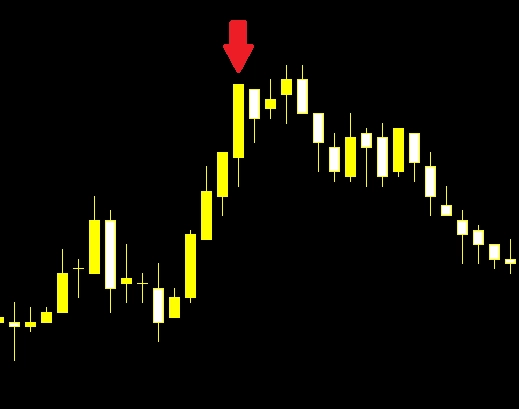
For example, suppose you want to enter at the point indicated by the arrow in the figure above.
Then, consider what features this entry point has.
What characteristics does it have?
・RSI above 70?
・Stochastic above 80?
・A relatively large bullish candle?
・A bullish candle without a long upper wick?
・Five consecutive bullish candles?
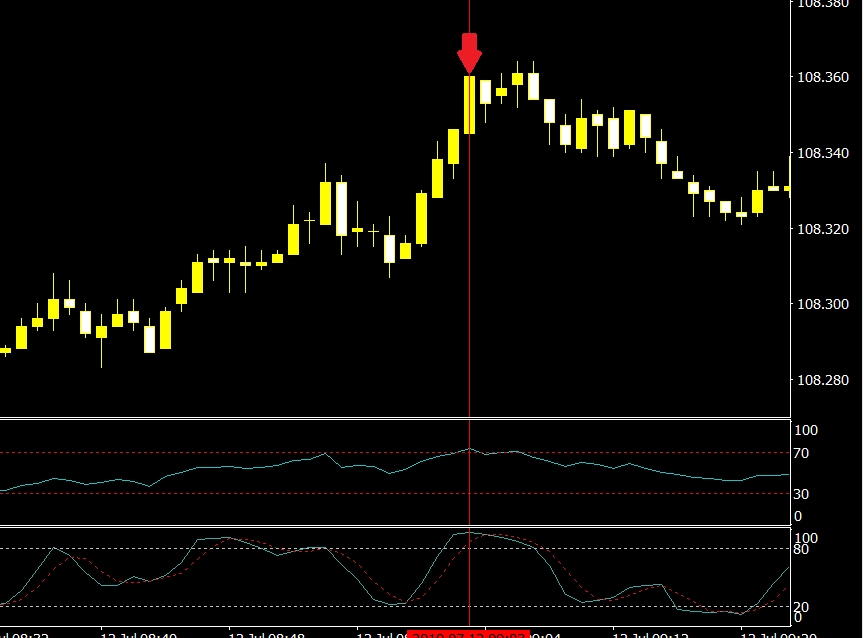
If you want indicator data, add it as needed.
By doing this, you will gradually see exactly what conditions constitute the entry point, so you’ll set provisional conditions.
Next, find several entry points that meet exactly the same conditions..
After searching to some extent, you’ll find “this is totally useless!” so you’ll gradually tighten the conditions and improve them.
You will continue this relentlessly until you are satisfied.
When you think you’ve found a high-probability entry point, you may find that the number of trades is too few,
or if you loosen conditions, your win rate may drop.
It’s an endless task, so in the end it’s about whether you are satisfied.
However, if you find even one entry point that you are satisfied with,
that would bean extremely wonderful invention achieved..
The path is humble and not easy, but
please give it a try.
If you feel stuck, taking a walk in nature is nice. Ha ha
In conclusion
That is all for the content.
If this article was helpful to even one reader, I would be happy.
Lastly, a quick promotion:
We are currently offering our indicator for free.
↓↓
https://www.gogojungle.co.jp/tools/indicators/19469
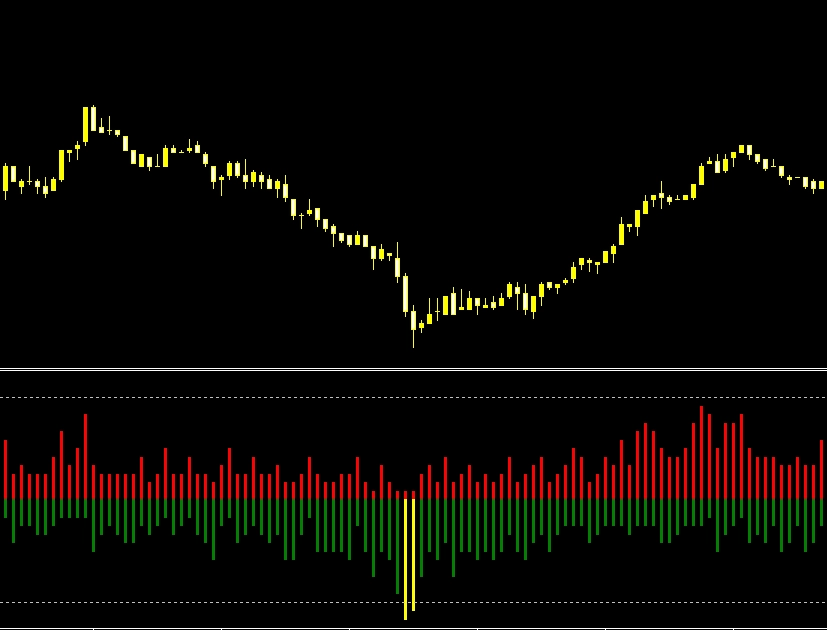
It is a simple oscillator-type indicator that is easy for beginners to use.
Usage instructions and backtests are also published, so if you’re curious, please check it out!
Thank you for reading to the end.