There are clues in the trader's psychology! What is the ultimate technical analysis method?
Hello.
My name is Guava.
Previous article discussed “Candlestick chart analysis.”
The foundation of technical analysis is candlesticks, so
before learning indicators, first study candlesticks.
That is how it ends.
In this article, I would like to delve a little further into price analysis using candlesticks.
What is the basis for candlestick analysis to be valid?
When people think of market analysis, they may picture math, but
the underlying factor is surprisingly human emotion.
Because,even now and in the past, what moves prices is humans.
And human emotions have not changed much over time.
That is why prices tend to repeat similar movements, and
the reason technical analysis remains valid in the future is found.
Why does a trending market occur?
This may come as a sudden topic about trends, but
have you ever wondered why trends occur?
If you think about it plainly, when prices go down, more people will buy, and
when prices go up, fewer people will buy.
Even practically, for example, if cigarettes rose to 1,000 yen,
most people would consider quitting and reduce purchases.
However,a trending market is an entirely opposite phenomenon.
The lower the price, the more it is sold; the higher the price, the more it is bought.
In other words,even though cigarettes rose to 1,000 yen,
smokers enthusiastically crowded to buy.If you witnessed such a phenomenon, you might wonder if you live in the wrong world.
But in reality, markets form by repeating trends and ranges.
What does this mean?
In conclusion,
the emergence of trends is caused by fear.
People who eagerly buy 1,000-yen cigarettes
may believe that cigarettes will rise to 10,000 yen in the future.
In other words,they feel compelled by the fear that if they don’t buy now, it might become even more expensive.
This is the forcing factor behind action, i.e., “fear.”.
If so, the reason for the action becomes understandable, doesn’t it?
Historically, when many people's attention turns to "fear," extraordinary price movements are observed—
and this has been confirmed many times.
In recent years, Bitcoin is a notable example.
Because you don’t know how high it will rise,
you buy at high prices out of fear of missing out on the opportunity.
To be lengthy, but basically,
the same can be said of a single candlestick.
Reading trader psychology from candlestick analysis
So, specifically, how can we read trader psychology from candlesticks?
This is explained here as well as in the previous article, with the diagram of the “Bullish Doji” (陽線ボウズ).
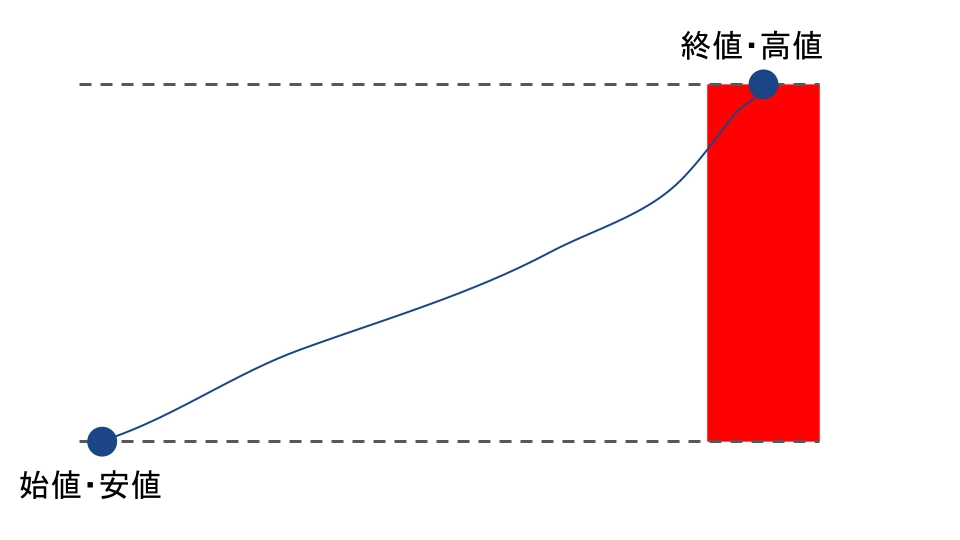
Looking at this candlestick, let's interpret how traders are thinking.
First, this candlestick is characterized by“a strong uptrend.”That’s right.
One thing that can be said is that
those with short positions are being driven to losses.
At this time, many who hold short positions will likely take the action of “stop loss.”
Because they are dominated by the fear that “the loss might grow further.”
On the other hand, those with long positions who are making profits, what about them?
They don’t necessarily have to act immediately; in fact, waiting could yield more profits.
Rather, those who are forced to act are the ones who have losses.
And when someone’s “stop loss” causes the price to rise further,
someone else cannot bear the loss and will again execute a “stop loss.”
This chain makes price more likely to rise.
How about that.
Even with just one candlestick, by reading the trader's psychology
a completely different perspective emerges, doesn’t it?
In actual markets, these candlesticks appear in succession, and the situation changes rapidly, but the basic idea remains the same.
Make price action your ally
Actually, the content up to here explains“Price Action.”.
Price action is a method of analysis that reads trader psychology from actual price movements (candlesticks) and assesses the market situation.
I think this is a very rational and excellent form of technical analysis.
Just one candlestick.
But everything starts from there.
Please try to master price action market analysis.
In closing
That is all.
If even one reader found this article helpful, I would be glad.
Lastly, a small promotion: we are currently offering our indicator for free.
↓↓
https://www.gogojungle.co.jp/tools/indicators/19469
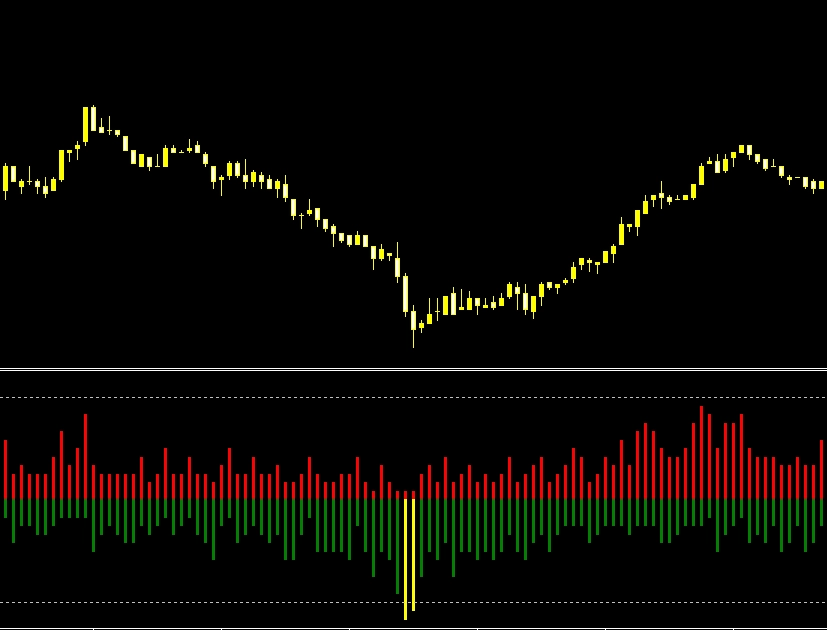
It is a simple oscillator-type indicator that is easy for beginners to use.
Usage instructions and backtests are also published, so
if you’re interested, please check it out!
Thank you very much for reading to the end.