
[Why I can’t win even though the waves are visible] The answer from 18 years of trading
? Reasons you can’t win even when you can see the waves | GOLD 18-year answer
When you look at the chart and feel, “Ah, it’s rising,” or “the downtrend wave is coming,” there are moments like that, right?
? But if you entered based on that perception, it moves in the opposite direction.
? Or, you’ve seen the wave but were late to jump in, thinking, “I was just looking at it.”
You’ve probably also heard the term environment recognition.
But honestly, isn’t it vague what exactly you should do for environment recognition?
Seeing the wave and being able to use the wave are completely different skills, you know.
In this article, we’ll delve into why recognizing waves and environment recognition end up ending as a mere vague impression like “just a feeling.”“Why I end up with only a vague sense”is explored here.
I wrote it so that after reading, you’ll realize, “Ah, my issue was here.”^^
? 1. You can see the waves but can’t win. The true nature of this contradiction
“I’m practicing environment recognition.”
I’ve been getting more consultations from traders like this.
But when you listen carefully, what they’re doing is more like atone of voice check—“it seems to be in an uptrend,” “maybe bearish,”
That itself isn’t wrong.
Looking at the chart and feeling the flow is necessary.
But that alone doesn’t become“usable recognition”, right?
What’s actually happening is this.
? Prices are in a rising wave and you enter thinking, “it will rise again.”
They rise a bit, but don’t extend as expected and reverse.
You take a loss and think, “why? the trend should have worked.”
Haven’t you experienced this?
The wave direction was correct. Yet you still lost.
? The core problem hides here.
“The wave direction is correct”and“I entered at a place where I could win”are completely different matters.
Even if the direction sense is correct, if you entered at a bad place, you’ll be stopped out.
Even if the flow is right, if the timing is off, you won’t get results.
? The true goal of recognizing waves is not knowing the direction, but knowing where you are in the wave
I didn’t get this part either back in the day (;'∀')
I kept getting burned by the simple thinking, “Because it’s an uptrend, buy.”
The flow is right. But the place you entered was just before the wave ends.
I can’t even count how many scenes I repeated like that.
If you think environment recognition is “grasping the direction,” you’ll spin endlessly in this contradiction.
And the tricky thing is, even in this state, you can“occasionally hit”profit.
If you only look at the wave direction and enter, you can still profit by chance when timing aligns.
That’s why you might mistake yourself into thinking your view is correct.
I think this is one reason why traders who can see the waves keep failing more and more.
? 2. The structural reason why “environment recognition” doesn’t work
Why does the wave you’re watching fail to function?
If you lay out the structure, there are two big problems that stack on top of each other.
? One is that which wave you’re watching is vague.
? The other is ignoring the relationship between the wave and the wall.
When these happen together, environment recognition ends up as “tone-checking.”
First“which wave you’re watching”.
? On a chart, depending on the time frame you look at, the wave you see is completely different.
In the lower timeframe it looks like an uptrend, but on the higher timeframe it’s a pullback within a down wave.
You judge it as “upward flow” based only on the lower timeframe and place a buy order.
But on the higher timeframe, you’re at a point where the down wave is accelerating.
This is the result of ignoring the“scale”of the waves you see.
Waves visible on the lower timeframe and waves visible on the higher timeframe exist on the same chart, but their roles are completely different.
?Lower timeframetells you “where you are right now, at this instant.”
?Higher timeframetells you “what this movement means within the whole.”
If you don’t understand this difference, looking at either will give you the same vague “wave check.”
Next,the relationship between wave and wall.
? Even if you only look at the wave, ignoring the wall means you don’t know where the price will stop when it hits a wall.
Waves always hit something and stop.
That “something” is the wall.
If you ignore the wall and chase only the wave direction, you’ll repeatedly experience, “I thought it would go further, but it stopped.”
That’s not a coincidence.It stops because there is a wall.…
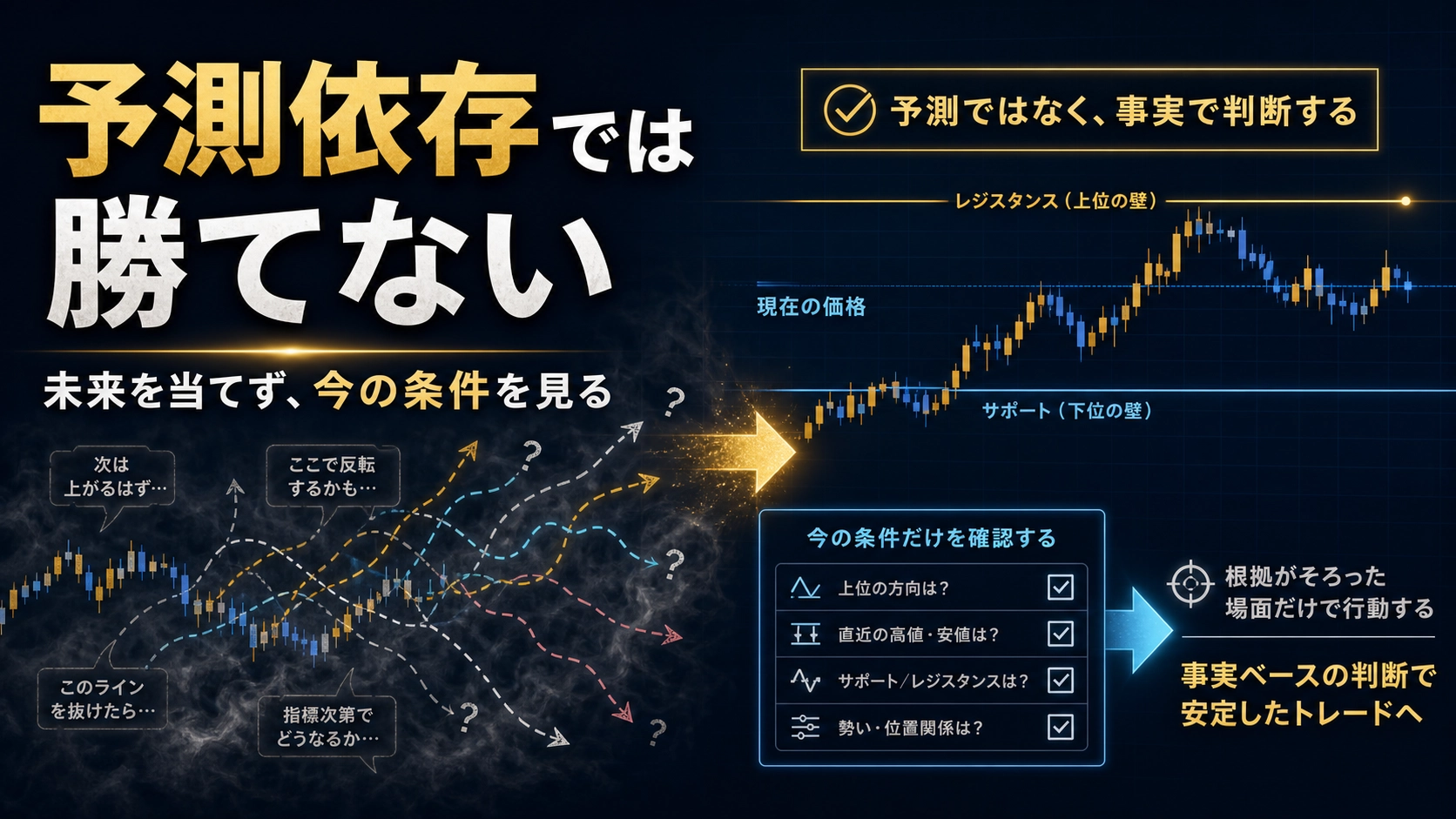
? The true purpose of environment recognition is to confirm which wall the current wave is heading toward and how far it can move
If you don’t understand this structure, even with the correct directional sense, you’ll get caught just before the wall and take a loss.
“Why did it stop?” you don’t know, so you’ll do the same next time.
Having practiced for 18 years, I’ve seen many traders continue to wander in this pattern.
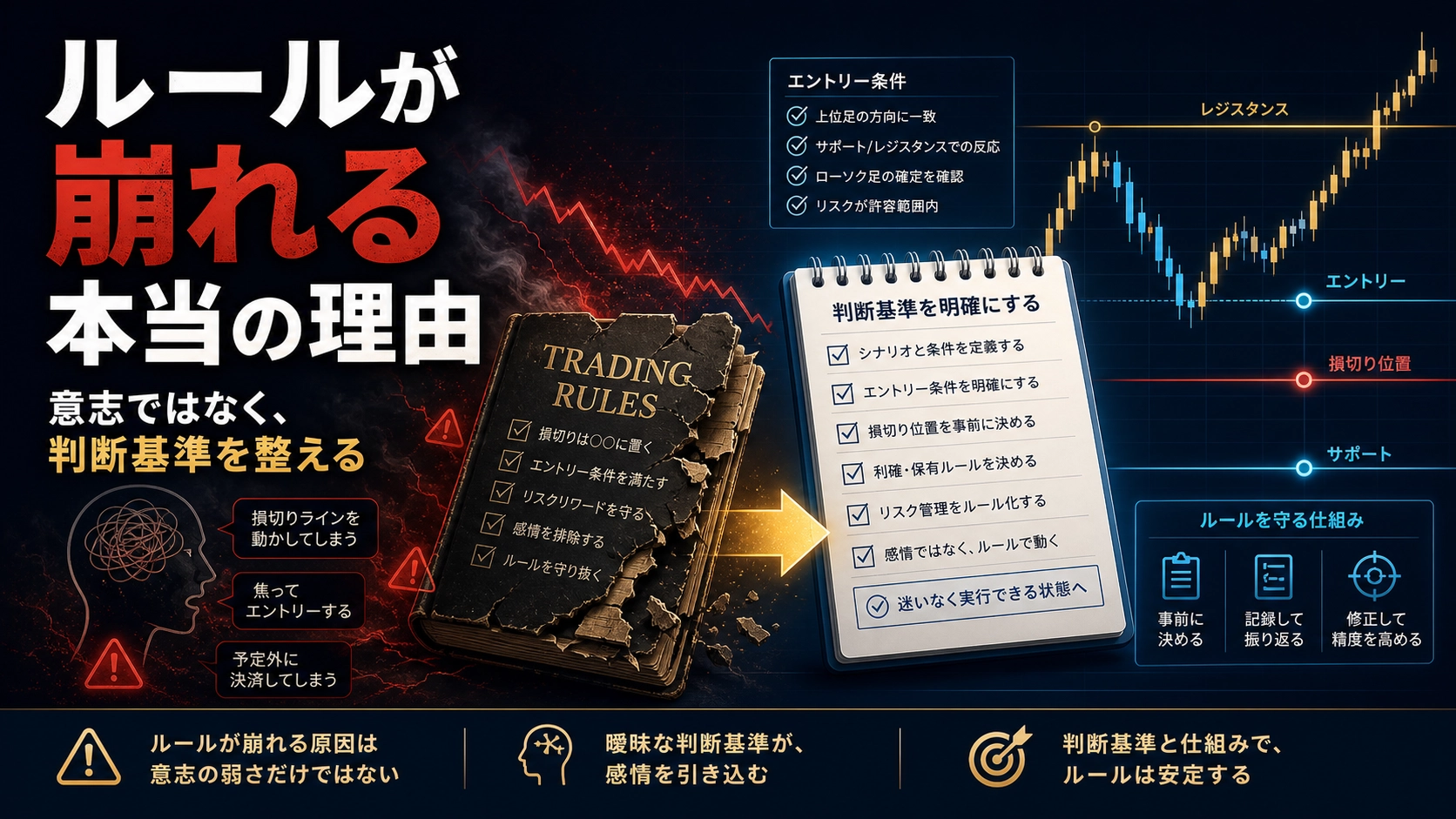
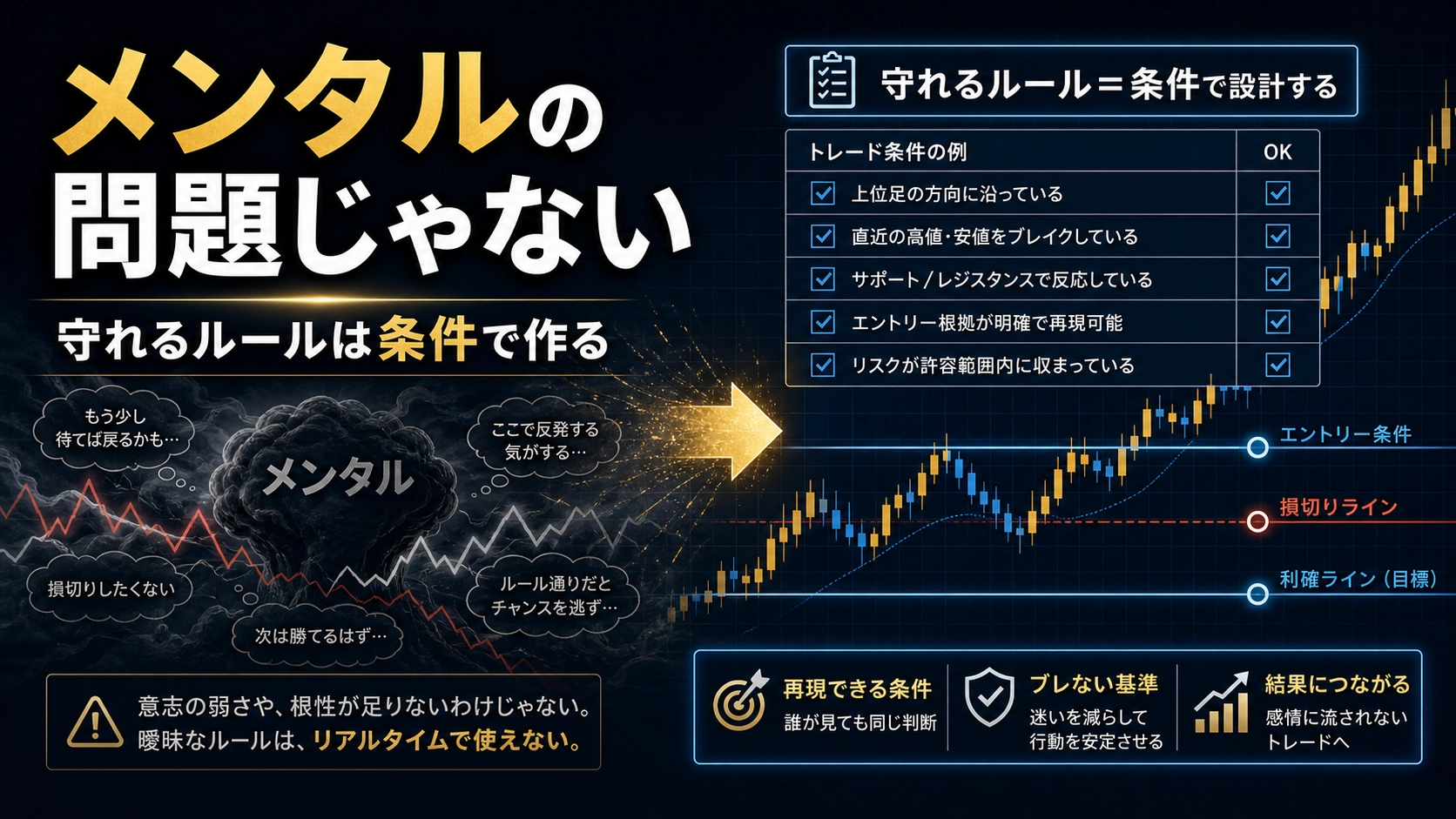
The problem isn’t mental state or study volume.
The structure you’re looking at itself was incomplete from the start only.
? 3. What exactly do winning traders look at in the waves?
Losing traders and winning traders.
Looking at the chart is the same action.
Confirming the wave is the same action.
But,what they look at is completely different.
To be honest, here’s the difference:
?【What losing traders are looking at】
・Direction of the current wave (up or down)
・Speed of the most recent move
・A feeling like, “it seems to extend somehow”
?【What winning traders are looking at】
・Where the current wave is in relation to the higher timeframe’s wave
・The relationship between the recent wave and the wall
・Where waves tend to stop and where they move more freely
Both are accurate in saying they are looking at waves.
But the amount of information they pick up is completely different.
“ vaguely rising” and “verifying the initial movement of the higher timeframe’s wave on the lower timeframe” are on completely different levels even when you’re looking at the same chart.
I’ll explain with a relatable example to illustrate what I mean.
Consider a trader who enters thinking, “It’s rising, so buy.”
?Losing traderlooks at the lower timeframe rising and enters right away.
But on the higher timeframe, they’re at a position just before a big wall.
They hit the wall and reverse, and take a loss.
?Winning traderchecks the downtrend on the lower timeframe to confirm rise, then checks on the higher timeframe “where the current wave is.”
If they know it’s just before a big wall, they do not enter there.
After the wall is cleared, they re-check on the lower timeframe before deciding.
? This difference isn’t about study quantity.
The difference is in “what you’re looking to verify when you view the time frame.”.
? Before techniques, if the purpose of viewing the time frame doesn’t change, you won’t get the same result even with the same technique
Winning traders often look like they’re “somehow getting results,” because their purpose when viewing is deeply ingrained.
It’s not just verbally articulated; there’s a real structure behind it.
consciously acquiring that structure is the next step.
? 4. Waves, walls, and time frames: a concept of “going back and forth”
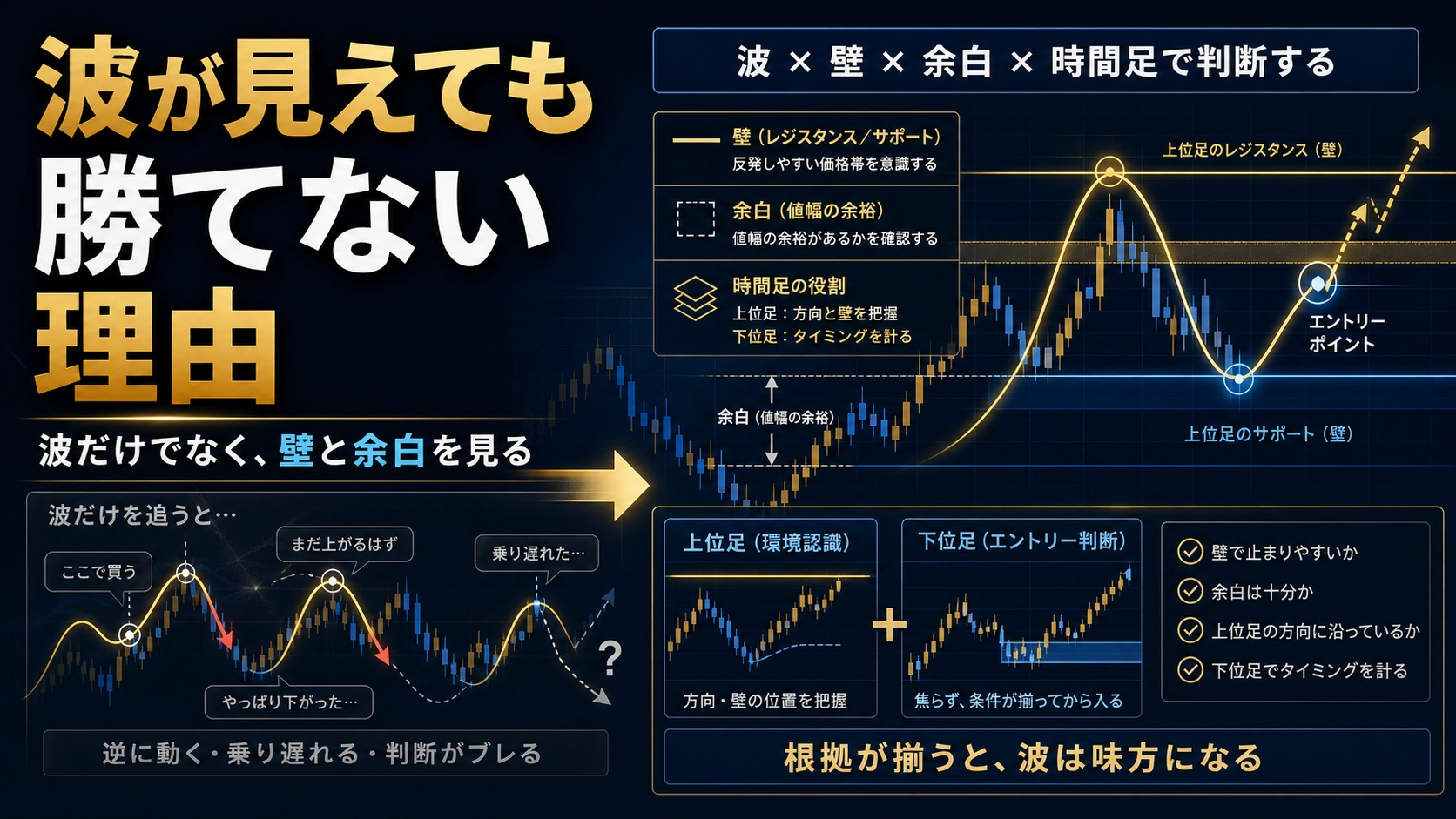
To make environment recognition work, you need to combine three things.3 components: waves, walls, and time frames.
?Wave・?Wall・⏱️Time frame.
If you try to understand these separately, you’ll keep saying, “I understand but can’t use it.”
Because you understand them as a set, they only function when combined..
First, about the time frame’s“reciprocal movement” idea.
Lower and higher time frames have distinct roles.
?Lower time frame role: Check the current instant state and decide on entries
?Higher time frame role: Check the wall’s position, grasp the overall wave, decide if it’s a place to contest
Because these roles differ, there is a reason to go back and forth.
Going back and forth between lower and higher time frames is not because one has the “answer,” but because they each hold different information.
You can’t make fine-entry judgments from the higher time frame alone.
You can’t see the overall structure from the lower time frame alone.
⚖️ By going back and forth, you understand “where you are in the whole right now.”
This is the essence of environment recognition.
Next, about the relationship between wave and wall.
? Waves stop because of walls.
? Walls gain meaning because waves come to them.
These two are inseparably linked.
When you confirm the wall’s position on the higher time frame, you determine whether the current wave is heading toward that wall or moving away from it.
Whether you ride a wave heading toward the wall or one moving away will completely change your strategy.
If you ignore walls and think, “just ride the wave,” you’ll never be able to predict where it will stop.
Also, the walls you confirm on the higher time frame aren’t merely vague notions of “this may act as resistance.”
In chart structure, there are places where it’s easier for price to stop.
By consciously treating those as walls, you can see the range the wave can move.
Specific judgment criteria and how to find walls are summarized in the “Answer to the Market,” but conceptually, it’s this:
“Will the current wave move to the next wall, or stop before it?”
Check this on the higher time frame before returning to the lower time frame.
This back-and-forth is the first step to graduating from “feeling.”
⚖️ Just by the habit of “checking the wall position before returning to the lower time frame,” your perspective changes dramatically
It may feel difficult, but for starters, just this is fine.
Please try it ^^
✅ 5 steps you can change starting tomorrow
So, concretely, what should you do?
I’ll properly answer “how should I do it?”
?Even if your knowledge increases, nothing changes unless you turn knowledge into action.
I’ll outline five steps you can start tomorrow.
✅Step 1: Make sure you aren’t judging only by “direction sense”
When you open the chart, what do you look at first?
If you’re judging only by a vague sense that it’s rising or looking bearish, stop and pause first.
Confirming direction sense isonly the starting point.
Develop a habit of checking “where in the higher-time-frame wave is the current wave” next.
✅Step 2: Check the wall’s position on the higher time frame before returning to the lower time frame
Before considering entry on the lower time frame, always check the higher time frame.
All you need to verify are two points: “is there a wall beyond the current wave?” and “is there a distance to the wall?”
If there’s no distance, you should pass on that moment. This alone reduces unnecessary losses.
✅Step 3: Stop the reflex of “ride the wave when it comes”
If you have a habit of reflexively riding the wave, pause for 5 seconds before entering.
Then articulate where in the higher-time-frame’s structure the current wave is located and decide.If you can’t articulate it, you can pass on that moment.
Entries that can’t be articulated are almost always “vague.”
✅Step 4: Review losing trades by the wave-wall relationship
After a loss, it’s risky to immediately search for a cause (I’ve wandered there too).
Take some time, then review the lost trades.
When you review, check whether you were watching the wave-wall relationship or whether you were checking the wall on the higher time frame—these two points.
Mental state or stop-loss width are things to consider after this foundation is solid.
✅Step 5: Develop the habit of going back and forth between lower and higher time frames
Consciously repeat the action of “checking the higher time frame and then returning to the lower time frame.”
At first it may feel tedious.
But continuing this will embed a sense of “the present within the bigger whole.”
✍️ Rather than chasing flashy techniques, dedicating time to repeating the basic actions yields faster results
Having practiced for 18 years, I’ve noticed that successful people all spent time on the repetition of basic actions.
? Summary
Wave recognition and environment recognition.
The reason this ends up as a vague impression is that you’re stopping at confirming direction sense.? Grasp where the wave is, confirm its relationship with the wall, and ⏱️ go back and forth between the lower and higher time frames.
Once this structure is in place, environment recognition becomes usable.
It isn’t a difficult topic.
Only turning it into action will change the results.
? After you can see the waves, what you should do is form a habit of confirming where in the wave you are
No need to rush.
Take it one step at a time, steadily ^^
? The reciprocal movement of waves, walls, and time frames.
This approach has been further explored and organized into a practical form called“The Market’s Answer”.
If you want more than understanding concepts—if you want to know, “how exactly do I use it?”—please take a look.
It’s not flashy, but it gives you a solid axis to judge for yourself ^^
? Learn more here
https://www.gogojungle.co.jp/tools/ebooks/77829
? I also created a free AI tool for trade analysis. If you like, give it a try
https://trade-ai-free.streamlit.app/
【Classic techniques for megaprofit】
▼ GOLD-specific medicine manual
https://www.gogojungle.co.jp/tools/ebooks/50406
? Free gift|Partial manual公開
https://www.gogojungle.co.jp/info/22533