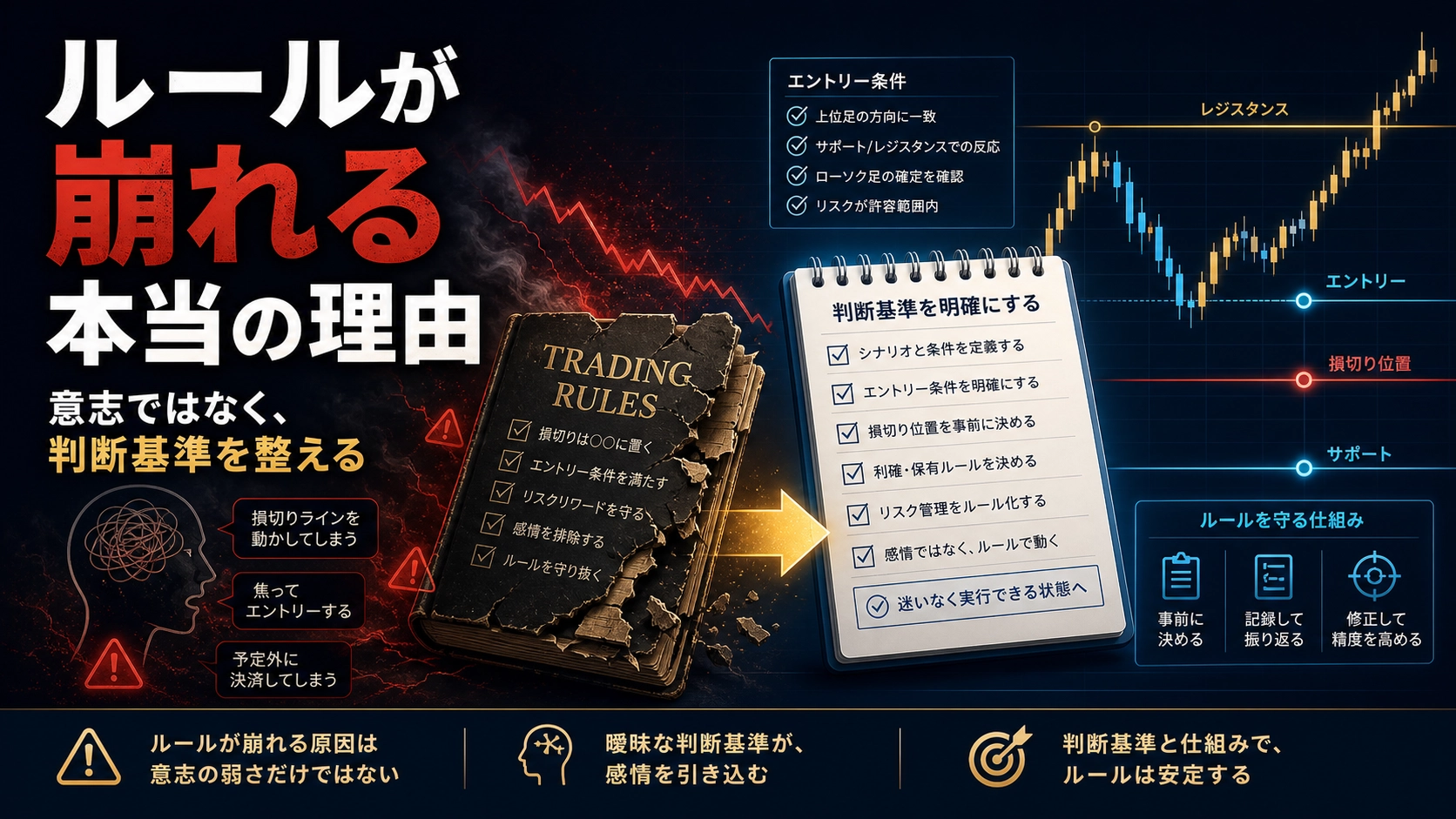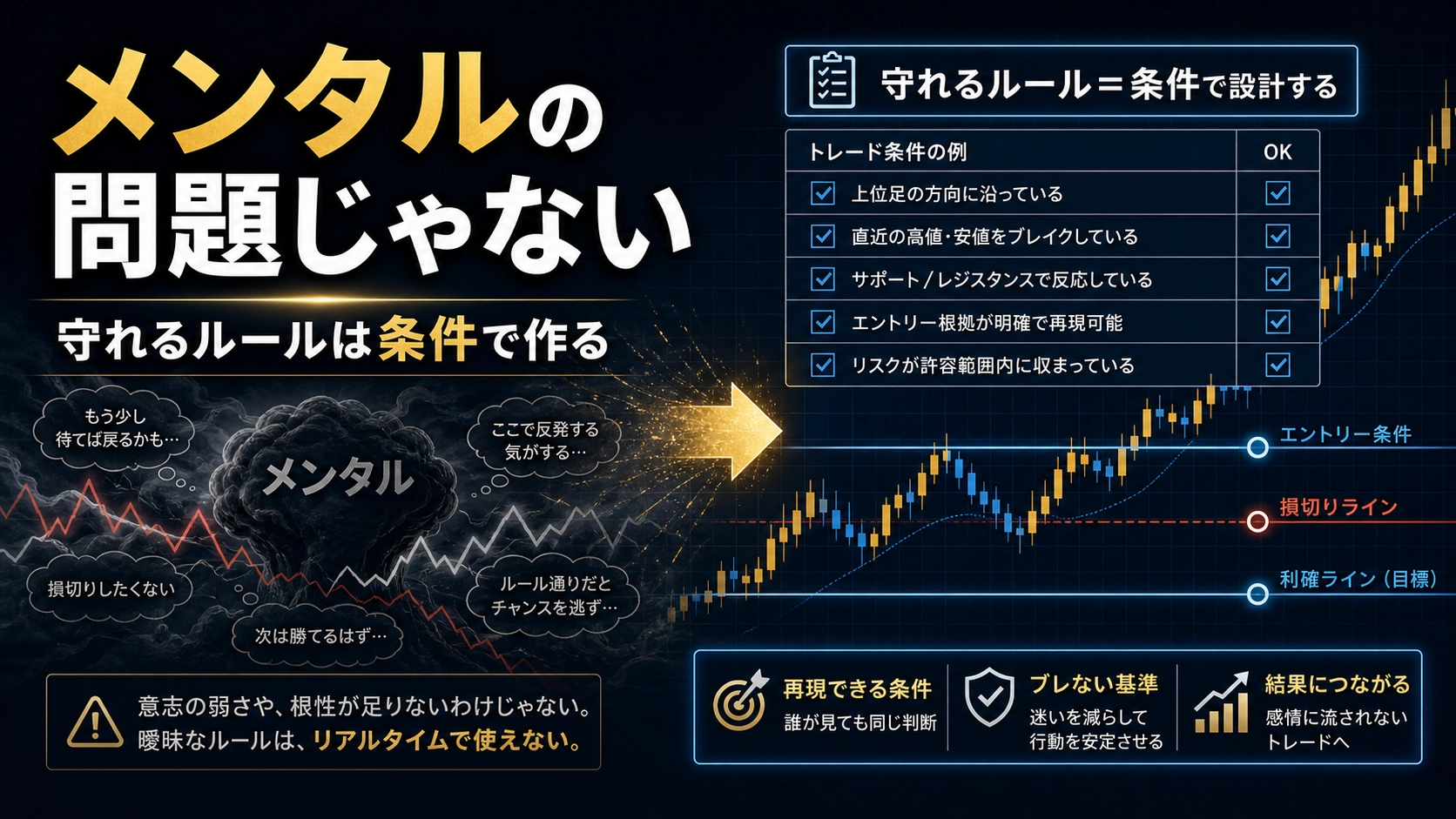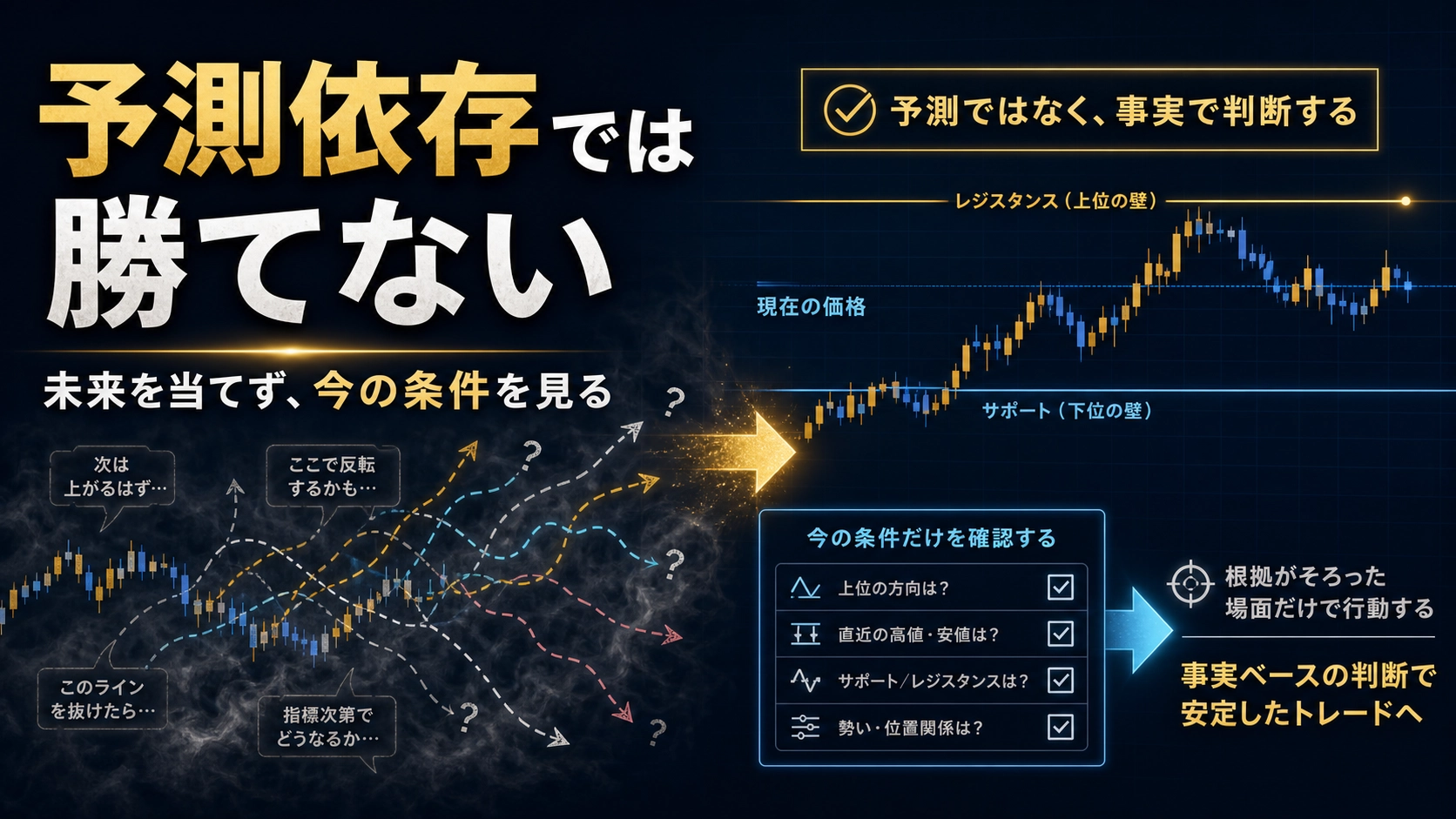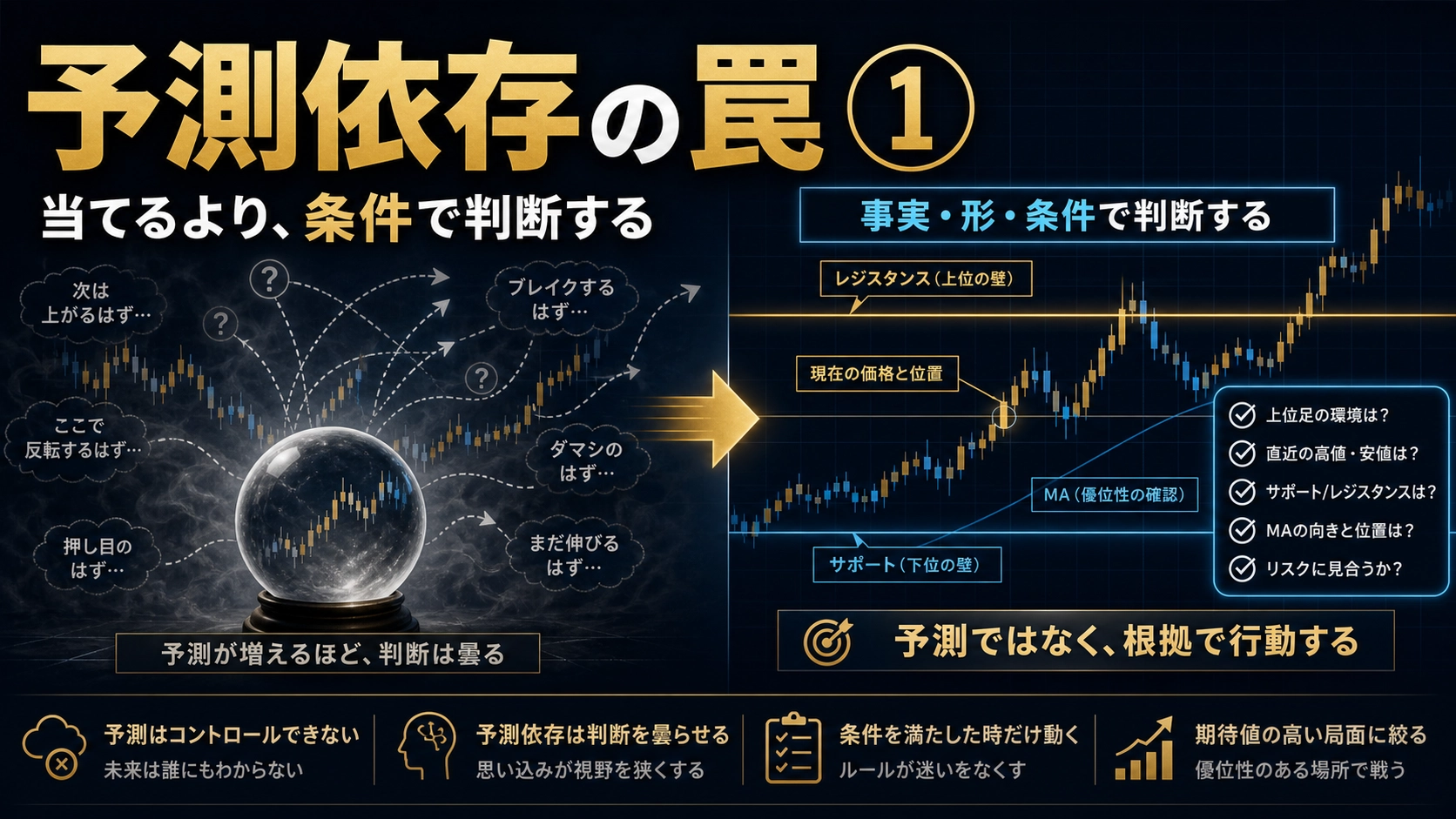

[Forecast Dependency Trap Part 2] The real reason forecast-dependent traders can't win
? The Trap of Prediction Dependency (Part 2): The Real Reason Predictive Traders Fail
“It should go up next.”
“It might reverse here.”
Studied technicals, lined up indicators.
Yet somehow, every time you enter, the price moves against you.
It reverses right after you cut your losses. I’ve felt that frustration many times (;'∀')
The more you try to refine your predictions, the more you get dragged around by the market’s structureand end up sinking into it yourself.
In this article,the essence of the trap that predictive traders fall into—“prediction dependence”and the way out of it, will be discussed.
This isn’t about methods,but about thinking structures
? 1. Can you break free from the cycle of “hit or miss”?
After you’ve traded for a while, many people fall into the same pit.
Open the chart in the morning.
Check the news.
Gather others’ opinions on social media.
Watch three “today’s market predictions” on YouTube.
Then you decide, in your own way, “today is up” or “it will drop here,” and enter.
This looks like you’re being very thorough, doesn’t it?
But to be honest,
this isnot “preparation” but “prediction dependence.”.
? In predictive traders, this often happens:
・After entry, if price doesn’t move in the expected direction, anxiety kicks in
・When it reverses right after you cut losses, you think, “My reading was right after all.”
・In the next trade you size up bigger, thinking “this time for sure.”
・Indicators keep piling up, yet judgments become harder
・“Prediction hit” days feel good, but “missed” days bring you down
If any one of these applies to you,you’re at the entry point of prediction dependenceperhaps.
When I first started trading, it was exactly the same (;'A')
Read about moving averages, learned RSI, set up MACD.Opened charts and told myself, “this is the evidence,” and entered.
As long as you continue the cycle of “hit or miss,” you’re not trading, you’re playing a guessing game.
But that study keeps pushing toward increasing prediction accuracy.
This is the essence of the trap.
? The belief that “the reason you aren’t winning yet is because your predictive accuracy isn’t high enough” is already a trap
? 2. Why does trying to predict lead to continued losses—an structural view
So why does prediction dependence lead to losses?
This isn’t a matter of “low accuracy.”
It’s a structural problem.
First, as a premise, no one can know the market’s future.
Professional analysts, hedge fund managers, even me with 18 years of experience, cannot know with 100% certainty how the market will move next.
That is a fact.
Yet many traders assume“if accuracy improves, you’ll win.”They trade under this premise.
If moving averages alone aren’t enough, add Bollinger Bands.
If still not enough, look at RSI. Add MACD as well.
Before you know it, your chart is full of indicators, and you don’t know what to trust.
? People think that adding tools increases the basis for judgment.
In reality, more information creates more questions about which to prioritize, making judgment harder.
? Increasing the basis for prediction does not reduce doubt; it increases it
Let’s dig a bit deeper.
? In markets there is a concept of a“wall”.
Places where price stops often, and reversals happen repeatedly.
Anyone who looks at a chart can spot this wall.
But knowing the wall exists and being able to use it effectively are two different things.
Predictive traders spot the wall and try to“predict whether they will break through this wall”and use it as a basis for prediction.
“This time it should bounce here.”
“Perhaps it will break out this time.”
They turn the wall into material for prediction.
But the wall’s true utility is not as prediction material.
If you know how to use the wall, your view of the market changes at a fundamental level.
? So too with waves.
If you focus only on predicting the next move without checking the state of the wave, you’ll enter blind to your position inside the wave.Entering near the top of a wave or near the bottom and letting it move against youis what happens structurally.
You buy near the peak of a wave or sell near the bottom, and it moves against you.
This is how the structure plays out.
? 3. Winners don’t try to “predict”—a contrast of thinking
Where do winning traders and losing traders differ?
Many think it’s a skill gap, but honestlythe starting point of thinking is totally different.
Let’s contrast more clearly.
?【Thinking of losing traders】
・Enter thinking, “It looks like it will go up from here.”
・Enter because multiple indicators line up, giving a sense of “there’s evidence.”
・Enter because others on SNS or analyses say so, thinking “everyone says the same.”
・After a loss, think, “It reversed here, my analysis was right.”
・When losing, rush to gather more information to improve accuracy
?【Thinking of winning traders】
・First, check if this is a position where you can actually win
・Assess wall and wave state to determine if it’s a good entry
・Don’t rely on others’ predictions. Look at the market’s structure only
・Losses are a matter of following rules, not a source of frustration
・After a loss, only reflect on whether you followed the rules
Winning traders are not concerned with “what will happen next,” but with “where am I now”.
In short, the difference isthe shift from predicting to confirming.
Prediction is an activity aimed at thefuture.
You’re trying to guess what hasn’t happened yet.
That’s why your mental state sways every time you’re wrong.
Confirmation is an activity aimed at thepresent.
“Right now, am I near a wall?”
“Is the trend rising or falling?”
“Are the lower- and higher-timeframe states aligned?”
The answers lie in the current chart.
“Things look like they might go up”
The essence of this intuition is that you are predicting without confirming.
? The more experience you gain, the more you lean on this “hunch.”
Because past experiences of “hunch” hitting have stuck in memory.
I too once felt my “hunch” sharpen over time (;'A')
But continuing to trade on that sense led to a month of big drawdowns, and I finally realized something.
? “Hunches” have no reproducibility. No matter how much you win with an unreproducible method, that isn’t real skill
? 4. The mindset of confirming after stopping prediction
So, how can you break free from prediction dependence?
This isn’t about,“not predicting”.
More accurately, you should shift to“not using prediction as the starting point”.
Since the market’s future can’t be known 100%, there will always be some prediction in trading.
But when prediction is the starting point, the justification for an entry becomes about “whether it will hit.”
That’s the core of the problem.
? What changes when you shift the starting point to “confirmation”?
The way you read charts changes entirely.
Specifically, when you open a chart, what you do first is no longer,
but rather“where am I right now”.
Are you near a wall or far from it?
Is the wave in an uptrend or downtrend?
These are things you confirm.
And when confirming, the important thing is toalternate between lower and higher timeframes.
? In the lower timeframe, confirm in real time what’s happening now.
To grasp what’s happening in a fast-moving price area.
? In the higher timeframe, confirm the wall’s position and the state of the wave.
The structure visible on the higher timeframe informs the context of your current judgment.
By alternating between the two, you clearly know“where am I trying to win now”.
If you judge only on the lower timeframe, you’ll be swept by small moves.
If you judge only on the higher timeframe, you won’t see the current timing clearly.
⚖️ Alternate between lower and higher timeframes to understand both the current situation and structural position
I’ll add a bit more about walls.
When you check the wall’s position on the higher timeframe, you don’t predict whether you’ll break through it;you check whether the price is near the wall now. That’s all.
If you’re near the wall, you’re closer to a possible entry.
If you’re far from the wall, it’s early to enter.
This judgment becomes the starting point for your entry.
If prediction isn’t the starting point and confirmation is, even if you don’t enter, you’ve chosen the “right path.”.
If after confirming you determine that now isn’t a good time to trade, you pass.
This is following the rules and, when accumulated, reduces losses^^
✅ 5. What you can do from tomorrow—Five steps to let go of prediction dependence
If you’ve read this far and are wondering, “So what should I do starting tomorrow?” here are concrete steps.
You don’t need to change everything at once.
Try changing just one thing.
Change this: what you do first when you open a chart—just that.
✅Step 1: When you open a chart, decide first not to predict
as soon as you open the chart, consciously decide not to think, “Today will go up” or “It will drop here.”
Just this changes your perspective.
✅Step 2: Before entering, verbalize in one phrase where you are trying to win
Before pressing the enter button, can you say in one phrase where you’re trying to win now?
If you can’t verbalize it, you’re still in the “hunch” state.
✅Step 3: Habitually alternate between lower and higher timeframes
Check the lower timeframe for the speed and direction of current moves, and check the higher timeframe for wall position and wave state.
See whether what you’re seeing on the two timeframes aligns.
If they don’t align, don’t force an entry.
✅Step 4: Don’t dwell on “hit or miss”
At the end of the day, reflect not on whether your prediction was right or wrong, but“whether you could enter after confirming”.
Entering after confirmation is a correct process, even if you stop out.
✅Step 5: Cut your time spent reading others’ market predictions in half
The more you look at other people’s predictions, the more your starting point becomes “what everyone says,” rather than “what you think.”
Information gathering often reinforces prediction dependence.
✍️ Stop entries you can’t verbalize. This alone reduces prediction dependence considerably
? Summary
What I’ve shared this time is the structure of the trap that traders fall into when they have prediction dependencewithout realizing it.?
? The difference with the winning group isn’t technique, but“whether prediction is the starting point or confirmation is”—the initial thinking.
I also spent a long time to realize this trap.
But once I did, my view of the market changed clearly.
? The moment you stop predicting, the market becomes readable for the first time
? The concepts touched in this article—“how to use walls,” “alternating lower and higher timeframes,” “confirmation-based judgments”—are further organized in my course“The Market’s Answer”
To move from a vague understanding to a framework you can apply, I spent two years building videos and an AI tool.
It’s not flashy, butyou won’t be confused—that’s the main feature^^
If you’re curious, have a look.
? Details here
https://www.gogojungle.co.jp/tools/ebooks/77829
? I also created a free AI tool for trade analysis. Please feel free to try it
https://trade-ai-free.streamlit.app/
【Classic techniques for massive profits】
▼ GOLD Special Cure Manual
https://www.gogojungle.co.jp/tools/ebooks/50406
? Free gift — partial manual released
https://www.gogojungle.co.jp/info/22533