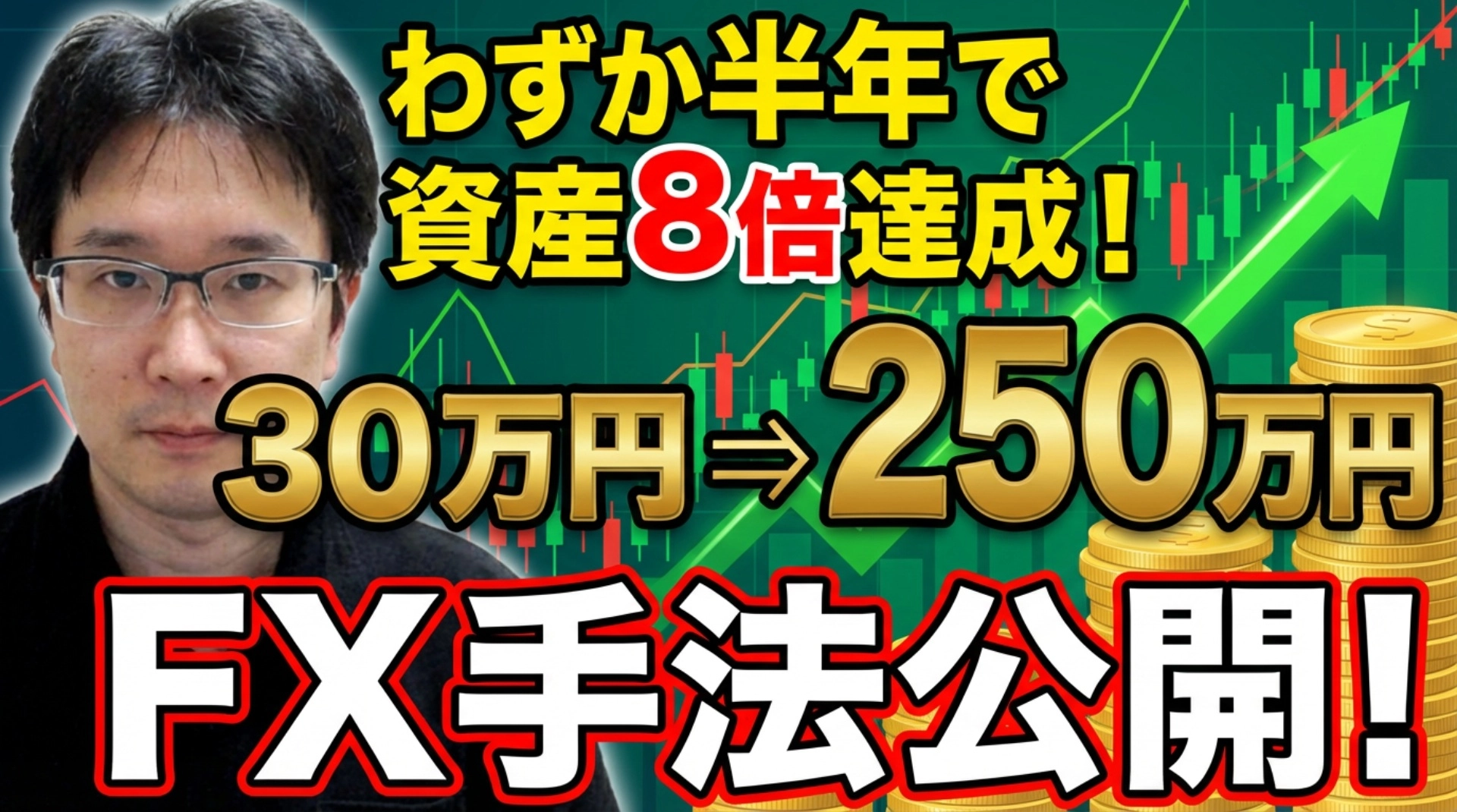

Publicizing FX practical methods that multiplied funds eightfold in half a year
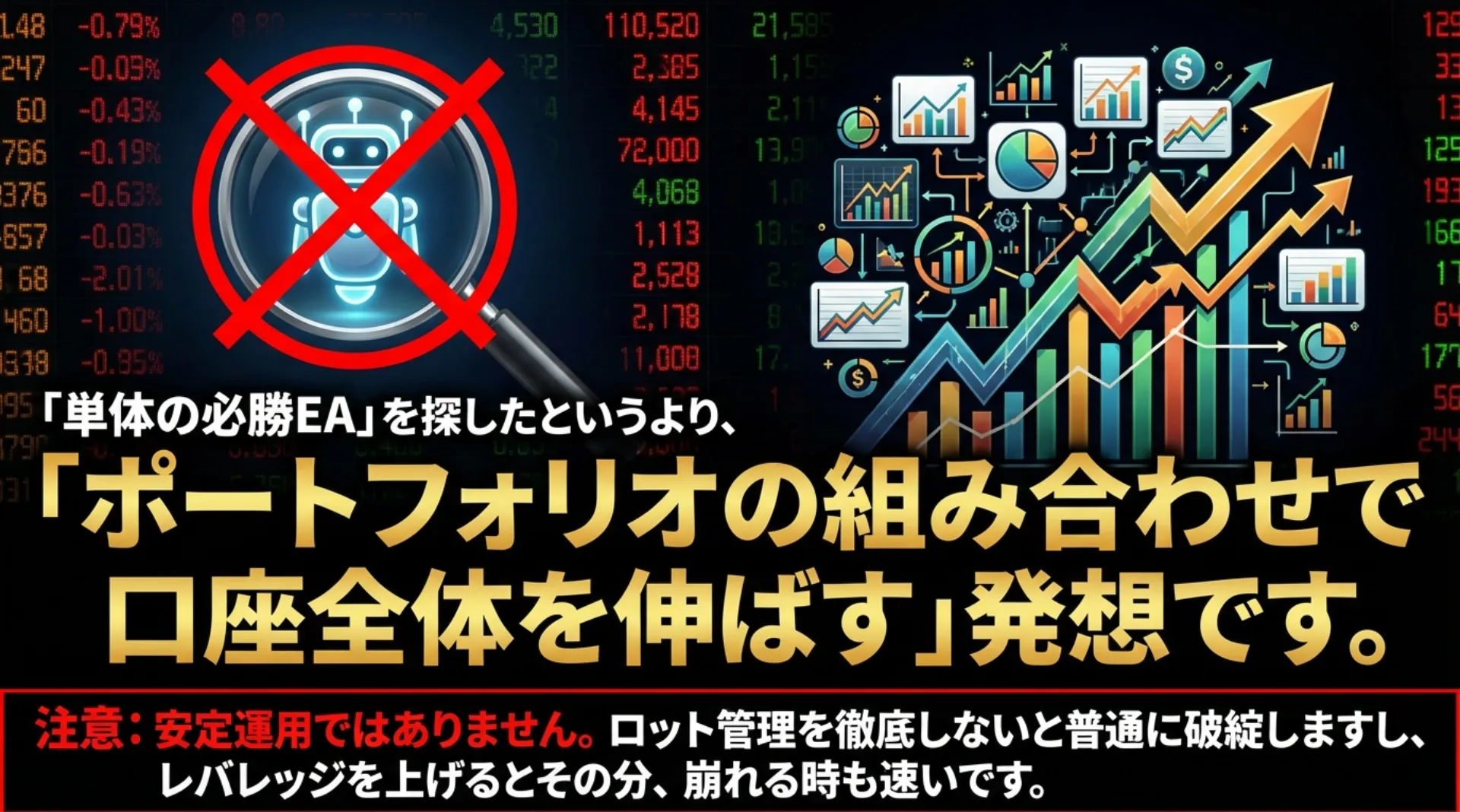
What matters here is that I did not bet everything on a single EA.
As an EA developer, I selected about 10 EAs with relatively good forward performance and competitive logic from the more than 100 I had created, and ran themin the FXTF account.
In other words,
instead of chasing a “single must-win EA,” I adopted the concept of “growing the entire account through a portfolio.”
However, this is not stable operation.
If you don’t manage lots strictly, you’ll go broke, and if you raise leverage, you’ll also see quicker collapses.
Actual operating method in 2024
![]() Select around 10 EAs from 100 and portfolio them
Select around 10 EAs from 100 and portfolio them
 Select around 10 EAs from 100 and portfolio them
In 2024, I chose about 10 of the EAs I had developed and formed a portfolio.
The selection criteria were simple:
- Those with relatively good forward performance
- Those with confidence in their logic
- Diversified across trend-following, counter-trend, and anomaly styles
- Not overly concentrated on the same logic
As an EA developer, you learn that even if backtests look clean, in actual trading an EA can fail completely.
Conversely, there are EAs that aren’t flashy but endure in live trading.
I started MT4/MT5 EA development in 2020 and have created over 100 EAs since.
About 50 were sold on GoGoJungle, and about 50 were distributed for free on ****.
From that experience, I realizedthat ultimately what matters is whether the logic works in live trading, not just how clean the past performance looks.
Why start with 300,000 yen
At that time I started by funding a domestic FXTF MT4 account with 300,000 yen.
For me, 300,000 yen was the right amount—enough that I could recover even if I lost it all.
With 300,000 yen, highly leveraged operations would be fairly volatile.
That’s why rigorous money management and pushing to the limit led to the success I’m going to describe.
Thinking on position sizing and leverage management
Position sizing started with a base of 0.1 lots for EAs I trusted, i.e., 10,000 units per EA.
However, not everything used the same lot size.
Some EAs held multiple positions, so I adjusted lot sizing finely.
The key is not to consider each EA in isolation, but to consider how large the total positions could become in the entire account.
I did not handle grid-napping martingale EAs.
Thus, the configuration was relatively easy to manage in terms of lot control.
I also developed EAs capable of holding up to 10 positions, so when running those, I calculated lot distribution based on the maximum total lots at peak.
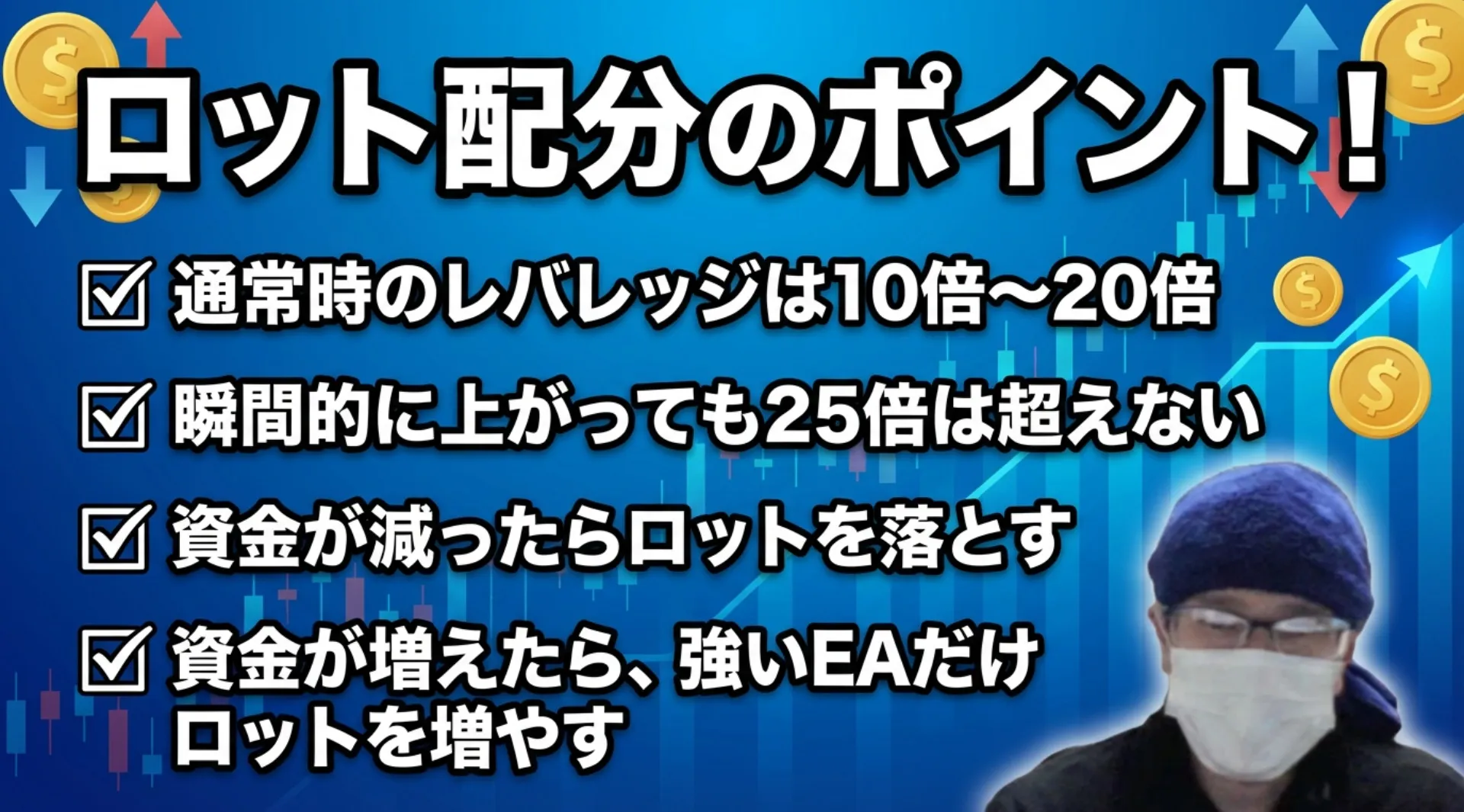
- Normal leverage: 10x–20x
- Even if it spikes, never exceed 25x
- If funds decrease, reduce lots
- If funds increase, only increase lots for the strongest EAs
For example, upgrade an EA from 0.1 lots to 0.2 lots as capital grows.
Alternatively, move from 0.01 lot multiple-position EAs to 0.02 lots.
Thus, I kept the account’s leverage consistently at 10x–20x according to balance.
This is very important.
If you don’t increase lots when the balance grows, capital efficiency falls.
Conversely, if you don’t reduce lots when the balance falls, leverage can exceed 25x.
Therefore, while domestic FX firms have limits, adjusting maximum leverage to within25x is the most capital-efficient method in domestic FX.
How I adjusted during drawdown or capital decline
The most important aspect of this operation is not when you are winning, but how you respond when losing.
If I started with 300,000 yen and it fell to 200,000 yen, what would I do?
Continuing with the same lots would be dangerous.
Because the funds are lower, the leverage would rise, approaching forced liquidation.
So I mechanically adjusted when funds declined.
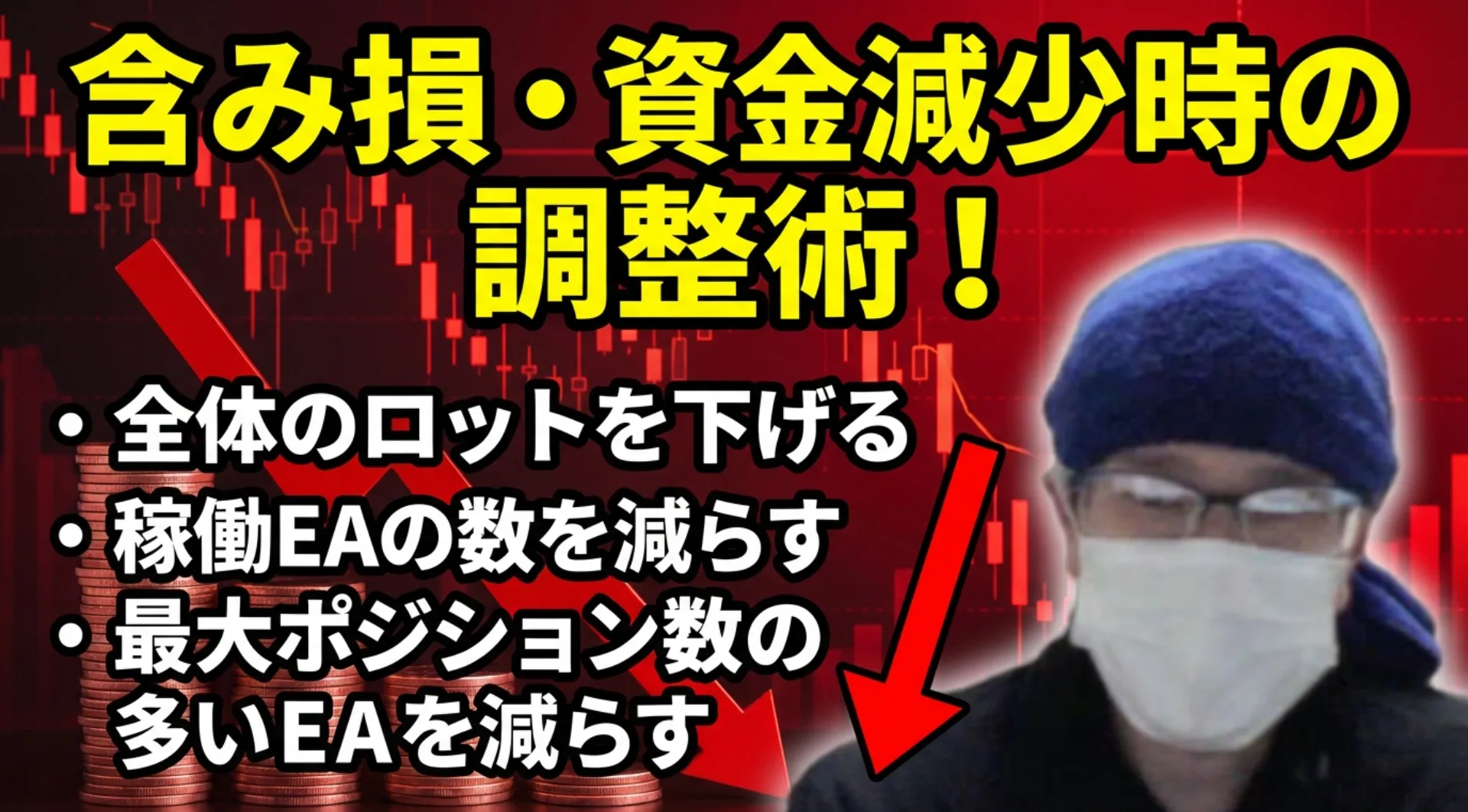
- Lower total lots
- Reduce number of active EAs
- Reduce EAs with the most positions
This is more about money management than trading strategy.
Equally important as EA selection ismoney management.
How did the funds grow?
![]() In 2024, the dollar-yen rate rose to around 161.96 in July and sharply fell to 140 in September, at which time assets grew rapidly.
In 2024, the dollar-yen rate rose to around 161.96 in July and sharply fell to 140 in September, at which time assets grew rapidly.
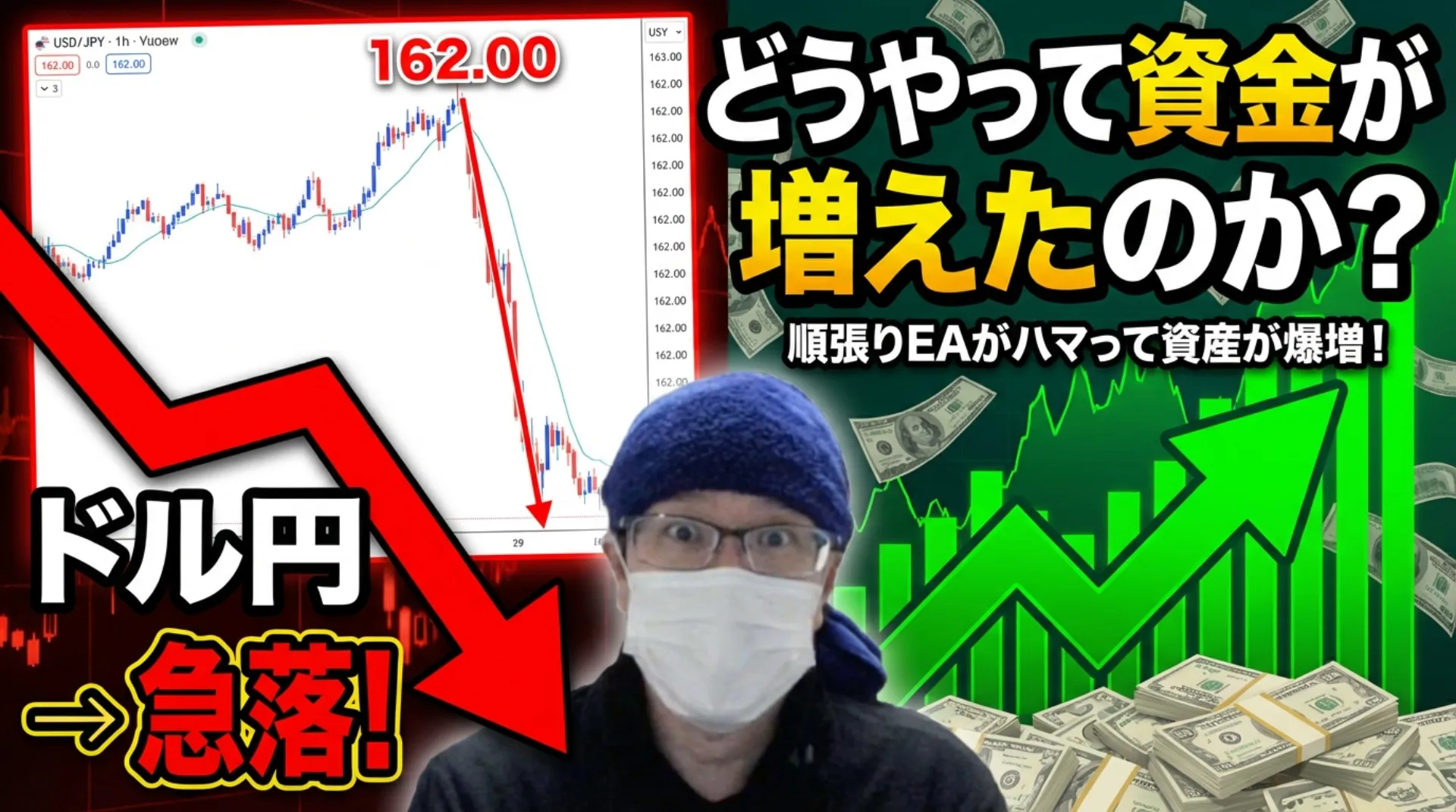 In 2024, the dollar-yen rate rose to around 161.96 in July and sharply fell to 140 in September, at which time assets grew rapidly.
Fortunately, there wasn’t a large drawdown right after starting the operation.
The 300,000 yen account steadily increased,
Around the time of the June 2024 currency intervention
The trend-following logic began to work quite well.
Note:From late June to July 2024, the Ministry of Finance conducted a ¥5,534.8 billion currency intervention (yen buying, dollar selling). It is believed that interventions occurred mainly on July 11–12 after yen weakened beyond 160 per dollar on June 26.
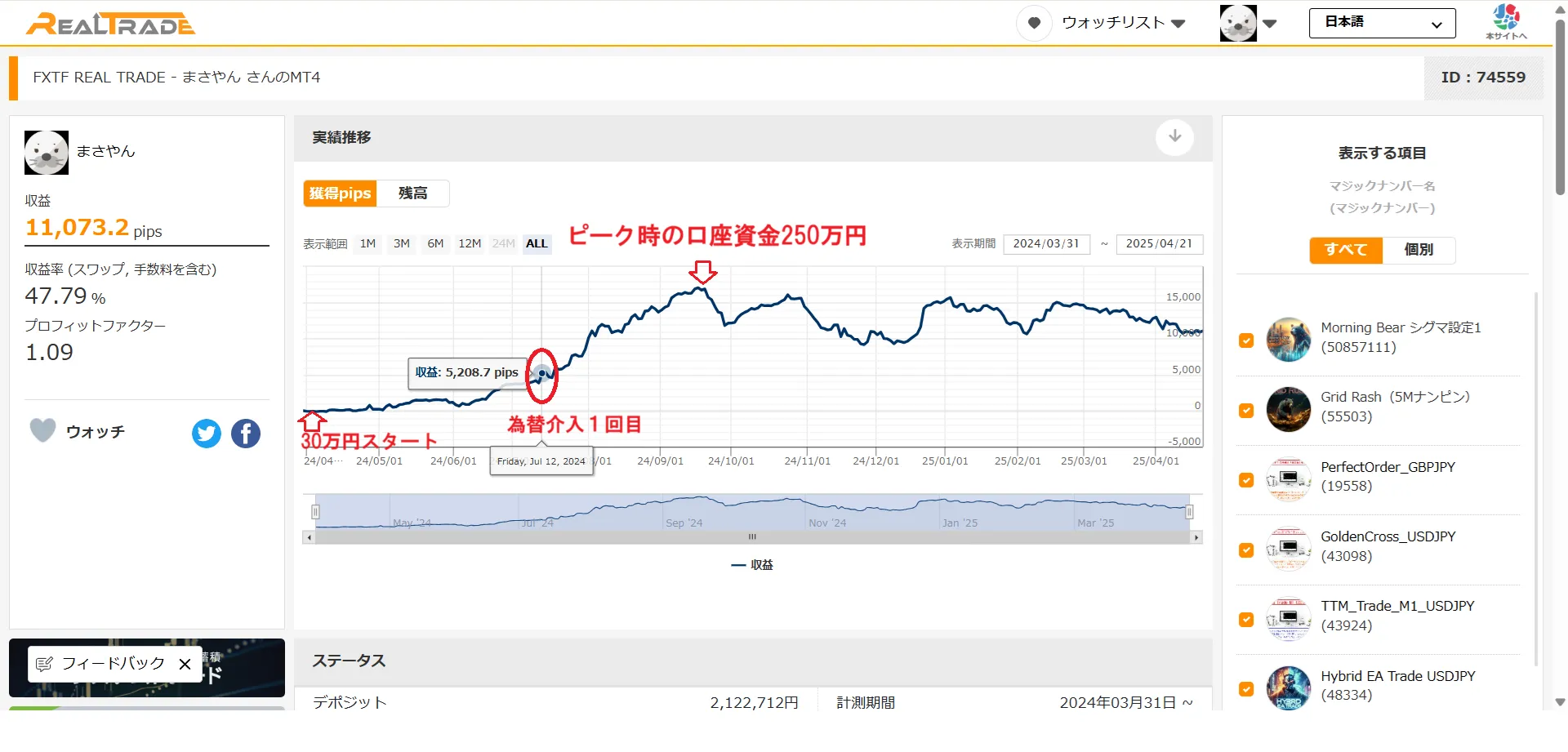
This is the so-called sweet spot where the trend-following EA “hit.”
When market moves and EA logic align, there are times when the growth is astonishing.
As a result, the account quickly expanded to 1 million, then 2 million yen.
Ultimately, it reached around 2.7–2.8 million yen momentarily.
Starting from 300,000 yen, that is more than eightfold.
At that time, honestly, I thought, “I could aim for 10 million yen.”
Peak of the account in September 2024
What stands out most is September 2024.
There was a significant drop in the Nikkei and Dow, and USD/JPY also strengthened the yen, falling to around 140.
At that time, the trend-following logic in my portfolio was working quite well.
When USD/JPY hit the 140 bottom, I held shorts fully, and the account peaked at that moment.
It was like moving a month’s salary in one day.
With growing funds, people naturally feel fear and anxiety.
But automated EA trading can eliminate emotions, so at that time I felt like playing a game.
Watching the balance keep increasing toward 10 million yen, I thought it would continue to rise.
But after that, I hit hell
High-leverage trading earns fast but can collapse in an instant
This is the most important part of this story.
If you only look at the result of eightfold in six months, it may seem dreamlike.
But in reality,high-leverage trading makes capital grow fast, but collapses in an instant.
When the account was at its peak, I was quite bullish.
Leverage was above 10x and briefly even above 20x.
I did have some counter-trend EAs running, but when USD/JPY reversed into a large drawdown—near full shorting—the account funds dropped rapidly.
Why it dropped from about 2.8 million yen to around 1.5 million yen
The peak was near 2.8 million yen, but afterward it dropped to around 1.5 million yen rapidly.
In other words, a drawdown of over 1 million yen.
The reason is simple:
I held short positions while in a high-leverage state.
Increasing lots as funds grew isn’t wrong in itself.
But if you stay over-leveraged when the market stops moving in your favor, you get pulled back quickly.
This is really scary.
When looking at the numbers, you might think “there are still 1.5 million yen,” but it feels like “losing 1.3 million.”
Back then I treated the EA as a game and believed I could win back what I lost.
This part may be hard to understand unless you’ve personally grown assets greatly with EAs and seen them shrink dramatically.
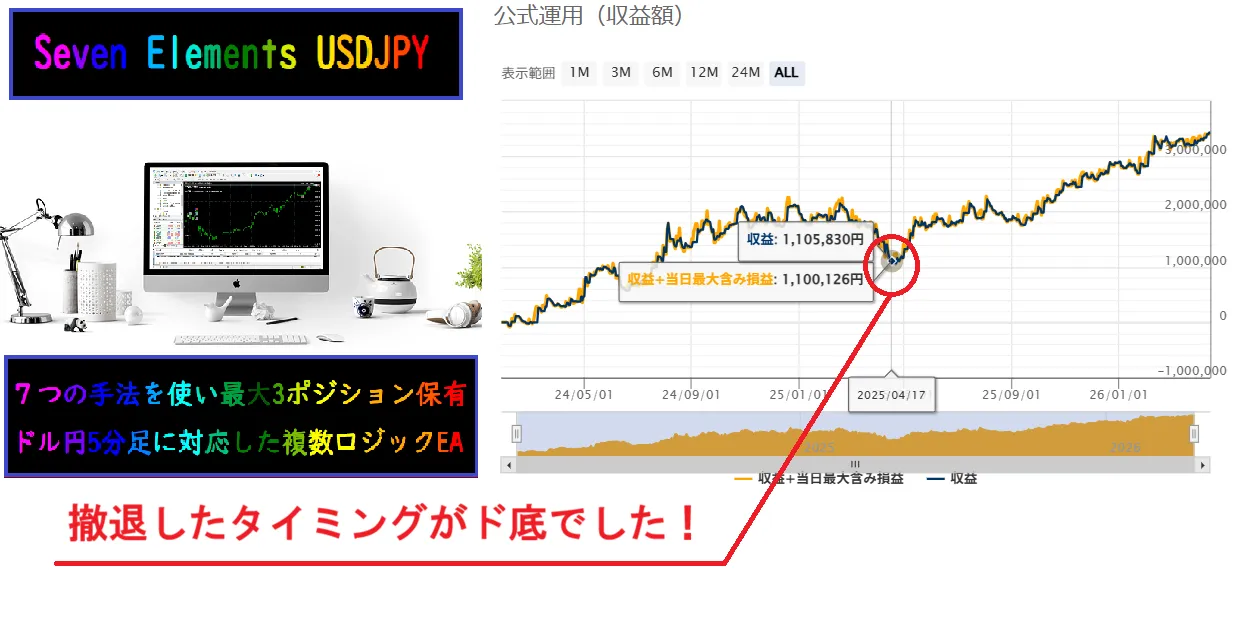
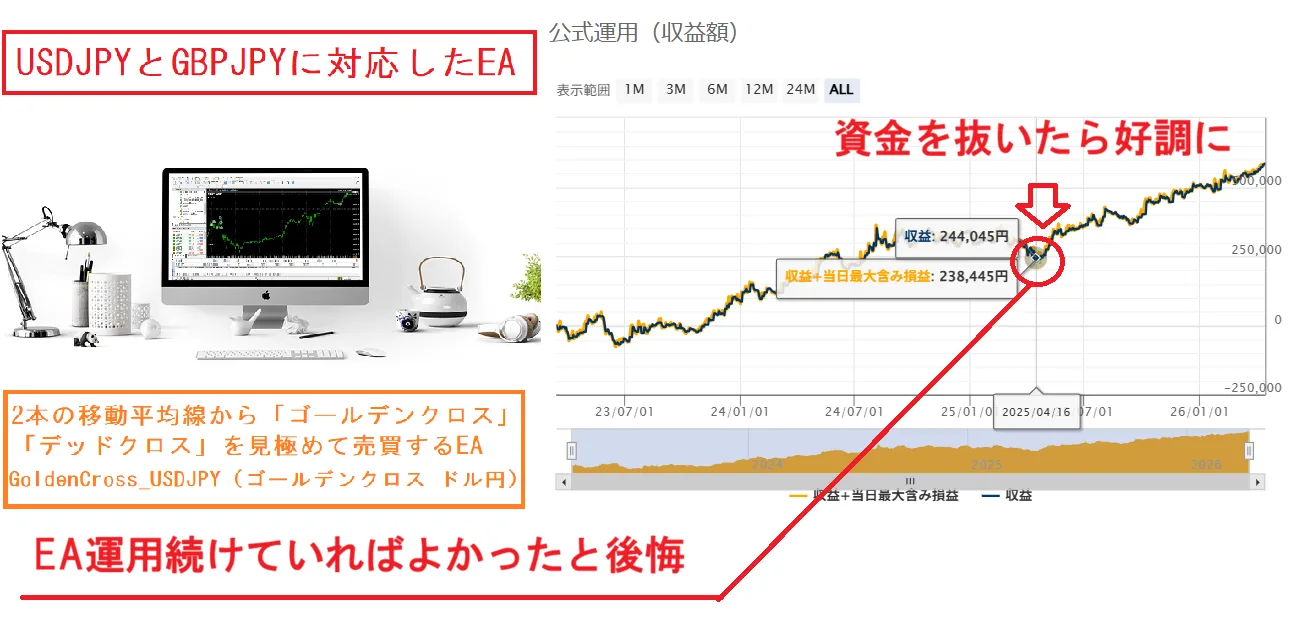
Ultimately, I withdrew everything in April 2025 and chose to exit with gains
There I finally woke up.
I reduced lots and shifted toward stable operation, but by then the overall portfolio momentum had started to slow.
As a result, I withdrew everything in April 2025.That’s the so-called “quit on a high note.”
This isn’t losing and leaving; it’s a principled exit while winning.
In nanpin-martingale-style approaches, the rule is “withdraw funds when it grows,” but although my main EA wasn’t a nanpin EA, the overall account carried substantial risk.
That’s why I withdrew everything to reset to zero.
I later realized in 2026 that this decision was a mistake.
If I had kept going, I would have significantly increased my funds in the latter half of 2025.
? EA name: Seven Elements
? URL:https://www.gogojungle.co.jp/systemtrade/fx/49099
? EA name: GoldenCross_USDJPY
? URL:https://www.gogojungle.co.jp/systemtrade/fx/43098
What I learned from this experience
What I learned from the experience of eightfold in six months
The biggest takeaway is this:
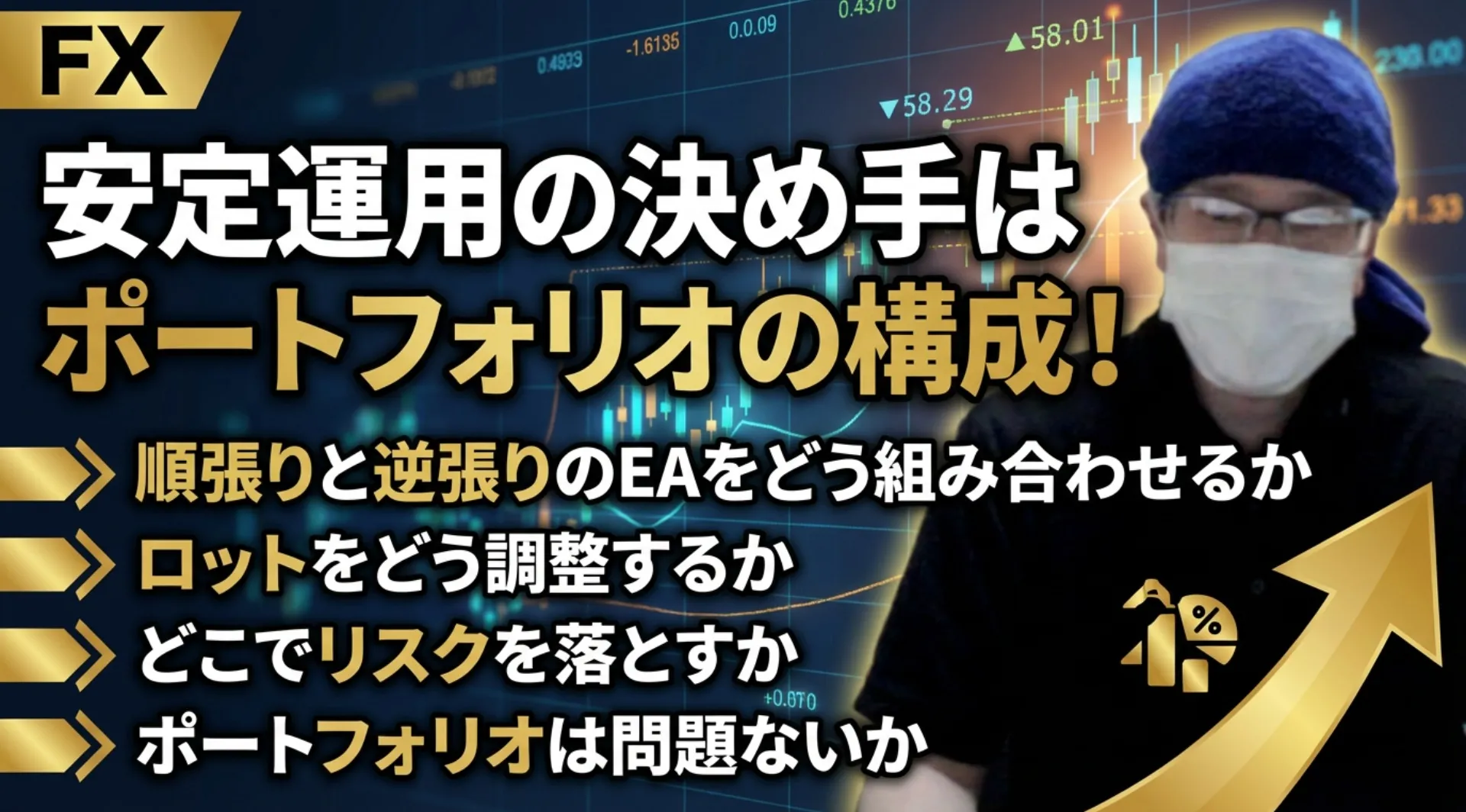
Stable operation is more important than chasing account growth
But in live trading, more importantly:
- How to combine trend-following and counter-trend EAs
- How to adjust lots
- Where to cut risk
- Is the portfolio balanced
These decisions consistently generate profits.
“Raising lots because funds increased is correct, but over-concentrated portfolios collapse”
Raise lots when funds increase.
This is rational.
However, the problem lies in the portfolio’s composition.
If you allocate all newly gained funds to “trend-following EAs” or to “grid/nanpin EAs,” drawdowns will be larger when losses occur.
I myself became too skewed toward trend-following EAs and deeply failed.
In the end I could exit with gains, but continuing that approach could have yielded even greater assets.
EAs are strongest when combining trend-following and counter-trend

Only trend-following or only counter-trend or only anomaly can be strong in a bull market, but rigid in others.
Conversely, mixing EAs with different personalities can help sustain performance when one underperforms.
That is the strength of portfolio trading.
What changed when I restarted the 300,000-yen challenge in 2026
I combined two trend-following EAs and one counter-trend EA
After I withdrew everything in April 2025, I restarted the 300,000-yen challenge in March 2026.
However, I changed the approach.
The biggest change isto clearly combine a trend-following EA with a counter-trend EA.
I had sensed portfolio effectiveness before, but this time I deliberately designed a combination that bridges different market environments.
Role of the counter-trend EA “Grid Rash EURUSD”
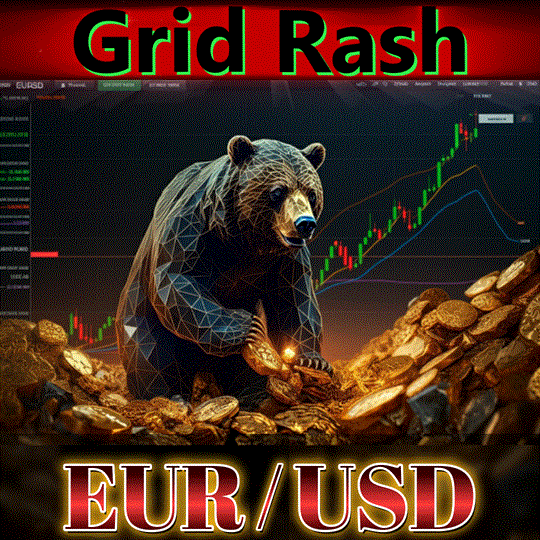
First, the counter-trend side includesGrid Rash EURUSD.
This is a counter-trend EA that trades against the Euro-Dollar trend.
It works well with low-spread domestic accounts and is currently running on the Gaiten FX Finest MT4 account.
The strengths of this EA are strong in range-bound markets.
Its weaknesses are clear as well.
Weak to strong directional trends...
In other words, it wins steadily but can be hit hard when a trend emerges.
This type of counter-trend EA loses in trending markets.
? EA name: Grid Rash EURUSD
? URL:https://www.gogojungle.co.jp/systemtrade/fx/55503
Trend-following EA “GoldenCross_USDJPY” and “Seven Elements” roles
A standalone strong Grid Rash in range markets loses in trend markets, so I added the USD/JPY trend-following EA to fill that gap.
Specifically,GoldenCross_USDJPYandSeven Elementsare the two EAs I run.
Both are trend-following models.
They aim to profit when USD/JPY moves significantly.
- Range markets: counter-trend EA seeks gains
- Trend markets: trend-following EA seeks gains
- When the market is uncertain, they cover each other
Of course, no market is absolute.
Depending on Euro-Dollar and USD/JPY movements, both can struggle.
Still, as of now, this combination makes a lot of sense to me.
At least it’s far more stable than a portfolio where everything uses similar logic.
Why I think this combination is the best move now
In March 2026, after restarting with this setup for only a month, the 300,000-yen starting amount grew to 330,000 yen.
You might think that’s just 30,000 yen.
But I’m currently keeping leverage lower.
Rather than chasing the possibility of a rapid rise,
“build a combination that is resistant to any market environment”
This approach is more practical for long-term continuation.
EA trading values reproducibility and continuity more than flashy performance.
This is something I’ve strongly felt after six years of EA development.
Why I’m also challenging AI trading
AI Signal Trader that judges by reading news

The reason is simple:I feel there are trading advantages from angles different from traditional EA development.
One of them isAI Signal Trader.
?News monitoring-type “AI Signal Trader”
https://www.gogojungle.co.jp/finance/navi/articles/114430
AI monitors news automatically and makes buy/sell decisions!
- instead of seeking edge in past charts, read current news and predict future price movement to trade
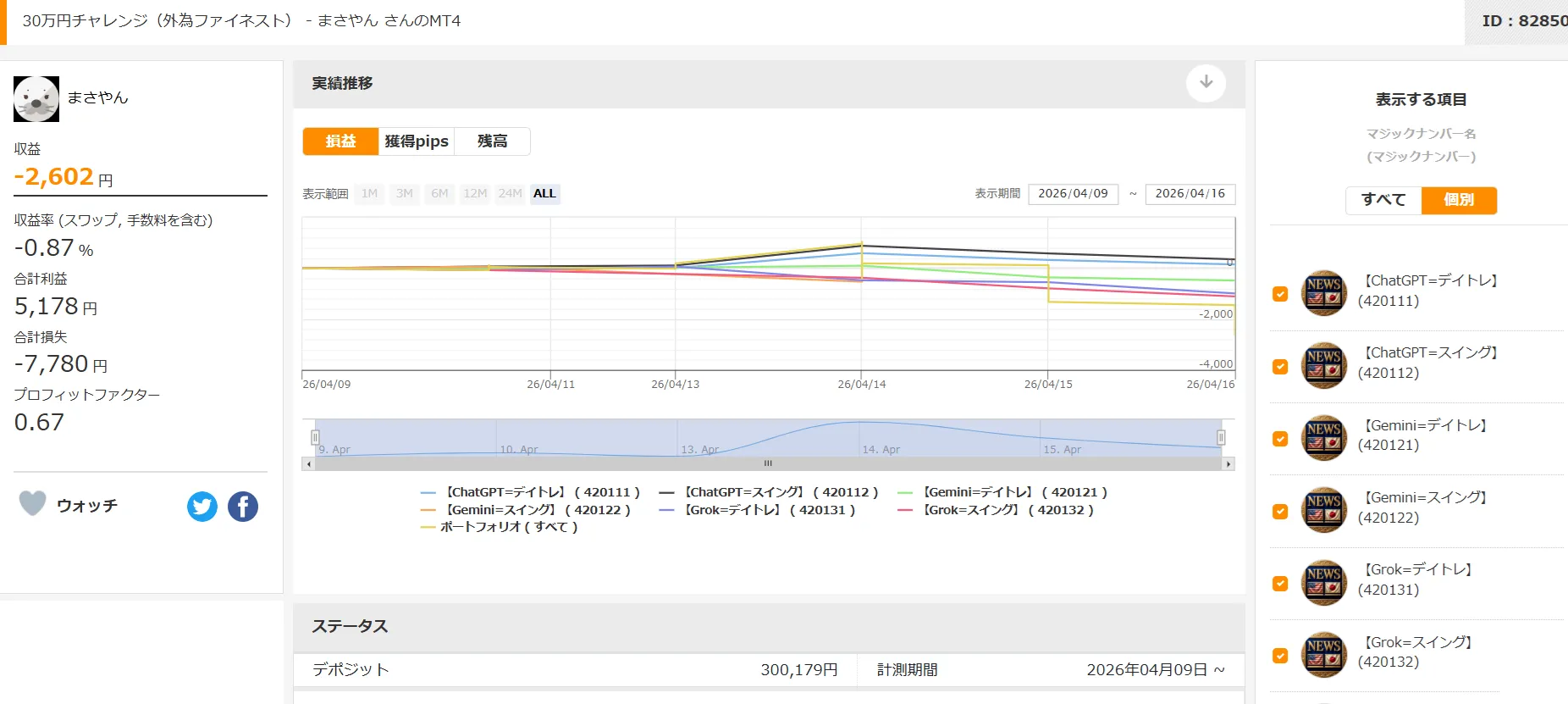
Distinguishing between ChatGPT, Gemini, and Grok
Furthermore,
- a day-trading mode
- a swing-trading mode
are separated, so
in reality, it runs3 models × 2 modes = 6 patterns.
The reason for multiple patterns is that each AI model has a different judgment bias.
Even reading the same news, they weigh different factors and decide with varying degrees of bullishness or bearishness.
Differences between AI models themselves become part of the strategy.
AI trading cannot be fully backtested; forward testing is essential
The weakness of this AI-trading type isalmost no backtesting is possible.
Therefore I prioritize forward testing from the start.
In other words, run it in a real account and observe.
Currently, I’m operating on
- OANDA Securities MT5 account
- Forex Finest MT4 account
to see which combinations survive.
Honestly, I don’t expect all of them to be usable.
More than half might be unusable.
But that’s fine with me.
If 10 trials yield 1 real usable system, that’s enough—this is common in EA development as well.
AI trading is the same:if one or two are reliably usable, that alone has value.
AI Breakout Line: making charts readable by AI

This model gives AI 100 candles worth of data, asks it to analyze support/resistance and round numbers, and then decide whether to use trend-following or counter-trend logic.
?Chart-analysis type “AI Breakout Line”
https://www.gogojungle.co.jp/finance/navi/articles/114426
AI analyzes charts and makes automatic entries!
What’s interesting about this mechanism is
that prompts can let AI replicate the methods of top traders.
For example, by verbalizing a trading method into prompts and letting AI trade accordingly,
AI might reproduce the strategies of successful traders.
Of course, current AI won’t automatically create magical winning strategies.
Please don’t misunderstand this.
However, with properly crafted prompts,
“reproducing winning methods with AI”
is possible.
How to master this AI trading system?
This is very important, so I’ll be explicit.
AI trading systems aren’t for everyone.
- People who understand EA and automated trading to some extent
- People who can adjust lot sizing and leverage themselves
- People who can think through logic and prompts and verify them
- People who can perform AI-based coexistence coding
Conversely, who they aren’t suited for:
- People who think AI will increase assets with no risk
- People who can’t emotionally tolerate drawdowns
- People who are not good at system building or programming
- People who evaluate EA by short-term results
As an EA developer for a long time, I believe
the survivors are those who can manage risk rather than chase flashy logic..
For those interested — start with a free demo
After reading this, you might think,
“I want to try AI trading myself.”
There are paid options, but we also sell AI-based trading systems that read news and chart-analysis-based AI trading systems.
If you’re curious, I recommend trying thefree demofirst.
https://www.gogojungle.co.jp/finance/navi/articles/114420
To get used to the system, first run it.
Understand what kind of programs produce AI trading.
Try the demo first, and if you’re convinced, consider purchasing the paid version.
Summary
The method I used to nearly eightfold my funds in about six months in 2024 was
to diversify self-made EAs to about 10, and dynamically adjust lots and leverage to run a high-leverage portfolio.
But behind that were things like
- Large fluctuations due to high leverage
- An EA portfolio overly biased toward trend-following
- Greed leading to gambling trades
- Ultimately withdrawing everything to exit on a win
and I experienced these things.
- Counter-trend EAs
- Trend-following EAs
- AI trading
to find a more practical and less fragile portfolio.
If you draw one lesson from this article,
it’s not about chasing the Holy Grail EA, buthow you combine EAs and how you manage funds.
There certainly are ways to dramatically increase your account,
but even more important is not letting the increased funds burn away.