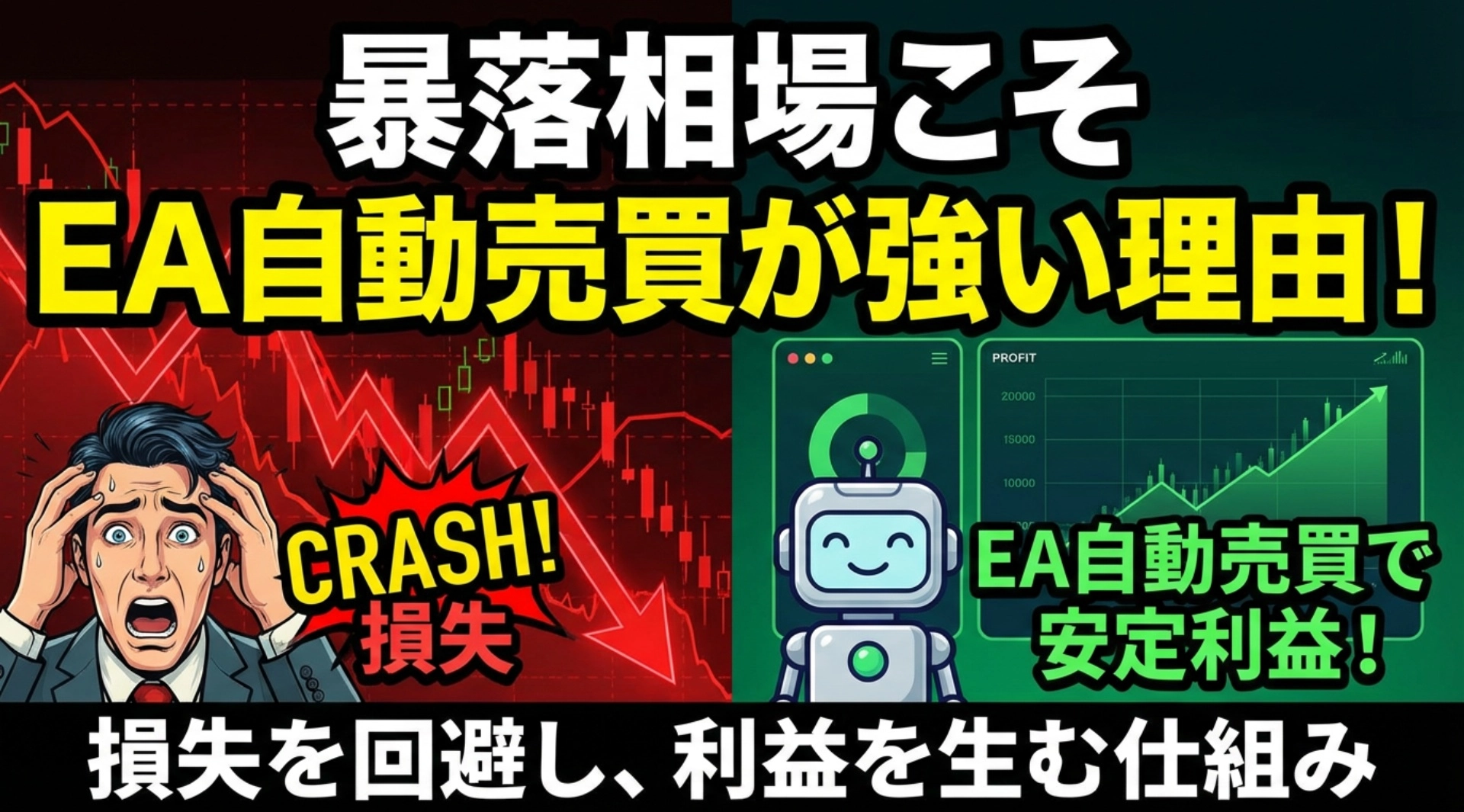

【EA Trade】Why automatic trading with EA is strongest during a crash market
Crash markets are scary. But for EA they can also be opportunities
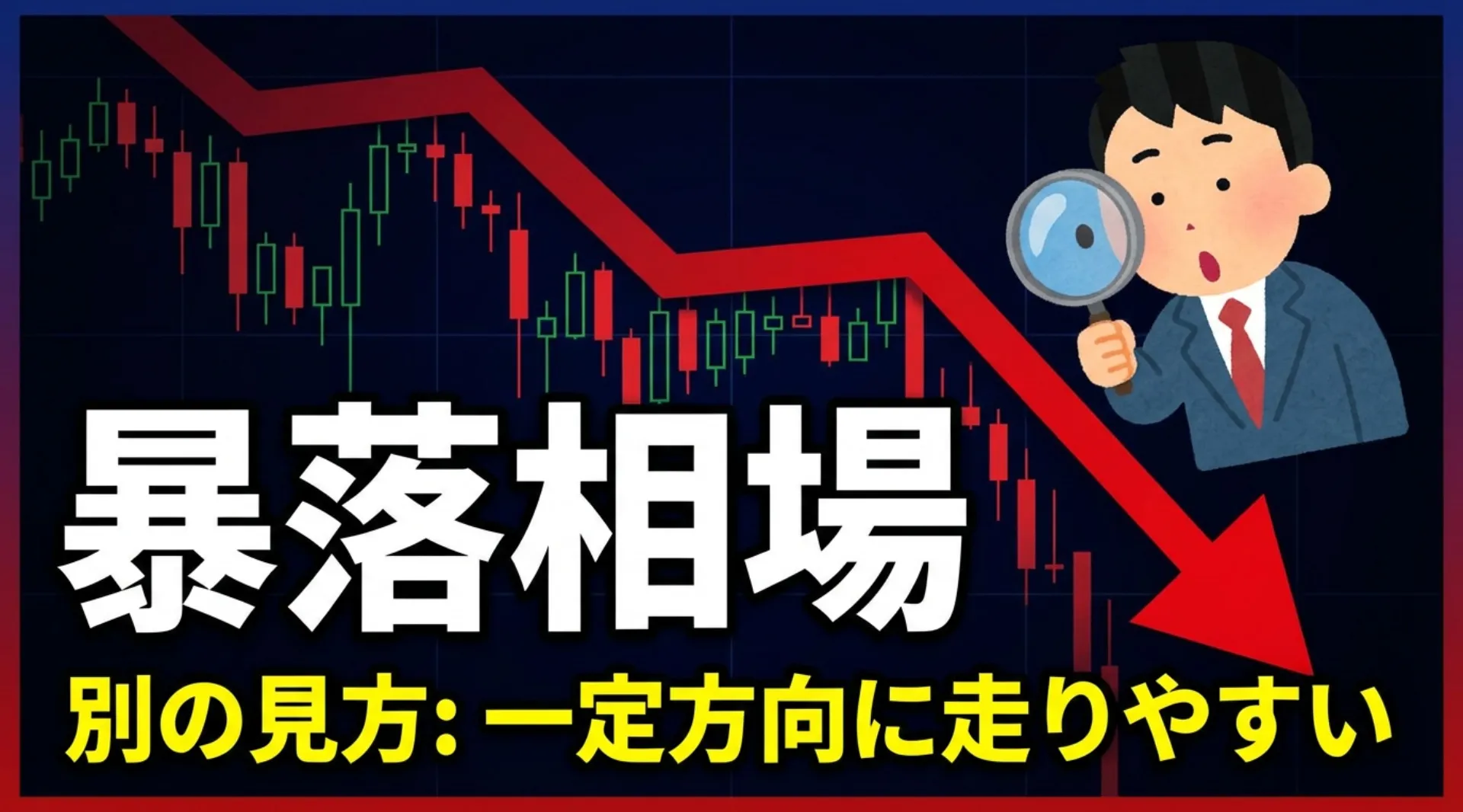
Stock prices plunge, unrealized losses on held positions swell. Market participants' psychology becomes unstable, and those trading discretionarily tend to have wavering judgments. In reality, staying calm in these situations is not easy.
However, when real money is running FX EAs, a crash market can be viewed differently.
That is,the market tends to move in a single direction.
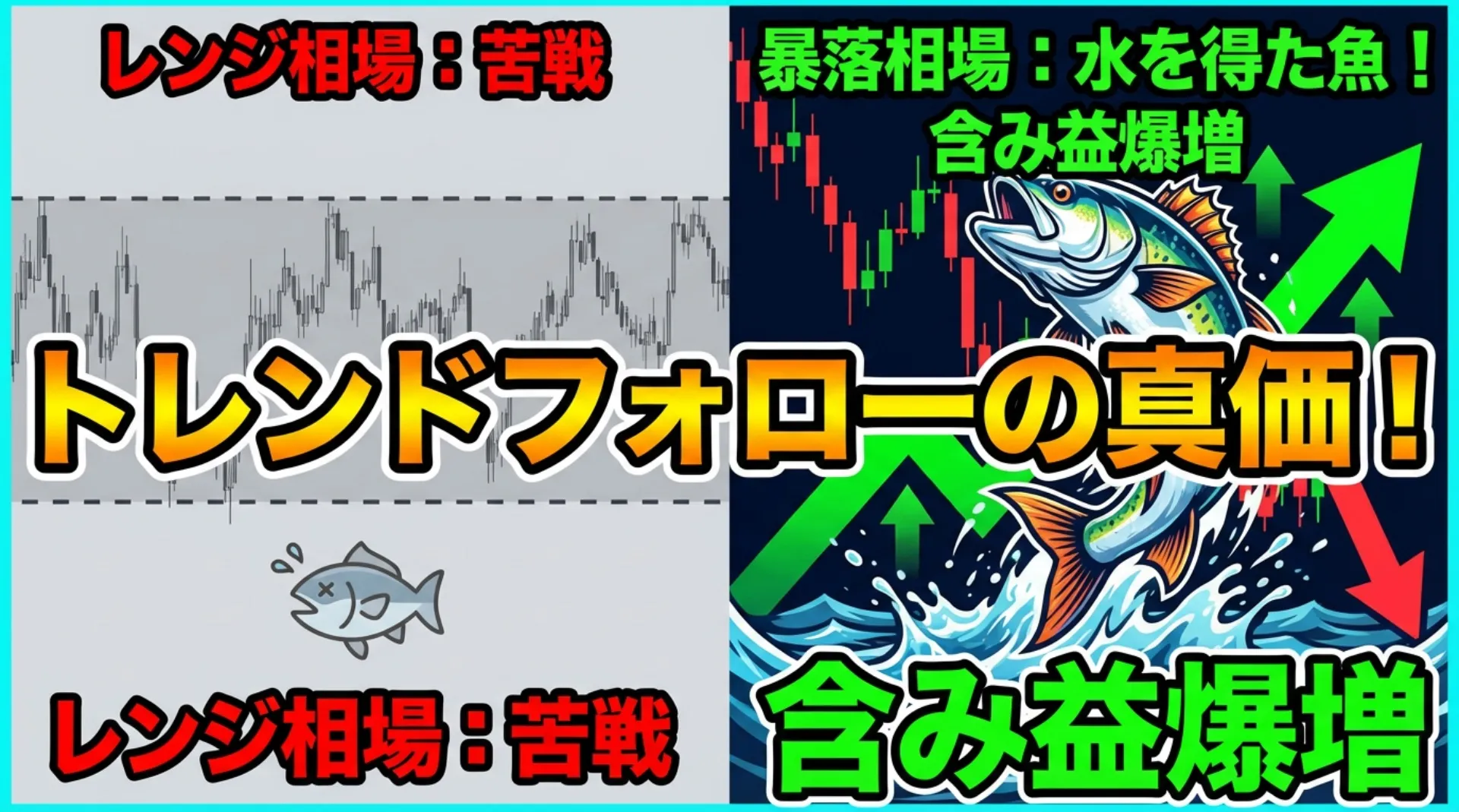
Normal markets may not break out upward or downward and may move back and forth in a range. Such markets may look calm, but for EA they are not necessarily easy environments. Even if you enter, you may not get a strong move, and losses from stop-loss tend to accumulate.
On the other hand, in crash markets, market participants' psychology tends to skew all at once. As a result, prices tend to move strongly in one direction, and volatility expands. In other words,the market becomes a trend-friendly environment.
In such situations, humans inevitably feel fear and hesitation.
But EAs do not have emotions. If conditions are met, they enter; if conditions break, they exit. That’s all.
This ability to “act without hesitation” is a very strong advantage in crash markets. In fact, even during events like the Lehman Shock and the Corona Shock, when the market has a clear directional trend, trend-following logic tends to work well.
Crash markets are indeed scary, butthey can turn into opportunities for automated trading.
In crash markets, a trend-following EA beats a counter-trend EA
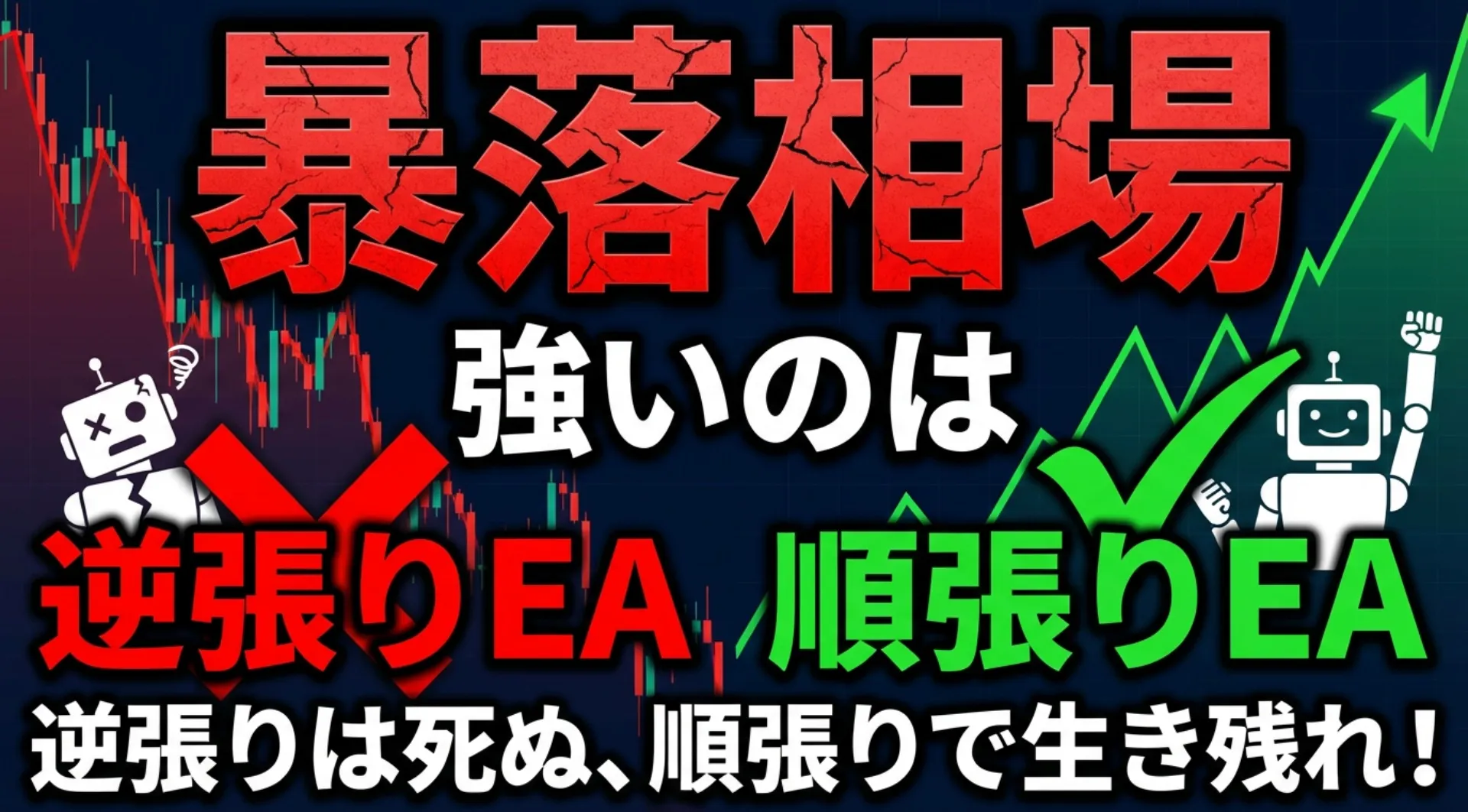
What matters here is that crash markets do not automatically make every EA advantageous.
In reality, there are EAs that perform well in crash markets and others that are risky.
In short, the EAs that fit crash markets well aretrend-following EAs, especially those that are trend-following.
Why reversal and averaging (NAN) strategies tend to be dangerous
A reversal EA is based on the idea of “buy when it’s fallen too far” and “sell when it has risen too much.”
In normal range markets, this approach can work at times. Indeed, in markets that swing within a certain range, reversal logic can look stable.
However, in crash markets, things change completely.
Because there are times when the market continues to move further after appearing to have gone too far.
Buying at a scene that looked like a further drop? It drops further. Averaging down. It drops again. When this flow occurs, unrealized losses swell rapidly.
From my experience developing more than 100 EAs, I strongly feel thatreversal strategies look stable in normal times but tend to become fragile as soon as the market collapses. In particular, averaging-down strategies require caution in crash markets.
Backtests may look like a clean upward curve, but in real trading during shock markets they can collapse quickly.
Why trend-following EAs are advantageous
On the other hand, trend-following EAs are designed to follow the direction in motion.
If there is momentum upward, buy. If momentum downward, sell. It’s very simple, but in crash markets this simplicity becomes a strength.
During shock markets, even small rebounds or temporary retracements tend to keep overall movement in the same direction. Then trend-following EAs tend to extend profits after entry.
Of course, not all trend-following EAs will be profitable.
But at least,crash-market properties favor trend-following over reversal.
Among the many EAs I have developed for euro pairs, pound pairs, and cross-yen pairs, I have found that in major trending market phases, trend-following logic tends to capture profits more easily.
How will USD/JPY move in a crash market?
When considering a crash market, USD/JPY movement is very important.
However, it’s important to note that the price action during a crash changes with time.
Before, the yen was often bought
In previous crash markets, people often said “risk-off, yen buying.”
Sales of stocks and capital fleeing risky assets made the yen relatively attractive, resulting in a fall in the USD/JPY.
Looking back at past markets, this pattern was indeed frequently seen.
Therefore, even now many people have the image of “crash = yen appreciation.”
Now there is also a possibility of yen selling and Japan selling
However, in the current market environment, that is not necessarily the case.
Recently, there is a possibility of a flow ofyen selling, Japan selling, and dollar buyingoccurring.
Considering concerns about the Japanese economy, interest rate differentials, and the strength of the US as a safe haven, shock markets could see the dollar being bought, and USD/JPY rising as a result.
From my own EA development and operation experience, I strongly feel USD/JPY is a currency pair that attract capital and can be operated stably. Abroad, many trades focus on EURUSD, but for Japanese traders, USD/JPY tends to be central. In my EA development and testing, I also develop targeting USD/JPY.
Be mindful of the risk of intervention by the BOJ
However, when handling USD/JPY, one cannot ignoreforeign exchange intervention risk
Even if USD/JPY moves strongly in one direction, once it surpasses a certain level, intervention risk rises, and if intervention actually occurs, it can reverse by several yen in a short time. Such moves are extremely volatile and the biggest enemy of a pure-trend EA.
In other words, while trend-following in USD/JPY is indeed advantageous in crash markets, blindly chasing it is not wise.
You need the ability to ride the trend and the resolve to cut losses decisively when a sharp reversal occurs.
Characteristics of EAs that tend to win in crash markets, after developing 100+ EAs
From here, I will整理 the features of EAs that I have found strong in crash markets based on my actual development experience.
Do not go against the market
First and foremost,do not go against the market
In crash markets, you naturally want to think “it will bounce back soon.”
But that judgment leads to large losses.
What is advantageous in such crash phases is not trying to catch the rebound, but following the direction that is moving now. In my EAs, directionally clear logics like Golden Cross or Dead Cross tend to perform well when a trend has formed.
Ranges may have whipsaws, but EA that can reliably capture in a trending phase tends to be stronger in the long run.
Clear stop-loss and lot size management
Next important point is stop-loss and lot management.
This is crucial in both EA development and discretionary trading.
No matter how good the logic is, if the lot is too large or the stop-loss is vague, a single rapid change in a crash market can wipe you out.
In development, it’s not only about “how to win.”
It’s important to think about how to cut losses
Suitability to USD/JPY characteristics
In recent markets, risk-off yen buying has become less common. Still, USD/JPY has its own quirks.
Movement can be fast once it starts, so when building an EA, it’s not enough to simply combine technicals; you must considerwhether the current USD/JPY market fits. This is true for both MT4 EAs and MT5 EAs; whether the market fits is extremely important.
AI trading also pairs well in crash markets
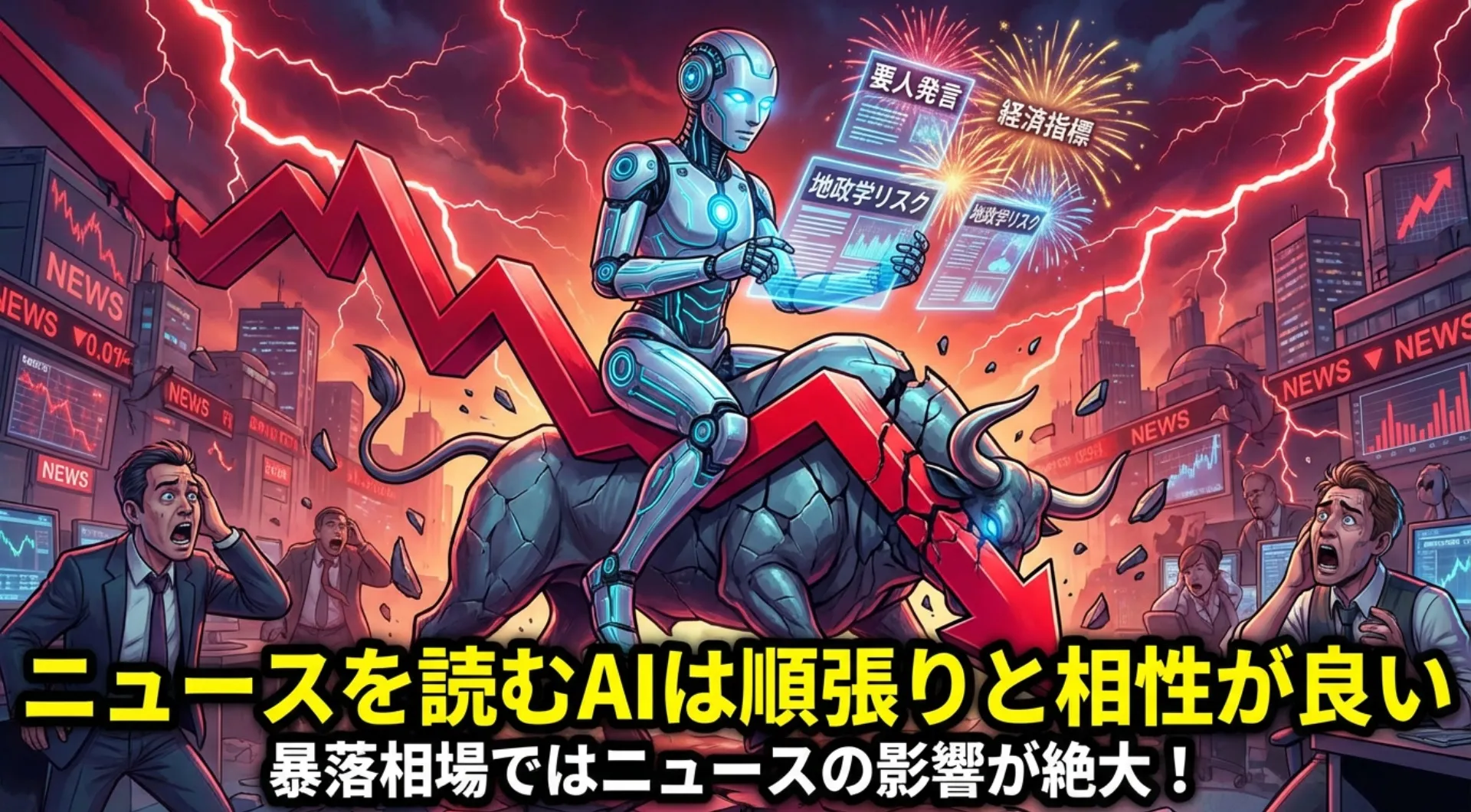
Using LLMs like ChatGPT, Gemini, Grok to read news and market information, and base buy/sell decisions on that content. What used to be difficult for individuals is now feasible.
AI reading news pairs well with momentum trading
In a crash market, not only charts but news impact becomes very significant.
Opinions of leaders, economic indicators, monetary policy, geopolitical risks—various factors push market psychology in one direction.
This is where AI’s strength comes in.
AI excels at reading text and organizing its meaning. For example, by feeding it recent news to determine whether “dollar-buying factors are stronger” or “yen-selling factors are stronger,” and then using that to inform trading decisions.
In particular, its compatibility with momentum is very good.
If the market is moving in one direction and the news supports that direction, the justification for entries becomes easier to align with.
AI can補完 flows that charts alone cannot capture
Normal EAs rely mainly on chart data and technical analysis.
This is effective, but it cannot directly read news or market themes.
The strength of AI trading lies in补充ing this gap.
For example, on charts it may still appear to be early movement, but following the news content can reveal that market participants’ perceptions have already shifted substantially. This capacity to detect such shifts is a major advantage of AI analysis.
The AI trading system I recently developed also uses momentum as its trading style. It analyzes the market direction from news and trades in that flow. In this sense, it is essentially similar to a Golden Cross type EA.
[Now for sale] “AI Signal Trader” AI monitors news, economic indicators, and social media to make trading decisions

EA and AI are not adversaries but complementary
What I want to emphasize here is that the emergence of AI trading does not mean traditional EAs become unnecessary.
In fact,
EAs excel at executing rules precisely, while AI excels at interpreting information
.
Therefore, in reality, combining both is effective.
For example,
- read news with AI to determine market direction
- use EA to formalize entries and exits by rules
- improve accuracy using both charts and news
This kind of design is a compelling approach for future AI automated trading styles.
Rather than separating EA development and AI programming, it seems more practical to integrate and utilize them together.
What to do if you want to profit in crash markets
Finally, here is what those hoping to profit in crash markets should be mindful of.
Discard reversal thinking
First, it is important not to bring over the reversal mindset like “it’s fallen a lot, so it will bounce back soon.”
Of course, markets will eventually reverse.
But in crash markets, timing is extremely difficult, and early reversal can lead to large losses.
Therefore, at least in shock markets, it is more realistic to prioritize momentum-following thinking over reversal.
Backtest sufficiently to validate
EA trading is not recommended to start with real capital immediately.
In particular crash markets involve large price movements, so profits and losses can expand beyond expectations.
First, thoroughly test in a demo environment and backtests,
to understand what results it would achieve in past crash markets
.
For the AI trading I offer, I also provide a free demo to test the AI communication part first.
AI trading demo version released! | ChatGPT, Gemini, Grok supported, source code fully copyable!
https://www.gogojungle.co.jp/finance/navi/articles/114420
Operate with an understanding of the system
Finally, it is important not to use EA as a black box.
Nowadays, with ChatGPT, Codex, Cursor, etc., it has become relatively easy to create code.
But just because you can create it does not mean you can operate it.
What entry conditions and stop-loss criteria you use?
How you interpret news?
What happens if there are communication or API issues?
If you do not understand these aspects, performance in real trading will not be stable.
From my own EA development, I strongly feel thatcreating a robust system is more important than building a winning logic.
Crash markets are indeed opportunities.
But at the same time, buggy EAs can easily fail.
For those preparing for future crash markets, first understand momentum trading mindset and start validating EAs and AI trading.
In volatile markets, it is crucial to respond with a mechanism rather than emotion.
In that sense, trading using EA and AI will continue to be an increasingly powerful option.