

Why are there many Gold EAs but Oil EAs don’t become popular? The real reason revealed by CFD validation from EA developers
Why are there many Gold EAs but almost none for Crude Oil?
From my experience developing crude oil EAs, there is a clear reason.
To put it bluntly,crude oil is difficult for technicals to work effectively.

Some people think, “Since it moves a lot, it should be easy to profit with an EA,” but in reality it’s the opposite,the movement is too erratic to handle.
Until now I have tested not only FX but also gold, crude oil, and indices like US30, NASDAQ, S&P 500, and Nikkei, among others.
Among them, crude oil feels exceptionally unique.
Gold is also difficult. Stock indices aren’t easy either.
But among them, crude oil stands out as particularly challenging.
This is not simply because technicals don’t work or because volatility is high;
the very premise required for EA development tends to break down.
Especially two major factors:
- Wide spreads
- Logics based on past charts often become meaningless
The second reason is especially serious: you don’t get good results in backtests, and in real trading it’s often unusable.
So crude oil istruly difficult to turn into an EA.
Crude Oil EA is hard to develop for Reason 1: Spreads are too wide
First, one of the biggest reasons crude oil EAs are hard iswide spreads.
This is very important.
Yet it’s something beginners often overlook.
For example, major currencies like USD/JPY or EUR/USD have relatively narrow spreads.
Thus, even in short-term trading, you’re not losing too much to spread.
But crude oil is different.
Because spreads are wide, you are at a disadvantage the moment you enter.
Moreover, moving trading around 24 hours tends to increase the number of trades.
Depending on the logic, you may trade several times a day.
Each time, the spread cost accumulates.
In other words, for a instrument like crude with wide spreads, a little advantage isn’t enough at all.
Unless you have a solid edge,you’ll get shaved down the more you trade.
I have used Tick Data Suite (TDS) to obtain crude oil time-series data and validate it.
The data is obtainable, and backtests are possible.
However, as you’ll see when you try, crude oil is not about “finding a winning logic” first; it’s aboutbuilding a structure that can withstand spreads.
This is very different from USD/JPY.
With USD/JPY, even if entry precision is somewhat rough, you can still be saved by the narrower spread.
But for crude, that saving grace is small.Even small entry slippages, delays in exits, or thin edge can directly worsen performance.
In short, crude oil may look like it’s ripe for profits because it moves, but the reality is you start at a significant cost disadvantage.You start with a substantial disadvantage at the cost stage.
Crude Oil EA is hard to develop for Reason 2: Past charts don’t translate well
Another reason crude oil is difficult is
past charts don’t translate well.
EA development basically relies on past price actions, patterns, and edges, and automates them.
Whether in MQL4 or MQL5, you search for patterns and codify them into an automated system.
Thus the fundamental assumption of EA development is
what worked in the past should continue to work to some extent
.
But crude oil often breaks this premise.
Directly affected by wars, Middle East tensions, and production cuts
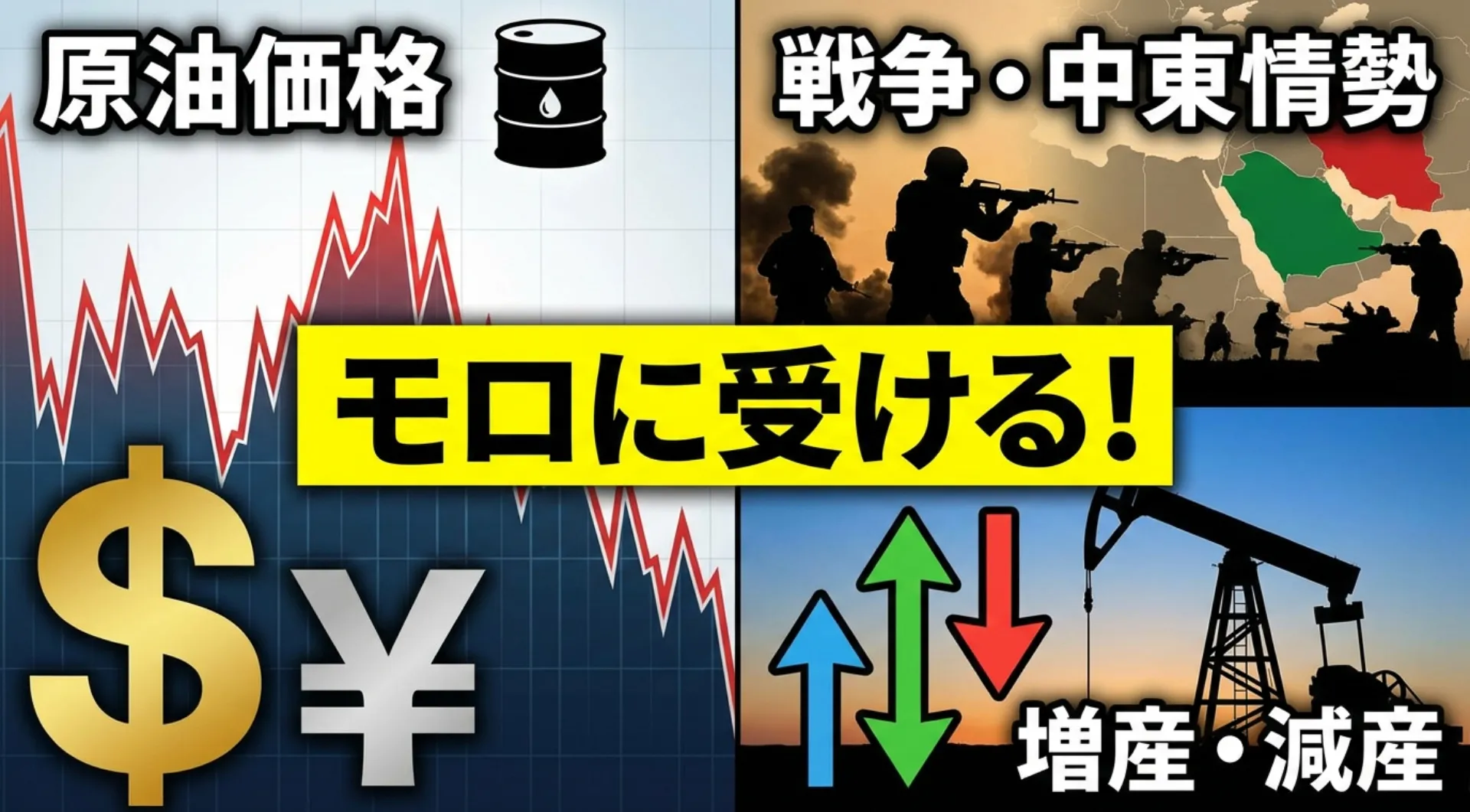
Crude oil is more susceptible to global events than forex.
For example,
- wars
- Middle East developments
- OPEC production increases or cuts
- supply concerns
- shipping issues
- sanctions
- geopolitical risk
these factors reflect directly in prices.
In other words, relying on chart patterns alone isn’t enough.
A logic that worked on past charts can suddenly fail due to a single news catalyst.
This is quite different from typical FX currencies.
Of course USD/JPY moves on BOJ or FOMC statements too.
But crude oil is more readily influenced by external factors.
Therefore chart-only EA approaches tend to be less compatible.
Chart-based edge loses its meaning
The scariest aspect for crude oil is here.
Backtests may look promising, but once put into real operation, they crumble.
This happens quite often.
For example, range-based counter-trend logic. Or logic based on a certain pullback and retracement. Such logics may work in normal times, but when events like wars or supply shocks occur, they break in an instant.
In other words, it’s not that the technicals don’t work; the difference between times when they work and don’t work is too large.
This lack of reproducibility is the biggest challenge for crude oil EAs.
I have tested many approaches, and while you can build EAs that look good in a certain period,
keeping them running long-term is another matter.
An EA is only meaningful if it can run continuously.
In that sense, crude oil is very tough.
So why did Gold EAs become popular?
Then, why were Gold EAs so prevalent?
That’s another interesting question.
In short,historical gold prices were relatively compatible with averaging/nanpin-type EAs.
Good compatibility with averaging-nanpin systems

Gold EAs often heavily feature averaging-nanpin or grid strategies.
They gradually add to losing positions and take profits when prices recover.
This spread existed because, in historical gold markets, there were more frequent recoveries.
Of course it wasn’t always easy.
But compared to crude oil, there were more opportunities for “rebound.”
As a result, EAs with apparent win rates were easier to create and market.
Indeed, one reason gold EAs proliferated is likely this.
However, do not misunderstand:
high win rate does not equal safety.
Nanpin systems can win very cleanly in normal times.
They tend to have streaks of wins.
But when a major trend goes one way, they collapse rapidly.
Is Gold safer nowadays?
In the past, gold was sometimes considered relatively stable, conducive to averaging strategies.
In fact, many gold EAs were built with that thinking.
But today gold has become more volatile.
While gold is still a safe-haven asset, it now moves much more dramatically due to
- wars and geopolitical risk
- dollar strength/weakness
- interest-rate outlook
- inflation
- risk-off flows
which can lead to much bigger moves than before.
So,
saying “Gold is ballpark safe for averaging”
is no longer valid.
Rather, recentlyGold EAs tend to show weaknesses more readily in current conditions.
Gold is also quite risky these days
Not to the same extent as crude oil, but gold has become quite choppy recently.
Among Gold EA enthusiasts, many think
“Gold is more tolerable than crude”
“Gold moves more than currencies”
“Nanpin works well with gold”
and so on.
But gold has been fluctuating widely lately.
When prices swing up then down sharply with large ranges, nanpin EAs become truly dangerous.
Why? Because nanpin essentially relies on the assumption that prices will revert toward a mean.
If prices continue to move against the position, the losses grow.
If the lot size is increasing, the damage escalates quickly.
I can build nanpin EAs, and I can code the logic, but if you ask me to run one, I wouldn’t.
The reason is simple:
the risk of losing everything in a single big move.
Even if you can see good looks during normal times, sustaining capital is another matter.
This is something I’ve observed carefully through development and testing.
What recent Gold EA performance reveals
I won’t name specific EAs; I’ll discuss overall trends.
Many Gold EAs today are quite harshly tested.
Especially nanpin-martingale types tend to suffer reversals in volatile markets like now.
This is natural.
During calmer markets, even with a small adverse move, they bounce back.So they look robust.
But when the market vibrates with higher volatility, the “return to normal” premise collapses.
Thus, the sequence is often
- increasing unrealized losses
- increasing lot sizes
- margin pressure
- inability to cut losses and endure
- further adverse moves
This flow tends to occur.
Therefore, thinking “Gold EAs are popular, therefore excellent” is dangerous.
More accurately,there was a period when Gold EAs were easy to create.
And now that premise is quite questionable.
You should watch this carefully.
Common points learned from testing Crude Oil, Gold, and Stock Indices CFDs
So far I’ve focused on crude and gold, but stock index CFDs like US30, NASDAQ, S&P 500, and Nikkei share many commonalities with EA development.
What are they?
They have heavy spreads and costs, and their market nature changes easily due to news and external factors.
In other words, just because a backtest shows profits doesn’t guarantee safe live operation.
CFD instruments have wide price moves, so noise is high and abrupt shifts are common.
Moreover, reactions to news differ by instrument.
- For crude oil: wars and supply issues
- For gold: geopolitics and interest rates
- For stock indices: monetary policy and recession fears
Ignoring these backgrounds and pushing through with chart-only logic is very difficult.
I have developed 100+ EAs and indicators, and what I feel is
the more flashy the asset, the harder it is.
At first glance, assets that look profitable often hide many pitfalls.
This is very true.
Finally, why I narrowed to USD/JPY and EUR/USD
After extensive testing, my current focus centers onUSD/JPY and EUR/USD.
In the end, major currency pairs are the target.
Do higher trading volumes make for better EA compatibility?
First, USD/JPY and EUR/USD have high trading volumes.
High liquidity means more participants and thicker liquidity.
- more stable spreads
- fewer extreme price surges
- better reproducibility of logic
- smaller gaps between backtests and live trading
These benefits make development easier.
Of course USD/JPY and EUR/USD aren’t easy either.
But compared to crude oil or gold or stock indices CFDs, they’re much more manageable as EA development targets.
Mean-reversion may favor EUR/USD more
In practical testing, mean-reversion strategies sometimes perform better on EUR/USD than on USD/JPY.
That doesn’t mean EUR/USD is always range-bound.
However, when building mean-reversion logic,EUR/USD tends to fit more naturally.
Many overseas EA creators focus on EUR/USD, which likely reflects this dynamic.
Globally, EUR/USD plays the lead role.
Meanwhile, for Japanese traders, USD/JPY feels more familiar.
News is easier to follow, and the sense of market feel is easier to grasp.
So I think:
focus on USD/JPY as the main axis, with EUR/USD favorable for mean-reversion strategies
.
Why I stopped pursuing GBP/JPY
I used to develop GBP/JPY EAs as well.
But today I hardly work on GBP/JPY EAs, and I don’t touch them much myself.
Reason is simple:it tends to be highly volatile.
Pound pairs can work very well when they move, but they can also crash hard.
EAs tend to be more mechanical than discretionary, and rapid, sharp moves aren’t friendly to them.
What I want to tell people starting EA development
For those starting MT4 or MT5 EA development, I want to share this first.
Don’t start with difficult assets from the get-go.
Crude oil, Gold, US30.
All look attractive.
They have large price swings, so you might think, “If it fits, I can profit.”
But actually building an EA, testing it, and running it long-term is quite challenging.
So I think it’s best to start with the classics.
- USD/JPY
- EUR/USD
Start with these,
learn the basics of EA development: how to read backtests, forward testing, the impact of spreads, the effectiveness of logic, etc.
Jumping to flashy assets can wait.
In fact, if you dive into difficult assets first, you may end up thinking,
“Is EA this hard?”
“Is nothing I make any good?”
which is not good for motivation.
But in many cases, the problem is not the asset but the selection.
So beginners shouldchoose major currencies.
Even with AI trading, asset selection remains crucial
I also work on AI trading and offer a demo version for free.
https://www.gogojungle.co.jp/finance/navi/articles/114420
In my regular development, I heavily use AI-driven development.
Using ChatGPT, Codex, Cursor, and when needed Gemini, has significantly boosted development efficiency.
However, a common misconception is
that simply using AI makes it possible for anyone to create an EA
.
Code-writing with AI is easy.
Development speed increases.
MQL4/MQL5 programming can be done without thinking.
But that does not guarantee you’ll create a profitable EA.
In fact, the more AI you use, the more important becomes
“which asset to choose”
“why that logic works”
“whether that edge will persist”
This design aspect becomes even more important.
In other words, in this era of AI-driven development,
the edge of the logic becomes increasingly crucial.
Summary
Gold EAs are plentiful, but crude oil EAs hardly become popular.
The reason is clear.
Crude oil EAs are hard because
- spreads are wide
- they are highly influenced by wars, Middle East tensions, and production decisions
- the edge based on past charts tends to break
These are the main factors.
On the other hand, Gold EAs were numerous because there was a period when averaging/nanpin systems performed well.
But today gold is moving quite aggressively, and gold alone can’t be considered safe.
In my extensive testing across Gold, Crude Oil, and stock indices CFDs, the final takeaway wasthe mainstream currencies like USD/JPY and EUR/USD are the classic avenues.
If you’re starting EA development now,
start with major currencies.
I also develop AI trading and provide a free demo, so please have a look.
If you’re interested, please check out as well.
【Free】AI Trading Demo Available!|ChatGPT・Gemini・Grok support, full source code copyable!
https://www.gogojungle.co.jp/finance/navi/articles/114420
【Paid】“AI Breakout Line” An EA trading system that uses AI to analyze charts and automatically enters on breakout points
https://www.gogojungle.co.jp/finance/navi/articles/114426
【Paid】“AI Signal Trader” AI monitors news/economic indicators/SNS to make trading decisions
https://www.gogojungle.co.jp/finance/navi/articles/114430