
The real work starts after landing the 9th tranche! The story of how I finally realized the way in and how I kept spending funds【SMC Practice③】
Hello, this is nao.
In the previous issue (Vol. 8), we explained in five steps how to verbalize a scenario before a trade and draw it on the chart: "decide the direction, identify the zone, prepare multiple scenarios, and draw on the chart." If you’ve done up to this point, the rest isto wait for the price to come to the zone.
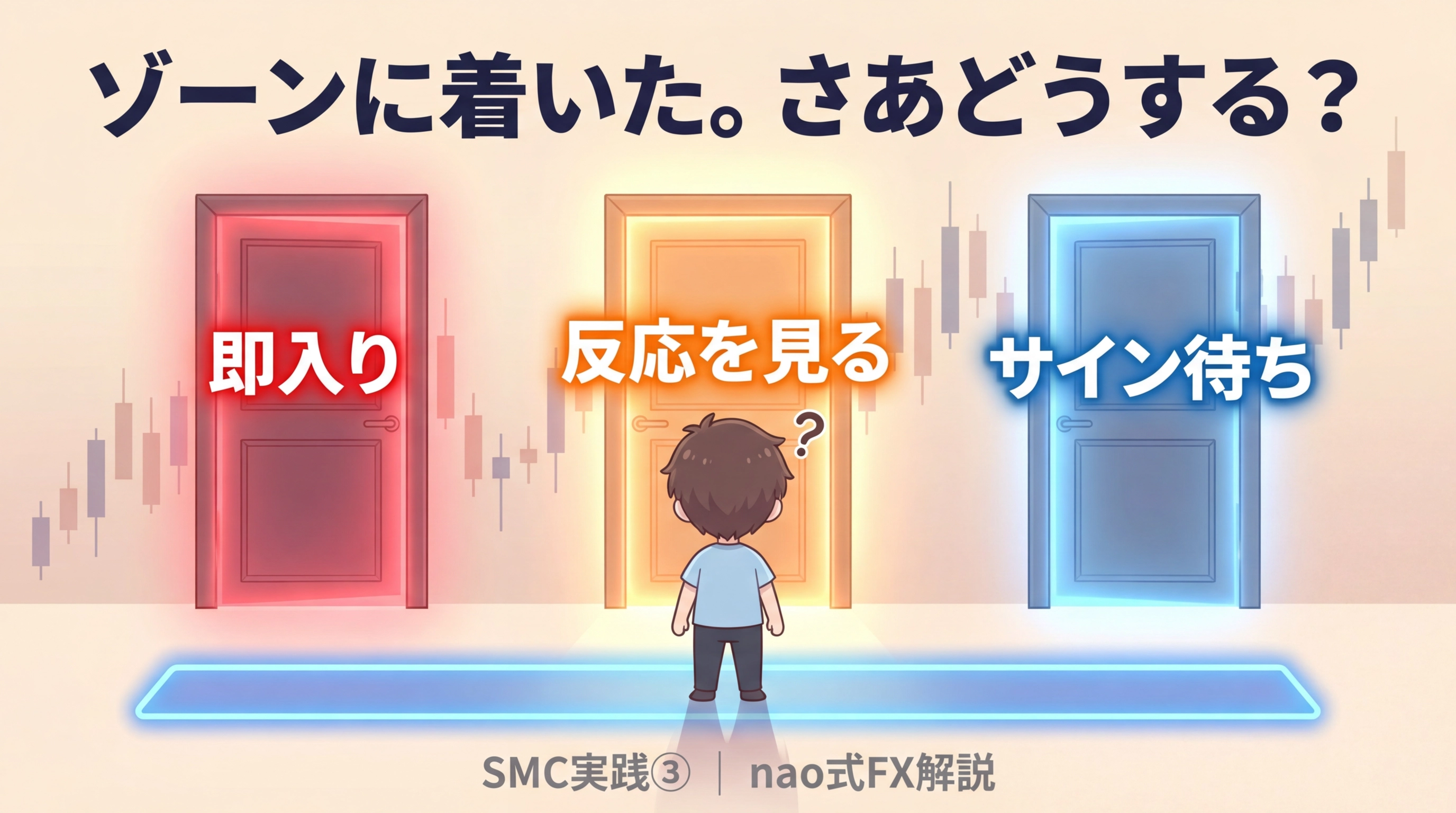
The theme this time is,"What to do after the price comes to the zone".
Entry decision, placement of SL, and a second chance when OB didn’t work. We will cover these three. This article fills in the gap for readers who have a decent grasp of SMC but still don’t know how to actually enter — this article addresses that.
This article consolidates three themes into onerecap. Separate articles have been prepared that explain each theme more clearly and in more detail.
→Vol. 9A: Detailed explanation of three entry methods
→Vol. 9B: Detailed explanation of the Unicorn model
→Vol. 9C: Detailed explanation of the five ways to think about SL
If you want to grasp the overall flow in one go, keep reading. If you want to read each theme in depth, go to A/B/C in the individual articles.
■ OB Rebound Entry
The price reached the OB zone as per the scenario. The real work begins here.
However, arriving at the OB does not automatically mean entry. This was also written in Vol. 7. After reaching the OB,wait for a trigger on the lower time frame. This is the basic approach.
Here, three entry methods are introduced. It isn’t about which one is correct, but rather choosing the one that fits your own style.
●
Risk Entry
The simplest way to enter.Enter when the price touches the OB zone. Do not wait for confirmation on a lower time frame. You might be inclined to say, "But I just said touching OB does not equal entry," and I understand that intuitionw. This method is chosen when you judge the OB to be highly reliable, so it’s not simply "enter because it touched."
The clear benefit isentering at the most favorable price
The clear drawback is that if the zone does not function, you will take a loss as isbecause you are stopped out. It’s common to hit the OB and then pass through it without entering.
There are conditions under which risk entry tends to work well: a highly reliable OB (described later), alignment of the higher-time-frame structure and direction, overlapping OB or FVG across multiple time frames (MTF clusters), and being within the KZ. The more of these conditions that align, the more you can judge that this zone has high reliability. Conversely, if the conditions don’t align, choosing risk entry is close to gambling.
●
Confirmation Entry
After the price enters the OB zone, enter only after confirming a clear reversal signal on the lower time frame, such as CHoCH, BOS, or a engulfing patternbefore entering.
The benefit is that you enter after seeing evidence that the zone is functioning, whichincreases win rate.
The drawback is that waiting for confirmation makes the entry price less favorable. Entering from further away from the zone edge means the entry is farther from the same SL position, worsening the risk-reward. Waiting for CHoCH confirmation on M15 or M5 can mean the price has already moved several hundred pips on GOLD or tens of pips on currency pairs like USD/JPY.
Also, while you wait for confirmation, the price may move and reverse, causing you to miss the entry.
Even so,"confirm before entering" is the safest way to enter. If you are still developing your own style, this is recommended to start with.
●
Nao-style (Price Action → Try-entry → CHoCH Follow-up)
This is a middle ground between Risk Entry and Confirmation Entry. This is the method I actually use.
The idea behind this method isHypothesizing and testing. When a reaction occurs at the zone, you assume "it will reverse from here" and enter. If the hypothesis fails, you withdraw quickly. Thoroughly applying this switch is the premise of the nao style.
There is another ten thousand characters of information beyond this point.