
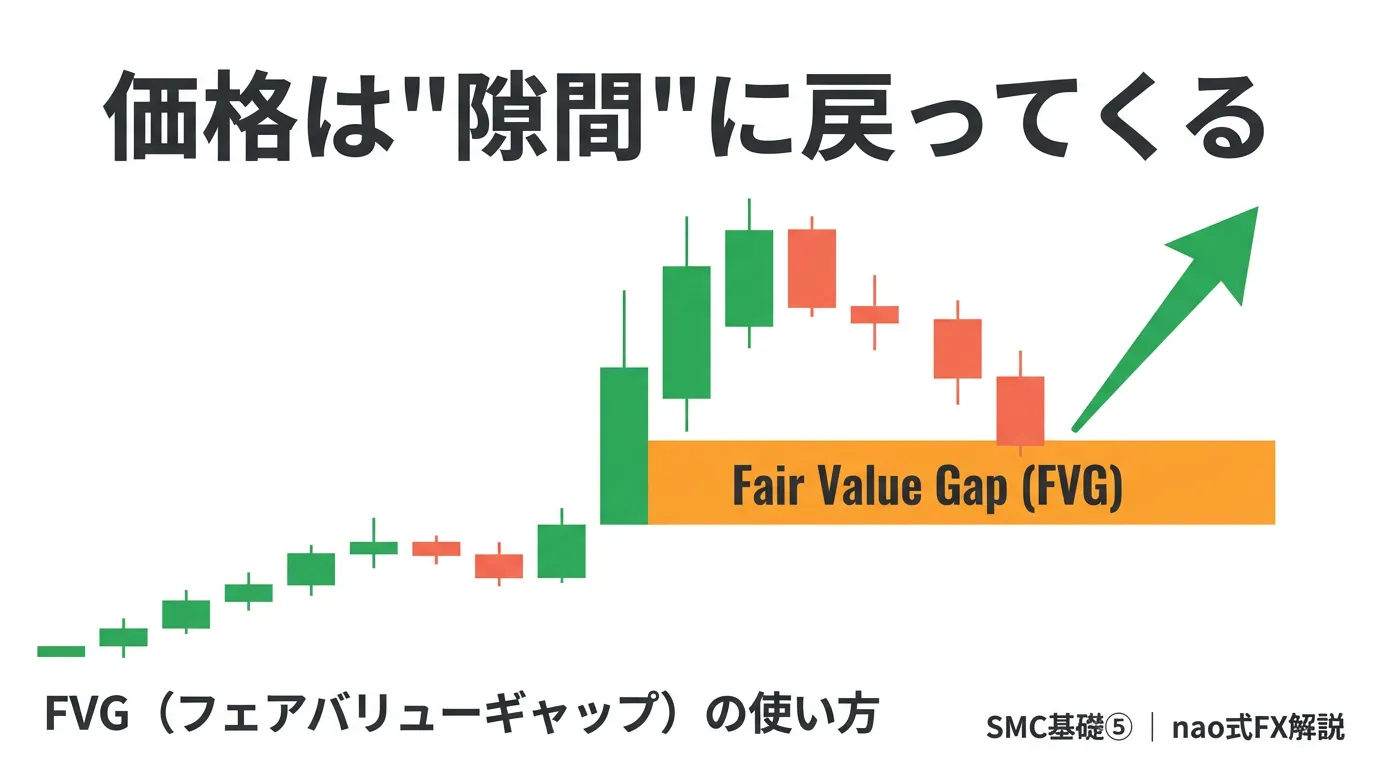
Episode 5: The Reason Prices Return to the "Gap" - How to Use FVG (Fair Value Gap) [SMC Basics ⑤]
Hello,naohere.
Last time we explained Order Block (OB). By identifying where big players placed orders, entry precision for pullbacks and retracements improves.
This time we will cover “FVG(Fair Value Gap)——A concept also known in Japanese as “Fair Value Gap” or “Supply-Demand Gap.”
Along with OB,FVG is one of the most commonly used entry rationales inSMC.
■ FVG(Fair Value Gap)What is it?
FVG refers to the“price gap” that appears when prices move sharply.
Typically, prices move up and down gradually. However, when big news or large orders hit, prices can jump, creating a price range where trades have not been executed:“unfilled price zone”. This is theFVG.
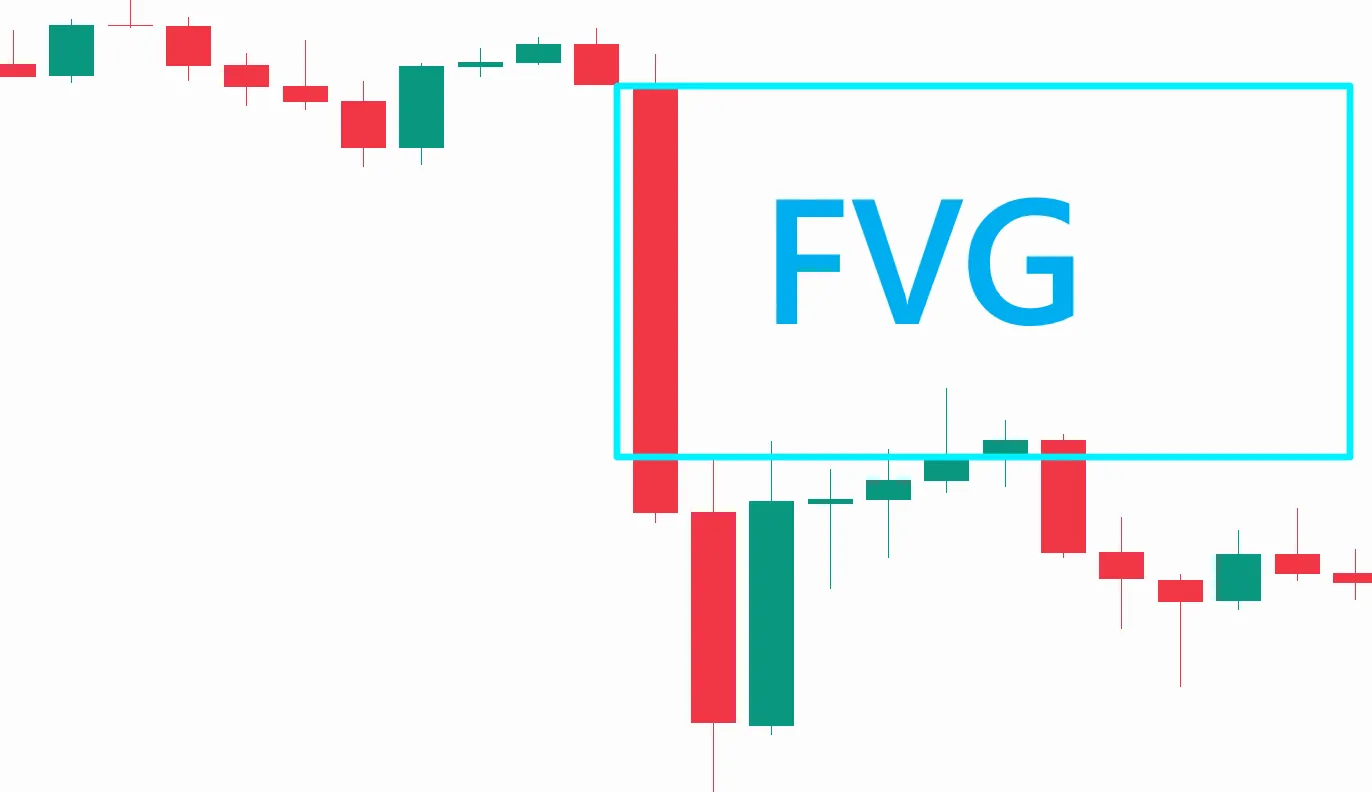
To confirm on the chart, usethe first three candles.
【AscendingFVGConfirmation】
・1High of the first candle (top of upper wick)
・3Low of the first candle (bottom of lower wick)
・There is a price gap between these2points → FVG confirmed
【DescendingFVGConfirmation】
・1Low of the first candle (bottom of lower wick)
・3High of the first candle (top of upper wick)
・There is a price gap between these2points → FVG confirmed
■Why does the price come back to FVG? The phrase “gaps get filled” is well known in stock gap theory,
When a sharp move happens, the price band has not had enough trading.FX also follows a similar principle.
From a big-player perspective,Unmatched orders remain in the “untraded price band,” causing price to be drawn back there.
Furthermore, in the English-speakingSMC community, there is often discussion about “algorithm design.”ICT proposesIPDA(Interbank Price Delivery Algorithm) concept: in the interbank market, algorithms deliver prices efficiently, and they tend to move to fill gaps likeFVG—these price bands have not yet been processed. This is one interpretation widely shared in the English-speaking world, though not proven conclusively.
■ FVGreturning and rejection probability——50% importance of lines
When prices return to an FVG, how far they retrace greatly changes the probability of a rebound.
From my experience, here are some tendencies:
Touching with the wick and the body closes outside the zone→most reliable pattern for a bounce.FVG
Even if the body stays inside the zone, closing below the midpoint (50%)>→still a bounce possibility remains. But next candle movement should be checked carefully.
If the body closes above the midpoint (50%)→In my experience, over 80% of the time it continues to fill fully. If you cross this line, you can judge that the function of FVG is nearly finished.
In the English-speaking world, this midpoint is called CE (Consequent Encroachment).“The wick is OK; if the body crosses CE, it is nearly invalidated” is a common understanding in the SMC community and aligns with my experience.
When using FVG, if you view it as a rebound starting point, the decisive moment is “wick touch to CE and body closes below CE.”CE crossing is weak as a justification.
■EffectiveFVGvs. ineffectiveFVG
FVG can appear all over the chart, but not all function the same way.
【EffectiveFVG】
・Occurs during impulsive (strong price move) conditionsFVG
・OBFVG
・Can be confirmed on higher timeframes (4H・Daily)FVG
・Unfilled (price has not yet returned) FVG
・Aligns with the major market trend directionFVG
【Less effectiveFVG】
・Small FVG formed in range marketsFVG
・Already touched/filled onceFVG
・Can be confirmed only on lower timeframes and is isolatedFVG
・Moves opposite to the trendFVG
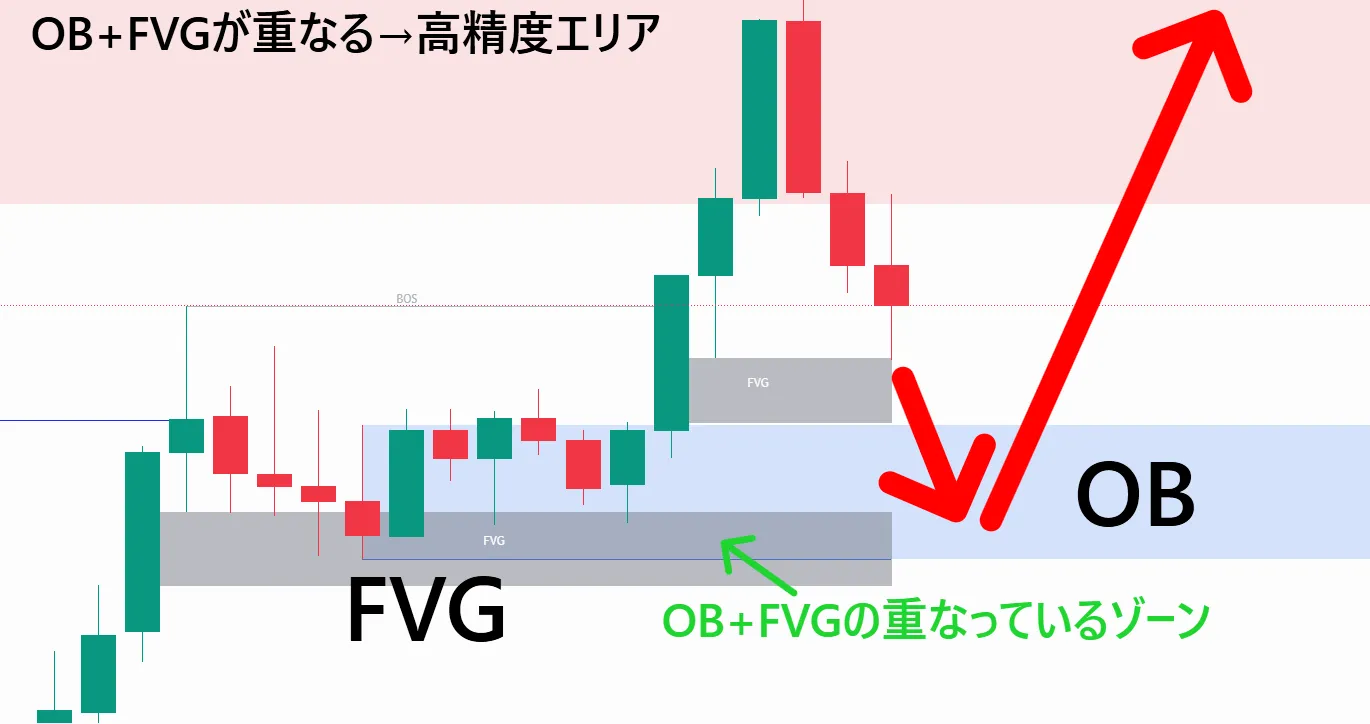
What I particularly emphasize is“Where OB and FVG overlap (converge) in the same area.”This is where big players’ setup locations (OB) and unfilled price bands (FVG) coincide, greatly increasing the reliability of the reaction.
■ OBandFVGPractical combined usage
Putting together the four moves learned so far, the core of SMC entries builds as follows.
①Confirm the major trend direction in Market Structure (first wave)
②BOS/ChopChop (second wave) determine continuation or reversal
③Gauge liquidity and sweep (third wave) to identify where big players target
④OB (fourth wave) +FVG (fifth wave) to pinpoint precise entry zones
Entry illustration:
“On higher timeframes confirmOB→around that area FVG overlaps→on the lower timeframe confirm CHoCH/BOS near the price returning to that zone→entry”
If these logics stack, you won’t decide to enter because it “feels like a bounce.” Instead, you will be able to judge that you are entering because multiple evidences align.
■ naoTruthful opinion:FVGis""
FVGdiffers from OB, being a concept learned after studying SMC. At first I tried just the idea of “gap means reversal,” but often prices moved through it, so I doubted it for a while.
What I learned through practice is thatthe 15-minute and 1-hour timeframes’ FVG entrances work well. And another realization:——FVG if a candle remains within the FVG zone on close, that FVG is likely to be broken out soon.I haven’t numerically proven it, but it’s clearly evident from watching charts for a long time.
Incidentally, in the English-speakingSMC community, this phenomenon is known as “IFVG(Inversion Fair Value Gap),” and the phenomenon exists as a theory. My practical experience later supported this.
So now I don’t say “approach FVG = entry,” but rather“observe how the price reacts when it arrives at an FVG.”If it closes inside on the close, I no longer trust that FVG.
However, overlapping OB with FVG is exceptional.A single FVG’s reaction strength is far weaker. When the OB and the supply-demand gap (FVG) coincide, the reliability surges.A FVG that does not align with OB may be half-believed; the moment OB overlaps, the call changes to “this is the real thing”—that is my current rule.
■Summary: Today’s3Key Points
① FVG (Fair Value Gap) is a price band created by a sharp move where no trades occurred.3Candle gaps confirm it.
②What makes an FVG effective: “occurs within impulse,” “unfilled,” “confirmed on higher timeframes,” and “overlaps with OB.” More criteria increase reliability.
③ OB andFVG overlapping creates the highest-precision reaction zone where big players are set and supply-demand gap align.SMC entries hinge on this.
From next time, building on these basics, I will explain more practical entry methods, timeframe analysis, and the combination withtundereR】.
Basics5 lessons to embed SMC’s map in your mind. The real work starts now. Thank you for continuing!
─────────────────────────
【Author Profile】
─────────────────────────
nao|FX-only trader for 16 years; EA developer
Specializes in GOLD scalping and day trading centered on SMC/ICT.
As I continued trading, I faced the problem of “I can read it correctly, but my mental state shakes,”
so I developed the hybrid tool “tundere【R】” combining discretionary entries with EA automation management.
I provide a system that eliminates the fear of stops and maximizes profits during favorable moves for gold traders.
▶ Details of tundere【R】 here
https://www.gogojungle.co.jp/tools/indicators/71019?via=toppage_recentViewed