

Details of the Japan-U.S. tariff agreement announced! The truth about 80 trillion yen in investments and 15% tariffs: the tariff deal sparked by Trump
Tonight's topic is the “Japan-U.S. Tariff Agreement,” signed on September 5, 2025. On September 5, Minister Akaza signed a memorandum on investment with U.S. Commerce Secretary Raimondo in Washington, and its details were announced around September 10. On social media, opinions range from “Japanese diplomatic victory” to “the return of unequal treaties.” What do you see beyond this buzz? If numbers tire you, relax your shoulders a little and just listen with your ears. Let’s look calmly, without siding with anyone, and with occasional questions as we go along.
? What appears in the agreement document and what doesn’t
Tracing the published documents, there are two main pillars.Tariff handlingandFramework for U.S. investment. Tariffs are fixed at 15%, including automobiles and parts, with no further increases on items where existing rates are 15% or higher. Investment totals 5.5 trillion dollars (about 80 trillion yen).However, what is written in the document and how it is actually implemented on the ground are different matters. Automobiles are symbolic. The drop from 27.5% to 15% may look like a reduction, but if exchange rates and the costs of reconfiguring supply chains accumulate, 15% can still be heavy. How far will price pass-through be tolerated? What about dealer inventory pressures? If you were in the sales field, to what extent would you factor in consumer psychology? Will you “maintain margins even if volumes drop,” or “defend market share even at thin margins”? Behind the numbers lie difficult choices.
? Semiconductors, pharmaceuticals, aviation, rice imports, and civil aircraft
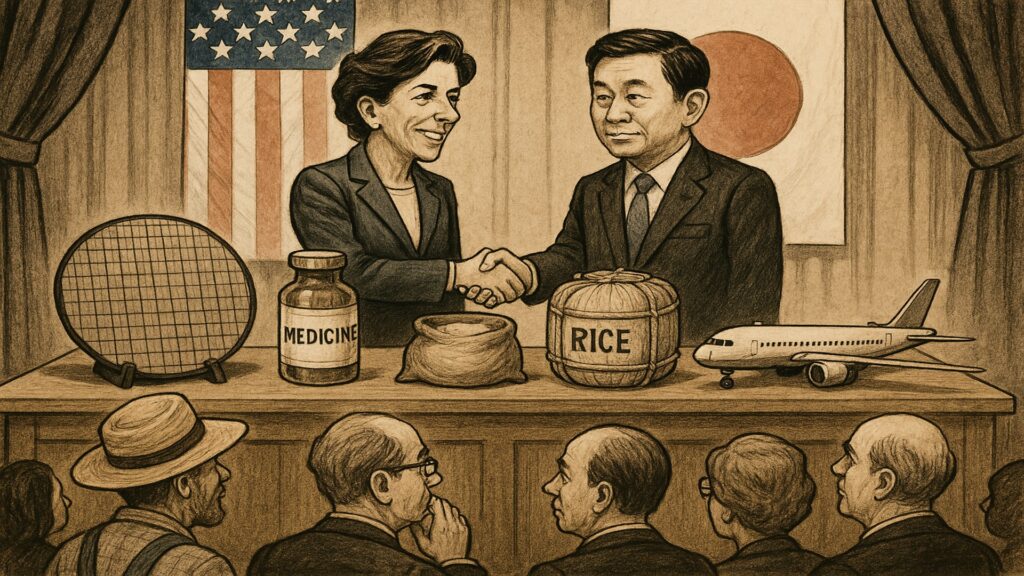
Semiconductors and pharmaceuticals are areas where international competitiveness and supply-security concerns intertwine. They are treated to avoid being disadvantaged by MFN status, and aircraft and parts are explicitly covered as duty-free. Expanding imports of U.S. rice, orders for civil aircraft—these headlines are flashy, but many measures operate within existing plans and minimum access quotas. The outward “increase” may look like a real rise, but in practice it could be pre-arranged or bundled. In JA’s field, people focus on price and demand-supply fluctuations, and airlines are also planning purchase scales.
? The source of 80 trillion yen: private investment and policy finance as the main players
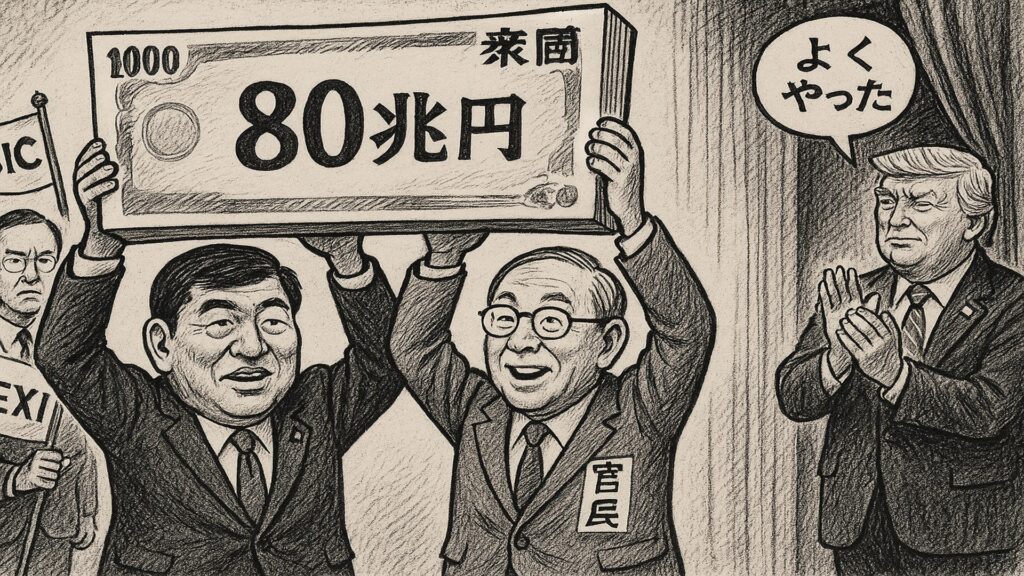
The figure of “80 trillion yen” is heavy, isn’t it? Yet its substance isprivate investment, policy finance, and existing budgets. In other words, rather than a large new injection of public funds, it is a re-tackling of already underway investments, changing the overall appearance from the original proposal. Japanese companies’ investments in the U.S. over the past several years are substantial. Electrification of autos, relocation of semiconductors, expansion of energy and data centers, and so on—the list of projects goes on. The role of policy finance is to help private sector take that first step. JBIC loans and NEXI insurance support U.S. investments. How much public involvement do you think is healthy?
? Reading tax revenue increases: will tariffs become a source of fiscal revenue
If a broad 15% is applied, U.S. tariff revenues will certainly rise. But some of that will be passed back to consumers through higher prices. Households bear higher import prices, and businesses struggle between procurement costs and sales. The overall economic impact cannot be explained by tariff revenue alone. Will it be a source of funds, or an inconspicuous tax?invisible tax. Consider this alongside your own lived experience. If tariffs reduce import volumes, the apparent trade deficit shrinks. On the other hand, if domestic production increases, the “hidden flows” such asdividends, interest, and intangible asset royalties shift and another component of the balance of payments grows. Even if a table looks good, realities on the ground can still offset it. Could there be a future where numbers shrink but people’s experiences stay the same?
? The fate of the “uniform 15%” scenario and Japan’s competitiveness
A scenario where the EU, Japan, and others are all at 15%, with other regions within a 10–20% band, is realistic as a compromise. However, exceptions like USMCA and geopolitical considerations could still lead to a different approach, such as applying different rates to China. If there were a “loophole 15%,” the competitive conditions would be entirely different. If Japan shares the same conditions as the EU, it would be easier to leverage its traditional strengths.Case A: Other countries receive under 5% preferential treatment…Japan’s relative disadvantage. A scenario where price competition is avoided and added value and after-sales service are used to protect market position.
? A wavering assessment? Victory or a price paid, or somewhere in between
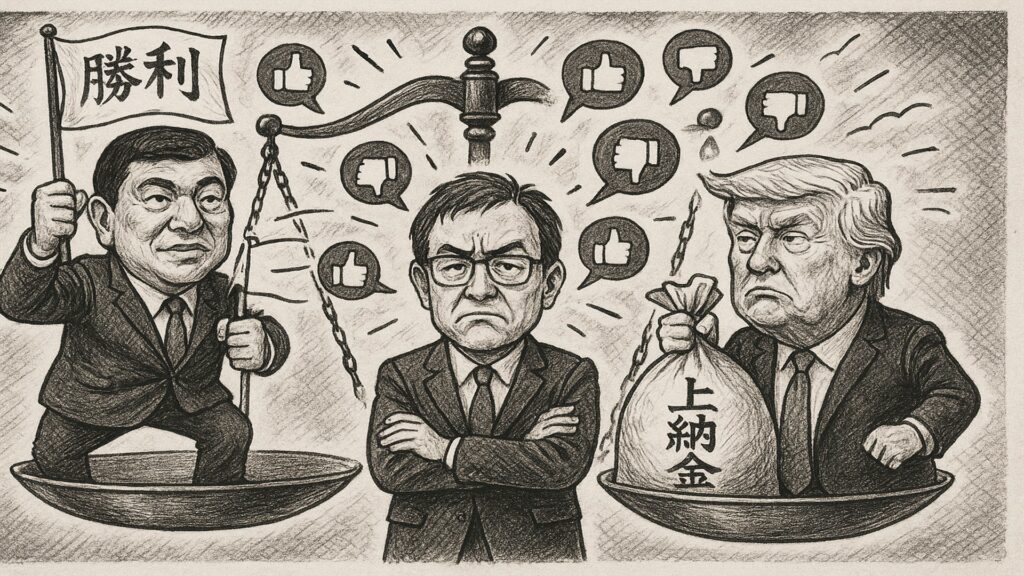
On social media, some call the 15% restraint a diplomatic victory, while others doubt it as an actual price paid. Both views mix evidence and sentiment. The important thing is to recognize from whose perspective you are looking.Whose perspective do you consider? Exports-focused firms, farmers, consumers, or the fiscal authorities. The joint committee oversees investment project selection and monitoring. What is asked here istransparencyandaccountability. Which projects were selected and according to what criteria? How much employment or external effects are expected? Terms like “historic agreement” or “defense of national interests” sound impressive, but it is common for ordinary people's lived experience to lag behind. 15% is by no means light. How will the economy unfold going forward? Small and medium-sized enterprises will feel it gradually.
? Beyond a simple yes or no: victory or price paid, and moving past that binary
The U.S.-Japan tariff agreement lowers the 25% barrier to 15% and presents a plan to “bundle existing plans” under an 80 trillion yen investment—this is one way to read it. But we should pause to ensure that this sense of relief is not numbing us to the Trump theater. After all, the basic U.S. tariff on passenger cars is 2.5%, so 15% is effectively an increase, and the visibility of U.S. investments, utilization of minimum access, and orders for civil aircraft and defense equipment have precedence, which is the natural result of pre-timing and bundling. Even so, if there is a mood of relief, it is healthy to reassess whether the performance is a crafted display. A different administration could have achieved a 10% or other outcome—this hypothesis is worth keeping.10% or other outcomes could have been possibleThis remains a valuable line of inquiry for our world.
Practice and verify freely with a completely risk-free trade simulator!
Details page for One-Click FX Training MAX