
"Is spring coming to Japanese stocks and the Japanese economy? U.S. financial analysts deliver bullish forecast"

At the end of July, Prime Minister Abe announced an economic stimulus package totaling 28 trillion yen. Excluding the Lehman Brothers collapse era of 2008–2009, this was the largest in the past 23 years. Regarding this economic measure, Naoki Shinohara, former Finance official and former IMF deputy managing director, offered the following remarks in a Bloomberg article dated July 31, describing a startling truth.
“If you look at the history of the Japanese economy, many economic measures have been repeated, but ultimately they did not have a significant impact on potential growth.”
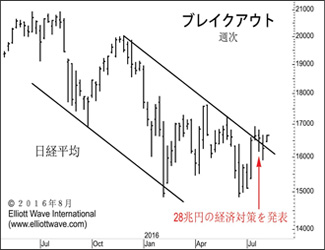
While many investors debated the effectiveness of this stimulus, Elliott Wave International (EWI), a financial research firm based in the suburbs of Atlanta, USA, proposed a completely different view. EWI does not predict the success or failure of this package; rather, the timing of the announcement itself is seen as a manifestation of market sentiment and as strong evidence supporting EWI's forecast for the Nikkei average.
According to EWI's global financial market survey, government economic measures are often announced when a major equity market adjustment period is nearing its end, in response to excessive market anxiety.
The additional stimulus under the Abe administration was announced a few weeks after the Nikkei index finished its “downward adjustment phase,” and the timing also coincided with the Nikkei breaking above the resistance line of the downward trend channel that had included the past year's decline.
In other words, it is reasonable to view the July-end announcement by the Japanese government as being triggered by the panic caused by Japan's stock decline in June 2016.
As one piece of evidence supporting how severe that panic was, the May–June short-selling ratio on the Tokyo Stock Exchange reached 47% of daily trading value. This surpassed the highest levels recorded in the world's major financial markets.
During large-scale adjustments, not only stock traders become pessimistic. Journalists, corporate executives, and scholars all fall into a pessimistic mood and call for government measures. And weeks later, government responses are announced. The July 27 economic stimulus announcement is a typical example of such behavior.
Based on this situation, unlike short sellers on the TSE, EWI analysts hold an extremely optimistic outlook for the Japanese economy and Japanese stocks. However, this optimism does not come from trusting Japan's politics or the Bank of Japan's monetary policy.
EWI analysts are convinced of the effectiveness of a series of patterns seen in market price trends, based on the Elliott Wave Principle discovered by Ralph Nelson Elliott decades ago. They view the current economic stimulus announcement as just another example supporting this conviction.
Elliott Wave International (EWI)

Elliott Wave International (EWI) is the world's largest independent research firm specializing in technical analysis. Since its founding by Robert Prechter in 1979, it has analyzed major global financial indices around the clock and has received numerous awards across various publications. For more information, please visit our website at www.elliottwave.com. If you would like to learn more about the background behind EWI analysts’ bullish outlook on Japanese stocks and the Japanese economy, as well as the Elliott Wave Principle, please subscribe to“The Special Report on Elliott Waves! ‘Spring Comes to Japan’ ~ Alignment of Elliott Waves and Kondratieff Cycles ~”.
× ![]()