【FX】What is window opening and window closing?
1. What is a “gap” (window) in Forex?
One of the terms in FX is “gap” (window), which basically refers to the gap in the candlesticks that appears at the beginning of the week compared to the previous week’s candlestick.
...Although this may be hard to understand, let’s actually look at a chart with a gap.
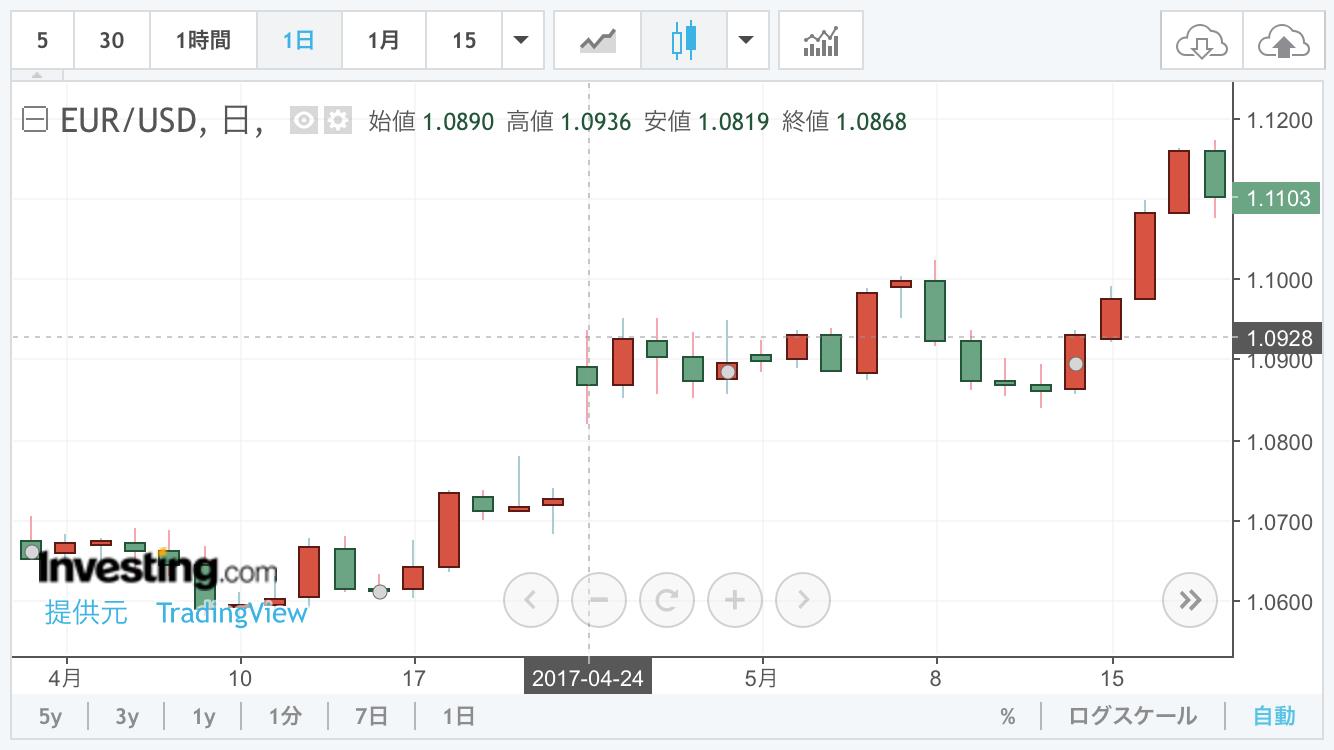
EUR/USD daily chart. From the settlement on April 21, 2017 to the opening on April 24 after a weekend, the price shows a large divergence. This is what is commonly called a “gap opening.”
2. Why do gaps open?
Even though the market should have been closed, why do gaps like this occur? There are several reasons.
a. Trading in the Islamic world.
In some Islamic countries, Saturday and Sunday are not holidays, and markets are open, so prices can move even over the weekend due to trades there.
b. Special hours
I’m not fully sure, but in some banks, orders can be accepted even on holidays. It seems quite large orders can come in.
c. Open in Wellington (New Zealand)
Before 6–7 a.m. when we look at the opening price, the Wellington market in New Zealand starts weekly trading earlier. Since trading there can move prices, this is another reason gaps occur.
These are the main factors cited for gaps.
One note: trades made for these reasons tend to have low volume and generally cannot significantly influence price movements. In other words, as in the Euro/US dollar chart I posted earlier, even on a daily chart, a noticeable gap is only possible if the players’ actions align to a large extent. Specifically, when new material (news) comes out on the weekend, or when the trend is very clear. These are the two points.
3. What is “gap filling”?
Next is gap filling. Gap filling means that the candlestick created at the start of the week fills in the gap created earlier... but it’s easier to understand by looking at a chart, so I’ve included one.
From the settlement on April 21, 2017 to the opening on April 24 after a weekend, the price shows a large divergence. This is what is commonly called a “gap opening.”
2. Why do gaps open?
Even though the market should have been closed, why do gaps like this occur? There are several reasons.
a. Trading in the Islamic world.
In some Islamic countries, Saturday and Sunday are not holidays, and markets are open, so prices can move even over the weekend due to trades there.
b. Special hours
I’m not fully sure, but in some banks, orders can be accepted even on holidays. It seems quite large orders can come in.
c. Open in Wellington (New Zealand)
Before 6–7 a.m. when we look at the opening price, the Wellington market in New Zealand starts weekly trading earlier. Since trading there can move prices, this is another reason gaps occur.
These are the main factors cited for gaps.
One note: trades made for these reasons tend to have low volume and generally cannot significantly influence price movements. In other words, as in the Euro/US dollar chart I posted earlier, even on a daily chart, a noticeable gap is only possible if the players’ actions align to a large extent. Specifically, when new material (news) comes out on the weekend, or when the trend is very clear. These are the two points.
3. What is “gap filling”?
Next is gap filling. Gap filling means that the candlestick created at the start of the week fills in the gap created earlier... but it’s easier to understand by looking at a chart, so I’ve included one. USD/JPY 15-minute chart.
On Monday, January 21, at the 5:00 a.m. opening, you can see a gap relative to the previous week’s close. From there, the price moves to fill that gap (the space between last week’s close and this week’s open). This is the phenomenon called “gap filling.”
There is a well-known market adage that “there is no gap that cannot be filled,” which reflects that gaps tend to fill with high probability for two main reasons:
a. Early morning ranges are common, so small gaps tend to fill within that range.
b. It’s a well-known phenomenon, widely recognized by traders (indeed it is almost universally anticipated)
4. Summary so far.
Basically, gaps occur somewhat because of weekend and early-morning trading, and since trading happens, price movement is inevitable. In most cases, gaps don’t carry substantial meaning and are quickly filled.
However, gaps can provide useful hints for trading. Below, I’ll describe the popular “gap filling strategy” among traders or how to form trading plans around gaps.
5. About gap filling methods.
First, to be upfront, chasing small gap fills on the first thing in the morning as shown in the USD/JPY chart is not realistic. Those who look at the morning chart know that spreads are wide early and liquidity is low, leading to highly unstable price movements.
So, a gap-filling method typically requires conditions such as “the gap is reasonably wide open” and “the gap has not been filled yet by the Asia open.”
Now, let’s look at concrete examples.
USD/JPY 1-hour chart.
USD/JPY 15-minute chart.
On Monday, January 21, at the 5:00 a.m. opening, you can see a gap relative to the previous week’s close. From there, the price moves to fill that gap (the space between last week’s close and this week’s open). This is the phenomenon called “gap filling.”
There is a well-known market adage that “there is no gap that cannot be filled,” which reflects that gaps tend to fill with high probability for two main reasons:
a. Early morning ranges are common, so small gaps tend to fill within that range.
b. It’s a well-known phenomenon, widely recognized by traders (indeed it is almost universally anticipated)
4. Summary so far.
Basically, gaps occur somewhat because of weekend and early-morning trading, and since trading happens, price movement is inevitable. In most cases, gaps don’t carry substantial meaning and are quickly filled.
However, gaps can provide useful hints for trading. Below, I’ll describe the popular “gap filling strategy” among traders or how to form trading plans around gaps.
5. About gap filling methods.
First, to be upfront, chasing small gap fills on the first thing in the morning as shown in the USD/JPY chart is not realistic. Those who look at the morning chart know that spreads are wide early and liquidity is low, leading to highly unstable price movements.
So, a gap-filling method typically requires conditions such as “the gap is reasonably wide open” and “the gap has not been filled yet by the Asia open.”
Now, let’s look at concrete examples.
USD/JPY 1-hour chart. From the close on December 1 to the start on December 3, a relatively large gap opens, and then the gap cannot be filled, and prices rise away from the gap for a while.
The reason for this movement was probably news related to the US-China trade war early Monday morning, but that is precisely the kind of moment when one might trade with the view that the gap could fill.
As noted earlier, nearly all traders are aware of gaps, so it’s difficult to open new positions away from the gap; news related to the US-China trade war often leads to all-reversals. Also, in this moment, USD/JPY was not in an uptrend but in a high-range near resistance around 113.8 (what the resistance is, I’ve forgotten), so buying on news that temporarily paused near that resistance allowed for a contrarian trade and profit.
In this way, using gaps as part of the trading reasoning is what gap-filling trading is about.
A caution: I exited at the point where the gap filled, but generally the subsequent movement after a gap fills is unpredictable. In this chart, after filling the gap and a pullback, there was another drop, but that is not always the case. It depends on the moment.
6. Gap-filling method, failure case.
Let me show the Euro/US dollar chart again.
From the close on December 1 to the start on December 3, a relatively large gap opens, and then the gap cannot be filled, and prices rise away from the gap for a while.
The reason for this movement was probably news related to the US-China trade war early Monday morning, but that is precisely the kind of moment when one might trade with the view that the gap could fill.
As noted earlier, nearly all traders are aware of gaps, so it’s difficult to open new positions away from the gap; news related to the US-China trade war often leads to all-reversals. Also, in this moment, USD/JPY was not in an uptrend but in a high-range near resistance around 113.8 (what the resistance is, I’ve forgotten), so buying on news that temporarily paused near that resistance allowed for a contrarian trade and profit.
In this way, using gaps as part of the trading reasoning is what gap-filling trading is about.
A caution: I exited at the point where the gap filled, but generally the subsequent movement after a gap fills is unpredictable. In this chart, after filling the gap and a pullback, there was another drop, but that is not always the case. It depends on the moment.
6. Gap-filling method, failure case.
Let me show the Euro/US dollar chart again. This is a pattern where the gap did not fill. Well, the gap is about 200 pips wide, so it’s understandable that it could not fill. Even now, more than a year later, that gap remains unfilled, and if someone had attempted gap filling here and failed to place an appropriate stop, it could have been a big loss.
Gaps that are too large are best left alone. Also, use proper stop-losses.
7. Do gaps become support or resistance?
I read somewhere that gaps become support/resistance, but my view is: isn’t it just the weekly close and open being watched anyway?
Of course, there are traders who have achieved results far beyond mine, so I won’t argue, but this is my own view.
Anyway, both interpretations are roughly similar in meaning, so I think gaps tend to be observed.
8. Gaps are a limited-type technique.
Gaps occur mainly after holidays and under limited conditions where they are strongly anticipated, so I personally view them as “lucky if they open well.” Repeating: I don’t recommend chasing small gap fills in the early morning. If it’s 10 pips or more, you might consider it, but early-morning spreads can hurt.
9. Summary
a. Gaps are caused by weekend and early-morning trading.
b. Gaps do fill with high probability, but relying on them too much and being caught in a margin call or being stuck can be dangerous, so keep in mind that “they may not fill.”
c. Gap-based methods are very limited but powerful. Even GFF (the trader with assets up to 600 million) reportedly used gap filling as their main method.
This article focused on the concept of “gaps” in FX.
Gaps can be surprisingly deep, so I hope you study them and apply them to actual trading.評判・メリット・デメリット of Money Partners FX
Invast Securities TriAuto FX魅力
What is the Sakata Gohō (technical analysis) of the Edo period?
What are the merits and how to open a Monex FX account?
This is a pattern where the gap did not fill. Well, the gap is about 200 pips wide, so it’s understandable that it could not fill. Even now, more than a year later, that gap remains unfilled, and if someone had attempted gap filling here and failed to place an appropriate stop, it could have been a big loss.
Gaps that are too large are best left alone. Also, use proper stop-losses.
7. Do gaps become support or resistance?
I read somewhere that gaps become support/resistance, but my view is: isn’t it just the weekly close and open being watched anyway?
Of course, there are traders who have achieved results far beyond mine, so I won’t argue, but this is my own view.
Anyway, both interpretations are roughly similar in meaning, so I think gaps tend to be observed.
8. Gaps are a limited-type technique.
Gaps occur mainly after holidays and under limited conditions where they are strongly anticipated, so I personally view them as “lucky if they open well.” Repeating: I don’t recommend chasing small gap fills in the early morning. If it’s 10 pips or more, you might consider it, but early-morning spreads can hurt.
9. Summary
a. Gaps are caused by weekend and early-morning trading.
b. Gaps do fill with high probability, but relying on them too much and being caught in a margin call or being stuck can be dangerous, so keep in mind that “they may not fill.”
c. Gap-based methods are very limited but powerful. Even GFF (the trader with assets up to 600 million) reportedly used gap filling as their main method.
This article focused on the concept of “gaps” in FX.
Gaps can be surprisingly deep, so I hope you study them and apply them to actual trading.評判・メリット・デメリット of Money Partners FX
Invast Securities TriAuto FX魅力
What is the Sakata Gohō (technical analysis) of the Edo period?
What are the merits and how to open a Monex FX account?
From the settlement on April 21, 2017 to the opening on April 24 after a weekend, the price shows a large divergence. This is what is commonly called a “gap opening.”
2. Why do gaps open?
Even though the market should have been closed, why do gaps like this occur? There are several reasons.
a. Trading in the Islamic world.
In some Islamic countries, Saturday and Sunday are not holidays, and markets are open, so prices can move even over the weekend due to trades there.
b. Special hours
I’m not fully sure, but in some banks, orders can be accepted even on holidays. It seems quite large orders can come in.
c. Open in Wellington (New Zealand)
Before 6–7 a.m. when we look at the opening price, the Wellington market in New Zealand starts weekly trading earlier. Since trading there can move prices, this is another reason gaps occur.
These are the main factors cited for gaps.
One note: trades made for these reasons tend to have low volume and generally cannot significantly influence price movements. In other words, as in the Euro/US dollar chart I posted earlier, even on a daily chart, a noticeable gap is only possible if the players’ actions align to a large extent. Specifically, when new material (news) comes out on the weekend, or when the trend is very clear. These are the two points.
3. What is “gap filling”?
Next is gap filling. Gap filling means that the candlestick created at the start of the week fills in the gap created earlier... but it’s easier to understand by looking at a chart, so I’ve included one.USD/JPY 15-minute chart.
On Monday, January 21, at the 5:00 a.m. opening, you can see a gap relative to the previous week’s close. From there, the price moves to fill that gap (the space between last week’s close and this week’s open). This is the phenomenon called “gap filling.”
There is a well-known market adage that “there is no gap that cannot be filled,” which reflects that gaps tend to fill with high probability for two main reasons:
a. Early morning ranges are common, so small gaps tend to fill within that range.
b. It’s a well-known phenomenon, widely recognized by traders (indeed it is almost universally anticipated)
4. Summary so far.
Basically, gaps occur somewhat because of weekend and early-morning trading, and since trading happens, price movement is inevitable. In most cases, gaps don’t carry substantial meaning and are quickly filled.
However, gaps can provide useful hints for trading. Below, I’ll describe the popular “gap filling strategy” among traders or how to form trading plans around gaps.
5. About gap filling methods.
First, to be upfront, chasing small gap fills on the first thing in the morning as shown in the USD/JPY chart is not realistic. Those who look at the morning chart know that spreads are wide early and liquidity is low, leading to highly unstable price movements.
So, a gap-filling method typically requires conditions such as “the gap is reasonably wide open” and “the gap has not been filled yet by the Asia open.”
Now, let’s look at concrete examples.
USD/JPY 1-hour chart.From the close on December 1 to the start on December 3, a relatively large gap opens, and then the gap cannot be filled, and prices rise away from the gap for a while.
The reason for this movement was probably news related to the US-China trade war early Monday morning, but that is precisely the kind of moment when one might trade with the view that the gap could fill.
As noted earlier, nearly all traders are aware of gaps, so it’s difficult to open new positions away from the gap; news related to the US-China trade war often leads to all-reversals. Also, in this moment, USD/JPY was not in an uptrend but in a high-range near resistance around 113.8 (what the resistance is, I’ve forgotten), so buying on news that temporarily paused near that resistance allowed for a contrarian trade and profit.
In this way, using gaps as part of the trading reasoning is what gap-filling trading is about.
A caution: I exited at the point where the gap filled, but generally the subsequent movement after a gap fills is unpredictable. In this chart, after filling the gap and a pullback, there was another drop, but that is not always the case. It depends on the moment.
6. Gap-filling method, failure case.
Let me show the Euro/US dollar chart again.This is a pattern where the gap did not fill. Well, the gap is about 200 pips wide, so it’s understandable that it could not fill. Even now, more than a year later, that gap remains unfilled, and if someone had attempted gap filling here and failed to place an appropriate stop, it could have been a big loss.
Gaps that are too large are best left alone. Also, use proper stop-losses.
7. Do gaps become support or resistance?
I read somewhere that gaps become support/resistance, but my view is: isn’t it just the weekly close and open being watched anyway?
Of course, there are traders who have achieved results far beyond mine, so I won’t argue, but this is my own view.
Anyway, both interpretations are roughly similar in meaning, so I think gaps tend to be observed.
8. Gaps are a limited-type technique.
Gaps occur mainly after holidays and under limited conditions where they are strongly anticipated, so I personally view them as “lucky if they open well.” Repeating: I don’t recommend chasing small gap fills in the early morning. If it’s 10 pips or more, you might consider it, but early-morning spreads can hurt.
9. Summary
a. Gaps are caused by weekend and early-morning trading.
b. Gaps do fill with high probability, but relying on them too much and being caught in a margin call or being stuck can be dangerous, so keep in mind that “they may not fill.”
c. Gap-based methods are very limited but powerful. Even GFF (the trader with assets up to 600 million) reportedly used gap filling as their main method.
This article focused on the concept of “gaps” in FX.
Gaps can be surprisingly deep, so I hope you study them and apply them to actual trading.評判・メリット・デメリット of Money Partners FX
Invast Securities TriAuto FX魅力
What is the Sakata Gohō (technical analysis) of the Edo period?
What are the merits and how to open a Monex FX account?(Please rewrite this section for public viewing)
× ![]()