

Binary 1-minute chart & Scalper Catch The Wave Indicator
Hello!
I am Satori, researching Binary Options & FX.
It has been a while since my last article.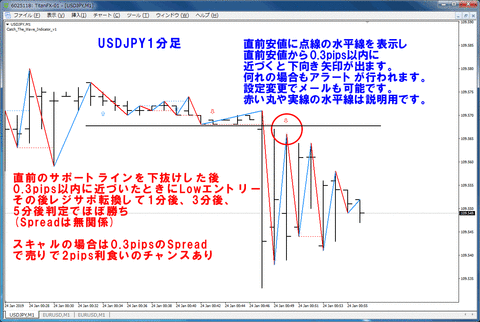
http://livedoor.blogimg.jp/fxmt4indicator/imgs/5/3/531836e7.gif
The figure above shows a Low-entry chart image of USDJPY on a 1-minute chart displaying the Catch The Wave indicator.
This is an entry example using support/resistance reversal.
Actually, since this year I decided to incorporate Binary Options research with the aim of enabling efficient operation after returning home or in 2–3 free hours, keeping that in mind.
If you had to stay glued to charts all day or constantly worry about positions, it would not be psychologically or physically favorable.
In such circumstances, I decided to practically study binary options and scalping, which deliver positive or negative results in a short time, starting this year.
I have finally begun focusing on entries that occur with a higher frequency so that statistical data can be readily utilized.
The advantage of binary options is that losses are limited and you don’t need to worry about spreads when trading High/Low where you predict whether the rate will rise or fall.
The downside is that judging times are fixed (e.g., 1 minute, 5 minutes), so you must be cautious with entries.
Nevertheless, since you also need to seek entry points with a certain level of frequency, I created an ultra-high-sensitivity indicator that traces highs and lows with high precision.
That is, “Binary 1-minute & Scalping Catch The Wave Indicator.”
http://fxmt4indicator.abproducts.biz/wp/?page_id=3128
Going forward, I plan to primarily test using the Catch The Wave indicator and time-space concepts, and incorporate the parts that can be applied to the EA and indicators I have developed so far.
Here I will explain the main features of the Catch The Wave indicator.
【Main features of Catch The Wave Indicator】
・Based on Dow Theory
・Automatically draws non-repainting lines by marking higher highs and higher lows
・Optimized for 1-minute charts but displays on all timeframes up to monthly
・Ultra-high-sensitivity setting where highs and lows reverse by 0.1 pips (sensitivity can be adjusted)
・When it surpasses a previous high, it draws a blue dashed non-repainting horizontal line and alerts (Break-Up Point)
・When it surpasses a previous high, it automatically draws a non-repainting low trend line if conditions are met (N-up)
・When it falls below a previous low, it draws a red dashed non-repainting horizontal line and alerts (Break-Down Point)
・When it falls below a previous low, it automatically draws a non-repainting high trend line if conditions are met (N-down)
・When it crosses above the previous high and approaches within 0.3 pips, it shows a non-repainting blue upward arrow and alert
(Resistance/Support reversal point)
・When it falls below the previous low and approaches within 0.3 pips, it shows a non-repainting red downward arrow and alert
(Support/Resistance reversal point)
・Alerts via email can be sent together with arrow display by changing settings
・Dotted horizontal lines at high/low breakouts and solid trend lines near resistance/support reversal points do not repaint
YouTube video: Overview of Catch The Wave
As you can see, the Catch The Wave indicator is based on Dow Theory, simple, and focuses on essential functions.
And because it yields frequent results, it is easy to obtain statistical results from test training on a demo account, or with small amounts such as 100 yen, 1000 yen, or 1000 currency units, and by improving this, I believe it can become more practical.
In other words, you must confirm profitability on a demo account before proceeding to real trading.
Catch The Wave Indicator is a crucial tool to help find entry rationale from a Dow Theory perspective; I would be grateful if you consider it.
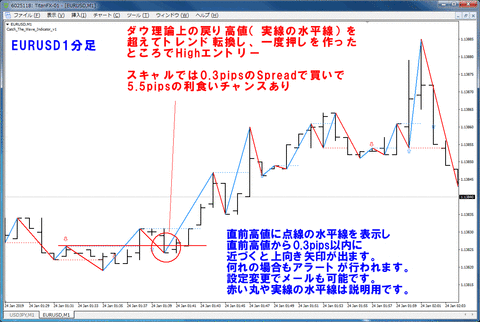
The figure below is a High-entry chart image of EURUSD on a 1-minute chart displaying Catch The Wave Indicator.
http://livedoor.blogimg.jp/fxmt4indicator/imgs/5/6/563efef2.gif
In the USDJPY chart at the top, it was an example of resistance/support reversal, while in the above figure it is an entry example using a Dow Theory-based rising trend reversal.
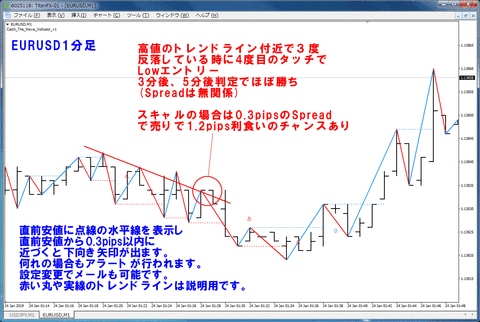
The figure below shows an entry example on EURUSD 1-minute chart using a high trendline for highs.
http://livedoor.blogimg.jp/fxmt4indicator/imgs/7/c/7cbb486a.gif
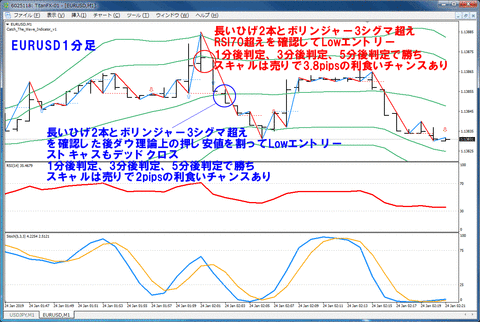
The next image shows a Low-entry example confirmed by a long upper wick near the high, Bollinger Bands, RSI, Stochastics, and a downward trend reversal.
http://livedoor.blogimg.jp/fxmt4indicator/imgs/9/e/9e25a1a9.gif
In binary options, even starting with around 40% win rate, improvement to 65–70% win rate makes the path clearer.
In scalping, with tight targets like 2 pips profit and 2 pips stop, starting around 40% win rate and improving to 65–70% is likewise feasible.
Finally, with binary options and scalping, do not trade strictly by signals; instead, continually assess signals and the conditions of highs and lows, accumulate experience, verify on a demo or small-scale investment, and then proceed to real trading.
The indicators used today are as follows:
********************************************************************
Notifications via signal arrows, email, and alerts!
*********************************************************************
Thank you very much for reading up to here today.
Technic al Trade Blog Ranking
Note: Please register for the free newsletter “Binary & FX Research” at the URL below.