

About government agencies' closures and their impacts
The government shutdown persists as budget measures fail to be approved between President Trump and the Democratic Party. Perhaps we’ve grown accustomed to it recently, and with other high-profile events like the UK Brexit vote, attention has shifted, but the risk is that attention on this has lessened. However, the shutdown period has become the longest on record. As the shutdown prolongs, it is likely to attract renewed attention.
◎ What a partial government shutdown means
When the budget bill cannot be agreed upon and its deadline passes, national facilities and government agencies shut down due to lack of funding. However, not all agencies close; actions deemed essential to federal operations remain open.
Even for those deemed essential, only the minimum necessary staff work. For example, baggage screening at airports is done with a minimal workforce. Because only a few lanes are open, there is severe congestion. This congestion slows baggage screening and causes flight departures to be delayed.
There is a site that collects other impacts, which I have borrowed and posted here.
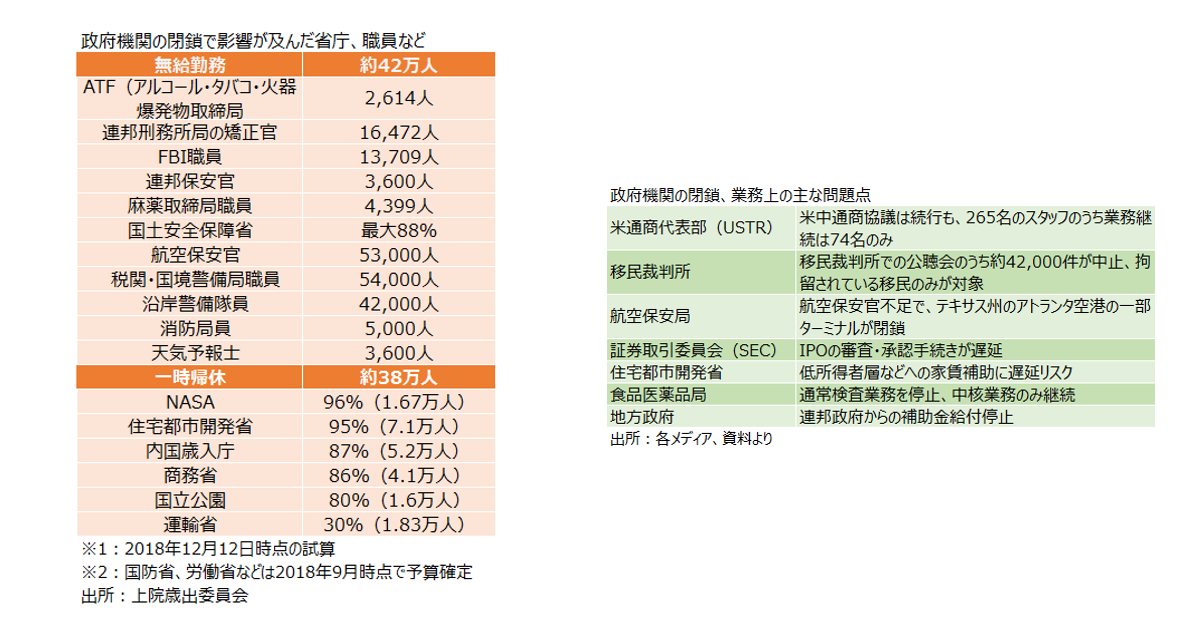
※ Refer to Agora Institute
◎ Impacts on some government agencies
We considered how government agency shutdowns affect various areas.
1) Economic impact
With civil servants off work, regions that house many government offices become empty. Local restaurants and shops suffer. National parks and tourist attractions are closed, and delays in flights and public transportation raise concerns, leading to a sharp drop in tourism.
Also, since the on-leave staff are not receiving pay, they are unlikely to overspend. As a result, economic activity stalls.
The extent of the impact varies by estimates, butThe White House estimates a 0.1 percentage point downgrade in growth in two weeks, and some economists estimate a 0.1%–0.2% downgrade in growth in one week.
2) Impact on ordinary citizens
Economic activity stagnates,reducing income for those in service and tourism industries. In addition, public transportation and airports become less convenient. Furthermore, since food inspection agencies are shut down, 80% of食品 inspections may be unavailable, and environmental testing may be halted, increasing the risks of food poisoning and disease.
Also, there is something akin to year-end tax adjustments in the United States as well. In Japan, year-end adjustments are modest; in the U.S., they feel more like bonuses. Thisrefund delay due to staff shortagesis occurring. Many people rely on refunds, so this also contributes to subdued consumer activity.
3) Impact on stock prices
If economic activity slows, corporate profits are affected. More significant, however, is theshutdown of the SEC (Securities and Exchange Commission).A shutdown of the SEC stops new stock issuances and IPOs. Consequently, new securities issues freeze up.
Companies planning to go public or expand will need to revise plans. If new equity cannot be issued, fundraising becomes difficult. While financially robust firms may weather it, others will struggle. Business plans must be reevaluated, and that naturally affects stock prices.
4) Market impact
A government agency shutdown has a major impact on us as investors. The economic indicators we rely on for investing willnot be released. Some indicators are released by private entities, but those released by public institutions will be delayed. This creates difficulties for us as investors, and the Federal Reserve also lacks data. Therefore, decisions about monetary policy must be made with incomplete data. This is my assumption, butit is risky to change monetary policy when data are not yet available, so I expect rates will be held steady.
◎ Outlook for the future
President Trump walked out during budget negotiations with the Speaker of the House and the Secretary of the Interior, calling them a waste of time. This was reportedly driven by his disagreement over funding for the border wall with Mexico. Yet, the Democrats, who hold a majority after the midterms, are unlikely to agree. If so, the impasse will continue, and government shutdowns may persist.Trump may declare a national emergency to build the wall. If the border wall can be constructed, Trump might then settle and agree to the Democratic budget plan.
A national emergency declaration gives the president unilateral authority to use funds and implement policies during national crises. It is a last-resort, powerful instrument. By the way, Obama declared national emergencies 12 times, and George W. Bush did so 13 times.
Another concern is the debt ceiling, which, along with the budget, is important. The debt ceiling is the limit on how much the government can borrow. If we think of debt as government securities, the debt ceiling is that cap.A bill to raise the debt ceilingmust be approved; otherwise, the government cannot issue new government bonds. Without new bond issuance, budgets disappear, and a partial government shutdown will no longer suffice. Like the budget, raising the debt ceiling requires congressional approval and the president's signature.
If the shutdown extends or the debt ceiling cannot be raised, it will affect credit ratings. Downgrades and similar effects should be anticipated.