
Extremely practical fundamentals analysis that really makes money | Episode 4: Sensing a genuine trend from the breath of the market [Koichiro Amaya]
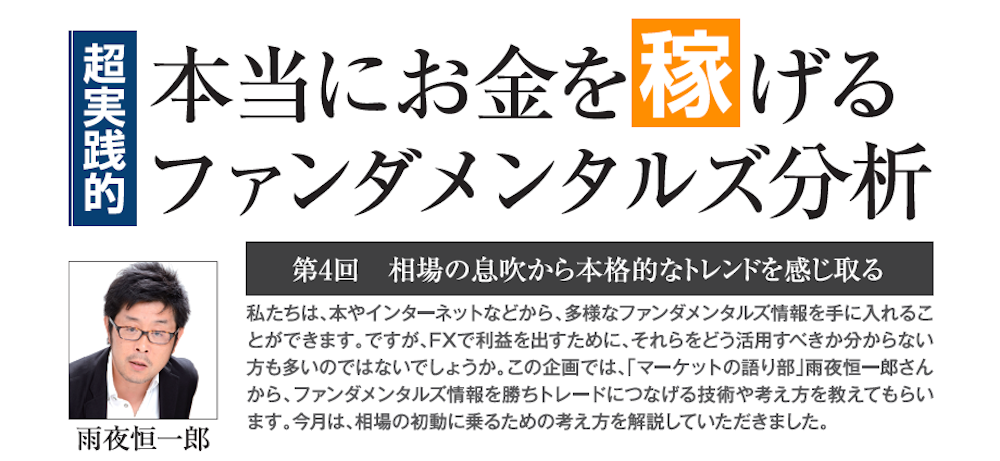
We can obtain a variety of fundamental information from books, the Internet, and other sources. However, for many people, you may not know how to apply them to profit in FX. In this program, Koichiro Amaya, the “narrator of the market,” will teach techniques and ways of thinking to turn fundamental information into winning trades. This time, he explains how to approach riding the market’s initial movements.
Table of Contents
1. Discover the market’s breath and uncover the long-term trend
2. Distinguishing the impact of news where experience matters
3. Summary of Part 4
● Word count: 1735 characters (including headings)
● Image: 1
※This article is a re-edited version of an FX攻略.com August 2018 issue article
【Related articles (FX攻略.com official site)】
・“Narrator of the Market” Koichiro Amaya 8000-character interview “Legends of the Wall Street era and the future FX industry”
Koichiro Amaya (Amaya Kōichirō) Profile

For more than 20 years, he held senior foreign exchange positions at major foreign banks such as Credit Suisse, JPMorgan, and BNP Paribas. He has a history of ranking high in the Tokyo FX market popularity dealer rankings in the financial trade magazine EuroMoney. In 2006, he became a freelance financial analyst, providing FX market information to FX companies and portal sites from his sharp, independent perspective.
twitter:https://twitter.com/geh02066
【Extremely Practical: Truly Profitable Fundamentals Analysis】
Episode 1: Information sources that nakedly reveal market flow (Part 1)
Episode 2: Information sources that nakedly reveal market flow (Part 2)
Episode 3: Favorable division of responsibilities between news and charts
Episode 4: Sensing a real trend from the market’s breath
Episode 5: The key to long-term trends is the smart money’s perspective
Episode 6: What we can learn from Lehman Shock and Abenomics
Episode 7 (Final): The mainstream of market analysis in the 80s and 90s