

[Episode 4] Do Not Get Lost with Signals! How to Identify Trends and Practical Ways to Apply It
The “Strategy Signals (STG)” that also support automated trading are highly effective tools for discretionary traders. In particular, when you’re unsure about entry decisions, STG signals visually tell you whether you should “attack now.”
In this article, we explain how to utilize STG signal displays to determine trends, and how to translate that into discretionary decisions, illustrated with actual chart examples.
Using STG Signals Accordingly
STG includes a total of three entry signals: two contrarian signals and one trend-following signal. It automatically assesses the trend state and displays the appropriate signal accordingly.
- Contrarian (Buy#1, 2 / Sell#1, 2):Effective for aiming at reversals in ranging markets
- Trend-following (Buy#3 / Sell#3):Aiming for continuation at pullbacks and retracements within the trend
In particular, trend-following signals pair well with trend-following strategies, and having the signal backing enables more confident entries.
Characteristics of Buy#1 / Sell#1 Signals (Targeting the Initial Move in Reversals)
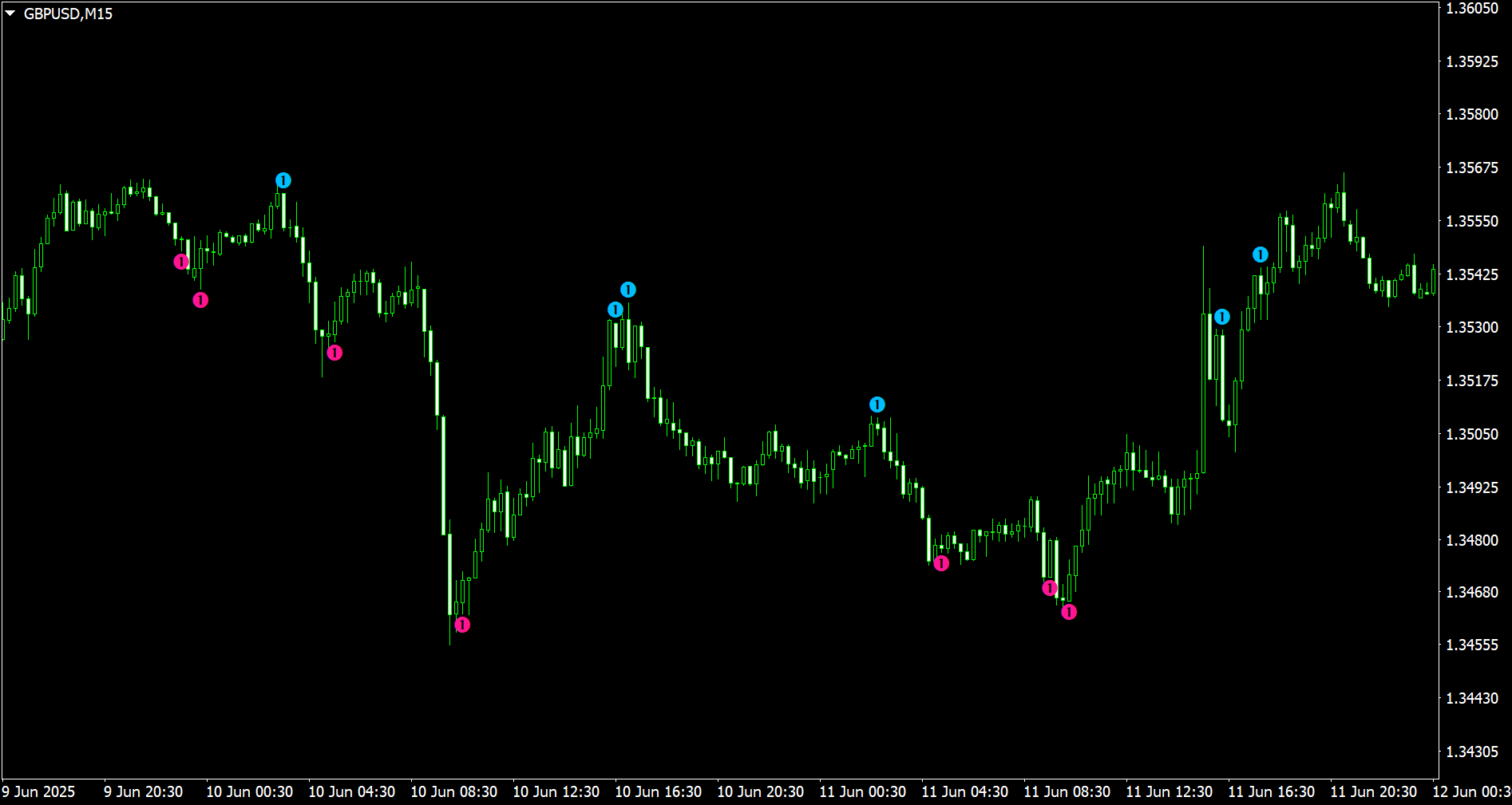
Buy#1 / Sell#1 signals capture timing when reversals become more likely in ranging markets or temporary counter-move phases.
They function as contrarian-type signals that aim for the initial move by comprehensively judging volatility and trend pressure.
▼ Figure: Actual chart example: GBPUSD 15-minute chart
How to Increase the “Reliability” of Signals
STG can quantify its effectiveness at the moment signals occur using a backtest feature. Check pure-profit pips, win rate, PF (Profit Factor), and other metrics, and focus on signals with high reliability.
Furthermore, by using a report viewer to see which signals hold an advantage for each currency pair and time frame, you can objectively build a trading strategy that suits you.
Translating into Discretionary Judgment
Rather than blindly following signals, develop a habit of considering the context in which a signal occurred, such as “in what market environment did this signal arise?” This improves the quality of discretionary trading. For example, if a trend-following signal aligns with the direction of the higher timeframe trend, the entry justification is stronger.
STG is designed to automatically assess technically while supporting discretionary judgment as a “tool.”
Summary: Gaining Confidence in Discretionary Trading with STG
In this article, we introduced how to utilize STG signals and tips for spotting trends. By combining discretionary judgment with STG logic, you can achieve higher-precision trading.
Next time, we will delve into a practical example of system operation by integrating STG and STG-EA. Stay tuned!
? Please also check out previous articles
- ?【Episode 1】What is Strategy Signals? An Easy Explanation of Charm and Potential
- ?【Episode 2】A Powerful Ally for Discretionary Trading! How to Use STG to Expand Auto-Trading
- ?【Episode 3】Are signals truly usable? Verifying STG’s accuracy and profitability!
✅ Details on STG here
GogoJungle|MT4 Strategy Signals