

Cryptocurrency Market Analysis [June 25]
Recently, the unstable market has continued, prompted by issues between Israel and Iran.
As for Bitcoin price movement, on the 22nd the price fell to $10,100 due to U.S. military strikes on Iran's nuclear facilities, then rebounded. Afterward, with Iran's approval to close the Hormuz Strait, it dropped further, dipping below $100,000.
And yesterday, from the news of a near-term ceasefire following an Iranian retaliation by U.S. forces, prices rebounded.
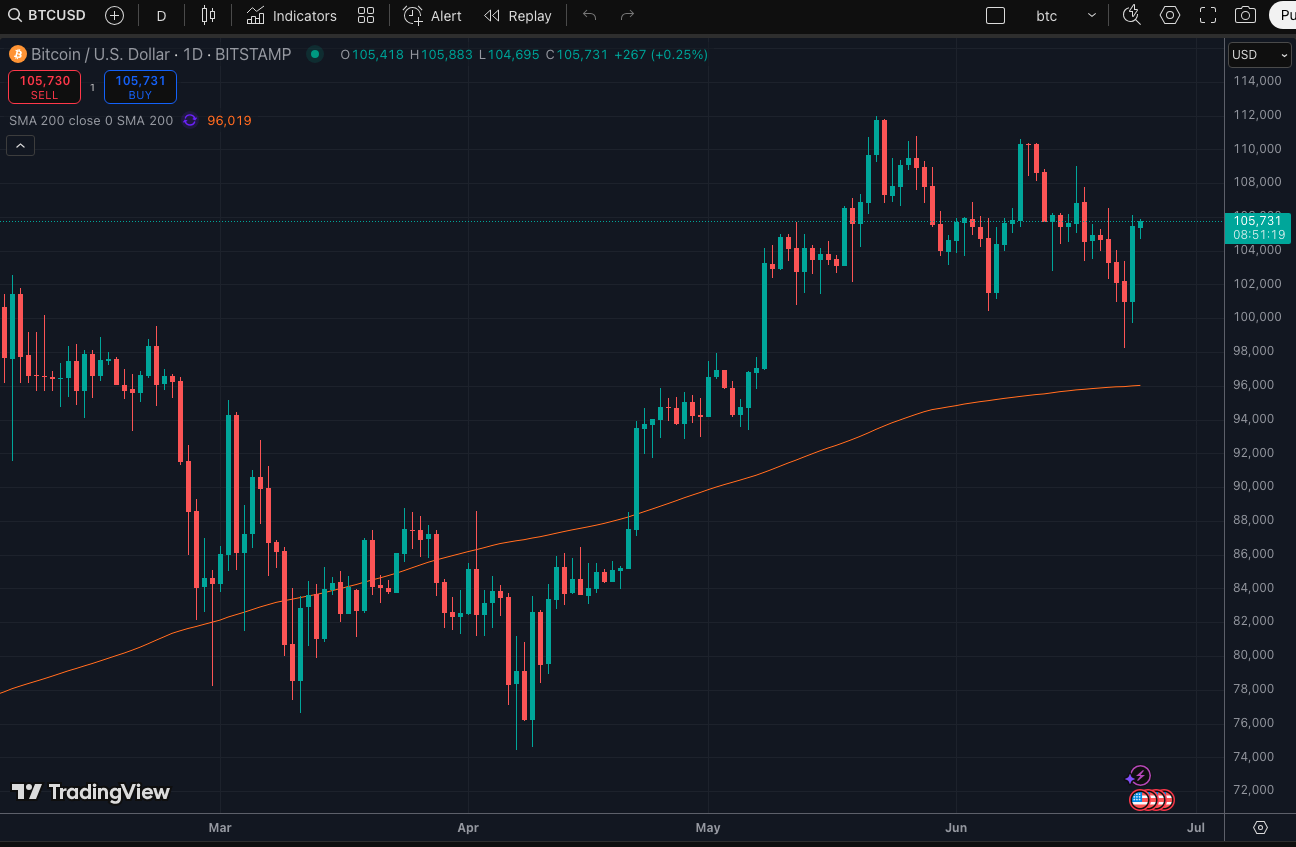
Today Bitcoin rebounded from the fall caused by the United States' attack on Iran.
Bitcoin (BTC) rose 1% in a day to $105,000. It rose from the weekend low of $99,000, but is still below the Friday high of $106,000. Meanwhile, Ethereum (ETH) rose 2.6% to $2,236, Ripple (XRP) rose 3% to $2, Solana (SOL) rose 3.2% to $132.
In terms of digital asset inflows, the United States is the top, followed by Hong Kong and Switzerland.
On the 23rd, Arthur Hayes, co-founder of BitMEX, said that Bitcoin dipping below $100,000 was simply because the printing presses were “revved up” to fulfill patriotic duties. He argues that the current weakness is temporary and will solidify BTC’s role as a safe-haven asset as currency values fall.
Whereas starting a war requires printing money, which in turn would push up Bitcoin’s value.
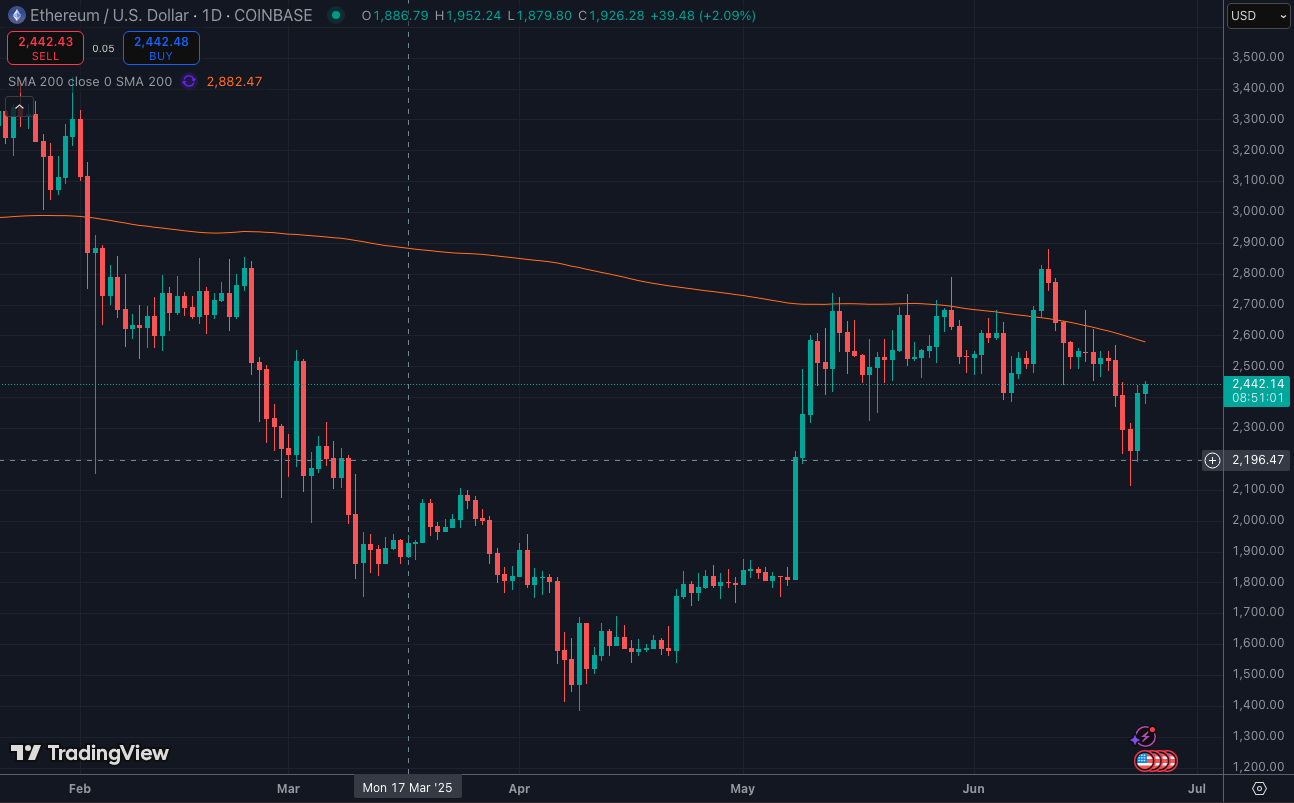
Next is Ethereum's chart: in this rebound it has recovered to $2,400, but this is still at the lower end of the recent range. Considering it had risen to $2,900 the week before last, the recovery is not yet full. The range is intersected by the 200-day moving average (orange); breaking above this could be a sign of further upside.
◯ Texas to establish Bitcoin reserve legislation
The Texas Legislature has passed the Strategic Bitcoin Reserve Act (SB 21). The House approved it 110 to 25, and the Senate completed final revisions. The bill is now sent to Governor Greg Abbott, who has stated he will sign it into law. The bill would establish a strategic Bitcoin reserve in Texas and marks a notable development in state-level cryptocurrency policy. Its passage reflects Texas’ growing interest in integrating Bitcoin into the state's financial and regulatory framework.
ーーーー
Texas has indeed enacted the Bitcoin bill. However, there is no such detail in the state law, raising questions about whether there is real interest or any ulterior motive.
Texas is one of the larger states in the U.S., but the news has not been very prominent, which feels a bit odd.
◯ Will rate cuts be priced in?
If a super-dovish someone becomes chair and does whatever President Trump wants, what would happen?
President Trump is expected to appoint a new chair before Powell’s term ends. If so, the new chair would be like a shadow Fed chair, and if upon taking office they say a 2% rate cut, what would happen? That statement alone can move interest rates.
Mr. Gundlach expects that if Trump names a new chair by next May and that chair talks about rate cuts, the bond market would begin pricing it in immediately — Global Macro Research
Attention is on the timing of the appointment of the Fed Chair by President Trump, and the market would price it in even before the term ends.
Such content could imply that the dollar, gold, and Bitcoin would rise in value due to inflation; however, the current U.S. efforts to issue stablecoins and streamline the digital dollar’s settlement infrastructure may be aimed at slowing that drop.
Regarding stablecoins, on the 17th the Genius Bill was passed by the U.S. Congress.
※In paid subscription sections, we provide more in-depth analysis of particular assets. Even beyond Bitcoin and Ethereum, if you want deeper investment insights and to ride the next waves in the crypto market, consider subscribing. Continuous research is essential.
(This article has been distributed since 2016)
× ![]()