

Who crushed the Abe administration’s “assertive agriculture”? — The abolition of the production adjustment policy and the resistance of farmers and fishers
Japan’s agricultural policy has long been supported by a “defensive agriculture” approach centered on the production adjustment policy and agricultural cooperatives. However, during the Abe administration, this trend was greatly reversed in an attempt to raise international competitiveness and shift toward “offensive agriculture.” This article explores the overall picture of agricultural reform centered on abolishing the production adjustment policy under the Abe administration, the vested interests that hindered it, and the challenges and prospects facing Japanese agriculture.
Did the Liberal Democratic Party’s agricultural policy fail?
When discussing Japan’s agricultural policy, there is a strong view that “the Liberal Democratic Party’s agricultural policy failed.” However, this view is one-sided, as a major shift in agricultural policy occurred under Shinzo Abe’s government. And what obstructed that reform may not have been the Liberal Democratic Party itself, but the faction within the party focused on agricultural and rural affairs and the JA (Japan Agricultural Cooperatives) group.
The Abe administration ended the long-standing production adjustment policy and aimed to raise the international competitiveness of agriculture by shifting to “offensive agriculture.” In reality, however, much of this vision was absorbed and distorted by regional vested interests.
Abolition of the production adjustment policy under Abe and its background
The production adjustment policy, started in 1970, was introduced to prevent price declines caused by an oversupply of rice. The government instructed farmers to limit production or shift crops and provided subsidies in return. However, due to a declining farming population, diversification of diets, and the advancement of free trade systems such as the TPP (Trans-Pacific Partnership), this system became outdated.
Prime Minister Abe announced the abolition of the production adjustment policy in 2013, and in 2014 formulated the “Plan to Create Vitality in Agriculture, Forestry and Fisheries and Rural Areas.” In 2018, the government proposed ending the allocation of production quantity targets, aiming to shift agriculture from “protection” to “market orientation.”
Transition to agriculture based on market principles
In reality, starting in 2014, the Household Income Compensation System introduced under the Democratic Party administration (subsidies corresponding to the production adjustment) was gradually reduced and was entirely abolished in 2018. At the same time, subsidies to promote crop switching to feed rice and rice flour rice were strengthened, stabilizing farmers’ management while moving toward a market-based production system.
Behind this policy was a goal to respect market-driven production decisions, allowing farmers to freely produce high-value-added crops such as branded rice or organic rice and to develop them for domestic and international markets.
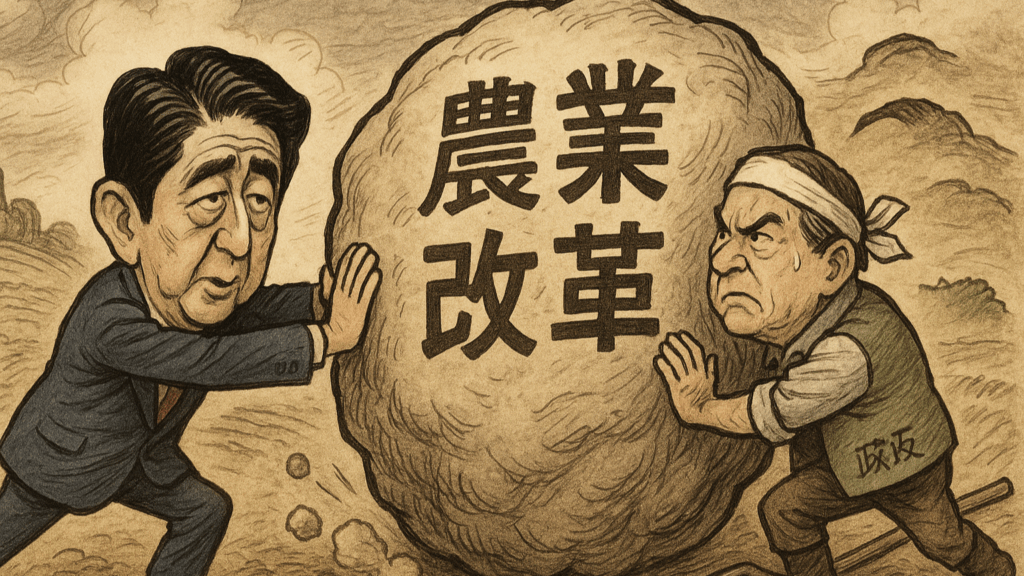
Vested interests and resisting forces that impeded reform
However, strong opposition confronted Abe’s agricultural reform. It came mainly from lawmakers within the Liberal Democratic Party who were part of the agricultural and fisheries faction and from the JA Group centered on the National Federation of Agricultural Cooperative Associations (JA Zen-Chu). JA feared that abolition of the production adjustment policy would lower rice prices, reduce farmers’ income, and cut into its own service revenue, leading to strong opposition.
As a result, although the production adjustment policy was formally abolished, its de facto effects did not change much. The “reference crop areas” and “appropriate production volumes” indicated by JA and regional Agricultural Revitalization Councils continued to function as substantial guidance for farmers.
JA’s influence in enclosing farmers
JA also served as the window for applying for subsidies for crop switching to feed rice, and JA’s influence, including providing information, supplying materials, and securing sales channels, is a critical infrastructure for agricultural management. Even if farmers appear to decide “independently,” in reality they are forced to follow JA’s policies.
For example, according to 2024 Ministry of Agriculture, Forestry and Fisheries data, the area planted with feed rice expanded to about 120,000 hectares. This was the result of JA groups in each region encouraging farmers to switch crops by utilizing subsidy programs. Notices, issued in a “request” format, asked farmers to reduce staple rice production, and if they did not comply with JA, subsidies might not be obtained or they could be placed in an unfavorable position in terms of sales.
Structural domination stemming from information and resource concentration
JA’s influence extends beyond adjusting production policies. It provides essential knowledge on market information, price trends, demand forecasts, and subsidy systems, and coordinates the regional production balance. It is difficult for farmers to independently collect and analyze this information, so following JA’s advice has become a practical management decision.
In 2025, in Ibaraki JA, most directors resigned after the executive director decided rice prices without passing through the board. This incident symbolized the backlash against JA’s decision-making not adequately reflecting farmers’ wishes.
Additionally, in JA Kumamoto, AI sorting machines have been introduced, with farmers pre-selecting the product, revealing the extent to which JA exerts influence over farmers’ production activities even on the technical side.
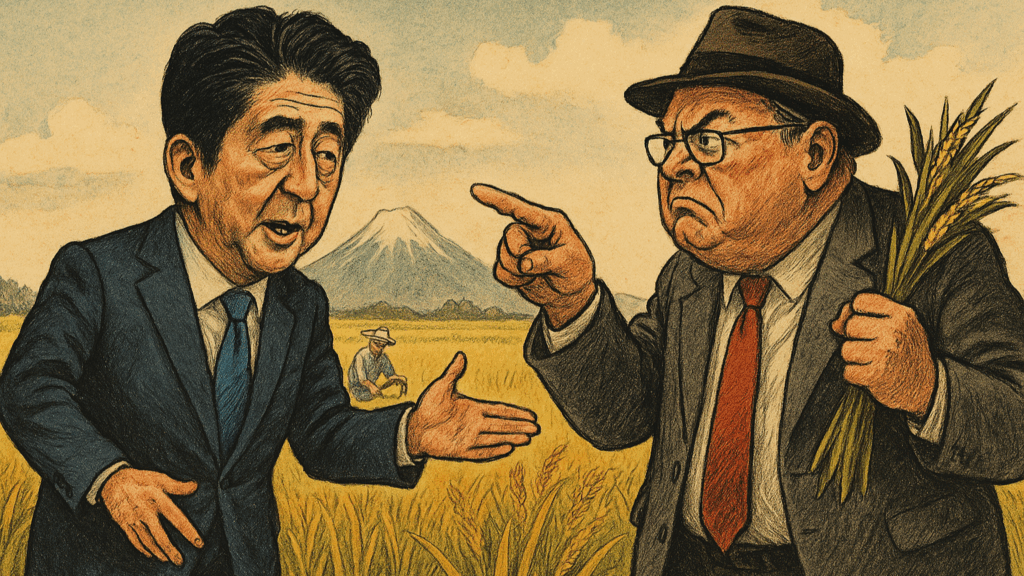
The Abe administration’s vision and the gap with reality
What the Abe administration aimed for was market-based, freely competitive agriculture and international expansion. Policies promoting sustainable agriculture—such as consolidating farmland, scaling up operations, reducing chemical fertilizers, and promoting organic farming—were introduced successively.
However, in reality, farmers’ freedom to make managerial decisions remains constrained by the influence of the agricultural and fisheries faction, JA’s power, and the persistence of subsidy systems. The aging of farmers is also a serious issue, with 61% of farmers being 65 or older as of 2018. The challenges of developing new sales channels and high-value-added crops are largely limited to a few large-scale operations and branded regions.
Taku Eto and the influence of the agricultural and rural affairs faction
Former agriculture minister Taku Eto, who resigned following an inappropriate remark, was not the direct decision-maker behind the 2018 abolition of the production adjustment policy. However, he held roles such as Vice-Minister of Agriculture, Forestry and Fisheries (2012–2013), Chief Policy Advisor (2018–2019), and Minister of Agriculture, Forestry and Fisheries (2019–2020), and he deeply participated in policy preparation and post-abolition agriculture policy.
Eto valued JA’s wishes and used subsidy systems that promote feed rice and crop switching, thereby tolerating continued practical production adjustments. Rather than reform JA’s conservative stance toward overseas expansion, the direction toward domestic rice price stability and farmer support was made clear.
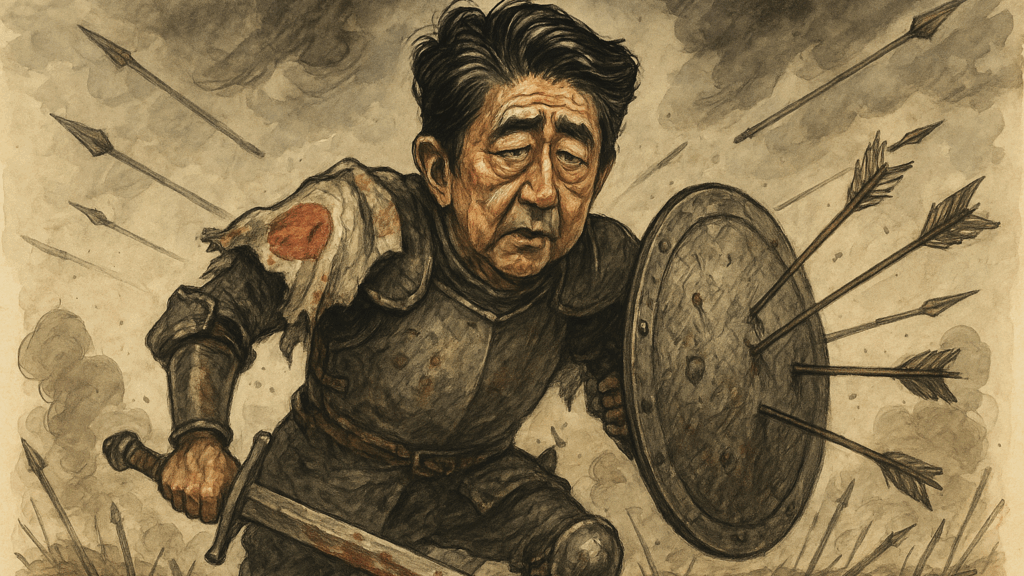
The agricultural and rural affairs faction and “defensive agriculture”
The criticism that “the Liberal Democratic Party’s agricultural policy failed” should more accurately be phrased as “factional resistance within the LDP blocked reform.” The Abe administration advanced structural reforms to revitalize agriculture and achieved a major shift, including abolishing the production adjustment policy.
However, even after abolishing the production adjustment policy, as long as JA’s regional production adjustments, subsidies-driven guidance, and farmers’ economic dependence continue, the “new agricultural policy” risks remaining only a theoretical ideal.
Conservative opposition and reformist structural tension
Yet, it would be inaccurate to label all of the agricultural and rural affairs faction as inherently evil. It reflects differing directions in agricultural policy. The Abe administration pushed to transform agriculture from a mere protected industry to a growth industry and to strengthen competitiveness in international markets—an “offensive agriculture.” Meanwhile, the agricultural and rural affairs faction focused on maintaining the traditional agricultural structure and protecting existing farming communities.
Going forward, it is essential to leverage the energy of regionally rooted young farmers and local lawmakers to develop realistic and sustainable agricultural revitalization measures. The key to unlocking the future of agriculture lies in a generational shift among reform advocates.
Misunderstandings and realities surrounding reserve rice
Meanwhile, regarding reserve rice, negative views on social media and reports labeling it as “animal feed” are widespread. Some of these opinions may be part of negative campaigns intended to reduce the number of buyers and lower competitiveness. Currently, reserve rice has limited selling venues and remains hard to obtain due to very high competition.
As a result, the rice that general consumers can realistically obtain tends to be the relatively high-priced, unsold stock around 4,000 yen per bag, and Minister Koizumi should fully understand this situation as well.
Completely risk-free trading simulator to practice and verify freely!
Details page for One-Click FX Training MAX