

Trump’s “90-day diplomacy” Explained: The Meaning of the 90-day US-China Tariff Truce as the Beginning of Serious Negotiations
The United States and China lowered tariffs for 90 days—this agreement, announced in May 2025, appears on the surface to be a “ceasefire,” but in reality it should be viewed as the opening act of a new diplomatic war involving the world. From the moment he took office, President Trump used tariffs as a tool to shake China, dramatically turning from tension to negotiation in just four months. In this article, we will read into the behind-the-scenes deals behind the 90-day agreement, the negotiation cards each side can deploy, and the true intention behind Trump’s theater of “moving the world on a quarterly basis.”
Details of the “90-day Extension” and the History Up to Now
In the spring of 2025, U.S.-China relations deteriorated rapidly. From the moment of his re-election, President Trump began raising tariffs on China in stages, and by April the tariff rates had risen to an extremely high 145% for shipments from the U.S. to China and 125% for shipments from China to the U.S.
These hardline measures caused China’s exports to the U.S. to fall 21% year over year, while U.S. retail sales dropped 2%, signaling broad impacts on the real economy. The S&P 500 also fell sharply at times, and both countries’ markets grew more tense.
Sudden Pivot to a “Relaxed Agreement”
In response to this situation, the two countries moved quickly behind the scenes and, in just over a month, agreed to a temporary easing of tariffs. The United States would cut tariffs from 145% to 30%, and China would cut from 125% to 10%, establishing a 90-day negotiation period to pursue a permanent trade agreement.
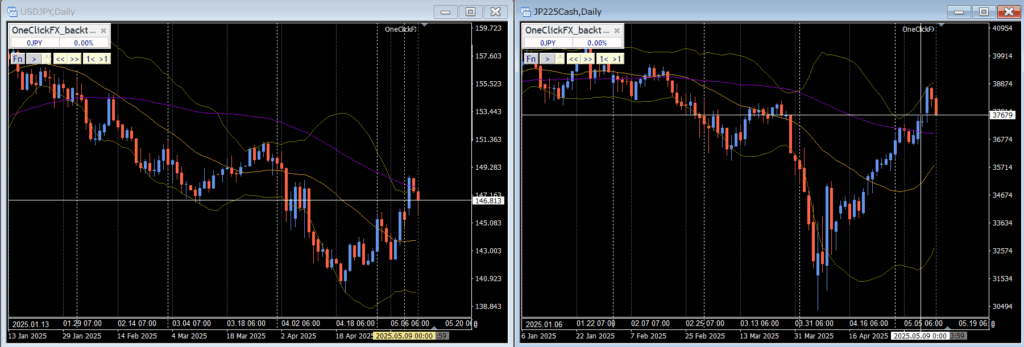
With the announcement of this agreement, the S&P 500 rose 3%, and the Nikkei stock average rebound surpassed 2,000 yen. In the currency market, the yen weakened and the dollar-yen rate reached the 148 yen level. Markets overall welcomed this “ceasefire” measure.
Negotiation Cards Held by Both Sides
One major card the United States can use in negotiations is tightening fentanyl regulation. This is a key issue President Trump had campaigned on as a response to the opioid crisis—a pressure point aimed at China with concrete demands for action. Additionally, even though tariffs were temporarily reduced in this agreement, there is a clear possibility they could be reimposed after 90 days, serving as a strong coercive tool in negotiations.
Origins in Wuhan, Taiwan, and the Renminbi—A Full Deployment of Diplomatic Cards
Another notable development is the White House releasing findings on the origin of the novel coronavirus at this timing. If confirmed to have leaked from a Wuhan laboratory, countries including the U.S. could push China to seek compensation, potentially delivering a major diplomatic blow to China.
If China’s initial responses are found to have concealed information, international pressure would intensify and undermine the Chinese government’s prestige and dignity. In this context, the U.S. has leveraged Taiwan, military technology, and export controls on advanced industries as negotiation tools, laying groundwork to strengthen strategic deterrence overall.
China’s Countercards—Rare Earths and a Geostrategic Encirclement
Meanwhile, China’s cards include restricting rare earth supplies. This would be a powerful bargaining chip that could affect not only the United States but also Japan’s semiconductor, aerospace, and defense industries in the medium to long term. China also appears to seek to maintain a leading position by curtailing military support to Russia, particularly through export controls on drone parts, while avoiding Western backlash. Furthermore, by shifting its export destinations and investments toward ASEAN and Latin America, China aims to reduce its dependence on the United States and reorganize its economic influence.
Thus, the current U.S.-China negotiations go beyond tariff management; they involve security, supply-chain construction, and even influences on international opinion. They represent a highly multi-layered form of statecraft, with behind-the-scenes talks likely ongoing across many areas. The framework of diplomacy now extends beyond economic negotiations to encompass a comprehensive foreign policy strategy.
Trump’s Unusual Speed
What is most remarkable about the 2025 U.S.-China trade talks is President Trump’s negotiation speed. Typically, trade negotiations progress over months to years, but he began imposing China tariffs immediately after taking office, added more, raised them to the maximum, and then eased them substantially in just over three months. This is a “speed diplomacy” that overturns conventional wisdom in trade diplomacy, forcing the other side to concede because they never know what will happen next.
The 90-day period is not merely a grace period; it is an integral part of an enforcement-based deal style of “impose sanctions and negotiate thereafter,” functioning as a real pressure rather than a threat. It suggests a multi-layered deal structure progressing behind the scenes, rather than simply a short-term market reaction.
“Pessimistic Reporting” Misses the Core—Trump’s Strategy’s Precision
The mainstream media often reports that Trump’s administration was rattled by stock price declines or a weaker dollar, or that rare earth prices rose causing large damage, but realistically such analyses are superficial at best. It is unlikely Trump did not anticipate stock declines; in his second term, it is natural to expect him to craft more precise and planned scenarios based on past experience. The Chinese countermeasures to tariffs were likely simulated in multiple patterns in advance. Even if rare earth prices rose briefly, it is well known the U.S. would hold strategic reserves, and this fact would be factored into negotiation strategy. It is unlikely that negotiations would be abandoned in just one month—the 90-day tariff relief should be viewed as the start of full negotiations.
Multilayered Deals with China
Another notable development is China’s apparent refusal to supply weapons to Russia, which may reflect an unofficial U.S. request. At the same time, the White House publicly stating that the origin of the coronavirus is in Wuhan carries substantial diplomatic weight against China. The United States continues to monitor and pressure the Renminbi policy, and by employing these elements in combination, the Trump administration appears to be skillfully and strategically advancing negotiations. The outcome of the full negotiations over the next 90 days is expected to have a significant impact not only on the diplomatic posture of both countries but also on international order and market movements.
Trump Moving in Quarters and Japan’s Challenges
The current tariff relief for U.S.-China trade is not merely a temporary ceasefire. Rather, it should be viewed as one act in a strategic deal drama by Trump that shakes the world every three months. The key to understanding the essence of this movement lies in three points.
First, it structures negotiations in a “90-day cycle” to keep the initiative continuously in hand. Second, tariffs are not the end goal but a means to advance negotiations, with layered intentions including security, diplomacy, and electoral strategy. Third, not only the United States and China, but Japan, the EU, ASEAN, and Latin America are also being drawn into this framework as a reality.
A 90-day deal cycle is close to the management approach of foreign-invested firms seeking quarterly results and is becoming a practical model for modern diplomacy.
Japan’s Negotiation Strategy and the Challenges Ahead
In today’s international environment, Japan’s role is not to simply follow the moves of the U.S. and China, but to clearly articulate its own stance and strategy, and to speak proactively in negotiations. Issues directly tied to Japan’s economy and security—auto tariffs, semiconductor supply chains, rare earth stability, and exchange-rate policy—are diverse and should all be used as diplomatic cards.
For instance, the one-month-old article on “One million tons of U.S. corn emergency imports” was not just about securing supplies but also a practical gesture to advance negotiations. It can function as a diplomatic card showing Japan’s proactive stance, not as accommodation to the United States. If other countries observe Japan’s moves and follow suit, Japan’s position will become stronger.
In future diplomacy, speed and building trust are paramount. To lead, Japan must maintain a visible presence in the international arena.

Should Japan’s Politics Be “Sticky” and Slow?
Current Japanese politics significantly lacks speed. Former Prime Minister Ishiba’s repeated phrases like “we must do this” led the Democratic Party leader Tomaki to mock him as “just saying sticky things,” illustrating how late responses no longer fit the times. Being preoccupied with election strategies and scandals risks disconnecting from citizens’ interests, which is serious.
Wouldn’t it be possible to spend enough time to understand that responding ambiguously to questions three months ago would yield no results? President Trump demands quarterly成果, and Japan, too, must possess strategic judgment and execution to adapt to this speed; otherwise it will be left behind in the international arena.
Now Is the Time for a “Total War Diplomacy”—Cross-Ministry and Bipartisan Coordination
The tariff negotiations are being led by Minister Akasawa, but the entire Ishiba administration should treat this as a national strategy, with all ministers actively engaging in diplomacy, including visiting the United States. A strong leadership by the prime minister himself to spearhead negotiations is indispensable.
If negotiations do not yield favorable results, it would be unfair to blame Minister Akasawa alone, and not in the national interest. This negotiation spans many areas—security, trade, energy—and thus requires unity beyond party lines and ideological divides, focusing on “protecting Japan’s national interests.”
With half of the 90-day negotiations already elapsed, Ishiba’s government must respond quickly and flexibly within the remaining time. Whether Japan can stay ahead by anticipating and taking the next step is now the decisive question.
Practice and verify freely with the Completely Risk-Free Trade Simulator!
Details page for One-Click FX Training MAX